Yes you say it’s tight but how many thousands of planes have landed on that runway without hitting vehicles? This may very well be the first.
There have been a number of incidents and accidents landing that runway. The Air Canada that dmspilot posted, a 737 dragging a wing tip, and a 757 landing on taxiway Zulu all come immediately to mind.
Saying, "Oh, they screwed up" is not productive. We need to determine why "they screwed up" so that we can mitigate the threats to prevent similar errors in the future.
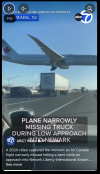
Also, it does not look like they hit a vehicle. The latest information suggests that they hit a light pole which then hit the truck. The video, from the dashcam, shows the dashcam falling to the floor, not the truck tipping over. It did not tip over.
I have no idea if they were or weren't. My point is that folks are considering eye height when computing the clearance. But pilots should be taking that into account when using PAPI (or VASI or whatever) and fly appropriately higher with a higher eye height. After all, you land on the wheels, not at eye height. So, if done properly the clearance of the wheels over the road should be approximately same regardless of eye height.
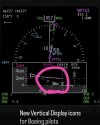
Right. And if you know you have a 24' eye height, you have to know that all red is super no bueno. Three red is probably even very no bueno.
On larger airplanes, you have a minimum TCH. When a runway's TCH is below that, you can't use it. I don't know if the 767-400 has one, as I've only flown the smaller -200 and -300 767. If I'm doing the math right, the difference between 2 Red 2 White and 4 Red over the freeway is 5-1/2' in altitude.
Perhaps you think it's possible to fly these airplanes in such a way that you are never below the desired glidepath. It is not, unless you always fly above the desired glidepath. You are always bracketing the desired path with small corrections, even on a calm day. With gusts, double the steady-state wind, thermals from quickly passing over land, water, land, then pavements, and the associated turbulence the corrections become larger. All this while being aligned with the runway for no more than 36 seconds from wings level to crossing the threshold in a 300,000+ pound airplane at around 160KIAS. (My record on Rwy 29 was a 165kt target speed)
So, we know the error--being too low. They didn't intentionally fly too low, so, what were the threats they faced? Which ones were unmitigated?
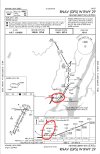
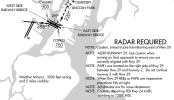
1. Shorter final segment on the RNAV W than the previously used procedures to Rwy 29.
2. Unusually slim obstacle clearance margin with the close-in light poles.
3. Gusty winds requiring the use of 29 and the turbulence and up/down drafts
4. Inertia of a 300,000+ pound airplane reducing response time.
5. Short runway will little margin for a long touchdown coupled with high gusts which limit the amount of landings flaps that can be used do to flap limit speeds.
6. Differences in handling and responsiveness between the 757-200, 757-300, 767-300, and 767-400 aircraft, any of which this crew could have flown on their last trip.
The question then is how do we mitigate those threats? Some ideas...
1. Fly the RNAV RNP Y or Stadium Visual, instead of the RNAV W, to give an extra mile, ~25 seconds, to establish on final and stabilize drift, speed, and vertical path.
2. Remove light poles that are aligned with the runway.
3. Additional wind additive for the gusty conditions. This is SOP, using a +20kt additive above Vref, +15kt in the 737.
4. Use the wind additive, and larger, faster thrust corrections, when the vertical sink increases
5. Use max braking and minimal float technique instead of trying to touchdown sooner with a reduced flap setting which allows flying at an approach speed that is safe for the conditions.
6. Look at splitting qualification on the 767-400 from the smaller variants.
Or, you can just say that the pilots were stupid. Which is more productive?