The stock market

Status
Not open for further replies.
Hang in there. I'm pretty sure the real plan is a to purposely depress stock prices so that certain people I won't mention will buy low and make a killing when it recovers.
One of the Sunday talking heads shows brought this up as a "I wonder if...." Personally, I don't wonder. I'll bet that a number of people in the D.C. area went short last week. Big time.
 
I have theorized that the market (and individual stocks) react with greater moves to bad news than with good. Stated another way, they tend to overreact to negative press, much moreso than their reaction to good news. Fast down, slow up, so to speak. If I had more time (and capital) I'd put my money where my typing fingers are and take advantage of this.

Neither the market nor stocks react. People make decisions based on a reaction (whether deliberate or knee-jerk) that result in a valuation change shown as a market price or volatility indicator.

When everyone else is jumping off a bridge, I’m not going to follow the lemmings.
 
Hang in there. I'm pretty sure the real plan is a to purposely depress stock prices so that certain people I won't mention will buy low and make a killing when it recovers.
It's even simpler than that.

No conspiracy is required. It is like gaming at a casino, some bets win, some bets lose, the house - market functionaries in this metaphor - always gets their steady cut.

Everything in life is cyclical. And those cycles are NEVER in sync.

Those with the ability to be first-in, are . . . as the markets ebb and flow. As the market adjusts to any new reality, be it a change in regulations, international relations, technology, weather, or public health, those who had to ability to invest - and like those gamblers who played the odds at the casino and backed a well-reasoned plan or strategy, make money. Those who backed a poorly-thought out plan lose. Those who waited a little make a little less. While those who waited too long get caught in the changing market as the next cycle comes along.

People or institutions who can diversify play the odds while they hedge against the less likely but more remunerative. In this way they make a healthy percentage on most of their money in the likely event that the market goes up*. But, by hedging, they make an even higher percentage on a smaller amount of money if the less likely occurs.

*Over time the markets in the developed world go up at a higher rate than inflation. Unless, as it was said before, the equity of an individual firm disappears. Even those holding paper on railroads that went bankrupt during the 1930's made money . . . if they held that paper 'till the 80's and 90's and were not forced by circumstance to sell it at a discount along the way.

 
Neither the market nor stocks react. People make decisions based on a reaction (whether deliberate or knee-jerk) that result in a valuation change shown as a market price or volatility indicator.

When everyone else is jumping off a bridge, I’m not going to follow the lemmings.
Ok, thank you FO for interjecting to make sure that I realize that it's not the airplane ahead that's cutting me off on final, it's the pilot that's doing so.
 
No conspiracy is required. It is like gaming at a casino, some bets win, some bets lose, the house - market functionaries in this metaphor - always gets their steady cut.
No, conspiracy is not required but the fact of the matter is that stock manipulation schemes like "pump and dump" and "short and distort" are real things that people have gone to prison for.
 
I sold a bunch at the end of the year, and kept it in cash, tax reasons mostly.

All in yesterday. Buy low right?

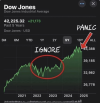
For reference:

View attachment 139667
The DOW is much lower than that chart indicates. Even after today's rally. I've seen that misleading image all over social media (because of course).
 
Probably not.

But how were people feeling in 1928?
There are leaders and followers. In every boom or bubble those who have a well reasoned strategy and get in early make money, and those who follow the leaders quickly make money on their shirttails. While those who follow at a distance get lost in the next wave.

Too many people cannot distinguish "new" from "improved" and see the wrong cues. Meaning not the cues that the leaders follow.
 
I have theorized that the market (and individual stocks) react with greater moves to bad news than with good. Stated another way, they tend to overreact to negative press, much moreso than their reaction to good news. Fast down, slow up, so to speak. If I had more time (and capital) I'd put my money where my typing fingers are and take advantage of this.

Yeah, previous good example of this was the COVID crash in March 2020. S&P lost 30% of market value in 30 days, then recovered and reached new high by August.
 
If you're able to hang in until the downturn is over, you'll almost certainly make money. It always comes back up, the trick is always when. Will it be a month, 6 months, a year, or several years? Who knows. But I'd say as long as you're able to keep your money for however long it takes, you'll come out ahead in the end.

Short term is always a crapshoot.
 
I prefer Captain Obvious.
Ok, that's a good response :rofl:

On an unrelated note, I typically adhere to the diversification mantra, especially when it comes to keeping a lot of stock in the company you work for when your income already relies somewhat on the health of the company you work for. But a lot of these public companies are making that difficult to do with the 'golden handcuffs' of unvested RSUs and options.
At this moment Mrs. Potato has a ton of currently-worthless options in her company stock that were given in lieu of a cash bonus at a particularly high point in her company's stock price.
 
No, conspiracy is not required but the fact of the matter is that stock manipulation schemes like "pump and dump" and "short and distort" are real things that people have gone to prison for.
Having grown up around people involved in making money work for people, I understand that there is a disconnect between logic, morality, ethics, and the law concerning banking, accounting, insuring, and investing. I know that there are plenty of ways that people can use proprietary and / or confidential information and personal / business connections to make money in ways frowned upon by society.

In fact, both of the examples you cited are criminal violations only when accompanied by overt acts. Like the three gasoline stations on a shared corner raising and lowering prices to maintain market share without engaging in a criminal conspiracy, the actions of suddenly purchasing or selling large amounts of equity can lead market players to guess that the buyer or seller is privy to information others do not have / do not recognize the significance of / cannot obtain.

Plenty of money can be made without violating any moral, ethical, or legal guide by simply being aware of what is happening, and how things are likely to shake out in the near future. I have no connection whatsoever to any of the movers and shakers on either a local, state, or national level. But I could listen to the rhetoric coming from Washington and see how I could invest an amount that I could afford in a manner that would allow me to make a few dollars no matter which way the whole tariff situation swung - in both the short and long term.
 
If you're able to hang in until the downturn is over, you'll almost certainly make money. It always comes back up, the trick is always when. Will it be a month, 6 months, a year, or several years? Who knows. But I'd say as long as you're able to keep your money for however long it takes, you'll come out ahead in the end.

Short term is always a crapshoot.

Chasing the market is like chasing airspeed ... unwise.

As I posted in another thread (my favorite version of this song):

 
A fever is a nonspecific sign for a whole bunch of illnesses. A cold can cause one to the same degree as pneumonia or as lymphoma (a cancer). Heck - even exercising hard or being out in the heat will raise the temperature. But it’s a sign - not a cause or a diagnosis.

The market is a sign. It can go down or up for a whole lot of reasons. The tech bubble was different than the 2008 crash or the Covid effect. The drop now is a sign.

I suspect most of us on this forum can weather the cycle (let’s face it - planes are expensive and typically discretionary). But the impact on the cost of goods almost across the board and the impact on employment across the world, including here, is going to be profound and is not fully predictable, I don’t think. Couple that with other shakeups, such as NATO support and a list of others, and the world is literally being changed top to bottom.

Kinda interesting reading the posts here. I wonder how this thread would have played out had the exact same things happened a year ago.
 
In fact, both of the examples you cited are criminal violations only when accompanied by overt acts.
Sort of. One has to distinguish between a conspiracy to do something and actually doing it.

A conspiracy between two or more requires an "overt act." Talk alone is cheap. But don't give it more emphasis than it deserves. The "conspiracy" is the agreement to do so something unlawful or improper. The "overt act" is just doing something beyond talk. Pretty much anything. In your three gasoline station example, quite right - just having the same price is not enough. Needed are (1) proof that they agreed to fix prices is required, which is where a lot of proof fails in those cases, although circumstantial evidence of agreement is typical; and (2) taking some step that furthers he agreement, maybe ordering new pricing signs. They don't even have to get as far as actually having the same proce.

But the substantive offense (as opposed to the conspiracy) obviously requires one to do something.

(Should I mention that my next-to-last trial in my criminal defense phase was a "pump and dump?")
 
Last edited:
And just like that, today's rally is gone.
I'm not sure if it's confirmation bias but it seems like swings of 3, 4, or 5 percent within one single day are indicators of an incoming storm front. Hope y'all have your instrument ratings.
j228w6y1ryne1.gif
 
Yeah, previous good example of this was the COVID crash in March 2020. S&P lost 30% of market value in 30 days, then recovered and reached new high by August.

As bad as COVID was, it was a disease that would eventually run its course, or find some background level of recurring illness. Many financial crises are similar, in that they can self correct over time.

A fear is that the U.S. may be suffering from a huge loss of stature in the global industrial and financial world. While that loss may be temporary, its repercussions may be felt for a long time going forward. Many great powers have faded from greatness over time, and there’s no reason to think the U.S. is immune.
 
As bad as COVID was, it was a disease that would eventually run its course, or find some background level of recurring illness.

Nobody knew that in March 2020. For all we knew, we would be burning bodies in the streets, zombie apocalypse style.
 
A fear is that the U.S. may be suffering from a huge loss of stature in the global industrial and financial world. While that loss may be temporary, its repercussions may be felt for a long time going forward. Many great powers have faded from greatness over time, and there’s no reason to think the U.S. is immune.
The US is not suddenly losing stature. If it's anything, it reflects the unrecognized loss of stature that has been going on for a while.

But the US is still one of the best places in the world to live. As long as we can keep it.
 
But the impact on the cost of goods almost across the board and the impact on employment across the world, including here, is going to be profound and is not fully predictable, I don’t think. Couple that with other shakeups, such as NATO support and a list of others, and the world is literally being changed top to bottom.

Maybe, maybe not. It is still not clear whether the tariff announcements that triggered recent market moves are settled policy or a very aggressive negotiating tactic.
 
As bad as COVID was, it was a disease that would eventually run its course, or find some background level of recurring illness.
Or mutate and kill 80% of humanity.

Never forget. Diseases don't have a mission statement or set of goals. They simply mutate and sometimes bad things happen. Sometimes, the bad thing causes the extinction of a species even if that extinction event takes the disease down with it.

Many financial crises are similar, in that they can self correct over time.
Sure, the past few hundred years has been a trend toward progress, productivity and improved quality of life for billions.

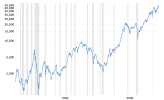
But, since this is a stock market thread, it's also worth pointing out that self correcting can take a really long time. In the past hundred years, well over half, sixty percent, has been spent recovering from just two "corrections". Adjusted for inflation it took 30 years to climb back to the 1929 high and another 30 years to climb back to the 1966 high. It took a comparably brief almost 14 years to get back to the levels of the dotcom bust. Adding dotcom into the mix, this means 75 years of the past hundred have been spent recovering from just three major corrections.

There are plenty of people on this board that don't have 14 years left. I would bet the majority don't have 30, since aviation trends older.

1744138057756.png
 
Tax loss harvest on the way down, and keep dollar cost averaging on the way back up.

Unless you're already recently retired, ignore it, and even if you did recently retire, just means it's time to maximize your Roth conversions.
 
If you want to worry about a REAL financial crisis, consider the effect of war with China. A lot of people in the US government feel that is inevitable in the next 5 years, based on very obvious Chinese preparations for an invasion of Taiwan. You can't hide amphibious assault barges.
 
Stock Market <> Economy

This is all just repricing.

What will have a bigger impact is the supposed Ft Knox audit and rumors of moving back onto gold standard (and gold going to a bazillion)
 
If you want to worry about a REAL financial crisis, consider the effect of war with China. A lot of people in the US government feel that is inevitable in the next 5 years, based on very obvious Chinese preparations for an invasion of Taiwan. You can't hide amphibious assault barges.
What odds are you giving on that bet? Seems extraordinarily unlikely.
 
There are plenty of people on this board that don't have 14 years left.
I think it has more to do with how one tracks the market for retirement. While the market corrections and subsequent value recovery you mention have their place in the overall picture, you'll find most will track or compare their retirement investments to the bear/bull market cycles and plan accordingly. And while one may lose earning potential during those downturns, if one planned properly, they will weather it while keeping their core investments intact until the market regains itself.
 
What odds are you giving on that bet? Seems extraordinarily unlikely.

People I know inside the Defense and Intel communities consider the odds at greater than 50/50. Many billions of dollars are being spent by both sides to prepare for it. As I mentioned, you cannot hide invasion preparations in the age of satellites. The Chinese are quite clearly building an amphibious fleet capable of taking Taiwan. This kind of capability is very specialized and not much use for anything else, so it is a fairly strong indicator of intent. The question is whether they will actually fight, or use that capability as leverage for a negotiated reunification.

IMO the big hole in their plan is the threat of shore-based missiles and drones. It is entirely possible that a Chinese invasion fleet would fail to reach Taiwan's shores.

 
Last edited:
Maybe, maybe not. It is still not clear whether the tariff announcements that triggered recent market moves are settled policy or a very aggressive negotiating tactic.
First, doubling down seems to be the norm.

He already threatened tariffs on Canada, China, and Mexico because of fentanyl(?!?). Backed off, back on, greatly amplified.

Whether this is “just” negotiations or not, the unpredictability itself will have impacts for a long time. Anyone calls the bluff and I think we all know that’ll be followed by “Oh yeah? Well, it’s 2X now” and we go at it again.

When you have Ted Cruz saying what’s happening is bad, that’s a red flag.
 
who's buying what right now?

Discretionary funds that might have been invested in stocks recently bought two 1oz gold coins instead*. Just in case inflation goes crazy. With the increased tariffs on China, it seems almost inevitable.


*$3,000 per coin seems high. But not so long ago $1,000 seemed high. And looking back, even $300 did not seem cheap at the time, albeit 40+ years ago.
 
Neither the market nor stocks react. People make decisions based on a reaction (whether deliberate or knee-jerk) that result in a valuation change shown as a market price or volatility indicator.

When everyone else is jumping off a bridge, I’m not going to follow the lemmings.

Its not even necessarily people involved in some of the trading. There was an event several years that showed that. Someone hacked into a major news source, maybe CNN or WaPo I don't recall, and posted a false story about a terror attack on the White House. There are apparently trading Bots that screen the internet for news, and when they saw the words attack and White House, the Dow dropped like 1,500 points in an automatic sell off in a matter of minutes. It quickly rebounded when it was found to be a hoax, but I think quite a few people were shocked our financial system was setup so precariously that a Tweet could gut the market.
 
who's buying what right now?
With tariffs on China increased today to 104%, tomorrow I'd wait for SPY to make a new low and then BUY the inverse ETF SPXU and put a trailing stop on your position.
 
Status
Not open for further replies.
Back
Top