Pilot knowledge

A few years ago I was flying into an airport adjacent to a TFR for an airshow that wasn't scheduled to be active until the next day. ATC informed me someone had made a mistake and even though it wasn't "officially" active it in reality was. Situations like that are one reason that I'm a fan of using flight following- there really wouldn't have been any other way for me to know.
 
Don't take away the raw reports that us professional pilots need. are used to.
FIFY. I kid, I kid……. ;)

I do remember a press conference where the FAA guy described the current NOTAM system as a hot pile of $$@“$/$$.

Being the optimist, there surely is a better way to present the information in METARs, NOTAMs, etc. They were designed to accommodate communication bandwidth, not comprehension.

Hey, if it works for you, fantastic. Maybe it could be better using today’s technology.
 
I do remember a press conference where the FAA guy described the current NOTAM system as a hot pile of $$@“$/$$.
I get emails of the various presentations on trying to fix the NOTAM system. It will be interesting to see what they eventually come up with on this LONG journey they're taking. :D
 
Only one of those actually uses the word “night.” If you use the word “night” to describe all of those, you will find that you can legally fly passengers at night without being night current.

Yes that is technically correct, but there are three different things that occur at different times in relation to that definition of night. In a discussion forum, we use words to convey ideas, even if they are imprecise. To be precise and rigorous, we should just copy and paste the FAR's and call it a day.
 
Would we be worse pilots if the FAA just went to a single definition of "night?" There's no reason I can see to complicate things.

Yes, it would be easier if night was simply defined as natural lighting below 1 lux.
 
I also think you lack a basic understanding of psychology…interest leads to learning. Requiring knowledge doesn’t lead to interest.

I’m not sure how you came to that conclusion from my comment about night. My interest in the topic is what led me to look into it - there was no requirement involved. It feels like we’re going in circles as you look for points of disagreement, but in fact, I’m largely in agreement with what you’re saying.
 
I’m not sure how you came to that conclusion from my comment about night. My interest in the topic is what led me to look into it - there was no requirement involved. It feels like we’re going in circles as you look for points of disagreement, but in fact, I’m largely in agreement with what you’re saying.
I didn’t. I came to that conclusion because you started this thread by stating that you thought everyone should be able to read METARs, TAFs, and sectional chart abbreviations, and then in post 111 you tied it to whether or not a pilot was interested in learning.
 
Yes that is technically correct, but there are three different things that occur at different times in relation to that definition of night. In a discussion forum, we use words to convey ideas, even if they are imprecise. To be precise and rigorous, we should just copy and paste the FAR's and call it a day.
Imprecise words often do not convey ideas accurately. You stated that the FAA had three different definitions of night. I don’t believe that statement conveyed what you intended.
 
That appears to be an AI answer and an unrelated link to the FAA UAS page for TFRs. Regardless, you originally asserted that the FAA took sanctions against the pilot even though the pilot was fed bad data. I seriously doubt it, but rumors float from hangar to hangar a lot faster than the reality that such an event would likely result in a nothingburger as far as enforcement action is concerned.
 
I do remember a press conference where the FAA guy described the current NOTAM system as a hot pile of $$@“$/$$.
Oh, yeah. The NOTAMs are a mess, but it's not because they use abbreviations, it is because there's no way to pick out the relevant ones without reading every single one of them. Again, several pages worth on a typical airline flight release. This creates the threat of important NOTAMs being missed because they get lost in the noise.
 
... fix the NOTAM system. It will be interesting to see what they eventually come up with
Agreed.
In the meantime, alternative sources for NOTAMs can offer better (more usable) presentation format.
For example, for NOTAM list by Location (or Flight Path), consider FNS NOTAM Search with: Sort and Filter options.
(with 'Plain Language' feature)
1763784997489.png
 
Last edited:
FIFY. I kid, I kid……. ;)

I do remember a press conference where the FAA guy described the current NOTAM system as a hot pile of $$@“$/$$.

Being the optimist, there surely is a better way to present the information in METARs, NOTAMs, etc. They were designed to accommodate communication bandwidth, not comprehension.

Hey, if it works for you, fantastic. Maybe it could be better using today’s technology.

It was the NTSB Chairman in 2018. One of my favorite quotes.

“That's what Notams are: they're a bunch of garbage that no one pays any attention to" - Robert Sumwalt
 
I know it's off the original topic, but what the heck, it's a discussion forum, right?

Would we be worse pilots if the FAA just went to a single definition of "night?" There's no reason I can see to complicate things.

I could see how the FAA really has 3 definitions. 1) Sunset - when you turn your nav lights on, 2) End of Civil Twilight - when you log night flight time, and 3) One Hour Past Sunset - when you do your three takes off and landings to full stop to be able to carry a passenger at night.

Yes that is technically correct, but there are three different things that occur at different times in relation to that definition of night. In a discussion forum, we use words to convey ideas, even if they are imprecise. To be precise and rigorous, we should just copy and paste the FAR's and call it a day.

I'm with @MauleSkinner (and others) on this - if you're being taught (or are teaching) that there is more than one definition of "night", that is incorrect and leads to much confusion. I know that _I_ was taught about the "3 definitions of night" and it kept me confused for years.

No, there's only one, and I don't consider it to be mere semantics. Night is end of civil twilight to start of civil twilight, "30 min after sunset to 30 min before sunrise, roughly". The other things are just how we treat differing levels of darkness.

We turn our nav lights on at sunset - not at "night".
We need landings an hour after sunset for passenger currency - not simply at "night".

To me at least, when you distill it down like this, it removes most of the confusion.

Most, except the situation where you can land 45 minutes after sunset, and log it as a "night landing" but it doesn't count for "night currency". But if you understand the "darkness" rules, that situation fits into the whole matrix and is easily figured out.

You're also able to quickly deduce that the "night" requirements for ratings - night flight time, night landings - since they aren't for currency, just have to meet the definition of "night" and not be sunset + 1 hour.
 
Last edited:
In 13 years of flying, I have never once said "Oh crap! I need my sectional!"
I think we are at the point that reliance on an EFB is the world we live in and it is a safe bet they are not all going to crap out.
I have it on good authority that there are 121 operations where it is required to fly.

How is that possible (unless you are always flying IFR and never look at a sectional)? Just because it is on a screen doesn't mean it is "not a sectional chart".
 
How is that possible (unless you are always flying IFR and never look at a sectional)? Just because it is on a screen doesn't mean it is "not a sectional chart".
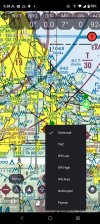
Always using Garmin Pilot's "Map" view rather than "Chart" (Sectional) view?
 
Always using Garmin Pilot's "Map" view rather than "Chart" (Sectional) view?

I’m not sure what a “Map” view is, but in the apps that I am familiar with, VFR charts are called “Sectionals”. The FAA's digital products repository also calls it "Sectional".

Screenshot_AvareX.png FAAgov.png
 
I’m not sure what a “Map” view is, but in the apps that I am familiar with, VFR charts are called “Sectionals”. The FAA's digital products repository also calls it "Sectional".
"Chart" is a rasterized version of the FAA sectional. "Map" is a rendered version of the FAA data. Zoom in on the rasterized image and the words get bigger along with everything else. Zoom in on the rendered version and the words stay the same size while everything else gets bigger. Switch the rasterized image to track-up and the words rotate. Switch the rendered image to track-up and the words stay in the same orientation as north-up.
 
I’m looking for some feedback on a trend I’ve been noticing lately. Increasingly, students seem to be relying on ForeFlight as their only source of navigational information, and many have very limited familiarity with the underlying FAA publications - sectional charts, the Chart Supplement, Aviation Weather Service products, and so on.

I’m bringing this up because I’m trying to understand whether this is simply a natural shift in how pilots interact with information, or whether we’re losing essential foundational knowledge. I don’t want to sound like an old-timer desperately clinging to an E6B - far from it. I’ve written my own aviation apps and I am much more comfortable with electronic information than most of these students in question. But I can’t shake the feeling that all pilots should still know how to read a METAR and interpret the airport info boxes on a sectional.

What say you?
You're assuming, to some extent, that the FAA's way of displaying things is the best way. Spoiler alert: Rarely is the FAA way the best way.

As long as someone can find the information they need in a timely manner, and has a backup way of getting said information in a timely manner, the format does not matter.

The instructors I've had have required me to have proficiency doing things the old school way, while also embracing electronic tools.
This. This is the way.

Once you solely use ForeFlight (or virtually any other EFB for that matter) for aeronautical information and charting, your charting symbology knowledge quickly degrades.
Only if you're not still using the chart in the EFB. Personally, I still use sectionals as the main layer ForeFlight's Maps view. It's just that this sectional ALSO has enhanced aeronautical information, traffic, and weather displayed on top of it as well.

I was referring to the abbreviated information that is on the VFR sectional chart - not whether it is printed on paper or displayed on a screen. Same with Chart Supplement - the data format is the same whether it is on in those green books, or on a screen.

My point was not about paper vs electronic. It is about "FAA format" vs "Foreflight format".
Who cares? Even the "FAA Format" isn't the original format. For example, the Chart Supplement is built off a database that's built off of the Airport Master Record forms, FAA Form 5010. There's nothing magic about the Chart Supplement!

Know what else is based off of that same database? ForeFlight's airport information. ForeFlight Airports and the Chart Supplement are literally just two different ways of consuming the information that's contained in the exact same database. One of them is optimized for printing on paper. The other is optimized for usability on a device that doesn't have the same limitations as paper.

Same with METAR/TAF. I was referring to the coded format. Not whether it comes out of a teletype printer or a screen.
Same deal. METAR and TAF exist in the format they do because they were being sent across teletype machines that were initially installed in Flight Service Stations in 1928, likely with a speed of only around 8-10 characters per second. That means METAR KMKE 240352Z 00000KT 10SM CLR 00/M04 A3012 RMK AO2 SLP207 T00001044 took 7-9 seconds to come out of the machine! You can read faster than that, so we needed all of the abbreviations to allow us to get the needed data in a reasonable amount of time.

Well, guess what - Tech has improved just a little over the past 97 years. We don't need METARs and TAFs any more than we need QWERTY keyboards... But here we are. My 8-year-old is learning to type on a QWERTY keyboard, even though he decided on his own to start on Dvorak when I answered his question about why keyboards are laid out the way they are. He can learn Dvorak on his own, but the school of course teaches QWERTY and not all computers will give you the necessary permissions to switch to a Dvorak layout. In any case, it's good to learn the METAR/TAF codes but there is also absolutely nothing wrong with using the decoded versions when they're available.
 
I’ll play devil’s advocate…..how many of you keep a copy of a ‘phone book’ with the ‘yellow pages’ to look up phone number? :biggrin:
LOL!

But this is a bit different in one respect. Flying with an EFB, we do have the original “Yellow Pages” - charts, plates, Chart Supplement, etc.
I think what @sarangan wants us to do is to use Google to pull up the Yellow Pages. :dunno: :rofl:

I trained in a plane without GPS, in a part of the country where it was relatively easy for a student pilot to get lost. I learned to add VORs into my position checks, and later used a Garmin 12 handheld GPS to help with SA.
When EFBs became a thing, I jumped on the bandwagon. Yes, I could still navigate with a map and a compass, but I wouldn't enjoy it.
Who has flown a UHF NDB. On purpose…
Yep. I trained /U for private and part of instrument, and /A for the rest of instrument. My CFII made me do an entire cross country with landings at three airports navigating solely by NDB.

Guess what? I tore the ADF out of my plane 8 years ago, having never used it once. And it was really nice, KR87 (digital tuning) with an electronic RMI.

But we have GPS now, and I use a GTN 750 and a GI 275 in my plane and I don't feel bad about it whatsoever... And I bought an iPad for ForeFlight on the very first day the iPad was available.

METAR codes are not inherently easier to read. They are a huge and totally unnecessary barrier to entry for would-be pilots.
And how many threads do we have bemoaning the lack of new GA pilots? Clinging to this old stuff is NOT helpful.
 
I have it on good authority that there are 121 operations where it is required to fly.
I bet it's hard to find one where it's not!

I recall an instance where a pilot checked Foreflight for TFRs and noted he was good to go with his planned flight. He ended up violating a TFR. His defense was he checked Foreflight. Foreflight said they get their data from FAA. FAA admitted they sent bad info to Foreflight. Pilot still got sanctioned for violating the TFR because Foreflight is not an approved source and if the pilot had called Flight Service, he would have gotten the correct data.
ForeFlight *IS* an approved source for preflight briefing data and has been since 2012.

I think where you’re getting crossed up is by paraphrasing things instead of using the actual FAA terminology. The FAA has only one definition of night.
In terms of calling it a definition, you are correct.

Practically speaking, however, there are at least three versions of night depending on whether you're talking about passenger currency, lighting requirements, or just "night" for other purposes. I personally find it kind of silly that I can have a flight that is logged entirely as "Night" but all of the takeoffs and landings are logged as day...

The point is, things like Night and Cross Country are used in several different ways by the FAA, which is an impediment to learning, which makes it harder to become a pilot, and we all want/need more pilots! There's plenty of other examples too - For one, there's a lot of things that change at 10,000 feet and 18,000 feet of altitude, but when it comes to holding speed limits the cutoffs are 6,000 and 14,000 feet. Why not make those 10 and 18 like most everything else? There's just a ton of things that could be cleaned up and made easier.

Ironic that in a single paragraph they say it is "crucial" that pilots verify their information directly with the FAA "or other reliable sources" while also admitting that the FAA is not a reliable source.
 
That appears to be an AI answer and an unrelated link to the FAA UAS page for TFRs. Regardless, you originally asserted that the FAA took sanctions against the pilot even though the pilot was fed bad data. I seriously doubt it, but rumors float from hangar to hangar a lot faster than the reality that such an event would likely result in a nothingburger as far as enforcement action is concerned.
There is at least one case I'm aware of that happened for real that is much like this - Except for the fact that once the FAA realized that they'd fed ForeFlight bad data, they dropped the case against the pilot.

This is probably one of those "rumors that float from hangar to hangar" like you said, but somewhere in the game of telephone the thing about the case being dropped got embellished into "and the damn FAA still hung the pilot!"
 
I’m not sure what a “Map” view is, but in the apps that I am familiar with, VFR charts are called “Sectionals”. The FAA's digital products repository also calls it "Sectional"
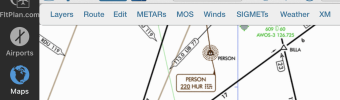
Funny, most of the EFBs I’ve used refers to that page as the “Map.” The “Map” view might display Sectional, IFR enroute charts, a EFB version of either, a Jepp version, a street map… Just three as examples…
1763987543957.png
1763987600167.png
1763987651514.png
 
The point is, things like Night and Cross Country are used in several different ways by the FAA, which is an impediment to learning,
I think the impediment to learning is not being clear when teaching this stuff, and lumping them together. “Night” is NOT used in several different ways by the FAA, to include regulatory references to “night” takeoffs and landings. And unless the majority of your cross country flights are less than 50 miles, cross country “for the purposes of” is probably not an issue worth worrying about.
I personally find it kind of silly that I can have a flight that is logged entirely as "Night" but all of the takeoffs and landings are logged as day...
I personally find it kind of silly that you would log it that way.
 
Last edited:
I personally find it kind of silly that you would log it that way.
Totally agree. I get this whole discussion and some folks thinking it is silly that the FAA has different "darkness" requirements to log different things. But they do, so why would someone think it is silly to log per the regs?

Seems pretty straight forward to me. And over the years I've also gotten quite a few of those departures where the Takeoff didn't count towards Night Currency, but I did log Night Time for the flight. I just think of my entries as Takeoffs or Landings OR Night T/O and Ldg. Not really Day vs Night, but night T/O and Ldgs require specific conditions are met and my other T/O and Ldgs have no requirements other than I leave the ground and land again.

And if you want to throw out silliness... There is no requirement to fly the Pattern when getting your three Takeoff and Landings for the 90 day currency. So you technicallyi can taxi to one end of a long runway and pulling off the Rwy, set back down and doing that two more times and then taxiing off the Rwy at the end. Per the Regs, you just did your three Takeoffs and Landings for currency. If you're in a Taildragger, you need to do full stops... but then they usually need less runway, so you probably could still pull it off. :D
 
I think the impediment to learning is not being clear when teaching this stuff, and lumping them together. “Night” is NOT used in several different ways by the FAA, to include regulatory references to “night” takeoffs and landings.
True... But this begs two questions: First, what do you call "The period from an hour after sunset to an hour before sunrise" using one syllable? Yep, that's why everyone calls them "night" takeoffs and landings. Second, what would be the harm in using the actual definition of night for passenger currency purposes?

And unless the majority of your cross country flights are less than 50 miles, cross country “for the purposes of” is probably not an issue worth worrying about.
Well... I got a bunch of ratings, so I logged everything as 50nm with landings. Then, I went for 135 and went back to add in all of the "missing" XC time. Then, I went for my ATP and had to go back to 50nm... In hindsight, I wouldn't do the change for 135 again because that is the only place, to my knowledge, where the "airport other than the point of origin" version of XC even matters, and it didn't matter enough.

I personally find it kind of silly that you would log it that way.
Totally agree. I get this whole discussion and some folks thinking it is silly that the FAA has different "darkness" requirements to log different things. But they do, so why would someone think it is silly to log per the regs?
I *am* logging "per the regs". The conditions of flight are "Day or Night" per 61.51(b)(3)(i) and thus as defined in 1.1, which is the "one" definition of Night (between evening and morning civil twilights). But for landings, they need to be logged to "meet the aeronautical experience requirements of this part" which in the case of landings is 1 hour after sunset to 1 hour before sunrise per 61.57(b)(1).

Thus, if you fly in the pattern from evening civil twilight until 1 hour after sunset, you would log, per the regs, all night time but no night landings.

And if you want to throw out silliness... There is no requirement to fly the Pattern when getting your three Takeoff and Landings for the 90 day currency. So you technicallyi can taxi to one end of a long runway and pulling off the Rwy, set back down and doing that two more times and then taxiing off the Rwy at the end. Per the Regs, you just did your three Takeoffs and Landings for currency. If you're in a Taildragger, you need to do full stops... but then they usually need less runway, so you probably could still pull it off. :D
Yep. Bounce it real good and you can get current in about 30 seconds. Might be hazardous to your prop tho. ;)
 
True... But this begs two questions: First, what do you call "The period from an hour after sunset to an hour before sunrise" using one syllable? Yep, that's why everyone calls them "night" takeoffs and landings. Second, what would be the harm in using the actual definition of night for passenger currency purposes?
Why is a one-syllable word required? Pilots are required to be able to read, write, speak, and understand English, and there is no restriction to one-syllable words.

Well... I got a bunch of ratings, so I logged everything as 50nm with landings. Then, I went for 135 and went back to add in all of the "missing" XC time. Then, I went for my ATP and had to go back to 50nm... In hindsight, I wouldn't do the change for 135 again because that is the only place, to my knowledge, where the "airport other than the point of origin" version of XC even matters, and it didn't matter enough.
I’ve got a bunch as well, and the only place I had to do more flying to qualify was for IFR 135. So that was the only one that mattered in my case. But it’s easy enough to figure out which cross countries qualify and which don’t when you’re getting ready for a checkride, so the difference between “cross country” and cross country “for the purposes of” is a pretty simple thing to figure out at that time.

I *am* logging "per the regs". The conditions of flight are "Day or Night" per 61.51(b)(3)(i) and thus as defined in 1.1, which is the "one" definition of Night (between evening and morning civil twilights). But for landings, they need to be logged to "meet the aeronautical experience requirements of this part" which in the case of landings is 1 hour after sunset to 1 hour before sunrise per 61.57(b)(1).

Thus, if you fly in the pattern from evening civil twilight until 1 hour after sunset, you would log, per the regs, all night time but no night landings.
No, you don’t need to be an hour after sunset to log night landings. You only need to log them during the time from an hour after sunset to an hour before sunrise for passenger carrying requirements. Not for anything where the reg specifies “takeoffs and landings” that are at “night”.
 
Last edited:
Why is a one-syllable word required? Pilots are required to be able to read, write, speak, and understand English, and there is no restriction to one-syllable words.
Because night is one syllable, so if it's not a one-syllable word, it's never going to be used instead of "night" by anybody. Do we talk about "1 hour after sunset to 1 hour before sunrise currency"? No, we talk about night currency.

Also, I'm going to go back to disagreeing about definitions of night. 61.57(b) is titled "Night takeoff and landing experience." Thus, it's not just lazy CFIs and pilots who call them "night landings", it's the FAA too. Thus, a second definition of night.

No, you don’t need to be an hour after sunset to log night landings. You only need to log them during the time from an hour after sunset to an hour before sunrise for passenger carrying requirements. Not for anything where the reg specifies “night takeoffs and landings.”
The reg specifies that you log "The aeronautical experience required for meeting the recent flight experience requirements of this part." 61.51(a)(2). There is no other requirement for any version of night landings besides the one for passenger carrying recency in 61.57, and thus you need to log the 1-hour-after-to-1-hour-before takeoffs and landings. But again, 5 letters and 1 syllable fits at the top of the logbook column, so everyone calls them "night landings".

And again, why did "night" landings for passenger currency have to be defined differently than the standard definition of night? It's plenty dark at civil twilight to require night landing skills.
 
Because night is one syllable, so if it's not a one-syllable word, it's never going to be used instead of "night" by anybody. Do we talk about "1 hour after sunset to 1 hour before sunrise currency"? No, we talk about night currency.
Maybe we should talk about “1 hour after sunset to 1 hour before sunrise PASSENGER currency.” It would be less confusing.
Also, I'm going to go back to disagreeing about definitions of night. 61.57(b) is titled "Night takeoff and landing experience." Thus, it's not just lazy CFIs and pilots who call them "night landings", it's the FAA too. Thus, a second definition of night.
No, it’s not a second definition. It’s a paraphrase that is probably a bad idea, as it confuses people.
The reg specifies that you log "The aeronautical experience required for meeting the recent flight experience requirements of this part." 61.51(a)(2). There is no other requirement for any version of night landings besides the one for passenger carrying recency in 61.57, and thus you need to log the 1-hour-after-to-1-hour-before takeoffs and landings. But again, 5 letters and 1 syllable fits at the top of the logbook column, so everyone calls them "night landings".
So “ 3 hours of night flight training in a single-engine airplane that includes—
….
(ii) 10 takeoffs and 10 landings to a full stop (with each landing involving a flight in the traffic pattern) at an airport.” in 61.109 doesn’t actually exist? Or the equivalent wording in 61.129? Or the actual phrase “night takeoffs and landings” in 61.159?

And again, why did "night" landings for passenger currency have to be defined differently than the standard definition of night? It's plenty dark at civil twilight to require night landing skills.
I would tend to disagree with that statement, as, apparently, does the FAA.
 
Last edited:
And again, why did "night" landings for passenger currency have to be defined differently than the standard definition of night? It's plenty dark at civil twilight to require night landing skills.
I think that part varies significantly at the more extreme latitudes.

The intent, seems to me, to ensure that it is completely dark for the takeoffs and landings that are used to show currency. It does make things complex for those trying to learn the requirement.

Funny part is, in the 121 world, we don't need, or even track, night currency. Three takeoffs and landings within 90 days is all we need.
 
Maybe we should talk about “1 hour after sunset to 1 hour before sunrise PASSENGER currency.” It would be less confusing.
That's still a lot of syllables. ;)

No, it’s not a second definition. It’s a paraphrase that is probably a bad idea, as it confuses people.
It's a de facto definition, but that's just semantics. The point is that, as you said, it is confusing, and thus an impediment to learning, which was my entire point to begin with.

So “ 3 hours of night flight training in a single-engine airplane that includes—
….
(ii) 10 takeoffs and 10 landings to a full stop (with each landing involving a flight in the traffic pattern) at an airport.” in 61.109 doesn’t actually exist? Or the equivalent wording in 61.129? Or the actual phrase “night takeoffs and landings” in 61.159?
Damn, it's been a long time since I got a new rating, I forgot all about that. So, you can have night landings that are only good for ratings but aren't good for passenger currency. Confusing, impediment to learning, yadda yadda...

I would tend to disagree with that stement, as, apparently, does the FAA.
If the FAA disagreed with that, then they would require your night training to be an hour after sunset.

Also, actually look up the civil twilight times sometime. It's not just "30 minutes after sunset" like a lot of people assume. It gets longer at higher latitudes and during the summer. It is defined by the sun being more than 6º below the horizon, so it's a more accurate representation of a particular brightness than 1 hour after to 1 hour before.

And if it's really not dark enough, why don't we just define night as nautical twilight instead?

FWIW, per timeanddate.com, after civil twilight it's dark enough that "artificial light is generally required for outdoor activities" and "most stars can be easily seen with the naked eye" so I think my assertion that it's dark enough to require night landing skills is good enough. However, the horizon is still visible, so aircraft control is easier than it would be later at night, which makes me think the FAA got it completely backwards.

The intent, seems to me, to ensure that it is completely dark for the takeoffs and landings that are used to show currency.
But it doesn't. For example, on my birthday this year, the sun set at 8:27 PM, but nautical twilight (where there's a visible horizon) didn't end until 9:44 PM.

I just can't come up with a good reason for the 1-hour thing. It's different than other versions of night, it's not guaranteed to be fully dark, it may be fully dark earlier... And it'd make a lot more sense to make the cutoff for all "night" at either civil or nautical twilight.

Funny part is, in the 121 world, we don't need, or even track, night currency. Three takeoffs and landings within 90 days is all we need.
135 gets even weirder. Both 91 and 135 still require night currency in category, class, and type, but in the 135 world sometimes a pilot will fly more than one type of aircraft, so there's an alternate night currency for 135 in multi-crew turbine airplanes. You have to have 1500 hours total time, be day current in type, have 15 hours in type within the last 90 days, and be either night current in any type of multi-crew turbine airplane OR have been through a Part 142 training program within 12 months that included at least 6 night takeoffs and landings in the sim.

 
That's still a lot of syllables. ;)
Well, maybe come up with a one-syllable word for “syllables” if you’re going to require that level of language.
It's a de facto definition, but that's just semantics. The point is that, as you said, it is confusing, and thus an impediment to learning, which was my entire point to begin with.
So you’re saying you could go into court and say you can carry passengers more than an hour after sunset having gotten “night current” between sunset and one hour after and expect the judge to agree?
Damn, it's been a long time since I got a new rating, I forgot all about that. So, you can have night landings that are only good for ratings but aren't good for passenger currency. Confusing, impediment to learning, yadda yadda...
Only if you call everything between sunset and sunrise “night.”
If the FAA disagreed with that, then they would require your night training to be an hour after sunset.
Why?
Also, actually look up the civil twilight times sometime. It's not just "30 minutes after sunset" like a lot of people assume. It gets longer at higher latitudes and during the summer. It is defined by the sun being more than 6º below the horizon, so it's a more accurate representation of a particular brightness than 1 hour after to 1 hour before.
I agree…civil twilight is the most confusing part of that whole thing, and most likely to cause erroneous logging because very few people actually look up those times.
And if it's really not dark enough, why don't we just define night as nautical twilight instead?
Submit a request to the FAA or your congresscritter.
FWIW, per timeanddate.com, after civil twilight it's dark enough that "artificial light is generally required for outdoor activities" and "most stars can be easily seen with the naked eye" so I think my assertion that it's dark enough to require night landing skills is good enough. However, the horizon is still visible, so aircraft control is easier than it would be later at night, which makes me think the FAA got it completely backwards.
Again, submit your request.
But it doesn't. For example, on my birthday this year, the sun set at 8:27 PM, but nautical twilight (where there's a visible horizon) didn't end until 9:44 PM.

I just can't come up with a good reason for the 1-hour thing. It's different than other versions of night, it's not guaranteed to be fully dark, it may be fully dark earlier... And it'd make a lot more sense to make the cutoff for all "night" at either civil or nautical twilight.
Same as the last two.
135 gets even weirder. Both 91 and 135 still require night currency in category, class, and type, but in the 135 world sometimes a pilot will fly more than one type of aircraft, so there's an alternate night currency for 135 in multi-crew turbine airplanes. You have to have 1500 hours total time, be day current in type, have 15 hours in type within the last 90 days, and be either night current in any type of multi-crew turbine airplane OR have been through a Part 142 training program within 12 months that included at least 6 night takeoffs and landings in the sim.
It doesn’t require more than one airplane, and can also be done under Part 61. An assumption of increased proficiency at that level shouldn’t be weird.
 
Last edited:
No, we talk about night currency.
Be careful... There is no "night currency" regulation it is pilot slang. :D

61.57(b) Night takeoff and landing experience. "...carrying persons during the period beginning 1 hour after sunset and ending 1 hour before sunrise, unless within the preceding 90 days that person has made at least three takeoffs and three landings to a full stop during the period beginning 1 hour after sunset and ending 1 hour before sunrise, and..."

The heading of the section is "experience" not currency and the actual regulation never mentions Night. The "night currency" is just pilot talking, not anywhere in the regs.
And I stand corrected, they do use the word “night” in conjunction with this, but it still isn’t contrary to the Part 1 definition.
 
Well, maybe come up with a one-syllable word for “syllables” if you’re going to require that level of language.
I'm not "requiring" anything, I'm merely stating what will happen... And I know this, because my name has one syllable, and of the many nicknames I've been given over the years, only the single-syllable ones ever stuck for very long. Otherwise it was just too easy to use my name.

So you’re saying you could go into court and say you can carry passengers more than an hour after sunset having gotten “night current” between sunset and one hour after and expect the judge to agree?
Nope. It doesn't supersede the 1.1 definition, but that doesn't mean it isn't a de facto definition in terms of passenger carrying currency.

Only if you call everything between sunset and sunrise “night.”
Again, you're making my point for me, because neither of the two definitions we've been talking about are sunset to sunrise. This is why people get confused and instructors have to spend too much time on it.

You think that if the FAA didn't think that civil twilight wasn't dark enough to represent night, that they'd let you get away with doing all your "night" training at a time that wasn't dark enough to represent "night"? And then carry passengers?

I agree…civil twilight is the most confusing part of that whole thing, and most likely to cause erroneous logging because very few people actually look up those times.
Luckily, these days we have tools like ForeFlight that do the night part for you so you don't have to look it up if you don't want to.

Submit a request to the FAA or your congresscritter.
Again, submit your request.
Same as the last two.
I'm quite sure they don't care. Besides, if they fixed everything, we wouldn't have anything to b*tch about on PoA! :D

It doesn’t require more than one airplane, and can also be done under Part 61.
Ah yes. I do think it was an NBAA request, so it'd make sense that it's available to corporate operations as well.

An assumption of increased proficiency at that level shouldn’t be weird.
Agreed.

Be careful... There is no "night currency" regulation it is pilot slang. :D

61.57(b) Night takeoff and landing experience. "...carrying persons during the period beginning 1 hour after sunset and ending 1 hour before sunrise, unless within the preceding 90 days that person has made at least three takeoffs and three landings to a full stop during the period beginning 1 hour after sunset and ending 1 hour before sunrise, and..."

The heading of the section is "experience" not currency and the actual regulation never mentions Night. The "night currency" is just pilot talking, not anywhere in the regs.
Currency isn't the word at issue here, Night is... And it IS in the regluation, it's literally the very first word!

And I stand corrected, they do use the word “night” in conjunction with this, but it still isn’t contrary to the Part 1 definition.
How so? The Part 1 definition is not used anywhere within that regulation. It doesn't supersede the Part 1 definition, but it is a separate de facto definition of the word night, and exactly the problem that we (now I) am/are complaining about.
 
Before I took my first checkride, I wanted to make sure I knew which version of "night" corresponded to what thing. So I did a search of an article, found a great resource, and being old I printed it out so I could read it later. I read it, then put it in my flight bag along with a bunch of other stuff for the exam.

During the oral part of the exam, sure enough, he asked about night, and I told the story of the article, and my take on it, and pulled it out of the flight bag. That wasn't the good part. The good part was that the DPE wrote the article.

 
Come to think of it, using your picture, @sarangan. :D
View attachment 147454

The term “Map” is simply a top-level label for the various chart types - Sectional, Low-Altitude Enroute, TAC, and others. So when someone says they’re using “Map view,” it doesn’t say what they are actually using.

Someone mentioned earlier in this thread that they haven’t used a sectional in 13 years, and another person suggested that might be because they’re using “map” instead of “sectional.” Neither of those statements make any sense to me. I think this comes from the misconception that sectionals refer to the old paper charts, and the EFB's use different kind of chart.
 
Back
Top