Pilot knowledge

I know it's off the original topic, but what the heck, it's a discussion forum, right?

I'm with @MauleSkinner (and others) on this - if you're being taught (or are teaching) that there is more than one definition of "night", that is incorrect and leads to much confusion. I know that _I_ was taught about the "3 definitions of night" and it kept me confused for years.

No, there's only one, and I don't consider it to be mere semantics. Night is end of civil twilight to start of civil twilight, "30 min after sunset to 30 min before sunrise, roughly". The other things are just how we treat differing levels of darkness.

We turn our nav lights on at sunset - not at "night".
We need landings an hour after sunset for passenger currency - not simply at "night".

To me at least, when you distill it down like this, it removes most of the confusion.

Most, except the situation where you can land 45 minutes after sunset, and log it as a "night landing" but it doesn't count for "night currency". But if you understand the "darkness" rules, that situation fits into the whole matrix and is easily figured out.

You're also able to quickly deduce that the "night" requirements for ratings - night flight time, night landings - since they aren't for currency, just have to meet the definition of "night" and not be sunset + 1 hour.

This is how I think about it - Turn on nav lights at sunset (one definition of darkness); To carry passengers when the sun is 6-deg below the horizon (second definition of darkness), you must have done three takeoffs and landings to a full stop 60 minutes after sunset (third definition of darkness). I see no confusion over this. I purposely used the term "darkness" here instead of "night" to not get caught up in semantics. Regardless what you call it, there are three separate events - sunset, 6-deg below horizon, and 60 minutes after sunset.

The confusion only starts if you define one event as "night" (as the FAR does) and insist that the other two are "not night". It's much simpler (at least to me) to think of all three as different degrees of nightness.

It is interesting to think about why it is 60 minutes after sunset for landing currency when we could have just used the 6-deg below horizon. In most places, it is the darkest of the three options, so that makes sense. But near the Arctic, the sun will not dip 6-deg below the horizon in summer. If we use the 6-deg definition for landing currency, pilots on those regions will not be able to meet the recency requirements until the season changes. By setting it by time rather than the position of the sun, they can now do the 3 landings anywhere where the sun actually sets.
 
This is how I think about it - Turn on nav lights at sunset (one definition of darkness); To carry passengers when the sun is 6-deg below the horizon (second definition of darkness), you must have done three takeoffs and landings to a full stop 60 minutes after sunset (third definition of darkness).
Unfortunately that’s incorrect. You can carry passengers when the Sun is 6 degrees below the horizon without he takeoffs and landings during the period from an hour after sunset to an hour before sunrise if you don’t carry passengers during the time from an hour after sunset to an hour before sunrise.
 
Currency isn't the word at issue here, Night is... And it IS in the regluation, it's literally the very first word!
When talking "Night" in terms of FAA Regulations, you MUST put it in context. If you're talking about 61.57, there is NO "Night Currency" The full title of 61.57(b) is Night takeoff and landing experience. Not Night "Currency."

In all of 61.57 the only time you find the word "currency" is in reference to Instrument Currency. Without context you could be taking about Poetry Night, Date Night, Night as in that time after dinner where the sun is still up in the summer, "good night" when you leave the office at 5pm.... :D
 
The term “Map” is simply a top-level label for the various chart types - Sectional, Low-Altitude Enroute, TAC, and others. So when someone says they’re using “Map view,” it doesn’t say what they are actually using.

Someone mentioned earlier in this thread that they haven’t used a sectional in 13 years, and another person suggested that might be because they’re using “map” instead of “sectional.” Neither of those statements make any sense to me. I think this comes from the misconception that sectionals refer to the old paper charts, and the EFB's use different kind of chart.
Ah. Gotcha. I suspect they mean either one of two things.

As you say, they think a Sectional is not a Sectional if it is a digital Sectional. :D

Or they are referring to the Aeronautical Layer from ForeFlight or its equivalent in other EFBs. I know that many pilots who prefer those and rarely, if ever, pull up the FAA charts.
 
And I stand corrected, they do use the word “night” in conjunction with this, but it still isn’t contrary to the Part 1 definition.
There’s actually a rule of interpretation that titles and headings are guides but do not add meaning unless the language of the rule is ambiguous. So, since the content doesn’t use “night” it’s not really a “definition” of night.

But that’s a legal technicality and it’s much more fun to say the rules are silly.
 
Or they are referring to the Aeronautical Layer from ForeFlight or its equivalent in other EFBs. I know that many pilots who prefer those and rarely, if ever, pull up the FAA charts.
Which of the EFBs have the navaid Morse code dots and dashes other than on the rasterized FAA charts?
 
Or they are referring to the Aeronautical Layer from ForeFlight or its equivalent in other EFBs. I know that many pilots who prefer those and rarely, if ever, pull up the FAA charts.
I would agree with you that anyone that said they do not use a Sectional probably uses the digital map provided by the EFB.

I'm not the one that said they have not use a "Sectional" in 13 years, but I am one of those that do not use a "Sectional" whether it be paper or digital (they are the same "chart"). But I do use FF Aeronautical layer when viewing the Map page in FF. I think a large number of EFB users have moved on from the Sectional which is Print Era Technology to the newer option given to us by an EFB. The Sectional has been created digitally for years, and then printed which what it was designed for.
Personally, I do prefer the Sectional over the aeronautical layer/equivalent. But I prefer the aeronautical over the LIFR chart. My agnosticism know no bounds :D
 
Which of the EFBs have the navaid Morse code dots and dashes other than on the rasterized FAA charts?
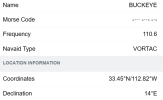
I would assume all of them. I use FF and I get the below info (and more) when I Tap on the NavAid.

It is amazing all the info you get in an EFB if you look and you DO NOT need to squint, turn the chart, turn on the lights, etc., etc. :D

FF NavAid Info.png
 
I would assume all of them. I use FF and I get the below info (and more) when I Tap on the NavAid.
I'll have to give that a try. The airplanes I fly, the radios decode the Morse for me. :)
 
This is how I think about it - Turn on nav lights at sunset (one definition of darkness); To carry passengers when the sun is 6-deg below the horizon (second definition of darkness), you must have done three takeoffs and landings to a full stop 60 minutes after sunset (third definition of darkness). I see no confusion over this.

Since you yourself have stated the rule incorrectly, I would suggest that there is indeed some confusion over this.

The passenger carrying rules only require that you have done the takeoffs and landings 1 hr after sunset if you're going to carry passengers 1 hr after sunset. You can fly up to 59 minutes after sunset while having only "day" landings. 61.57b(1). This is regardless of civil twilight or degrees below the horizon.
 
This is how I think about it - Turn on nav lights at sunset (one definition of darkness); To carry passengers when the sun is 6-deg below the horizon (second definition of darkness), you must have done three takeoffs and landings to a full stop 60 minutes after sunset (third definition of darkness). I see no confusion over this. I purposely used the term "darkness" here instead of "night" to not get caught up in semantics. Regardless what you call it, there are three separate events - sunset, 6-deg below horizon, and 60 minutes after sunset.

The confusion only starts if you define one event as "night" (as the FAR does) and insist that the other two are "not night". It's much simpler (at least to me) to think of all three as different degrees of nightness.
Ah, but you also got it wrong, proving yet again that it's a source of confusion.

I do like your use of the word "darkness" which I think would be a great way to get rid of some of the confusion. Nav lights could be "while the sun is down", "Night" could stay as it is, and "Darkness" could be defined as the period from 1 hour after sunset to 1 hour before sunrise. Of course, we'd need to do a better job of teaching people how to look up definitions in 1.1, but that would be a good thing anyway.

It is interesting to think about why it is 60 minutes after sunset for landing currency when we could have just used the 6-deg below horizon.
Right... There really wasn't a need to have another meaning of "night".

There’s actually a rule of interpretation that titles and headings are guides but do not add meaning unless the language of the rule is ambiguous. So, since the content doesn’t use “night” it’s not really a “definition” of night.
Like I said, it's not a "definition" per se - A better way to say it would have been to say a different meaning. But I guess if the FAA has decided those words officially have no meaning, then we have more to complain about. ;)

Do you have a link to that LOI?

Personally, I do prefer the Sectional over the aeronautical layer/equivalent. But I prefer the aeronautical over the LIFR chart. My agnosticism know no bounds :D
I use the Sectional *and* the Aeronautical layer. Makes it easier to get to airport information, highlights airspace boundaries, etc...
 
This is how I think about it - Turn on nav lights at sunset (one definition of darkness); To carry passengers when the sun is 6-deg below the horizon (second definition of darkness), you must have done three takeoffs and landings to a full stop 60 minutes after sunset (third definition of darkness). I see no confusion over this. I purposely used the term "darkness" here instead of "night" to not get caught up in semantics. Regardless what you call it, there are three separate events - sunset, 6-deg below horizon, and 60 minutes after sunset.

The confusion only starts if you define one event as "night" (as the FAR does) and insist that the other two are "not night". It's much simpler (at least to me) to think of all three as different degrees of nightness.

It is interesting to think about why it is 60 minutes after sunset for landing currency when we could have just used the 6-deg below horizon. In most places, it is the darkest of the three options, so that makes sense. But near the Arctic, the sun will not dip 6-deg below the horizon in summer. If we use the 6-deg definition for landing currency, pilots on those regions will not be able to meet the recency requirements until the season changes. By setting it by time rather than the position of the sun, they can now do the 3 landings anywhere where the sun actually sets.
Here is how I think of it;

A. There are equipment regulations that say the aircraft must be equipped with nav lights and those nav lights must be illuminated from sunset to sunrise.

B. There is a pilot regulation that says no person may act as pilot in command of an aircraft carrying persons during the period beginning 1 hour after sunset and ending 1 hour before sunrise, unless within the preceding 90 days that person has made at least three takeoffs and three landings to a full stop during the period beginning 1 hour after sunset and ending 1 hour before sunrise. Night isn’t mentioned in this regulation.

C. There is a definition that says Night means the time between the end of evening civil twilight and the beginning of morning civil twilight, as published in the Air Almanac, converted to local time.

D. The result is when a pilot doesn’t meet the requirements of B, they can carry persons, takeoff / land while logging night during the period ~20-25 minutes to 59 minutes after sunset.
 
Last edited:
Like I said, it's not a "definition" per se - A better way to say it would have been to say a different meaning. But I guess if the FAA has decided those words officially have no meaning, then we have more to complain about. ;)
It’s not an FAA thing.
 
Oh, I was thinking "Letter of interpretation" not "Rule". Probably more of a law school thing then? Who makes that sort of rule?
That’s a good question. I don’t know the specific origins but it goes back to English common law. WAG? There was a dispute and something in the heading of a paragraph conflicted with the content of the paragraph. Judge ended up saying something like, “the heading can’t change the plain meaning of the text” (in more flowery language, of course). Made sense to other judges and it went viral. Sometimes the disclaimer is actually written into laws and constitutions and contracts.

That’s how a lot of interpretation standards came about. It allows for consistencies when faced with similar language.

The opposite can also happen. The paragraph/section/whatever is so convoluted that only the title of the paragraph can give any meaning to it.
 
Back
Top