[NA] Since 182 buy fell through, ordered a Tesla Y

...I give up; what is FSD....
Full Self-Driving. It handles 99% of the driving. You need to actively monitor it for the 1% where it does not. If it senses through various means if you're not paying attention, the car puts you in time out and you must drive like the good ole days.
 
Full Self-Driving. It handles 99% of the driving. You need to actively monitor it for the 1% where it does not. If it senses through various means if you're not paying attention, the car puts you in time out and you must drive like the good ole days.
I guess that is a good thing. Otherwise, people would be crawling in the back seat to take a nap or whatever.

It's possible I fell asleep for a couple minutes on autopilot once. Neither me nor the other pilot remember those few minutes at 4am.
 
It's the computer teaching the person to watch it, so the lawyers can blame the person when or if the computer kills someone. More or less. But it's safer, and we can blame the person, so it's all good. Not much sarcasm, and too tired to write more with more style, sorry.

If the computer could actually drive, then it would be perfectly fine for the person to nap in the back.

Meanwhile, if you design tires that might hurt people, you have risk. If you design software that might hurt people, you don't have to worry about a thing.
 
It's the computer teaching the person to watch it, so the lawyers can blame the person
I think it is an evolution that has been going on for decades.

First, we had cruise control that would plow into a brick wall, without slowing down, if the driver didn't intervene.
Later, we had active cruise control which would slow down, but not necessarily stop, when approaching a slower, or stopped, object.
Then, we had cruise control which could manage stop-and-go traffic.
We also had automatic emergency braking and lane assist. Then lane centering.

All of these systems required driver monitoring.

Now we have hands-free driving that can navigate and complete entire trips without any intervention from the driver, but it still requires driver monitoring. We are close to autonomous driving but we are not there yet. When we get there, driver monitoring will no longer be required.

I think that Tesla would have been better to name it SSD for Supervised Self-Driving and to have saved the FSD label for when it reaches full autonomy.

Nobody complained that all of those previous steps in the evolution fell short of full autonomy but they complain about FSD Supervised because they interpret the name as meaning full autonomy.
 
Now we have hands-free driving that can navigate and complete entire trips without any intervention from the driver, but it still requires driver monitoring. We are close to autonomous driving but we are not there yet. When we get there, driver monitoring will no longer be required.
Where do you rank Waymo on this evolutionary scale?
 
Where do you rank Waymo on this evolutionary scale?
I've ridden Waymo, and FSD drives me around in my own car everyday, so I have experience with both. Each system can do things that the other system cannot.

Waymo requires hi-def mapping of its geo-fenced zone, Tesla can drive anywhere that it can identify a road, and often without identifying a road. Neither lane markings, nor map date, are required.

Tesla requires a driver in the driver's seat who pays attention and can intervene, Waymo doesn't have any in-car safety driver but does periodically require help from their monitoring center, or remote road service crews, to get un-stuck.

You can buy a Tesla that is hardware-capable of FSD for as little as $36,990 (Model 3 Standard). Waymos are not available for purchase but the estimated cost of car plus hardware is $150,000-$200,000. Tesla's FSD features are available for $99/mo or a one-time fee of $8,000, which is frequently transferrable when a new Tesla is purchased. Waymo's software cannot be purchased.

When "races" have been staged between an FSD car and a Waymo on the same route, the Tesla has won by several minutes on each one I've seen. The Tesla seems to take faster routings and it has more access to freeways than Waymo, which just now is in the testing phase for freeways.

Tesla is a smoother driver than Waymo, likely due to compute power.

Both systems are affected by heavy rain and both ride-hailing services will pause service when it is encountered. A non-Robotaxi Tesla will degrade and alert the driver to takeover.

Waymo is better at finding pickup/dropoff spots than Tesla's widely released v13.2.9 is at finding parking. Tesla's 14.1.4, in early access testing now, has improved significantly upon v13. I haven't seen enough of the Robotaxi's performance with pickup/dropoff spots to fairly compare. It was spotty at first, but has been improving. Tesla has not revealed what version of FSD is running on the Robotaxis.

Tesla has the advantage when it comes to scaling. Their Robotaxi-capable car is significantly cheaper to produce, can currently produce over 2 Million (Model Y) per year, and will start production of the even cheaper Cybercab next year. They also have the advantage when it comes to data with about 6 Billion miles driven by FSD while Waymo is a bit over 100 Million.

Each company took different approaches to autonomy with different goals. Waymo uses multiple types of sensors with a modular software architecture while Tesla uses a single sensor type and end-to-end neural net learning. Tesla has said that multiple sensor types hinders a timely driving solution due to the need to evaluate conflicting data. This creates indecision as the compute processes multiple inputs, limits the max driving speed (freeways) at which the compute can keep up, and a less-smooth ride. Tesla's recent focus has been on optimizing the software for faster process so that more relevant parameters can be processed in real time and improving the computer (HW3 > AI4 > the upcoming AI5 computers). Musk has talked quite a bit about these last points for those whose computer architecture knowledge exceeds mine.

 
I think it is an evolution that has been going on for decades.

First, we had cruise control that would plow into a brick wall, without slowing down, if the driver didn't intervene.
Later, we had active cruise control which would slow down, but not necessarily stop, when approaching a slower, or stopped, object.
Then, we had cruise control which could manage stop-and-go traffic.
We also had automatic emergency braking and lane assist. Then lane centering.

All of these systems required driver monitoring.

Now we have hands-free driving that can navigate and complete entire trips without any intervention from the driver, but it still requires driver monitoring. We are close to autonomous driving but we are not there yet. When we get there, driver monitoring will no longer be required.

I think that Tesla would have been better to name it SSD for Supervised Self-Driving and to have saved the FSD label for when it reaches full autonomy.

Nobody complained that all of those previous steps in the evolution fell short of full autonomy but they complain about FSD Supervised because they interpret the name as meaning full autonomy.
That's fair, and it explains a lot of the concern, but there's a piece missing at the end and it's that with the Tesla system is that the driver isn't actively engaged in the process. It's the aircraft equivalent to being a CFI with a student pilot rather than a pilot. Worse, because in an airplane, except for the takeoff and landing, you generally have a few seconds to correct what's going on. Famously, Sully asked for a few seconds to react to the unexpected loss of two engines to make a decision. But if you're driving a car you don't have a few seconds.

It seems to compare to the magenta line problem and that famous lecture, where pilots were supposed to fly the airplane as little as possible and just take over the last 1000' or whatever for landing. It didn't work. Or prior to that, the F-111's, a friend's dad worked on them at Plattsburgh, where the plane would fly itself fast and low. Except that once in a while it would screw up, and pilots couldn't react fast enough to fix it. As pilots we should understand way more than most not just the benefits of automation, but also the potential danger.
 
there's a piece missing at the end and it's that with the Tesla system is that the driver isn't actively engaged in the process.
You are supposed to be engaged, and I am. I have never received a "strike". The vision monitoring does a good job of ensuring that the driver stays engaged.

The system doesn't suddenly do a hard-over into opposing traffic similarly to how a standard cruise control doesn't suddenly floor it. Mistakes are things like getting into the wrong lane for an upcoming turn or missing opportunities to pull out into a gap in traffic. These are things that you can see coming, if you're paying attention, and have plenty of time to correct. The worst mistake it's made in over 2-1/2 years are a couple of attempts to make illegal turns but, again, those were easy to see coming and to correct.

My interventions have often turned out to be my mistake, not FSDs. Most often, it has re-routed due to traffic and I intervened because I thought it was going the wrong way. It wasn't. When I first bought FSD, it took a while to gain confidence in the system and to understand that it was creeping forward for visibility, not pulling out in front of traffic. It is better than me at changing lanes on a busy multi-lane highway because it can look in all (eight) directions at once while I have to scan back and forth. It never fails to notice that the car in front has slowed or stopped in heavy traffic or that the car two lanes over has started to change lanes at the same time as me.

As I've said, I don't have the latest hardware nor the latest software version. Newer cars are more capable than mine and run more advanced software. Yet, in over 2-1/2 years, I have never had to intervene to prevent an accident.
 
Tesla has said that multiple sensor types hinders a timely driving solution due to the need to evaluate conflicting data. This creates indecision as the compute processes multiple inputs, limits the max driving speed (freeways) at which the compute can keep up, and a less-smooth ride.
Yeah, I don't buy that. The indecision, yes, but you can still tell the computer to have a hard source priority if there's any indecision. Tesla was just having trouble with that, and ditched the forward-looking radar to make the car cheaper to produce and have a good scapegoat for all the phantom braking that was happening at that point.

And there's some cool stuff you can do with radar/lidar. One is to be able to drive safer in low-vis conditions - And all of the biggest, worst traffic accident pileups are of that variety.

Another is to "see" what can't easily be seen - An earlier version of Tesla's autopilot when it had not yet transitioned to vision only had the capability of using signals bounced under the car(s) in front of you to see farther up the line and react before anything can be seen. There was a really cool video of this on YouTube shortly after that came out where they were cruising along fat, dumb and happy, and all of a sudden the car beeped and slammed on the brakes. The humans reacted with confusion initially, until a couple of seconds AFTER the Tesla had hit it brakes, the vehicle 2 in front of them hits something and rolls over and the vehicle in front of them hits it, while the Tesla brings itself to a pretty easy stop before any of the debris on the road. It was quite impressive - And can't be done by Tesla's newer vision-only system. :dunno:
 
FSD in action

Bought a used Model Y a few months back. Still enjoying it.
 
....Another is to "see" what can't easily be seen...
My one month FSD trial ended yesterday so no more observations for me :( I believe looking several cars ahead is a FSD weakness which I learned the hard way when FSD had to hit the breaks hard launching a Costco rotisserie chicken I had in the back (proving chickens can actually fly). I learned that's a scenario where you need to be prepared to intervene. I liked how it becomes more conservative as conditions deteriorate, but, even in chill mode, it followed cars in front of me closer than I would have given the conditions.
 
Last edited:
Yeah, I don't buy that.
Musk has been very clear on that point and I'm not going to argue with him. That is right down the middle of his technical wheelhouse. And it makes complete sense to me.

If you're going to hard code a priority hierarchy then why have any sensors other than the ones at the top of the tree? If there are situations where you need to disregard the top priority sensors, in favor of lower-priority sensors, then you have the exact problem with compute resources than Musk claims.

FSD in action
I've never seen anything that dramatic, of course, but I have seen numerous situations where it saw things before I did because I was looking in a different direction. The Wham Bam Teslacam YouTube channel has shown a number of instances of FSD hitting the brakes going through an intersection when it sees crossing traffic that isn't stopping.
 
Juniper version 14 released to my Tesla model Y today.
Cool! That should be v14.1.4, from what I've been seeing online. Quite a few new capabilities but expect a few more .x.x updates in the next few weeks polishing the rough edges.
 
I believe looking several cars ahead is a FSD weakness which I learned the hard way when FSD had to hit the breaks hard launching a Costco rotisserie chicken I had in the back (proving chickens can actually fly). I learned that's a scenario where you need to be prepared to intervene.
FSD isn't looking several cars ahead - FSD is vision only, what I was talking about was from when they still had radar on the front bumper.

What you're talking about is "phantom braking" which has been an issue for a long time. It tends to get moderately better and then get a little worse, and so on. So, it's not as bad as it used to be, but it's still the most annoying part about FSD.

FWIW, whether I'm on autopilot (normally) or FSD (when there's a free trial), I always have my foot ready to step on the accelerator and that is BY FAR my most common intervention. I actually preferred to use Autopilot just for the Autosteer and then use my foot to control speed. Unfortunately, recent versions of Autopilot don't allow this any more. It works for maybe 10-15 seconds and then the screen starts flashing blue and if you don't get off the pedal it'll shut off (nicely, of course, warning you to take over).

If you're going to hard code a priority hierarchy then why have any sensors other than the ones at the top of the tree? If there are situations where you need to disregard the top priority sensors, in favor of lower-priority sensors, then you have the exact problem with compute resources than Musk claims.
The hard coding is *only* for if there's not enough compute to make the decision quickly enough, as the "right" decision made too slowly is still the wrong decision. I suggested it only as a possible solution to the issue of not making the decision fast enough based on the available hardware, which is getting better all the time.

I don't think you'd ever be disregarding the top priority sensors? You'd be combining the information from all available sensors UNLESS it resulted in an indecision lock-up in which case it'd just take the top priority sensors and go with it. It can't be worse than what they're already doing, which is to only use one type of sensing, thus the hard-coded "decide now" priority would be doing what is being done now with Tesla Vision.

The Wham Bam Teslacam YouTube channel has shown a number of instances of FSD hitting the brakes going through an intersection when it sees crossing traffic that isn't stopping.
I find that the software is ULTRA conservative when it comes to crossing traffic ahead. Drives me nuts - I do a lot of driving on secondary two-lane highways, and if someone turns left or crosses 1/4 mile in front of me the car slams on the brakes and continues to slow down even after the threat has passed (car is all the way through my lane and moving away). This is one of those scenarios that makes me keep my foot ready on the accelerator.
 
What you're talking about is "phantom braking" which has been an issue for a long time.
...
I find that the software is ULTRA conservative when it comes to crossing traffic ahead. Drives me nuts
That describes my experience with Autopilot, not FSD. At least not since v12 of FSD. I haven't driven Autopilot since mid-2023, though.

Now it's not phantom braking, it's phantom slowing down. Typically approaching something that it original thinks might be a speed bump. It slows a few mph then figures out it's just a shadow and accelerates. No need to override it.

The second behavior is completely gone for me. It does an excellent job of determining if the crossing traffic will clear before we get there and, when it won't, adjusts speed appropriately.

My understanding is that Autopilot goes away in v14 and is replaced by Autosteer by FSD. That'll have the FSD stack driving the car but with a limited feature set. It will be interesting to hear how that works once v14 ships to cars without FSD.

I don't remember. Do you have HW3 or AI4? I'm sure AI4 will get it first.
 
@Larry in TN , are there plans for Tesla Navigation to show user reported objects in road, speed traps, etc.? It bugs me to have to run Google Maps on my phone at the same time as using Tesla Navigation.
 
@Larry in TN , are there plans for Tesla Navigation to show user reported objects in road, speed traps, etc.? It bugs me to have to run Google Maps on my phone at the same time as using Tesla Navigation.
I have not heard of that. I used to use Waze, on previous cars, but just use the built in nav on the Tesla. I don't drive fast enough to worry about speed traps. The traffic info it provides has been very good in my area.
 
...I don't drive fast enough to worry about speed traps..
I wouldn't call myself a speeder but I like to know when I'm about to enter a speed trap.

Do you ever drive in Maryland or an area with speed cameras? It's easy to be 5mph+ in these zones. I'd love to see statistics. I bet the tickets are mostly cars from out of town. Google Maps alerts you to the cameras which saved me recently.

Objects in road would be handy. When I had FSD, the car drove right over road debris which I would have straddled had I been driving.
 
Last edited:
That describes my experience with Autopilot, not FSD. At least not since v12 of FSD. I haven't driven Autopilot since mid-2023, though.
Hmmm. I didn't notice a different on the last free trial. That was 13 though wasn't it? Whatever it was, it was still bad enough that I was glad I didn't pay for it. I'm curious to see what the next version will look like, once they have another trial.

Now it's not phantom braking, it's phantom slowing down.
It phantom slows down using the brakes, at least for me. And it slows down quick enough to get the heart rate elevated and freak out pax.

The second behavior is completely gone for me. It does an excellent job of determining if the crossing traffic will clear before we get there and, when it won't, adjusts speed appropriately.
Glad to hear it.

My understanding is that Autopilot goes away in v14 and is replaced by Autosteer by FSD. That'll have the FSD stack driving the car but with a limited feature set. It will be interesting to hear how that works once v14 ships to cars without FSD.
It feels like Autopilot has been on a backwards slide for the last couple of years, like they've been neglecting it and focusing solely on FSD. I'm very much looking forward to the common stack.

I don't remember. Do you have HW3 or AI4? I'm sure AI4 will get it first.
Still on HW3.

@Larry in TN , are there plans for Tesla Navigation to show user reported objects in road, speed traps, etc.? It bugs me to have to run Google Maps on my phone at the same time as using Tesla Navigation.
Google Maps? I don't recall ever getting those features in Google Maps, I always had to use Waze (which is owned by Google, so they do have the data.)

Google Maps alerts you to the cameras which saved me recently.

Objects in road would be handy. When I had FSD, the car drove right over road debris which I would have straddled had I been driving.
I did hear about one cool trick: A Tesla driver set up a Shortcut on their iPhone so that whenever the phone first connected to their Tesla's Bluetooth it would automatically launch Waze and set the volume to an appropriate level to hear it in the car so that they'd still hear those alerts from Waze even when using Tesla's navigation. Pretty slick.
 
I have not heard of that. I used to use Waze, on previous cars, but just use the built in nav on the Tesla. I don't drive fast enough to worry about speed traps. The traffic info it provides has been very good in my area.

I still keep WAZE up on my iPhone on road trips for the add'l warnings it provides. And sometimes WingX for radar returns - something it would be nice if Tesla offered as well.

51985622045_76b78977ef_z.jpg
 
And sometimes WingX for radar returns - something it would be nice if Tesla offered as well.
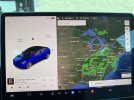
They do. Bottom icon on the toolbar at right:

IMG_0803.JPG

That said, it looks like maybe you don't subscribe to premium connectivity, which might be required. Not sure about that.
 
....maybe you don't subscribe to premium connectivity, which might be required. Not sure about that.
I plan on using my phone as a hot spot now that premium connectivity trial has expired. Now you have me questioning what might not work.
 
I plan on using my phone as a hot spot now that premium connectivity trial has expired. Now you have me questioning what might not work.
There's a table of what's included with each here:


And yes, it appears that weather radar requires premium connectivity. But coming from vehicles that had OnStar that you had to pay $20/mo for just to remote start them, the number of features you get with Tesla's premium connectivity for $9.99/mo or $99/year is great.
 
There's a table...
Thanks!

I don't quite understand why Standard Connectivity is only valid for 8 years. Nevertheless, I'm cheap and I'm also stubborn. I won't pay $100/year on the principal that I already pay for mobile data and shouldn't have to pay again because yet another company is forcing a never ending subscription.

Since Tesla is already forcing me to use Google Maps in addition to Tesla Navigation, it looks like I'll always have a phone or tablet simultaneously running.
 
Last edited:
I don't quite understand why Standard Connectivity is only valid for 8 years. Nevertheless, I'm cheap and I'm also stubborn. I won't pay $100/year on the principal that I already pay for mobile data and shouldn't have to pay again because yet another company is forcing a never ending subscription.
I'd imagine that it is only for 8 years because Tesla has to pay for the car's data and they're only willing to do that for 8 years.

I didn't know that premium connectivity included speed camera data. We don't have them so I haven't seen them pop up.

I subscribe to premium connectivity for the streaming and traffic data. I listen, almost exclusively, to Spotify in the car and I use the traffic data frequently. I do the less expensive yearly plan.
 
They do. Bottom icon on the toolbar at right:

View attachment 146680

That said, it looks like maybe you don't subscribe to premium connectivity, which might be required. Not sure about that.
I do have Premium Connectivity. I’ll see if I have that icon later - I sure don’t remember seeing it.
 
Musk has been very clear on that point and I'm not going to argue with him. That is right down the middle of his technical wheelhouse. And it makes complete sense to me.
That's fine. I will then. :-)

Two points.

1) Musk regularly creates nonsense out of thin air when it suits his purposes. On this subject, for example, the engineers actually working on FSD wanted to keep lidar and he overrode them. Those two facts combine to make me believe him exactly zero when he claims this move was anything other than cost cutting. As another example of his nonsense, he's been predicting that FSD was about a year away since 2013. Never trust Musk. Sometimes he says things that are true, but anything interesting to come out of his mouth should be looked at with skepticism and verified.

2) The lidar equipped cars last shipped in 2021 (IIRC, I didn't bother to chase this down). Even if his nonsense was true at the time, it wouldn't be true now because Moore's law has made the compute power available double or quadruple since 2021. So he could easily have equipped current generation cars with lidar and sufficient hardware to consume the data if that were actually the problem. But it never was.
 
Two points.
Your information is wrong. Tesla's has never had LIDAR on their cars though SpaceX does use both LIDAR and RADAR in their spacecraft.

Cars did have RADAR, until ~late 2021, when the decision was made to go vision-only. Today, the cars that originally shipped with RADAR no longer use it for FSD, just obstacle warning and detections when parking. The vision only replaced that functionality with a synthetic visualization of the surrounding obstacles when parking, entering a garage, etc. There was disagreement about the vision-only approach at the time but they've stuck with vision-only and now produce the most capable self-driving system that you can buy today.
Correct. Radar, not lidar. Aside from mislabelling the technology used, everything else I wrote is correct. Including the part about Musk being untrustworthy and Tesla engineering not wanting to remove the radar.
 
...I subscribe to premium connectivity for the streaming and traffic data. I listen, almost exclusively, to Spotify...
Pretty much those are the two reasons I want connectivity too. Today was my first drive w/o premium connectivity. I just used my phone as a mobile hot spot. It worked just fine. The only downside is I have to remember to turn on my hot spot when getting in the car. I see no need to pay for premium.
 
Correct. Radar, not lidar. Aside from mislabelling the technology used, everything else I wrote is correct. Including the part about Musk being untrustworthy and Tesla engineering not wanting to remove the radar.
It wasn't the engineering team, it was some of the engineers. That's how you develop things that are never been made before. Different views come together and a decision is reached.

Your opinion on Musk's trustworthiness is just that. Your opinion.
 
Full Self-Driving. It handles 99% of the driving. You need to actively monitor it for the 1% where it does not. If it senses through various means if you're not paying attention, the car puts you in time out and you must drive like the good ole days.
If you get put in time-out, just pull over, put the car in park for a second, then drive off again, and you can re-engage FSD.
 
Back
Top