Have We Angered The Economy?

You missed the word "generally".

nope. But it would appear that you went from "A scary number of Americans believe that simply raising the federal minimum..." to "don't think that's accurate at all."
 
Separately, if we are on the road, and time is available, Cracker Barrel for a broadly balanced meal, well prepared, and politely served by someone who needs the money.

In a hurry, early AM? Waffle House! Great waffles for my wife, perfect omelet with ham and home fries full of onions for me, plus coffee and juice. We split about half each. Some are not 24 hour, and we have arrived before the crack of dawn, waited with the waitresses for the manager to unlock. They produced a scribble sheet, took our order while we waited, and had breakfast cooking as soon as surfaces were hot. Those people cared about our time.

WH is good just for the entertainment of watching the action behind the counter when they get busy. The lingo and the plate code are fun.
 
I came across WH's training videos on YourTube a while back. They're actually pretty interesting to watch if you like to sit at the counter. It helps you understand the complexity back there.

I remember years ago I was chasing after this pretty girl who waitressed at a WH in Pensacola. Their evening cook had this interesting way of receiving the order. When the waitresses would go to their position for the call, he would take about a half step back from the griddle and stand at attention, motionless and expressionless. The waitress would give the full call no matter how short or long. Once complete, he would read the whole thing back without error and get to work. A very impressive show to me at the time.
 
Eliminating the starting wage.......

Both of my sons started at a pizza place.
3 kids next door started at MacDonald's.
2 kids across the street started out at another fast food place.

ALL went to college and obtained very good jobs...

The high minimum wages to assure that all those employees had a "Living wage" meant that the stores could not stand the training costs of high turnover, and the starter jobs disappeared .

A lot of college was paid for by those starter jobs.

That age group has nearly the highest unemployment in the country, just in the portion seeking work.

The minimum was $1.00 when I was earning for college.
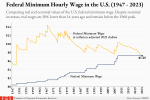
You and I have covered this ground before. Adjusted for inflation, minimum wage isn't as high as it used to be. It is, in fact, the lowest it has been since 1949. Further, again adjusted for inflation, college is vast more expensive than it used to be. It's great that your dad made ends meet during the great depression. It's great that your kids went to school before prices exploded. But you really have got to stop pretending that things are the same now as they used to be during your kids, yours and your dad's experiences.

Fun coincidence. Google tells me that minimum wage was a buck in 1967. Adjusted for inflation, that's $14. So you were making almost exactly the minimum wage you're arguing against today, while also noting that such a wage paid for a lot of college. You went to college during the absolute peak of affordability because you made good money, even at minimum wage, and college was tremendously more affordable itself. Good for you. It's fantastic to be lucky. Now let's recognize that neither of those two things are the operating mode in 2025.

1756937751513.png
 
Last edited:
I'm impressed. And all these years of going to a Waffle House, the only thing that I noticed was how the cook could let the ash on his cigarette grow to almost two inches without it breaking off into the griddle. That always amazed me. But after reading some of these explanations, I don't think I could have handled the job as well as they do.
 
I don't think that's accurate at all. Those of us who support a living wage generally support it in order to switch the burden of paying the employees from the taxpayer (in the form of federal food and housing support) to the employer. So we are acutely aware of where that money comes from.
So where does the money the "employer" spends on this come from?
Quoting Margret Thatcher "Socialism is great until you run out of other people's money"
 
So where does the money the "employer" spends on this come from?
Quoting Margret Thatcher "Socialism is great until you run out of other people's money"
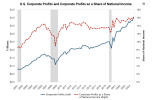
Do you not know how capitalism works? The money the employer spends on wages comes from revenue generated by sales in the free market. We are currently in a socialistically blended economy where the employers don't pay the full wage necessary to survive, so the government feeds and houses people instead. The suggestion is that a higher minimum wage would put the burden back on the businesses, rather than the tax payers. Fortunately, they can afford it. Profits are at records highs, having about doubled in the past five years.

1756941603109.png
 
I am fine with a $14 minimum wage, a true starter wage, but not $25 and up.

I had zero dollars of assistance from my widowed Mom, just room and board. My commute was 3 hours round trip for work, walking about a mile to the district line terminal, going, 2 miles returning, as I just missed the suburban hourly scheduled bus. Home at midnight, 8 AM class the next day.

I never reached even a 2 year degree. I did take all the courses that were valuable for my desired vocation. I also did find employment in that area, and excelled there.

The early '50s were not an easy time, but making the minimum wage sufficient to have a home and raise children is not good for the entry level opportunities that are disappearing. I had a friend who had a small business, he did not even give any interview with applicants who had no previous work experience. He had learned that a history of on time appearance, and co operating with other employees, was something he had no time to teach. They had it, verified by a phone call to their previous employer, or forget them.

He was a professional civil engineer, fielding survey teams, and distractions made errors likely.
 
This isn't "the sky is falling," but I'm trying to understand what the heck is the growth spot in the economy over the next 0-5 years? I'd like to see + hear some data/opinions if you have any you'd like to share.

My observations in no particular order:
The white collar job market is not healthy; most of the "were hiring" stories you hear about are for low paid gigs. Personally I have a few friends who have been unemployed for almost a year, so that contributes to my pessimism (since they're all pretty solid workers in previous growth fields). But the data also supports this.
Commercial real estate has been extending terms for a while waiting for a recovery that isn't actually arriving, and their mortgages aren't getting any smaller... There's certainly not any booming investment in CRE office.
Private equity saddled with several trillion dollars of portfolio companies they can't unload which are purchased with leverage on leverage on leverage; their limited partners are anxious to get their money back... the current solution seems to be write an executive order making people's 401k's a honeypot for bad valuation deals that PE needs to get rid of.
Artificial Intelligence: hit a pretty significant road bump that doesn't have an obvious path forward to fulfilling investor (or user) expectations. Llama4 and GPT5 are both examples. That isn't to say the craze is over, but it could well be a catalyst that causes a recalibration in people's expectations and investments. TBD.
Manufacturers have tariffs to contend with and will eventually have to trim costs or boost prices to deal with it; in no case can that be considered a positive thing
Inflation risk is omni-present
The IPO market is still in the toilet
Homebuilders for most of the market (ex high end) can only sell new houses with big financial incentives and hurling discounts at people, which has dropped profitability
Existing housing market has decidedly flipped, with the national data showing it takes longer to sell and for lower prices. There's some geographic variation, but on the whole it's in favor of buyers.
To save money lots of people have switched to DIY rather than paying laborers; prioritizing $ over your time is usually a tightening sign
I know some will argue this point, but from the data I see the aircraft market is also a lot weaker than the numbers show. Listings sit for a long time.
Restaurants are feeling pinched with consumers cutting back
The boom/bust pilot cycle is not booming
The boom/bust energy cycle is not booming
The boom/bust real estate cycle is not booming, unless you're building data centers
Gov't and healthcare employment accounts for over half the job growth over the last 3 years, and that growth engine is dead (no judgment on that, it's just a fact)
Student loan payments are in the toilet, with delinquencies having increased substantially despite fewer people actually being in a payment phase of the loan
Last but not least, we're >35 trillion in federal debt -- and with fed independence in jeopardy. There is no situation where this could be considered a positive development.


Here's the only bright spots I see: ....

Thought I'd throw out a data point here.

From what I've seen in the last 12 months a reasonably invested portfolio of stocks and bonds could easily have grown about 11% including dividends and unrealized gains.

The S&P 500 is up 16.81% in the preceding 12 months; The DJIA is up 10.59% over the same period.

The 30 year mortgage rate is 6.56%, slightly higher than 12 months ago, but down from a high of a little over 7% at the beginning of the year.

Unemployment is running about 4.2% The historical average since 1948 has been around 5.6%.

The CPI is up 2.7% TTM which is a full half a percent less than it was this time last year.

The defense sector is strong as you say. But, there's more than one defense industry blue-chip lagging far behind. Its innovative technology and the ability to adapt to changing markets and manufacturing demands that are shaping the winners, not traditional boardroom politics.

I don't know what the next 12 months are gonna look like (or the 12 after that). But investment wise, as of right now, things really are not too bad at all.
 
Last edited:
Eliminating the starting wage.......

Both of my sons started at a pizza place.
3 kids next door started at MacDonald's.
2 kids across the street started out at another fast food place.

ALL went to college and obtained very good jobs...

The high minimum wages to assure that all those employees had a "Living wage" meant that the stores could not stand the training costs of high turnover, and the starter jobs disappeared .

A lot of college was paid for by those starter jobs.

That age group has nearly the highest unemployment in the country, just in the portion seeking work.

The minimum was $1.00 when I was earning for college.
lmao, sorry but this is funny. Look at the ratio of tuition for even in-state college vs those salaries.
Also, look at the ratio of funding for college and universities and where it comes from.
Entitlement programs have effectively crowded out basically all other government spending. The result, is rather predictable.

Then look at our economy, we have not adjusted our education system to the current economic realities (e.g. why do we have summer break?). Back in college I took a sociology class and the numbers were kind of scary. I am going on memory, so take it with a grain of salt, but you will get the idea.
When we had an agricultural economy we needed:
80% Unskilled labor
19% Managers
1% Thinkers

When we built an industrial economy we needed:
80% Unskilled labor
10% Managers
10% Thinkers

When we changed to an information age economy we needed:
10% Unskilled
10% Managers
80% Thinkers

Our society, our expectations, and our education system have not changed to reflect these new realities.

Tim
 
Our society, our expectations, and our education system have not changed to reflect these new realities.

I'm not so sure we haven't slid partially in that direction. High schools seem to want to prep everyone for college these days, and there seems to be an expectation in society at large that everyone should continue education beyond high school. When I was a student, public schools had several tracks: pre-college, business (bookkeeping, typing, etc.), vocational (shop, agriculture, etc) and so on. Most of that seems to be gone now. If someone wants to become a mechanic, a welder, a machinist, a carpenter, a brick mason, or similar, they can't get it from public schools anymore.

I'm not really sure how to breed to get a population of 80% thinkers anyway, so maybe we should make other plans.
 
Entry level positions exist for a reason; they are not intended to be destinations.
:yeahthat:

There are also unreasonable expectations among entry level employees, at least in the professional ranks. So many of our new engineers thought they should immediately be doing very senior work, and on a path to be chief engineers (if not CEOs) within 5 years.
 
Interesting. So you believe that all entry level jobs should pay a living wage?
Yes. Or said another way, I do not believe that employers paying below survival wages should be subsidized by my taxes. Any company that needs a job done needs to be paying employees enough to survive. That this is even a debate is a bummer.
 
… Most of that seems to be gone now. If someone wants to become a mechanic, a welder, a machinist, a carpenter, a brick mason, or similar, they can't get it from public schools anymore…
What used to be Vo-Tech is now CTE with pathways or clusters. You can find what’s available in Florida (or any other state) here: https://careertech.org/state-profile/florida/

High school CTE programs are top of funnel; apprenticeships are starting to make a comeback outside union shops, and the community college route offers similar experiences except you’re paying for one program and getting paid at the other.

One challenge, whether college or CTE, is transitioning from the learning environment to the workforce since nobody* trains specifically to that except maybe your local Workforce Center (unemployment office). Everything from career/industry research to resume writing to job fairs and mock interviews. It takes a humble person to walk thru those doors though so those services are vastly underutilized.

*yes, internships still exist, but those opportunities are nowhere near the scale they could be

Another thing I feel isn’t well addressed is ongoing skills development/continuous learning. That whole space pretty much relies on self-motivation. I won’t soapbox that, but motivating factors play a huge role and it’s something I fear there’s more stunted outcomes there than should be.
 
The rent in Nashville is too damn high...
 
Last edited:
Yes. Or said another way, I do not believe that employers paying below survival wages should be subsidized by my taxes. Any company that needs a job done needs to be paying employees enough to survive. That this is even a debate is a bummer.
I agree that taxpayers should not be subsidizing companies full time employees, especially when companies refuse to pay them enough to be independent while writing out dividend checks to shareholders or doing share buybacks. IMHO, that's totally gross. For a long period of time the biggest recipient of that was Walmart (may still be). I think it was Minnesota that finally quantified the amount of money they were subsidizing Walmart employees via public benefits and it was a staggering multibillion dollar sum per annum. That's pretty repulsive when the Walmart heirs and heiress stockholders are some of the biggest dynastic wealth centers in the world.

But I'll also say that is it's impossible to have an intellectually honest conversation on the topic unless there is a definition for what "survival wages" means. That definition is far from clear.

I say that as someone currently supporting corporate welfare by writing a check to my veteran brother every month to make up for his financial shortfall from his employer who pays (what I consider to be) slave wages. He's living a ridiculously spartan lifestyle with 0$ to spare. He's gone over 5 years without a vacation outside his state, and when he takes those vacations he sleeps in his car. His only furniture is a mattress, a recliner and a card table/chair. Prior to financial assistance the man couldn't even afford to buy a garbage can for his house. Just eats ramen, boxed mac and cheese and whatever is on sale at the discount grocery store. His big luxuries are going to a boutique music coffee shop on Saturday and Sunday and spending five whole dollars for a mocha where he plays their guitars for a couple hours; that's his grand entertainment budget. That's about as barebones a living as you can get IMHO, but he is surviving.

My point in mentioning this, and the only thing I'll say in defense of his very crappy, has absolutely zero future employer (who sometimes I wish would just collapse) is this: my brother chose the job. And he chose to stay in the job despite it being a 0 profit industry. He knows he could make more money working at Costco or an Amazon warehouse stacking boxes, delivering pizzas for Papa Johns, driving for Uber, but he'd rather work in a dying field that aligns with his college major, and thus he commands a nauseatingly low wage (in a higher cost of living area -- pacific northwest). And his employer, which is publicly traded, is undeniably in the midst of a long term, slow motion financial trainwreck -- which is par for the course for his industry. There's no question that increasing the hourly rate he gets from the employer means the job goes away and they make do with less people, they don't have a choice there.

If he insists on staying in his industry, I'm not sure unemployment is a better outcome for him than a demoralizing, painfully low wage.
To me, the right answer is for him (and others) to get different jobs -- no matter how unpalatable they may be. But I also believe that when an employer is capable of paying a survival (or survival++) wage, they should absolutely do so out of respect for their employees.
 
There are also unreasonable expectations among entry level employees, at least in the professional ranks. So many of our new engineers thought they should immediately be doing very senior work, and on a path to be chief engineers (if not CEOs) within 5 years.
Totally true.

Maybe the best discussion I had with someone in my chain of command who thought, after 1 project, they were ready to throw their hat in the ring to run the group.
Their total job experience post undergrad? <9 months. Current group leader: 15 years.

I admired the self-confidence, but had to tell Mr. Speed Racer to pump the brakes.

Had another colleague (thankfully did not work for me) who flat out protested picking up her first assignment after college, which was a tedious but totally necessary financial reporting job for the fund.
She reminded us that since she went to Columbia University and had a good GPA she wanted to handle our investment fund "strategy". Didn't matter to her that she had <10 days of work experience at the time, couldn't even fully articulate what we did at the firm to make money, and probably still hadn't memorized where the bathroom was at on the office floor. She just knew she was above doing the boring stuff and was ready to start calling the multi billion dollar shots on our strategy!
 
…
My point in mentioning this, and the only thing I'll say in defense of his very crappy, has absolutely zero future employer (who sometimes I wish would just collapse) is this: my brother chose the job. And he chose to stay in the job despite it being a 0 profit industry. …
Those pesky motivational factors at play. It the not distant past, PFT/PFJ was a real thing in the airline industry, at it still is at certain 141 ops that only hire CFIs that went thru their *higher than a giraffe’s behind* priced program from zero to hero.

But people do it in all sorts other industries, too.
 
So, specifically, what is a living/survival wage?

In seriousness, and since I live in the land of the $20 fast food minimum wage -- there seems to be this idea that every job, however unskilled or meager, should supply ample rent _local to that job_, food, car, and enough left over for luxuries.

A small condo near our in-n-out burger will start at ~900K and my local facebook group is full of people desperately seeking rentals under $2500/mo and getting laughed at. So I don't know the answer. We either get our burger flippers some six-figure money so we can have double-doubles and shakes, or we ask them to commute an hour from the east. Neither seem great for what to me is a "job" not a "career"

"jobs" should provide enough money to pay your parents a few bucks for rent, either tuition or some sweet wheels/stereo components for your 1988 Subaru, and enough left over to get some weed or drinks on the weekend. The current narrative seems to not consider the difference between the two.
 
White collar jobs are a sham for decades. I spent 16 years in corporate life at a fortune 50 company and was fired due to my age (yes, I got a settlement). This company also outsourced most coding to India... and then it was up to the US staff (about 1/10 of the size as the India office) to test, fix, and release the code. But hey, the spreadsheet said they were saving money.

My FIRST DAY an an AnP I made more money than after 16 years at a desk.

As a Uni drop out I hired several BA's in CompSci at my company. They didn't know anything after 4 years of school. I will admit that enjoyed watching them flail about as I asked them basic, real life questions.

Like Mr Rowe has been saying for decades, you want a good job that pays well? Learn a trade, get skilled, then hire you own workers and start your own company.

In my mid - 50s, mid-life career change, married with a kid I'm making more money, living very comfortably with a fat 401K and fatter IRA now.

I want to meet these people who are struggling so I see how bad their life choices were in comparison.
 
Last edited:
So I don't know the answer.
And no one does since they treat it as a social matter and not an economic matter which is what really drives it. But without venturing too far into lock-territory, last I checked there is no mandate someone must have a job or must stay at the job they chose.
So it behooves the employer to offer a reasonable wage or go out of business. Or if the employee feels under paid seek out a job that meets their financial requirements, or travel to a state that has provided a social solution by mandating a higher wage structure.
 
But I'll also say that is it's impossible to have an intellectually honest conversation on the topic unless there is a definition for what "survival wages" means. That definition is far from clear.
Enough to get a studio apartment within 20 minutes of the job. If that means driving, then enough also for a very used, but still reliable, car. If there is useable public transit, then enough to pay for bus/train tickets. Enough to eat a healthy diet. Enough to have medical care when needed. Enough to have internet access.

Maybe there are a couple more small things, but that's a good starting point. And the first one is, by far, the biggest. It's also the reason why federal minimum wage isn't currently effective. There are places where you can achieve all the above for $10-12/hr. There are also places where it takes more like $25/hr.
 
But I'll also say that is it's impossible to have an intellectually honest conversation on the topic unless there is a definition for what "survival wages" means. That definition is far from clear.
Should that conversation also include just which jobs should be paying that survival wage?

Publix (around here anyway) hires various disabled people (young and old) to bag groceries and get carts from the parking lot. Should they have to pay these kids a sufficient wage to raise a family of four?

When I owned my vet clinic, I hired several kids to clean litter boxes after school. Should I have been required to pay them such a wage? If so, I just would not have hired them at all, depriving them of a small paycheck and work experience. There are many people that are just incapable of holding a job worthy of so-called "living wage". Why should an employer be held responsible for supporting their family in order to give them a little "make-work" to help them out?
 
So it behooves the employer to offer a reasonable wage or go out of business.
It's more complicated than that. Because many (all?) support programs for able bodied people have work requirements. So even if the wage isn't sufficient to survive on, people who want housing or food support must take that wage in order to get my tax money making up the difference.

It's also supply and demand. Many, many places have more unskilled labor than there are jobs for them. This pushes pay to the floor, despite the cost of housing and food remaining higher than the wage.

Or if the employee feels under paid seek out a job that meets their financial requirements, or travel to a state that has provided a social solution by mandating a higher wage structure.
"Travel to another state" is a fantasy for many living in proverty. Some don't have cars. By definition, none have the hundreds of dollars needed for gas. None have the thousands of dollars needed for first and last month rent + security deposit at the destination. Some can't afford to leave the family behind, because Mom is watching the kids. Most can't qualify for government support at the destination. Most are unskilled and there aren't any labor markets I'm aware of that has more unskilled jobs than the local labor pool can support. There is a reason people live in poverty stricken areas instead of moving, and it's not because moving is an easy thing to pull off. It's also why generational poverty tends to be broken by young people moving to opportunity after high school or college when they don't have much to lose by leaving their home area behind.
 
Should that conversation also include just which jobs should be paying that survival wage?
Was already asked. The answer is: All of them.

Publix (around here anyway) hires various disabled people (young and old) to bag groceries and get carts from the parking lot. Should they have to pay these kids a sufficient wage to raise a family of four?
Raising a family of four is not a survival wage. But, yes, as a nation we should have a very serious conversation about declining birthrates and whether or not we want to do anything about them. Not being able to make enough to support a family is a driving factor in that decision for tons of people. But, for now, a step forward would simply be for people to support themselves.

As for disabled people. We could have that discussion as well. It might well end with those 'jobs' being more properly categorized as 'social programs' and operating under a different set of rules, including expanded government subsidies, than those for the able bodied.

When I owned my vet clinic, I hired several kids to clean litter boxes after school. Should I have been required to pay them such a wage?
Yes

If so, I just would not have hired them at all, depriving them of a small paycheck and work experience.
That's fine. If you would prefer to do the litter box cleaning yourself, or have your administrative staff do it, then go ahead. I will point out that you'll be paying those staff members more than you would be paying the kid making a survivable wage, but it's an option I suppose.

There are many people that are just incapable of holding a job worthy of so-called "living wage". Why should an employer be held responsible for supporting their family in order to give them a little "make-work" to help them out?
I would have to reread the thread, but I think you are the only one calling a wage sufficient to raise a family of four the minimum survivable wage.
 
When I owned my vet clinic, I hired several kids to clean litter boxes after school.
How old were those kids? I'm guessing they were in high school? Then NO.
Part of what gets lost is the numerous opportunities for teens to have a job that taught them how to be on time, have responsibility etc. That used to be one of the primary roles of fast food establishments.
 
Back
Top