
- Joined
- Feb 22, 2005
- Messages
- 5,952
- Location
- New York City
- Display Name
- Skip Miller
- Home Airfield
- HPN
One word. Plastics.
…Here’s to you, Mrs. Robinson…

One word. Plastics.
…Here’s to you, Mrs. Robinson…
The Simpsons predicted it in 2004Donald Trump as President.
(not meant to be political; I defy anyone who knew of him to claim they thought in 1998 he would be President one day)
Predicting the future is folly.

…Here’s to you, Mrs. Robinson…
...Where have you gone, Joe Dimaggio....
First, the price of any individual stock already reflects all known information about that stock. Thus, the only thing that will change the price is unknown information.
Second, there are tens of thousands of professionals who work full time trying to predict those surprises. What are the odds I can outperform them?
Armed with that information, I put all my dough in S&P 500 Index funds at the end of that class 27 years ago and haven't looked back. But let's look back:
S&P 500 in 1998: 1196
S&P 500 today: 6479
Think of all the surprises since then that nobody could have foreseen. 911. GWOT. Smart phones. Social media. COVID. AI. Donald Trump as President.


Woo woo woo.Our nation turns its lonely eyes to you


The graph in the opening post where the 7-yr auto loan volume has surpassed the 5-yr auto loan term is a major deal. I can't see where this ends well for automakers (and their suppliers) in the long-term, as eventually there will be a point where people refuse to get long-term loans on a depreciable asset, especially when they're already increasingly-underwater on the loans. Used car market looks to be on solid ground for a while. I certainly won't be buying any new vehicles at current prices. The fact that a Yukon/Tahoe/Expedition/etc is ever a $100K vehicle just astounds me. Don't even get me started on a $100K Jeep Wagoneer, lol.
When I was a kid, my dad and his brother bought my grandmother a brand new Jeep Wagoneer for Christmas. It was 25K. Back then, auto loans were typically 3 years. If you could not afford it over a 3 year term, you needed to find a cheaper vehicle. Then suddenly it became 5 years. Then 72 months or more. Wages are clearly not keeping up with inflation and I do not see that changing anytime soon.
Assuming by market, you’re referring collectively to stock markets, there’s not correlation between market performance and the economy of a whole.
Keep in mind DJIA is an equity index while S&P and other indices are capitalization weighted. Neither of those weighting account for consumer sentiment, which is the bedrock for growth.
Broadly, investment performance and market volatility is also impacted by so many mathematicians that it’s almost disconnected from consumer sentiment and spending. At a macro level it’s more and more resembling a sports book and not a snapshot of the economy as a whole.
Growth will occur where consumers fund retail value and right now, consumers aren’t finding much retail value anywhere. Demographically boomers and older are a larger generation then mine (X), and most of them are behaving as fixed income spenders. My generations is where the most disposable income lies and they’re rapidly becoming caregivers to the parents AND their adult/college aged children, simultaneously. In effect, their direct spending is somewhat diluted and there’s already leveraged pretty heavily as whole. Sure, there’s some asset-based loans out there, but aside from mortgages, little of that debt is for appreciating assets. I won’t say the money has been wasted, but a lot of my peers are toting their student loan note and on the hook for or are directly their kids student loans.
Y/Millenials & Z and younger have relatively little spending power that will increase as a whole over time. They also seem to value experiences over hard assets. Look where they’re putting their disposable income and that’s the trendline to follow, especially considering they make up 55% of the population. Some think they’re waiting for their parents and grandparents to die off so they can take a bite of the stepped up basis/generational transfer of wealth, which is just a twist on trickle down theory since a lot of that wealth being transferred will play out over a decade, so I wouldn’t expect there to be some broad seismic inflationary moment associated with that.
The bright spot is that Y and Z are each larger in population than X. Over the next decade, Y will also start moving into peak earning years territory which should increase their disposable income.
Stagnant/slow growth doesn’t have to be a harbinger; the money is moving…finding where it ends up at is the hard part.

While I'm sure that inflection point is a hard stop, economically, my guess is that there's a point prior to the loan life/auto lifespan matching that introduces enough stress that it causes problems. Right now, it's hovering around loans lasting 50% of the average life of an auto. As you push toward 75%-80%, there are probably enough people who have vehicles that fail before the average which will have not-insignificant loan principle still left on the note. If you have enough of them, the volume of losses/defaults will force banks to tighten loans which results in fewer vehicles sold, which hurts automakers, and so on. Just like with the national debt, you push closer to the point where people are fully-leveraged and can't dig themselves out which results in economic calamity. Only with normal people, they can't print more money to solve their debt problem (without getting attention from the Secret Service).Loan length will only become an issue for the broader economy when the this starts to match the life of the vehicles. Cars are slowly increasing in average life, just over twelve years I believe now. Until it reaches that point, car loan length only has an effect on the car companies profit models and sales volume. With automation, cars are a shrinking percentage of the global and national economies (still very significant, just on a downward trend).
In addition, auto companies in the US marketplace have switched over the past decade to focusing on the most profitable segments (again, seems like a regular cycle now), as a result cheaper/basic vehicles are getting more rare. This is a significant portion of the drive up in price is the focus on more premium market; my Google Fu is failing, but I have seen multiple reports showing this trendline. I think all the auto companies are forgetting what happened in the 70s/80s (Japanese car companies really came into play focused on the entry level market), in the 2000s Japan like US companies focused more and more on the upper part of the market. Korea came in, and has really done well. Now Korean companies are trying to move up the food chain; leaving the bottom end of the market available. It will be interesting to see who comes in, I doubt China only because there is too much political baggage too allow them too.
Interesting viewpoint. I see lots of cracks in the economic data, but there have been cracks for fifteen years and for some reason it has not broken yet.
There has also been a split between soft economic data (consumer sentiment) vs hard economic data (consumer spending) since the early 2000s. Therefore, I do not view consumer sentiment as a reliable predictor anymore.
Each time I hear predictions of economic collapse, I ask why? Every time I think back to previous recessions (either lived through or read about), they are fundamentally linked to the job market. After the labor shortages of the past decade, companies as long as they are cash positive are not as willing to cut staff as they were a decade ago. With Baby Boomers retiring faster than Gen Z joining the work force, the available work force is shrinking, putting more pressure on companies to keep the staff they have. With immigration changes, we are effectively trying to remove roughly 10 million people from the labor force, and we do not have that many unemployed. Again, this keeps pressure on companies to keep staff.
Basically, I see no tipping point, or any hammer to break the stalemate. The USA economy seems destined to tread water effectively with slow to minimal growth until some dynamic changes. Most of the recent tax related changes are just permanent extensions of the status quo, they offer nothing new.
Tim

As you push toward 75%-80%, there are probably enough people who have vehicles that fail or wreck before the average which will have not-insignificant loan principle still left on the note.
No, but the default on loan and chances of being upside down increase when loan life gets longer. It gets tougher and tougher to roll old loans into new loans for the replacement vehicle.A vehicle might have plenty of life but be wrecked in an accident. Longer-life vehicles don't (necessarily) change the accident rate.
It gets tougher and tougher to roll old loans into new loans for the replacement vehicle.
In the end? Probably. Just like a lot of necessary changes, it's painful for many people for several years in the interim. Lack of loan access will certainly slow new car demand which then costs GDP/jobs and all of the suppliers that support the auto industry. Teaching people financial responsibility after decades of living fast and loose is a tough lesson to teach.That strikes me as a good thing.

The recent drop in Cracker Barrel stock, for example, is driven by emotion much more so than by information, and its recovery will be slowed by lingering emotion, regardless of what new information comes out.
Well, I care, because I really loved the haddock dinner with 3 vegetables, and CB cut that from the menu a few years ago. Grrrrr.

And their pot roast is no longer worth eating...
My guess, and only a guess, is that there will be a gradual increase in loan length so I doubt it will have such an economic calamity (on national scale, still really bad for those involved).While I'm sure that inflection point is a hard stop, economically, my guess is that there's a point prior to the loan life/auto lifespan matching that introduces enough stress that it causes problems. Right now, it's hovering around loans lasting 50% of the average life of an auto. As you push toward 75%-80%, there are probably enough people who have vehicles that fail before the average which will have not-insignificant loan principle still left on the note. If you have enough of them, the volume of losses/defaults will force banks to tighten loans which results in fewer vehicles sold, which hurts automakers, and so on. Just like with the national debt, you push closer to the point where people are fully-leveraged and can't dig themselves out which results in economic calamity. Only with normal people, they can't print more money to solve their debt problem (without getting attention from the Secret Service).
The automakers have absolutely focused heavily on the higher trim levels and well-optioned models because the profit margin is huge. The Lariat used to be the top trim level of a Ford F-series truck, and they were more rare than an XL or XLT back in the 70s- early 00s. Now, Lariats make up most of the trim levels but numerous other trims are also high volume sellers which command insane prices (Harley-Davidson, Limited, King Ranch, Platinum, etc). Finding an XL or XLT can be difficult and often has to be special ordered or purchased through a Fleet Sales dealer. Affordable vehicles have largely disappeared.
Same as the chicken fried steak, or at least that was the case maybe 3 or 4 years ago, as that was the last time I ate at Cracker Barrel. I remember eating at CB a lot 20 to 30 years ago. The food was phenomenal, close to (but not quite) mom’s home southern cooking. After serving a decade overseas, when I can back their food was on par with a Swanson TV dinner.
Same as the chicken fried steak, or at least that was the case maybe 3 or 4 years ago, as that was the last time I ate at Cracker Barrel. I remember eating at CB a lot 20 to 30 years ago. The food was phenomenal, close to (but not quite) mom’s home southern cooking. After serving a decade overseas, when I can back their food was on par with a Swanson TV dinner.


When they change the branding on Waffle House, I'll pay attention.

When they change the branding on Waffle House, I'll pay attention.

I would challenge that on a couple points, or at least I'd challenge the interpretation of those theories.First, the price of any individual stock already reflects all known information about that stock. Thus, the only thing that will change the price is unknown information. You are literally betting on surprises.
Back to the Nobel Prize fellow. He established that every portfolio has two sources of risk: stock-specific risk, and market risk. If you are sufficiently diversified, you eliminate stock-specific risk.
...
Predicting the future is folly.
Second, there are tens of thousands of professionals who work full time trying to predict those surprises. What are the odds I can outperform them?
A really good practical example of this is an alpha decay curve. In systematic trading that's something we'd normally put together when we build a strategy to see how sensitive it is to timing.I would challenge that on a couple points, or at least I'd challenge the interpretation of those theories.
Those theories don't translate in practice that you cannot beat the market, or that you're betting on unknowable surprises. There's lots of stock-specific (alpha) predictable surprises, it's just that the consensus/masses (which are both human and machine driven) do not factor those into their decisions either because they don't know them or they're unable to act on them. But that doesn't mean that those that do know about them will take a position in the security that's large enough to "price it in".
And there's a number of practical reasons why stock prices will not incorporate all known information at a given point. One is that knowledge is not symmetrical across the market -- not all market participants have equal access to resources (e.g., corporate access is a big one for fundamental investors). Another is risk limits. For good reasons, most investment companies will not allow you to take outsized positions in names. Even if you get a waiver from your risk team to allow you to exceed limits, you're still going to be precluded from acquiring enough of it where you're going to materially change the stock price (or have such a big position that it's a risk to the investment firm itself). You need a lot of people just like you to have that same information. Big short sellers like Carson Block and Nathan Anderson are a good example of this. They benefit by releasing their research so that the market can absorb it and come around to their line of thinking. Without it, their tiny short sell impact wouldn't be enough to change anything -- they might have to wait indefinitely to get paid for being right.
There's also unforced errors, which have been strategies in the past.
Circa 2010s and before (long enough back where I'm not sharing anything secret), you could make money by modeling more accurate earnings dates information (earnings dates are estimated and not known until a company announces it). What would happen is you'd have people who would build slightly more accurate models in projecting when companies would actually have earnings. Kind of a benign thing, right? Who would care if PLTR reports Thursday November 12th or Tuesday November 17th? Except by having a slightly more accurate read on earnings dates they would go into the options market and find expiries where volatility was mispriced based on the assumption of the discrepancy between their projected earnings date, and what this option was priced for. Then they'd make a bunch of money when the option got repriced once the company stated their earnings date.
There's many more examples like that. The "surprise" is predictable. It's just that someone does the work to figure it out. They make a tiny impact. Then they wait for the market to catch up. People are discovering new surprises every day and putting money behind them.
But you're absolutely right that as a trader that dabbles in it, it's highly unlikely you'll compete with people who work the problems around the clock.
The area where retail traders stand the best chance to succeed in beating the market is good fundamental research, then buying and holding for years.
EDIT: (But BY FAR the best choice for nearly anyone who isn't doing LOTS of research legwork is to just buy a low cost index fund)
"Come for the food, stay for the fights"When they change the branding on Waffle House, I'll pay attention.

Funny, I was thinking this exact same thing!When they change the branding on Waffle House, I'll pay attention.
You would buy that security and then leak or broadcast the news. Wouldn’t need to sell anything. You certainly would not want to keep the info to yourself. Watch your purchase skyrocket in value.If anyone actually knew the answer(s) to the original question, they would either keep it to themselves and be INSANELY WEALTHY, or they would sell that info to the rest of the world (again becoming EXTRA CRAZY RICH) and we would already know the answer(s) to the original question.
So, no one knows. No one.
“The shadow knows” (joke reference that probably predates almost everybody here’s time, but funny if you get it).If anyone actually knew the answer(s) to the original question, they would either keep it to themselves and be INSANELY WEALTHY, or they would sell that info to the rest of the world (again becoming EXTRA CRAZY RICH) and we would already know the answer(s) to the original question.
So, no one knows. No one.
There's a race car driver. Brendan Queen. Known as Butterbean Queen. He celebrates wins by going to the waffle house. He also has a mullet.When they change the branding on Waffle House, I'll pay attention.
 I grab it every time I end up on the road near one. I can't explain why I love that place.

A scary number of Americans believe that simply raising the federal minimum wage to $25 an hour will magically lift everyone out of poverty without a moment's thought about where that $25 per hour comes from.
I don't think that's accurate at all. Those of us who support a living wage generally support it in order to switch the burden of paying the employees from the taxpayer (in the form of federal food and housing support) to the employer. So we are acutely aware of where that money comes from.A scary number of Americans believe that simply raising the federal minimum wage to $25 an hour will magically lift everyone out of poverty without a moment's thought about where that $25 per hour comes from.

I don't think that's accurate at all. Those of us who support a living wage generally support it in order to switch the burden of paying the employees from the taxpayer (in the form of federal food and housing support) to the employer. So we are acutely aware of where that money comes from.
You missed the word "generally".you speak for everyone wanting a "living wage"?
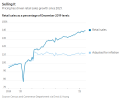
Glad you saw that article as well!WSJ has an article today on earnings season. Broadly, profitability is being supported by reduced labor costs (layoffs plus flat hiring) and efficiency (improved productivity) of the remaining workforce.
Glad you saw that article as well!
Here's a chart from it that I think is important.
View attachment 144733