Have We Angered The Economy?

There are a world of fancy graphics and indicators that could just as well point in the other direction (up and improving next 0-5 years).
^This is what I'm interested in.

EDIT: Hit send early.

Credible data that shows where the boom is occurring and where it is expected to last. I would love to see such indicators. I've looked many times. I don't see any except the ones I mentioned in my initial post: military/semis/datacenter/AI.
 
That's a very fair question, actually.

First, I'll start by saying that I haven't really said anything about what I think except that I think the economy is not doing great. I presented some data points in the form of screenshots of charts and excerpts to illustrate some reasoning behind it. I have many, many more data points I could (and would) have cited, except that I'm limited to 10 images per post and didn't want to make several posts in a row since it would be a touch overwhelming. I also don't want to just post links to dozens of sources that I doubt anyone will actually care to click through to.

Second, I'm not asking anyone to endorse my viewpoints or adopt my line of thinking. In fact, it's much more helpful if people would volunteer datapoints that conflict with mine -- or cover a blindspot I haven't addressed. That's because I'm hoping to find something I don't already know.

Third, this is my career. I've been paid by firms -- excellent firms -- to research data and find compelling trading opportunities. Throughout my career in hedge funds I've been provided significant sums of investor money to do that with, trading it both myself and by advising other analysts and portfolio managers. When someone entrusts you with a lot of money (and assuming you have any ethics at all), you care about being objective. Not political, not selling a narrative you don't actually believe, etc. When I research topics like macro, I'm not trying to sell anyone on any particular view of the economy. I'm trying to understand for myself where things are really at, so that I can make better choices. I'll make a case and I'll be curious if someone else can make a counter case.

Forth, I'm the first to admit I don't know it all. I've been wrong many times. If I'm wrong now, I'd rather know it now than later.

Lastly -- and I don't mean this in a snarky way -- is that I don't actually care at all if you come around to my line of thinking. I'm not trying to convince anyone, I'm trying to understand where growth is going to come from.

Have your viewpoints beat the market over years?

If you are a hedge fund guy, don't you have concerns discussing such things publicly?

I'd love to meet you!
 
^This is what I'm interested in.

EDIT: Hit send early.

Credible data that shows where the boom is occurring and where it is expected to last. I would love to see such indicators. I've looked many times. I don't see any except the ones I mentioned in my initial post: military/semis/datacenter/AI.

In 2020, what did you predict about 2025?
 
If you are a hedge fund guy, don't you have concerns discussing such things publicly?
I don't have concerns, actually.

Because right now I'm working in a contracting role helping a new firm build out their platform, so I'm not prohibited from sharing anything. Of course, I wouldn't give up anything that I'm specifically working on for them :)

Have your viewpoints beat the market over years?
The hedge funds that I've been at do not benchmark to the S&P or Nasdaq or the like. In levered, market neutral strategies (equal long/short exposure), your job is to make a good return that is uncorrelated to the market. "Good" depends on your client base and the risk/reward profile of your strategy.

Would I beat the S&P over the last 5 years in a long/short strategy without leverage? Absolutely not a snowball's chance in hell. No one could. Even if you have substantial leverage, hindsight shows that you'd almost certainly be better off just going long the market.

But that's not what clients want either, so it works out!
 
I don't have concerns, actually.

Because right now I'm working in a contracting role helping a new firm build out their platform, so I'm not prohibited from sharing anything. Of course, I wouldn't give up anything that I'm specifically working on for them :)


The hedge funds that I've been at do not benchmark to the S&P or Nasdaq or the like. In levered, market neutral strategies (equal long/short exposure), your job is to make a good return that is uncorrelated to the market. "Good" depends on your client base and the risk/reward profile of your strategy.

Would I beat the S&P over the last 5 years in a long/short strategy without leverage? Absolutely not a snowball's chance in hell. No one could. Even if you have substantial leverage, hindsight shows that you'd almost certainly be better off just going long the market.

But that's not what clients want either, so it works out!
I get the job dictates things but perhaps it has acclimated you towards mediocrity and safety?
 
In 2020, what did you predict about 2025?
In 2020 I didn't have any expectations about 2025 specifically. But I thought for sure we would go through a lot more pain when everything was shut down. I was obviously wrong about that. And crypto (not that I could have taken advantage of that anyways; crypto was not a tradeable item). I thought for sure crypto was going to absolutely implode on itself.

I still think it delivers virtually no economic value, but I threw up my arms long ago and recognize it will be worth whatever people want it to be worth. That was a missed opportunity to ride an upward roller coaster.
 
I think the sentiment here (seems quite negative) is an economic indicator for improvement.
 
Economic data, what does pending decrease in interest rates do for the future?
 
Economic data, what does pending decrease in interest rates do for the future?
All else equal, you'd expect a decline in interest rates to spur people to stop saving and open their wallets. I'm sure everyone here is expecting home prices to spike, airplane prices to spike and their investment portfolios to spike once rates start dropping.

But low rates are not a cheat code for growth. They're not a financial perpetual motion machine that, whenever lowered, will unleash the economy. They're one lever (albeit a powerful one) to use -- across a backdrop of much more complex machinery: consumer, companies and governments. When used in excess, it's destructive (we can ask lots of countries with runaway currencies about that!).

For instance, all else equal a nice drop in rates should cause the equity markets to go bonkers, right? Who doesn't want to make another 20-30% in their investment portfolio by just flipping a switch?

But what if people have already been anticipating a drop in rates and therefore loaded up on equities? And companies didn't postpone projects because they expected rates to come back down? Equity markets are forward looking, after all. In that case what effect should it have on the markets and the underlying economy and for how long? What if people anticipate a lot of the nastiness that low rates brings and think that will force a re-reraise in rates?

These are open questions -- I don't pretend to have an answer to them (if I did, I'd be floating in the south pacific on a megayacht).
 
Last edited:
what does pending decrease in interest rates do for the future?
Increase inflation. If interest rates are below inflation rates it gives a financial incentive to buy “now” with borrowed money artificially inflating the spending/earning balance. (Remember a dollar or any other form of currency is at its root a physical representation of work or physical object. The more of it that is “borrowed” (not yet done) to pay for goods and services will invariably cause the price of those goods and services to increase (work that has been done). At the very least base interest rate should be atleast equal to inflation rate. It is illogical to lend money when the purchasing power of the principle and interest is less when repaid than when it is lent. If the primary borrower is setting the rate, than that is a great plan… (low enough interest rate, payed back in depreciated value currency could result in a net negative “effective purchasing power” interest loan.
 
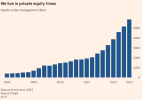
Not to mention that the earlier success of the PE firms brought in a lot of additional capital and lesser quality firms.

(Kind of like how Cathie Wood has unapologetically incinerated $14B of capital)
Absolutely!

This colorfully illustrates it:
1756261488954.png

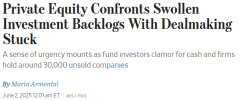
And all that indiscriminate investing has led to this:
1756261620727.png
1756262081489.png

For which our cure is to allow naive members of the public to buy into these companies.

If I'm a member of the retail public, I should be asking myself: "why are the investment banks and the government so incentivized all of the sudden over the last year to let me buy these assets?"

It's because their indiscriminate money-printing exit machine broke down (IPOs). Last I saw it published, they had >3.6 Trillion dollars of **** deals that they can't unload for anywhere near the prices that they carry them at.

Another byproduct of a long period of low interest rates.
 
Last edited:
One data point I have directly experienced/have knowledge of is lead times on some specialized industrial equipment. While for my personal needs it is good I do not see it as a good omen, MCC’s (industrial motor control centers), basically the the link between the power grid and an industrial scale facility end user lead times were quoted around 40 weeks in march, they are 16 weeks as of last Friday. Industrial scale evaporative heat exchangers were 25 weeks, they are now 11. Production volume has not increased, demand has drastically reduced.
 
If we're really at the beginning of an "AI revolution," we're going to need a lot more electricty. And if EVs gain widespread adoption on their own merits, that's more electricity still. If we're going to get serious about electricity, we'll eventually wind up with more nuclear power plants.

So, this economically illiterate anesthesiologist thinks there's growth to be had in whatever industries are involved in building nuclear power plants. If we're lucky, there will be parallel growth in whatever industries are involved in the dismantling of wind turbines and solar farms.

In hard times -- and of course there will be hard times, or always have been before -- fine art and other luxuries have done well. During the collapse of Weimar Germany, expensive cigars were better stores of wealth than marks were.
 
If we're really at the beginning of an "AI revolution," we're going to need a lot more electricty. And if EVs gain widespread adoption on their own merits, that's more electricity still. If we're going to get serious about electricity, we'll eventually wind up with more nuclear power plants.
Good timing -- Bloomberg actually has a thing about this morning...
1756294324543.png

In hard times -- and of course there will be hard times, or always have been before -- fine art and other luxuries have done well. During the collapse of Weimar Germany, expensive cigars were better stores of wealth than marks were.
Funny enough, the art market is currently struggling. Not for Picassos and Monets, those will always fetch a hefty price, but the general market has done poorly for a couple years. Same for the high end alcohol market and luxury products.
But during collapses like Germany's -- real assets will outperform currency. Cuz usually by that point the central bank printing presses are running a race against inflation and losing.
 
Last edited:
As one of the economically illiterate, my predictions are for Intel to fall off a cliff in five years, nVidia to face some kind of gov't scrutiny in the next ten, and AMD to be forced to give up some IP to Intel... In short, I'd bet against Intel for five years, for nVidia for five, and against nVidia in the following five... I'd also (probably) expect TSMC and Samsung to do very well, especially if they make good progress building foundries in the US.
 
If we're really at the beginning of an "AI revolution," we're going to need a lot more electricty. And if EVs gain widespread adoption on their own merits, that's more electricity still. If we're going to get serious about electricity, we'll eventually wind up with more nuclear power plants.

So, this economically illiterate anesthesiologist thinks there's growth to be had in whatever industries are involved in building nuclear power plants. If we're lucky, there will be parallel growth in whatever industries are involved in the dismantling of wind turbines and solar farms.

In hard times -- and of course there will be hard times, or always have been before -- fine art and other luxuries have done well. During the collapse of Weimar Germany, expensive cigars were better stores of wealth than marks were.

The nuclear and electric stuff is already well known. See charts for BE and GEV as examples of electric plays. I can't recall specific examples for nuclear.
The alt coin growing acceptance prolly another example of electric needs in the US.
 
As one of the economically illiterate, my predictions are for Intel to fall off a cliff in five years, nVidia to face some kind of gov't scrutiny in the next ten, and AMD to be forced to give up some IP to Intel... In short, I'd bet against Intel for five years, for nVidia for five, and against nVidia in the following five... I'd also (probably) expect TSMC and Samsung to do very well, especially if they make good progress building foundries in the US.

The problem with this is making a generic statement vs putting actual money on the line.
Intel is interesting choice. Tough for me to judge with 10% new stake along with the impact it will have.
 
Do any of you actively invest in companies?

OK, I will take a bite at sharing where I think the growth will come from. I won't be sharing charts or figures or really observations as I do not have any.

AI related will continue to offer economic growth, doing things more efficiently with fewer resources and bringing in more profits and/or consumer benefit. Chief among this will be companies like Palantir that will let various computer systems to work together, bring insight and understanding, and thus improve LOGISTICS and logistic choices. Improved logistics will grease the growth engines of companies. Think aviation related, Vans aircraft, emerged from bankruptcy. Huge logistics issues ordering in product, having material on hand, parts on hand, along with good info for UPS and Fedex. Likely different softwares handling accounting, labor management, inventory management, order tracking in two ways: keeping track of orders as they occur and keeping tracks of trends in orders. Doing these things better keeps them leaner, more profitable, and gets more planes in the hands of flying customers. It will allow them to observe and manage the impact of Mosaic real time. A failure to integrate systems will slow their growth trajectory and perhaps allow entry to some upstart that does it better. Economic growth

In the realm of aviation publishing we have had tremendous consolidation, firings, layoffs. AI is rumored to write articles now, not the old hats that now bemoan the state of things. Some have branched out on their own into new media, not yet fully shaped. Perhaps they reinvent new value offerings. A payed for video series on how to inspect each make and model airplane for those that take a 2 day class? More/better how to videos with updated quality? Anything done under the kitplanes umbrella likely stays there, perhaps they build anew and better value. They will have to risk real money (their own) and be forced to figure out the profit points. But perhaps something new and great comes out of it? Economic growth

More on Mosaic. There are so many new things coming forth that ought shake things up. Maybe we get more pilots, purchasing more planes, building more kits, working on more themselves. LSRM can start businesses. I think there are new instructional openings. More companies to build and sell planes. Growth

Self driving cars will revolutionize the world and reallocate resources towards better utility. Death and rebirth into economic growth growth

The security state/apparatus offers wild growth. Drones, borders, protection from crime

Healthcare has numerous things that might get reshaped with a new discovery, drug study results, procedural advances, AI efficiencies. Add in all the fearful things folks worry about but have it work.

For those on the welfare rolls, the net has some claiming there is a new work or volunteer requirement for things like food stamps. What if all the folks that do nothing had to pick up trash for 15 hours a week? What if all the cheaters and malingerers were found out and returned to productive activities?

Getting too much towards the rant end of things, but I see a world of opportunity for the US and abroad. We live in a great country full of inventors and engineers and economic growth is our destiny.
 
For those on the welfare rolls, the net has some claiming there is a new work or volunteer requirement for things like food stamps. What if all the folks that do nothing had to pick up trash for 15 hours a week? What if all the cheaters and malingerers were found out and returned to productive activities?
Ok, sorry, but I have to take issue with this. My family was on food stamps when I was a child. My father was enlisted and away on TDY quite often and my mother cared for multiple children, and also (in our own home) helped with caring for children of other service members. Omg, were my parents anything but lazy and we were not atypical.
 
Ok, sorry, but I have to take issue with this. My family was on food stamps when I was a child. My father was enlisted and away on TDY quite often and my mother cared for multiple children, and also (in our own home) helped with caring for children of other service members. Omg, were my parents anything but lazy and we were not atypical.

What do you take issue with? It sounds like you had a great family, with a great work ethic, and food stamps did well by you.

I was on food stamps also.

I'm reading a bit more on this it seems the facts are they have expanded the work requirements for SNAP for those age 55-64, about 900,000 people. If they do something, economic growth results. There might be more things going on but it is tough to determine truth on X or overflow TikTok stuff.
 
Getting too much towards the rant end of things, but I see a world of opportunity for the US and abroad. We live in a great country full of inventors and engineers and economic growth is our destiny.
No doubt we're in a great country full of smart people; the very best IMHO. But even the smartest, hardest working people with the best intentions will get things wrong occasionally -- or they'll stretch themselves too thin. Or pursue a path that looked promising which turned out to not work out. Or they'll do everything right and some unforeseeable event will cause their decision to backfire. Not for a lack of intelligence, but for a lack of perfect foresight, which no human (or collection of humans) can have.

That's inevitable when there are 350mil of us working in countless different industries running 150mil households.

To be clear, I'm not shortselling America as a whole. It's not like I think our best days are behind us and we're on a downward slide. But every economy since the earliest days takes pauses, retrenches, and has periods of "irrational exuberance" and overheating followed by cool downs. Almost by definition those periods occur after stretches of strong performance. People get over their skis with overly rosy expectations and then it catches up to them. It's happened to us before, it'll happen to us again. No country can avoid it. It's not to say we should pull our money out of the markets, we shouldn't.

It's just posing the question: what's the area that is going to power growth for the next several years?

It sounds like AI is among your top bets as a productivity/growth driver. Plus security stuff (defense), and perhaps self driving vehicles.
 
But even the smartest, hardest working people with the best intentions will get things wrong occasionally -- or they'll stretch themselves too thin. Or pursue a path that looked promising which turned out to not work out. Or they'll do everything right and some unforeseeable event will cause their decision to backfire. Not for a lack of intelligence, but for a lack of perfect foresight, which no human (or collection of humans) can have.

This is why, for me at least, individual stocks are a sucker bet and I stick with funds (including hedges). Any individual company can tank for the reasons you mention, but the overall average of many companies is much more likely to be successful.

Own the casino instead of trying to case the wheel.


It's just posing the question: what's the area that is going to power growth for the next several years?

Defense/aerospace. Wars will continue to sprout up, terrorist organizations will become better organized and more sophisticated, and US allies will continue to provide a solid market for weapons and other defense technology. Most meaningful and successful growth in areas like AI and automation will fall out of the defense industry, spurred by government investment.
 
In 2020 I didn't have any expectations about 2025 specifically. But I thought for sure we would go through a lot more pain when everything was shut down. I was obviously wrong about that. And crypto (not that I could have taken advantage of that anyways; crypto was not a tradeable item). I thought for sure crypto was going to absolutely implode on itself.

I still think it delivers virtually no economic value, but I threw up my arms long ago and recognize it will be worth whatever people want it to be worth. That was a missed opportunity to ride an upward roller coaster.

So why were you wrong then, and why do you think you're right now?
 
So why were you wrong then, and why do you think you're right now?
I think I'm right now because as hard as I look, I can't find appropriate growth drivers. In a market where we're setting all time highs nearly every other week for the last 18 months, I'd expect to see more broad based growth. The rising tide is not lifting all boats.

The growth seems to be: AI investment (chips + datacenters) and defense. If you're in one of those two areas, times have probably never been better. But if you're in a lot of the "regular" economic sectors, like where most people are employed, things aren't great.
Personally I don't know of any industry outside those where people are busting out the champagne celebrating huge wins.

It's also because it isn't just an absence of growth drivers, instead I see a lot of pain indicators and signs of deflating bubbles. Private equity, consumer stress, poor sentiment and outlook, rising delinquencies, worse jobs numbers, lower quits index, etc.

Those two things taken together -- to me they seem to flash a warning sign. Not a "Holy **** we're about to have a 2008 Lehman Moment" sign, but a warning sign nonetheless that maybe the market has become a bit untethered from the economy.

So why were you wrong then
I was wrong back then because I totally, totally overestimated the damage of COVID. Things came roaring back with a vengeance. But that was with the held of ZIRP and massive government influx to consumers and businesses; not something you can rely on as a long term growth driver.
 
I was wrong back then because I totally, totally overestimated the damage of COVID.

Could you be overestimating the implications of the indicators you're tracking now?

Could you be overlooking some other potential growth driver this time?

IOW, is your aperture open enough so that in 2030 you won't be saying "I totally, totally overlooked XXXX?"
 
This isn't "the sky is falling," but I'm trying to understand what the heck is the growth spot in the economy over the next 0-5 years? I'd like to see + hear some data/opinions if you have any you'd like to share.

My observations in no particular order:
The white collar job market is not healthy; most of the "were hiring" stories you hear about are for low paid gigs. Personally I have a few friends who have been unemployed for almost a year, so that contributes to my pessimism (since they're all pretty solid workers in previous growth fields). But the data also supports this.
Commercial real estate has been extending terms for a while waiting for a recovery that isn't actually arriving, and their mortgages aren't getting any smaller... There's certainly not any booming investment in CRE office.
Private equity saddled with several trillion dollars of portfolio companies they can't unload which are purchased with leverage on leverage on leverage; their limited partners are anxious to get their money back... the current solution seems to be write an executive order making people's 401k's a honeypot for bad valuation deals that PE needs to get rid of.
Artificial Intelligence: hit a pretty significant road bump that doesn't have an obvious path forward to fulfilling investor (or user) expectations. Llama4 and GPT5 are both examples. That isn't to say the craze is over, but it could well be a catalyst that causes a recalibration in people's expectations and investments. TBD.
Manufacturers have tariffs to contend with and will eventually have to trim costs or boost prices to deal with it; in no case can that be considered a positive thing
Inflation risk is omni-present
The IPO market is still in the toilet
Homebuilders for most of the market (ex high end) can only sell new houses with big financial incentives and hurling discounts at people, which has dropped profitability
Existing housing market has decidedly flipped, with the national data showing it takes longer to sell and for lower prices. There's some geographic variation, but on the whole it's in favor of buyers.
To save money lots of people have switched to DIY rather than paying laborers; prioritizing $ over your time is usually a tightening sign
I know some will argue this point, but from the data I see the aircraft market is also a lot weaker than the numbers show. Listings sit for a long time.
Restaurants are feeling pinched with consumers cutting back
The boom/bust pilot cycle is not booming
The boom/bust energy cycle is not booming
The boom/bust real estate cycle is not booming, unless you're building data centers
Gov't and healthcare employment accounts for over half the job growth over the last 3 years, and that growth engine is dead (no judgment on that, it's just a fact)
Student loan payments are in the toilet, with delinquencies having increased substantially despite fewer people actually being in a payment phase of the loan
Last but not least, we're >35 trillion in federal debt -- and with fed independence in jeopardy. There is no situation where this could be considered a positive development.


Here's the only bright spots I see:

If you're part of the military complex, you're doing great. War is good for business and the recent budget bill gives you a hefty piggy bank boost to play with.
If you're lighting venture capital investor money on fire to build a GPT wrapper, things are great until you have to re-raise.
If you're in the construction or real estate biz building data centers, you're doing great
If you build semiconductors or semicap equipment, you're doing great
If you have your 401k in speculative/growthy assets, you're currently doing wonderful (but that's not the economy, that's the fickle equity markets)


But to me, by all accounts, the underlying economy does not seem great. It seems like... pretty not great?


Random bits of data:
View attachment 144453

The "gen z kids can't get jobs because of AI taking the entry level jobs" narrative doesn't really hold, based on the age distribution. It's just a crappy market all around.
View attachment 144454

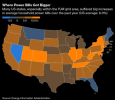
Also worth noting that the south/sunbelt is getting hit the hardest for housing, after also having a big boom.
View attachment 144452


Auto market. The subprime submarket (not broken out here) is at all time high delinquencies, that's even including the 2007-2010 disaster.
View attachment 144456

Car affordability has been getting worse for a while now.
View attachment 144451

Consumer sentiment is bad.
View attachment 144458

Jobs:
View attachment 144460
View attachment 144462

And existing jobs (note this is ADP, not the BLS numbers which are subject to substantial revisions):
View attachment 144461

Homes:
Still at record unaffordability. So sure your house is climbing in value on paper, but can it sell? And the answer is it depends, but for many people it's often not for the price you think it can.
Also worth noting that we're seeing a record rate of home purchase cancellations.
View attachment 144464

As for new homes (Lennar is not unique): """Stuart A. Miller, a chief executive of Lennar, one of the nation’s largest residential builders, said on a June call with analysts that the company had offered incentives of more than 13 percent of a home’s cost in the second quarter and that it would continue focusing on “lower cost structures.” That’s more than double the normal incentive rate, which Mr. Miller said on a March call should be around 5 or 6 percent."""

Seems to me your observations are right on the money. I have heard time thinking the next five years will be good. Maybe not the next ten or more. We have unserviceable debt (unless you want the fiat overlords printing more and devaluing everything). The bond market seems problematic. Mortgages are tied to the 10 year--so we have no reason to expect those to go down. We are grossly over extended on both obscene military adventurism and entitlements. Dollar decay is happening in real time. The hurdle rate is probably easily 7% or more. There is very little ROI to be had in real estate these days. Interest, taxes and insurance are in "Kill Bill" phase. The stock market P/E's are laughably out of whack. Probably a good time to ponder gold. Probably a good time to ponder bitcoin as well--if you have not already. They absolutely will not stop printing money and they absolutely will not stop spending money--so place your bets.
 
I'll let my crazy flag fly for a bit here.....

For most of the time I've been an adult what I've seen is an overall economy treading water. Sometimes we see a rise but it's usually following a big downturn. Most economic policy regardless of which variety of politicians have control have been targeted towards either making the DOW rise in the short term or bailing out people and businesses to avert a larger disaster. There's been little to no attention paid to doing anything foundational that would put us back in track for the long term- that sort of thing won't pay off within an election cycle and might even temporarily cause a downturn so they won't do it.

We've also consolidated... just about everything. Most industries are controlled by just a few gigantic companies. Now, there's some benefit to that- it tends to be more efficient and that makes our dollar go farther as consumers but it also means starting a competing business is nearly impossible. We don't have the kind of competition we need for a capitalist economy to thrive. Everything has become 'too big to fail'. But now and then businesses NEED to fail to make room for something new/innovative.

We shipped most of our manufacturing overseas and threw up tons of red tape that makes building anything new nearly impossible. We don't do much building of new facilities/businesses or much making of stuff. We just keep patching up our old stogy infrastructure and industries while keeping our population afloat on a sea of ridiculously cheap foreign(mostly Chinese) goods. Yes, I know we have a 'service' economy but IMHO there's a limit to how far you can keep 'servicing' before you run out of stuff to service and we're pretty much there.

Bottom line here is we're a stagnant society still riding what's left of a wave of prosperity that's several generations old. There needs to be a fundamental change above and beyond anything we've seen in the past decades. I fear that change will also have to start off with a collapse above and beyond anything that's happened in my lifetime. Back in 08' I was sure something bigger and worse was coming and I'm truly surprised it hasn't happened yet. Maybe it won't, maybe I'm wrong. Maybe we'll make enough small corrections and manage foundational changes gradually enough for that not to hit. Maybe. Either way I've set up my family's situation to be asAlso insulated as one can reasonably be from the economy falling out from under us.... I am not confident.
Those are also solid observations. An extreme turn for the worse should not shock anyone. We have followed a path of extreme spending on all fronts and we have allowed industry to go elsewhere. If you compare the S&P to long term charts of gold and the M2 it seems to me that they numbers get bigger--but your buying power is going down. This artificial expansion leads people to think they are making money--but are they?

My dad likes to think he is making crazy returns on his investments. He sold a business ages ago and has lived off the interest. However, his life really has not changed. Despite all those years of "investing", he is basically in the same spot he was when he retired at 40. Sure the numbers in his account go up--which excites him tremendously---but so has the numbers associated with everything he wants. He cannot seem to grasp it.
 
IOW, is your aperture open enough so that in 2030 you won't be saying "I totally, totally overlooked XXXX?"
... And that is exactly why I'm here! :)

I'd like to increase the scope of what I'm looking at and see if there are corners that I'm not seeing, which other people from all different walks of life/industry do see.

But to accurately answer your question: I really won't be able to answer that until 2030 ;)
 
Speaking for the O&G industry, we've been really slow this year. All of the go-to analysts had crude prices pegged at over $80/bbl for 2025 year-end predictions. We've been on a steady decline since January toward $60/bbl, and we're down about 45 drilling rigs in North America over that same period (we're down around 400 drilling rigs since 2020). That's a drop in drilling capacity of over 30% in 5 years. Producers aren't doing a ton of exploration right now, and what is being drilled isn't being completed (mostly so that they get to keep the lease agreements active). Everyone seems to be in a "wait and see" pattern because they'd rather not sell their product at $60/bbl. Conflicts in the Middle East/Russia haven't seemed to really have any material impact on gas/oil futures from what I have seen, just temporary blips, probably because the conflicts have been going on for so long that the "fear" of interruptions has subsided in the market. All of the service companies (Halliburton/SLB/Baker/etc) have squeezed their workforce down and are keeping their cards close to the vest in terms of forecasts and investment announcements. Tariffs have hit a lot of stuff pretty hard (aluminum/rubber/chemicals) which has driven up the production costs.

As far as the real estate market, it's been pretty solid in OK/TX from what I've seen. Houses that are priced right (like my parents') will move within weeks, but those that are still trying to fleece some California transplant with absurd pricing tend to go unsold. New auto prices are insane, and I'm not even sure who's still buying them these days. There's definitely a increasingly bigger chasm between the have's/have-nots where those at the bottom barely make enough to cover rent/bills.

I've been mostly invested in the S&P 500 indexes since Covid, but I've been looking at parking the money in something more insulated here soon waiting for the market to nosedive.
Tariffs, particularly tariffs shot from the hip are not going to help spur industry. And they are an end user tax, no matter what anyone tells you. Our current Commander in Chief could have really made a difference. He could have disconnected from these needless disputes, reigned in entitlements and at least embarked on a course of correction. I don't see that happening at all now. As for real estate, the over all trend is down. Consider Austin. Consider Florida. Of course, there will always be pockets that do well, because "all real estate is local". As for new cars--completely agree. To replace our Denali would be 87-93K. I am NOT paying basically 100K for a box on wheels. We had looked at an Ineos Grenadier as well---same basic price. Completely nuts to me.

Good luck with your S&P index investing.
 
Real estate market here (Illinois) is pretty decent as well. But like you say, that presumes it's "priced right". There's houses where people are still trying to get stretch pricing (my neighbors were one case), and their house sat on the market for a while. Someone finally bought after they came down quite a bit over 6+ months.

Re: Autos.
I'm still driving a used car I got for 12.7k$ in 2018. When I look at the replacement cost of that car, I want to vomit. And there's just no way I'm writing a check for ~$47k (average selling price of a new car in USA) for something that is functionally the same as what I have today.


It's good to hear first hand experience on that for the oil industry. A lot of the news/typical finance channels do always focus on middle east, and while that might result in some short term shocks it hasn't really seemed to play a role on where the price settles (things also haven't spiraled out of control there, either).

I'm curious: The oil workers normally collect decent sized checks. If they've squeezed their workforce down -- has that materialized at all in terms of local economy weakness in any perceptible way? Or do most of those guys easily walk into another industry?
I think the impact of the direct O&G workforce drawdown has been largely absorbed by locations other than where the drilling was happening. The guys doing field/rig work were transplants to North Dakota/West Texas/Western PA and when the prices dropped after 2020 many relocated back home or to locations that weren't necessarily O&G dependent for jobs. The fallout I think we're seeing right now, economically, is on the manufacturing side where the suppliers for O&G are having to walk back production to match the stacking of drilling rigs. The 5-yr run of stacking rigs and reduction of workforce is probably on a long-enough time scale that it would be tough to see a clear line if it were on a graph.

The other big change for O&G from a financial-operational standpoint was the shift away from using leverage for growth. The last big contraction in 2014 bit a lot of equity companies who had financed a lot of the growth and when prices fell, there were a lot of losses. Since then, free cash flow and "organic growth" has been on the forefront of most companies' plans, so rapid expansion is much more difficult. Even if there were an event that caused oil to make a run back up to $90-$100/bbl, it would take years to get mothballed rigs re-equipped and staffed. The fracking boom has matured, so future leaps in efficiency/output seem unlikely. Offshore is still moving along, but that's a whole different level of capital investment compared to onshore stuff (who knew drilling on the open ocean would be expensive?).
 
Tariffs, particularly tariffs shot from the hip are not going to help spur industry. And they are an end user tax, no matter what anyone tells you. Our current Commander in Chief could have really made a difference. He could have disconnected from these needless disputes, reigned in entitlements and at least embarked on a course of correction. I don't see that happening at all now. As for real estate, the over all trend is down. Consider Austin. Consider Florida. Of course, there will always be pockets that do well, because "all real estate is local". As for new cars--completely agree. To replace our Denali would be 87-93K. I am NOT paying basically 100K for a box on wheels. We had looked at an Ineos Grenadier as well---same basic price. Completely nuts to me.

Good luck with your S&P index investing.
The graph in the opening post where the 7-yr auto loan volume has surpassed the 5-yr auto loan term is a major deal. I can't see where this ends well for automakers (and their suppliers) in the long-term, as eventually there will be a point where people refuse to get long-term loans on a depreciable asset, especially when they're already increasingly-underwater on the loans. Used car market looks to be on solid ground for a while. I certainly won't be buying any new vehicles at current prices. The fact that a Yukon/Tahoe/Expedition/etc is ever a $100K vehicle just astounds me. Don't even get me started on a $100K Jeep Wagoneer, lol.
 
Generally speaking, economists seem to be accurate only in hindsight. They are adept at conjuring up explanations for what happened, but for what's going to happen they're like weather forecasters with Ouija boards.

Something I've noticed in the past few years is the growth of an underground economy. I realize that the plural of anecdote is not data, but personal experience leads me to wonder whether the off-the-record activity has not grown to the point of misleading the analysts.

One minor example: when we had tree work done after a recent hurricane, the company had a crew of a half-dozen workers at our place. When they finished, the supervisor asked if I would mind paying in cash so he could pay his workers in cash. I ran up to the bank, took out a couple of thousand, and paid, and he then handed out cash to his crew. I would be astonished if all that was recorded correctly in the books, and even more astonished if the workers paid taxes on any of it.

I could list several other examples, but the particulars aren't really the point. I'm just curious as to how large the "off the record" economy might be. I suspect employment is higher than the numbers indicate, but people are working privately for cash (and probably collecting unemployment checks, too) and that part of the labor market isn't captured in the records.
"Off the record economy"--good question. We know only that they are trying to make it smaller with each passing moment---our over lords want to know it all---what you earn/what you spend and everything in between. Funny how "paying cash" has become suspect in many markets. People will eventually figure it out that "KYC" wasn't about clamping down on drugs, it was about clamping down on us. Not to mention the "civil forfeiture" scam.
 
The graph in the opening post where the 7-yr auto loan volume has surpassed the 5-yr auto loan term is a major deal. I can't see where this ends well for automakers (and their suppliers) in the long-term, as eventually there will be a point where people refuse to get long-term loans on a depreciable asset, especially when they're already increasingly-underwater on the loans. Used car market looks to be on solid ground for a while. I certainly won't be buying any new vehicles at current prices. The fact that a Yukon/Tahoe/Expedition/etc is ever a $100K vehicle just astounds me. Don't even get me started on a $100K Jeep Wagoneer, lol.
When I was a kid, my dad and his brother bought my grandmother a brand new Jeep Wagoneer for Christmas. It was 25K. Back then, auto loans were typically 3 years. If you could not afford it over a 3 year term, you needed to find a cheaper vehicle. Then suddenly it became 5 years. Then 72 months or more. Wages are clearly not keeping up with inflation and I do not see that changing anytime soon.
 
The only thing constant in ours lives is change and there are both rapid and large changes coming. Brace yourselves.
 
I think I'm right now because as hard as I look, I can't find appropriate growth drivers. In a market where we're setting all time highs nearly every other week for the last 18 months, I'd expect to see more broad based growth. The rising tide is not lifting all boats.

….
Assuming by market, you’re referring collectively to stock markets, there’s not correlation between market performance and the economy of a whole.

Keep in mind DJIA is an equity index while S&P and other indices are capitalization weighted. Neither of those weighting account for consumer sentiment, which is the bedrock for growth.

Broadly, investment performance and market volatility is also impacted by so many mathematicians that it’s almost disconnected from consumer sentiment and spending. At a macro level it’s more and more resembling a sports book and not a snapshot of the economy as a whole.

Growth will occur where consumers fund retail value and right now, consumers aren’t finding much retail value anywhere. Demographically boomers and older are a larger generation then mine (X), and most of them are behaving as fixed income spenders. My generations is where the most disposable income lies and they’re rapidly becoming caregivers to the parents AND their adult/college aged children, simultaneously. In effect, their direct spending is somewhat diluted and there’s already leveraged pretty heavily as whole. Sure, there’s some asset-based loans out there, but aside from mortgages, little of that debt is for appreciating assets. I won’t say the money has been wasted, but a lot of my peers are toting their student loan note and on the hook for or are directly their kids student loans.

Y/Millenials & Z and younger have relatively little spending power that will increase as a whole over time. They also seem to value experiences over hard assets. Look where they’re putting their disposable income and that’s the trendline to follow, especially considering they make up 55% of the population. Some think they’re waiting for their parents and grandparents to die off so they can take a bite of the stepped up basis/generational transfer of wealth, which is just a twist on trickle down theory since a lot of that wealth being transferred will play out over a decade, so I wouldn’t expect there to be some broad seismic inflationary moment associated with that.

The bright spot is that Y and Z are each larger in population than X. Over the next decade, Y will also start moving into peak earning years territory which should increase their disposable income.

Stagnant/slow growth doesn’t have to be a harbinger; the money is moving…finding where it ends up at is the hard part.
 
Any individual company can tank for the reasons you mention, but the overall average of many companies is much more likely to be successful.

A fellow won the Nobel Prize in Economics for proving that mathematically.

I took a class on investing taught by the manager of the Harvard endowment fund. Largest educational endowment in the world. He explained two key principles that have stuck with me.

First, the price of any individual stock already reflects all known information about that stock. Thus, the only thing that will change the price is unknown information. You are literally betting on surprises.

Second, there are tens of thousands of professionals who work full time trying to predict those surprises. What are the odds I can outperform them?

Back to the Nobel Prize fellow. He established that every portfolio has two sources of risk: stock-specific risk, and market risk. If you are sufficiently diversified, you eliminate stock-specific risk.

Armed with that information, I put all my dough in S&P 500 Index funds at the end of that class 27 years ago and haven't looked back. But let's look back:

S&P 500 in 1998: 1196
S&P 500 today: 6479

Think of all the surprises since then that nobody could have foreseen. 911. GWOT. Smart phones. Social media. COVID. AI. Donald Trump as President.

(not meant to be political; I defy anyone to claim they thought in 1998 he would be President one day)

Predicting the future is folly.
 
Last edited:
Back
Top