Have We Angered The Economy?

I'll let my crazy flag fly for a bit here.…

Bottom line here is we're a stagnant society still riding what's left of a wave of prosperity that's several generations old. There needs to be a fundamental change above and beyond anything we've seen in the past decades. ….
You’re not wrong per se, but mature economies typically move towards stagnation anyways since you can only wring out so much efficiency and productivity before you get to the point of diminishing returns. The economy is much more defined by consumption when it comes to growth. Expectations play a role here, too. GDP growth at even the 4% mark typically defines developing economies.

The seismic shifts are truly transformative; industrial age; assembly line; affordable and scalable computing/automation. I don’t see AI being transformative and I don’t see much on the technology front that points toward anything other than incremental improvement in the frontier.

Something else to consider is while investors look to the public companies for growth, the real powerhouses are small and mid-size businesses, especially those small privately held companies that are expanding to meet demand. I sense those companies are in a conservative mode right now…a lot of increased costs have been put on those companies in a relatively short time and they’re not done adjusting to sustainable profitability.
 
Bottom line here is we're a stagnant society still riding what's left of a wave of prosperity that's several generations old. There needs to be a fundamental change above and beyond anything we've seen in the past decades. I fear that change will also have to start off with a collapse above and beyond anything that's happened in my lifetime. Back in 08' I was sure something bigger and worse was coming and I'm truly surprised it hasn't happened yet.
Our current society will make that fundamental change no other way, I'm afraid. Not if, but when.
 
I will continue to adhere to the advice I was given thirty years ago: do not take advice on finances or the economy from pilots.

I shall now return to YouTube and determine what I should do with my Crypto based on the ramblings of a former Army medic turned real estate mogul, as well as place some sports bets recommended by three excited men on a Zoom call with funny voices.
 
Wise man.

I'm stricly a funds investor. Picking individual stocks is like playing roulette, but investing in funds is more akin to owning casinos. Much better odds for long-term sustained returns. I did my own investing inside my 401k while working, but since retiring, I have a financial planner that handles all of it for me and I've been pleased with the results.

I've been all in S&P 500 index funds for 30 years. Long since quit caring what it does this week, month, or year.

I do own one stock, totally by happenstance. When I got out of the Army in 2008, a silicon valley startup hired me for some consulting. I got paid partially in options. They were worthless for years.

In 2020 the company finally went public. My business partner sold his shares. I was going to sell but kept putting off getting a login with their online brokerage. Honestly I was afraid I might have somehow missed a deadline and lost my shares.

Last summer the company got swept up in the AI boom and the stock exploded. A few weeks ago I finally got around to setting up an account and verified I still had 3000 shares. I almost fell out of my chair when I did the math.

The company was Palantir.
 
I've been all in S&P 500 index funds for 30 years. Long since quit caring what it does this week, month, or year.

I do own one stock, totally by happenstance. When I got out of the Army in 2008, a silicon valley startup hired me for some consulting. I got paid partially in options, with 3000 shares. They were worthless for years.

In 2020 the company finally went public. My business partner sold his shares. I was going to sell but kept putting off getting a login with their online brokerage. Honestly I was afraid I might have somehow missed a deadline and lost my shares.

Last summer the company got swept up in the AI boom and the stock exploded. A few weeks ago I finally got around to setting up an account and verifying I still had the shares. I almost fell out of my chair when I did the math.

The company was Palantir.

So I assume you’ll be buying a P51 soon?
 
Which brings me to another question: Since "inflation" is defined as an increase in the money supply, does sending cash out of the country reduce inflation?
That is not the definition of inflation. And, no, sending money out of the country doesn't change the amount of money in existence.
 
I've been all in S&P 500 index funds for 30 years. Long since quit caring what it does this week, month, or year.

I do own one stock, totally by happenstance. When I got out of the Army in 2008, a silicon valley startup hired me for some consulting. I got paid partially in options. They were worthless for years.

In 2020 the company finally went public. My business partner sold his shares. I was going to sell but kept putting off getting a login with their online brokerage. Honestly I was afraid I might have somehow missed a deadline and lost my shares.

Last summer the company got swept up in the AI boom and the stock exploded. A few weeks ago I finally got around to setting up an account and verified I still had 3000 shares. I almost fell out of my chair when I did the math.

The company was Palantir.

Congrats Ed. That is fanastic.
I've had it go the other way. Shares worth .001 when I logged in lol.

That dream panel just got dreamier :D
 
Maintenance and repair of anything and everything. Use your anecdotal evidence of new car prices and home prices and preserving/updating the old may win out over buying new. Invest in that on an institutional level.

A few others- healthcare, residential rentals, “food”, and of course alcohol & tobacco. Just my opinion.
 
Is that the plan?

Not anytime soon. I'm trying to posture to fully retire in next few years. So at some point will sell those shares and put into index funds. I am putting it off because I don't want to donate another 100K to the IRS.
 
I've been all in S&P 500 index funds for 30 years. Long since quit caring what it does this week, month, or year.

I do own one stock, totally by happenstance. When I got out of the Army in 2008, a silicon valley startup hired me for some consulting. I got paid partially in options. They were worthless for years.

In 2020 the company finally went public. My business partner sold his shares. I was going to sell but kept putting off getting a login with their online brokerage. Honestly I was afraid I might have somehow missed a deadline and lost my shares.

Last summer the company got swept up in the AI boom and the stock exploded. A few weeks ago I finally got around to setting up an account and verified I still had 3000 shares. I almost fell out of my chair when I did the math.

The company was Palantir.
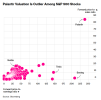
I know you don't want to donate 20% to the IRS, but that's definitely "a first world problem" when your valuation looks like this.
The company was doing well for a while, of course, but the retail crowd made it go from "doing well" to "off the charts insane". Who knows how long it can park itself at such an extreme level.

Also: congrats! That's a hell of a stock to be sitting on 3000 shares of :cool:
1756233009917.png
 
Maintenance and repair of anything and everything. Use your anecdotal evidence of new car prices and home prices and preserving/updating the old may win out over buying new. Invest in that on an institutional level.

A few others- healthcare, residential rentals, “food”, and of course alcohol & tobacco. Just my opinion.
I've been eyeing healthcare, especially companies in long term care. Retirement homes seem to be especially adept at separating Americans from their lifetime of savings in very short order, then get the gov't social security money to cover costs until their ultimate demise. You can watch a loved one's million-dollar nest egg dwindle down to pennies in a decade between medical expenses and long term living accommodations. Until the gov't decides to intervene, I'd imagine it's a pretty safe bet.
 
Not anytime soon. I'm trying to posture to fully retire in next few years. So at some point will sell those shares and put into index funds. I am putting it off because I don't want to donate another 100K to the IRS.

Don't put it off too long. What rises rapidly may plunge just as rapidly.
 
The “Economy” isn’t some homogenous blob that’s accurately represented by all the various data sources.

I think economists are having a hard time understanding what the economy is doing right now because, well, they don’t really know how to deal with things like gig workers whose data is not captured in a lot of official data. Then again, economists rarely understand what’s happening ‘right now’; they need to context time provides.

Broadly, we know savings have been depleted and debt has increased, but if the foreclosures and repos aren’t being appreciably affected, then cash is being generated and flowing. For some, it’s probably a losing battle, for others they’re likely treading water, some are sitting on the sidelines, and some are still doing deals.

I know we’ve paused some entry level hiring for the rest of the year but we’ve been backfilling staff attrition. Most of our folks that have been laid off were able to find elsewhere in the company during the notice period. The one person I know who’s been out of work for a year is that way by choice.
I agree -- this data is only a proxy to try and take the pulse of the economy, and often times it's a poor one at that (some could be due to gig economy, or the underground cash economy @Half Fast mentions -- among other reasons).
You try and make up for that shortcoming by using a mosaic of the economy and looking at lots of different sources that measure different things. When indicators tell different stories, that's interesting.
 
Don't put it off too long. What rises rapidly may plunge just as rapidly.

It already fell off quite a bit from the peak. But it's not like I have anything really invested.

I reported to the COO. He's a billionaire now.

When I consulted with them, they shared a building in Palo Alto with another start up: Facebook.
 
Not anytime soon. I'm trying to posture to fully retire in next few years. So at some point will sell those shares and put into index funds. I am putting it off because I don't want to donate another 100K to the IRS.


Two birds in a bush. If the value continues to increase, so does the IRS bill. If the IRS bill evaporates, so does the T-6.
 
You forgot global warming, dropping life expectancies and the plunging educational/achievement outcomes.

Also, lest we forget, there are probably aliens.
 
Two birds in a bush. If the value continues to increase, so does the IRS bill. If the IRS bill evaporates, so does the T-6.

TBH it's not a game changer for me either way. The last few years have been good to me financially. Just goes to show, money can't buy happiness.
 
I'd like to know how much of that "couple of thousand" stayed in circulation in the US.

Which brings me to another question: Since "inflation" is defined as an increase in the money supply, does sending cash out of the country reduce inflation?
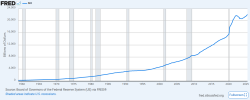
Inflation is measured by using a price index, rather than aggregate money supply.
However, when you see money supply curves that look like this -- you should expect inflation to follow.
1756237545589.png
 
As far as the real estate market, it's been pretty solid in OK/TX from what I've seen. Houses that are priced right (like my parents') will move within weeks, but those that are still trying to fleece some California transplant with absurd pricing tend to go unsold. New auto prices are insane, and I'm not even sure who's still buying them these days. There's definitely a increasingly bigger chasm between the have's/have-nots where those at the bottom barely make enough to cover rent/bills.
Real estate market here (Illinois) is pretty decent as well. But like you say, that presumes it's "priced right". There's houses where people are still trying to get stretch pricing (my neighbors were one case), and their house sat on the market for a while. Someone finally bought after they came down quite a bit over 6+ months.

Re: Autos.
I'm still driving a used car I got for 12.7k$ in 2018. When I look at the replacement cost of that car, I want to vomit. And there's just no way I'm writing a check for ~$47k (average selling price of a new car in USA) for something that is functionally the same as what I have today.

Speaking for the O&G industry, we've been really slow this year. All of the go-to analysts had crude prices pegged at over $80/bbl for 2025 year-end predictions. We've been on a steady decline since January toward $60/bbl, and we're down about 45 drilling rigs in North America over that same period (we're down around 400 drilling rigs since 2020). That's a drop in drilling capacity of over 30% in 5 years. Producers aren't doing a ton of exploration right now, and what is being drilled isn't being completed (mostly so that they get to keep the lease agreements active). Everyone seems to be in a "wait and see" pattern because they'd rather not sell their product at $60/bbl. Conflicts in the Middle East/Russia haven't seemed to really have any material impact on gas/oil futures from what I have seen, just temporary blips, probably because the conflicts have been going on for so long that the "fear" of interruptions has subsided in the market. All of the service companies (Halliburton/SLB/Baker/etc) have squeezed their workforce down and are keeping their cards close to the vest in terms of forecasts and investment announcements. Tariffs have hit a lot of stuff pretty hard (aluminum/rubber/chemicals) which has driven up the production costs.
It's good to hear first hand experience on that for the oil industry. A lot of the news/typical finance channels do always focus on middle east, and while that might result in some short term shocks it hasn't really seemed to play a role on where the price settles (things also haven't spiraled out of control there, either).

I'm curious: The oil workers normally collect decent sized checks. If they've squeezed their workforce down -- has that materialized at all in terms of local economy weakness in any perceptible way? Or do most of those guys easily walk into another industry?
 
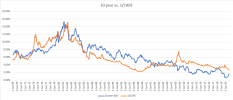
I created this graph a few years ago and haven't updated it recently but I think it tells a pretty good story. The 10 year treasury has been on a consistent downward march since the early eighties. Somewhere along the way, lower rates no longer spurred capital investment, they spurred recapitalization.
1756238975054.png
 
I created this graph a few years ago and haven't updated it recently but I think it tells a pretty good story.
View attachment 144486
What's funny is that a very close cousin of that chart is what is used for attributing most of private equity's success for the last 40 years.
It's pretty damned hard to lose money in an era with declining rates and expanding equity multiples, when your entire business is buying companies with debt, paying yourself with debt incurred by the company and then exiting at a higher multiple. Once that macro backdrop falls away and you have to actually deliver some tangible product that requires skill and operational improvements, they start to **** the bed. Hard.

Somewhere along the way, lower rates no longer spurred capital investment, they spurred recapitalization.
The increasing importance of buybacks over the last 15 years is a great example of this. On the cover, it looks like a nice maneuver. Why not use money to buy back shares and prop up the share price in a tax efficient-ish way? On the flip side, what does it say about your underlying business outlook and opportunity set when you're not using that money to invest in appealing projects, but instead just using it to boost the value of your shares?
 
Generally speaking, economists seem to be accurate only in hindsight. They are adept at conjuring up explanations for what happened, but for what's going to happen they're like weather forecasters with Ouija boards.
Or, to cite a quote: "An economist is an expert who will know tomorrow why the things he predicted yesterday didn't happen today."
 
This isn't "the sky is falling," but I'm trying to understand what the heck is the growth spot in the economy over the next 0-5 years? I'd like to see + hear some data/opinions if you have any you'd like to share.

My observations in no particular order:
The white collar job market is not healthy; most of the "were hiring" stories you hear about are for low paid gigs. Personally I have a few friends who have been unemployed for almost a year, so that contributes to my pessimism (since they're all pretty solid workers in previous growth fields). But the data also supports this.
Commercial real estate has been extending terms for a while waiting for a recovery that isn't actually arriving, and their mortgages aren't getting any smaller... There's certainly not any booming investment in CRE office.
Private equity saddled with several trillion dollars of portfolio companies they can't unload which are purchased with leverage on leverage on leverage; their limited partners are anxious to get their money back... the current solution seems to be write an executive order making people's 401k's a honeypot for bad valuation deals that PE needs to get rid of.
Artificial Intelligence: hit a pretty significant road bump that doesn't have an obvious path forward to fulfilling investor (or user) expectations. Llama4 and GPT5 are both examples. That isn't to say the craze is over, but it could well be a catalyst that causes a recalibration in people's expectations and investments. TBD.
Manufacturers have tariffs to contend with and will eventually have to trim costs or boost prices to deal with it; in no case can that be considered a positive thing
Inflation risk is omni-present
The IPO market is still in the toilet
Homebuilders for most of the market (ex high end) can only sell new houses with big financial incentives and hurling discounts at people, which has dropped profitability
Existing housing market has decidedly flipped, with the national data showing it takes longer to sell and for lower prices. There's some geographic variation, but on the whole it's in favor of buyers.
To save money lots of people have switched to DIY rather than paying laborers; prioritizing $ over your time is usually a tightening sign
I know some will argue this point, but from the data I see the aircraft market is also a lot weaker than the numbers show. Listings sit for a long time.
Restaurants are feeling pinched with consumers cutting back
The boom/bust pilot cycle is not booming
The boom/bust energy cycle is not booming
The boom/bust real estate cycle is not booming, unless you're building data centers
Gov't and healthcare employment accounts for over half the job growth over the last 3 years, and that growth engine is dead (no judgment on that, it's just a fact)
Student loan payments are in the toilet, with delinquencies having increased substantially despite fewer people actually being in a payment phase of the loan
Last but not least, we're >35 trillion in federal debt -- and with fed independence in jeopardy. There is no situation where this could be considered a positive development.


Here's the only bright spots I see:

If you're part of the military complex, you're doing great. War is good for business and the recent budget bill gives you a hefty piggy bank boost to play with.
If you're lighting venture capital investor money on fire to build a GPT wrapper, things are great until you have to re-raise.
If you're in the construction or real estate biz building data centers, you're doing great
If you build semiconductors or semicap equipment, you're doing great
If you have your 401k in speculative/growthy assets, you're currently doing wonderful (but that's not the economy, that's the fickle equity markets)


But to me, by all accounts, the underlying economy does not seem great. It seems like... pretty not great?


Random bits of data:
View attachment 144453

The "gen z kids can't get jobs because of AI taking the entry level jobs" narrative doesn't really hold, based on the age distribution. It's just a crappy market all around.
View attachment 144454

Also worth noting that the south/sunbelt is getting hit the hardest for housing, after also having a big boom.
View attachment 144452


Auto market. The subprime submarket (not broken out here) is at all time high delinquencies, that's even including the 2007-2010 disaster.
View attachment 144456

Car affordability has been getting worse for a while now.
View attachment 144451

Consumer sentiment is bad.
View attachment 144458

Jobs:
View attachment 144460
View attachment 144462

And existing jobs (note this is ADP, not the BLS numbers which are subject to substantial revisions):
View attachment 144461

Homes:
Still at record unaffordability. So sure your house is climbing in value on paper, but can it sell? And the answer is it depends, but for many people it's often not for the price you think it can.
Also worth noting that we're seeing a record rate of home purchase cancellations.
View attachment 144464

As for new homes (Lennar is not unique): """Stuart A. Miller, a chief executive of Lennar, one of the nation’s largest residential builders, said on a June call with analysts that the company had offered incentives of more than 13 percent of a home’s cost in the second quarter and that it would continue focusing on “lower cost structures.” That’s more than double the normal incentive rate, which Mr. Miller said on a March call should be around 5 or 6 percent."""


Wow, what a lot of stuff rolling around in your head. I am going to keep reading, but have to first ask:

What special abilities do you have to decipher the market? In other words, why should anything that you "think" guide your or others actions?
 
What's funny is that a very close cousin of that chart is what is used for attributing most of private equity's success for the last 40 years.
It's pretty damned hard to lose money in an era with declining rates and expanding equity multiples, when your entire business is buying companies with debt, paying yourself with debt incurred by the company and then exiting at a higher multiple. Once that macro backdrop falls away and you have to actually deliver some tangible product that requires skill and operational improvements, they start to **** the bed. Hard.
Not to mention that the earlier success of the PE firms brought in a lot of additional capital and lesser quality firms.

(Kind of like how Cathie Wood has unapologetically incinerated $14B of capital)
 
The stock market climbs a wall of worry. It is generally a six month predictor of the economy. So I expect the economy will also climb a wall of worry.
 
I disagree with most of the sentiment shared here. Lots are sharing their observations as indicators so here are mine:

My town has so many flipping roads being worked on it is a PITA
Skilled trades very busy, tough to get to work.
For my home shop I had one place that would not even come out to bid the work for 3 months. Anyone that is good is getting paid and working.

The stock market is a forward looking mechanism. The stock market is within reach of all time highs.
TDS is real so mucho dinero is still sitting on the sidelines. It will choose to buy in higher!

Those that think we won't get better almost seem unAmerican to me. We are in the land of exceptionalism and are leading the world in productivity through companies like PLTR mentioned upthread. Those that failed to embrace the future FAILED to see that company for what it was, for what they said it was, and for what they said it would do for the world. Many people failed to believe in the bullish case, with sentiments shared similar to this thread. Non believers!!!

There are a world of fancy graphics and indicators that could just as well point in the other direction (up and improving next 0-5 years).

I try not to pay too much attention to what I think and feel as it is often flawed, overly emotional, and fails to make me any money.

I do not see any big picture credit boom bust going on (Ala LTCM or 07 housing)

I want to emphasize Un American!
 
Wow, what a lot of stuff rolling around in your head. I am going to keep reading, but have to first ask:
What special abilities do you have to decipher the market? In other words, why should anything that you "think" guide your or others actions?
That's a very fair question, actually.

First, I'll start by saying that I haven't really said anything about what I think except that I think the economy is not doing great. I presented some data points in the form of screenshots of charts and excerpts to illustrate some reasoning behind it. I have many, many more data points I could (and would) have cited, except that I'm limited to 10 images per post and didn't want to make several posts in a row since it would be a touch overwhelming. I also don't want to just post links to dozens of sources that I doubt anyone will actually care to click through to.

Second, I'm not asking anyone to endorse my viewpoints or adopt my line of thinking. In fact, it's much more helpful if people would volunteer datapoints that conflict with mine -- or cover a blindspot I haven't addressed. That's because I'm hoping to find something I don't already know.

Third, this is my career. I've been paid by firms -- excellent firms -- to research data and find compelling trading opportunities. Throughout my career in hedge funds I've been provided significant sums of investor money to do that with, trading it both myself and by advising other analysts and portfolio managers. When someone entrusts you with a lot of money (and assuming you have any ethics at all), you care about being objective. Not political, not selling a narrative you don't actually believe, etc. When I research topics like macro, I'm not trying to sell anyone on any particular view of the economy. I'm trying to understand for myself where things are really at, so that I can make better choices. I'll make a case and I'll be curious if someone else can make a counter case.

Forth, I'm the first to admit I don't know it all. I've been wrong many times. If I'm wrong now, I'd rather know it now than later.

Lastly -- and I don't mean this in a snarky way -- is that I don't actually care at all if you come around to my line of thinking. I'm not trying to convince anyone, I'm trying to understand where growth is going to come from.
 
Back
Top