
So how do you handle it if you're coming from the east, direct-to, and runway in use is 27? Sideatep a couple miles to the north and then head south to cross midfield?I don't do upwind entries. I'll position for the overhead and execute a tear-drop or direct entry into the pattern depending on traffic.

You are using an out of date browser. It may not display this or other websites correctly.
You should upgrade or use an alternative browser.
You should upgrade or use an alternative browser.
The FAA changed the definition of Upwind
- Thread starter AV8R_87
- Start date

Half Fast
Touchdown! Greaser!
- Joined
- May 7, 2016
- Messages
- 21,192
- Location
- Central Florida
- Display Name
- Half Fast
- Home Airfield
- KGIF
I think a 45 degree to the upwind should be the corollary to the 45 to the downwind when approaching the airport from the opposite side. I think the midfield crosswind and midfield overflight methods both present unnecessary maneuvering risks.

It should look like this:
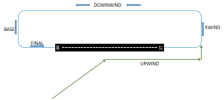
The upwind leg is not over the runway; rather, it's offset as shown. This affords a good view of the pattern traffic and the runway. If a plane is taking off, it's easy to turn right and just circle back around for another go. I think it's a good method when approaching the airport from the side opposite the pattern.

- Joined
- Sep 17, 2017
- Messages
- 1,184
- Location
- Indian Mound, TN
- Display Name
- Mooney Fan
- Home Airfield
- KHVC
That's an option. More likely I would be straight in traffic permitting. Or coming from the east with a heading of 270 I would slide over to the S-SW for a 45 entry given a left hand pattern.So how do you handle it if you're coming from the east, direct-to, and runway in use is 27? Sideatep a couple miles to the north and then head south to cross midfield?
I would not recommend what you've show as it is Non Standard and that's the last thing you want to do.It should look like this:
From the position you show you're arriving from you'd simple adjust so you ended up perpendicular to the active runway about 3+ miles out and then do an Overhead entry. From their it is your option, pending traffic, if you just join the Downwind or go out and do a Teardrop enter to enter on a 45.
Other thing that so many people don't realize, if you plan your arrival and turn just a bit, 10-15 miles out, you can arrive at the point to enter on the 45, potentially adding no time to your flight or maybe a minute or two at most. So if you don't like the Overhead entry, just plan a ways out to the point you can enter on the 45.

Ed Haywood
Final Approach
So how do you handle it if you're coming from the east, direct-to, and runway in use is 27? Sideatep a couple miles to the north and then head south to cross midfield?
Straight in, or overhead level break into midfield downwind.

- Joined
- Sep 17, 2017
- Messages
- 1,184
- Location
- Indian Mound, TN
- Display Name
- Mooney Fan
- Home Airfield
- KHVC
lol..... Been there done thatStraight in, or overhead level break into midfield downwind.
And nothing snapped.

Fast fwd to 1:05
The view of the runway is probably pretty bad if the field is right hand pattern. And if it's RP, there's probably a good reason that they don't want you on that side of the runway at TPA.This affords a good view of the pattern traffic and the runway.
Half Fast
Touchdown! Greaser!
- Joined
- May 7, 2016
- Messages
- 21,192
- Location
- Central Florida
- Display Name
- Half Fast
- Home Airfield
- KGIF
The view of the runway is probably pretty bad if the field is right hand pattern. And if it's RP, there's probably a good reason that they don't want you on that side of the runway at TPA.
The view of the runway is no worse than on the downwind in a RP. But RPs are a small subset anyway. In a conventional LP the 45 entry to the upwind works just fine.
Lindberg
Final Approach
Is there not a good reason they want you on "that side" of the airport of its a left-hand pattern?The view of the runway is probably pretty bad if the field is right hand pattern. And if it's RP, there's probably a good reason that they don't want you on that side of the runway at TPA.
True if it's a tandem seat aircraft. Otherwise, you're closer to the runway than on downwind and you'd have to lean over the passenger to see the runway.The view of the runway is no worse than on the downwind in a RP.
If there is not a reason they want RP then the default is to the left. The reverse is not true.Is there not a good reason they want you on "that side" of the airport of its a left-hand pattern?
Half Fast
Touchdown! Greaser!
- Joined
- May 7, 2016
- Messages
- 21,192
- Location
- Central Florida
- Display Name
- Half Fast
- Home Airfield
- KGIF
True if it's a tandem seat aircraft. Otherwise, you're closer to the runway than on downwind and you'd have to lean over the passenger to see the runway.
Maybe. Depends on how close. I haven't tried it with a RP yet, and might not have an opportunity to do so any time soon. It works just fine with a conventional LP, though.

- Joined
- Apr 18, 2013
- Messages
- 5,324
- Location
- The independent worm saloon
- Display Name
- Mantis Toboggan, MD
"Request carrier"Straight in, or overhead level break into midfield downwind.
(pssst...that means 800 ft AGL)
Nauga,
who knows how low he can go
Last edited:
Lindberg
Final Approach
Do you have difficulty seeing the runway when on right downwind? The planes i fly aren't big enough that it's an issue.True if it's a tandem seat aircraft. Otherwise, you're closer to the runway than on downwind and you'd have to lean over the passenger to see the runway.
But they get to decide, right?If there is not a reason they want RP then the default is to the left. The reverse is not true.
No, but the diagram from @Half Fast shows the upwind join as being much tighter than what would be a right downwind.Do you have difficulty seeing the runway when on right downwind?
I'm not privy to that decision-making, but I think if there's no good reason for RP then then it's left.But they get to decide, right?
Half Fast
Touchdown! Greaser!
- Joined
- May 7, 2016
- Messages
- 21,192
- Location
- Central Florida
- Display Name
- Half Fast
- Home Airfield
- KGIF
No, but the diagram from @Half Fast shows the upwind join as being much tighter than what would be a right downwind.
It should be tighter, but that doesn't necessarily mean so tight that you can't see the runway. If it needs to be that tight, then use a different method to enter the pattern.
Lindberg
Final Approach
Downwind to one place is just upwind to someplace else.

flyingcheesehead
Taxi to Parking
- Joined
- Feb 23, 2005
- Messages
- 28,191
- Location
- UQACY, WI
- Display Name
- iMooniac
- Home Airfield
- KUES/KMKE
And then there wasn't even anything to back up those assertions. I still fail to see how it's "bad" or "****-poor"."A bad idea"
"A ****-poor entry to the pattern"
<paraphrase> Your explanation was so close to being correct but you're wrong because I disagree
May not say outright that something is dangerous, but I argue that at best they do not promote an even-keeled discussion of techniques.
With some cockpits, being able to see the runway through the right side window could mean a track wide enough to be construed as a left downwind.It should be tighter, but that doesn't necessarily mean so tight that you can't see the runway. If it needs to be that tight, then use a different method to enter the pattern.
Therein lies the problem. An airport with RP could be designated such because left downwind flies over noise sensitive neighbors, a parachute landing zone, etc.Downwind to one place is just upwind to someplace else.

Matthew
Touchdown! Greaser!
That’s a good point: that pattern might be specifically set because of obstructions on the other side, too. It’s always something, stay aware of what you’re doing and why.Therein lies the problem. An airport with RP could be designated such because left downwind flies over noise sensitive neighbors, a parachute landing zone, etc.

Hang 4
En-Route
- Joined
- Aug 18, 2017
- Messages
- 3,425
- Display Name
- Hang 4
I am not a fan of upwind entry. My reason is that planes on departure are ascending, vs level on downwind. Simple scenario, low wing joins the pattern on the upwind, high wing is climbing on departure. There's a good potential that neither can see the other. Contrast that with joining the downwind by crossing midfield (one of the AIM suggested pattern entries), everyone is at the same altitude and there should be much better visibility.
Obviously there are exceptions due to airspace, geography (like the airport right next to PHL).
Obviously there are exceptions due to airspace, geography (like the airport right next to PHL).
Lindberg
Final Approach
Ok. I don't actually know what "wide enough to be construed as a left downwind" means. I'd bet a lot of posters would consider my normal downwind scary close to the runway, and others would fly inside it.With some cockpits, being able to see the runway through the right side window could mean a track wide enough to be construed as a left downwind.
Yes, different airports are different. So what's a great idea at one airport might not be a great idea at a different one. Likewise, what's a terrible idea at one airport might be a great one elsewhere.Therein lies the problem. An airport with RP could be designated such because left downwind flies over noise sensitive neighbors, a parachute landing zone, etc.

- Joined
- Jan 28, 2010
- Messages
- 1,680
- Location
- Central Florida
- Display Name
- jbarrass
- Home Airfield
- 06FD
^^^ This.Obviously there are exceptions due to airspace, geography (like the airport right next to PHL).
For example, my home field (KJYO) is class G with a part time mobile tower. TPA is 1100 feet, 1300 for jets, and the KIAD class B floor is at 1500. We are also in the DC Special use area with a carve out to the NW. Going over the top and turning back is not viable. The preferred runway is 17. We have 5 flight schools and some very busy traffic in a tight space. To get to the downwind when the tower is closed is exciting to say the least.
Not having a term for "the thing formerly as upwind" that everyone understands, absolutely does not help communications.
So basically, "unless you know the airport well, an upwind join is probably not a good idea"?Yes, different airports are different. So what's a great idea at one airport might not be a great idea at a different one. Likewise, what's a terrible idea at one airport might be a great one elsewhere.
Half Fast
Touchdown! Greaser!
- Joined
- May 7, 2016
- Messages
- 21,192
- Location
- Central Florida
- Display Name
- Half Fast
- Home Airfield
- KGIF
So basically, "unless you know the airport well, an upwind join is probably not a good idea"?
I certainly wouldn't say that. I'd say that, barring problems presented by airspace restrictions or NOTAMs or obstacles, etc., an upwind entry is a good idea when approaching an airport from the opposite side of the pattern.
Lindberg
Final Approach
That no more true than the generic, "Unless you know the airport well, ___________ is probably not a good idea."So basically, "unless you know the airport well, an upwind join is probably not a good idea"?

EdFred
Taxi to Parking
- Joined
- Feb 25, 2005
- Messages
- 31,404
- Location
- Michigan
- Display Name
- The Ed
- Home Airfield
- 9D9 / 6Y9 / 88TN
For those so adamant about not entering on a tight upwind, do you not look outside? You should be able to see any airplane that's on the runway for a mile or so before you are abeam the numbers you'll be landing on, and as you are cruising along on the upwind all you have to do is not be lazy and look at the runway to make sure no NORDO zips on it and launches. Then you make a turn onto the crosswind as if you just departed the runway, and you're safely in the pattern with no one climbing into you, and no one you're descending on to. I have yet to have any trouble seeing the runway or planes on it with 99% of my time being in low wings. But apparently we have a bunch of pilots zipping around chasing the farmer's wife.
- Joined
- Jan 28, 2010
- Messages
- 1,680
- Location
- Central Florida
- Display Name
- jbarrass
- Home Airfield
- 06FD
I don't know that "unless you know the airport well" is totally limiting. I do think looking at the chart, planning ahead, and then finding a spot to join the flow is probably a good idea.So basically, "unless you know the airport well, an upwind join is probably not a good idea"?
I just lament that communicating is also pretty important. And calling "midfield on the thing formerly known as upwind" is not very useful, nor is saying nothing. I don't know if it has to be called "upwind", but it should have a name everyone understands.
I don't know what problem this is trying to solve.
- Joined
- Sep 17, 2017
- Messages
- 1,184
- Location
- Indian Mound, TN
- Display Name
- Mooney Fan
- Home Airfield
- KHVC
I'm risk adverse. With a host of other options available, potentially flying across the path of departing traffic for me is unacceptable risk.For those so adamant about not entering on a tight upwind, do you not look outside? You should be able to see any airplane that's on the runway for a mile or so before you are abeam the numbers you'll be landing on, and as you are cruising along on the upwind all you have to do is not be lazy and look at the runway to make sure no NORDO zips on it and launches. Then you make a turn onto the crosswind as if you just departed the runway, and you're safely in the pattern with no one climbing into you, and no one you're descending on to. I have yet to have any trouble seeing the runway or planes on it with 99% of my time being in low wings. But apparently we have a bunch of pilots zipping around chasing the farmer's wife.
And that guy who needs to 'go around' can ruin our day as well.
EdFred
Taxi to Parking
- Joined
- Feb 25, 2005
- Messages
- 31,404
- Location
- Michigan
- Display Name
- The Ed
- Home Airfield
- 9D9 / 6Y9 / 88TN
Oh, you mean the option where you find all the traffic, then put your back to the field, and then have to attempt to find all the traffic again.I'm risk adverse. With a host of other options available, potentially flying across the path of departing traffic for me is unacceptable risk.
And that guy who needs to 'go around' can ruin our day as well.
And why are you that close to a guy landing that you have to worry about him going around?
Sounds like you have some spatial awareness issues based on that post.
- Joined
- Sep 17, 2017
- Messages
- 1,184
- Location
- Indian Mound, TN
- Display Name
- Mooney Fan
- Home Airfield
- KHVC
The FAA change speaks to controlled fields. My comments are more aligned with uncontrolled fields.Oh, you mean the option where you find all the traffic, then put your back to the field, and then have to attempt to find all the traffic again.
And why are you that close to a guy landing that you have to worry about him going around?
Sounds like you have some spatial awareness issues based on that post.
Below is an interesting tidbit from AI. Of course the tool is not a definitive source it does however give food for thought.
-------------------------
Dangers of Upwind Entries to the Traffic Pattern
Increased Collision Risk
Entering the traffic pattern on the upwind leg can significantly increase the risk of mid-air collisions. This is particularly true at non-towered airports where traffic may be high. When pilots enter the pattern from the upwind leg, they may conflict with aircraft already established in the pattern, especially those making a 45-degree entry to the downwind leg.Reduced Situational Awareness
Using the upwind leg for entry can lead to reduced situational awareness. Pilots may not be able to see other aircraft effectively, as they are not following the standard traffic pattern procedures. This lack of visibility can result in dangerous situations, especially if other pilots are not aware of the non-standard entry.Disruption of Standard Procedures
Standard traffic patterns are designed to maintain safety and efficiency. When pilots deviate from these procedures, such as entering on the upwind leg, it disrupts the predictable flow of traffic. This unpredictability can lead to confusion among pilots and increase the likelihood of operational hazards.Recommendations for Safe Entries
To mitigate these risks, pilots are advised to adhere to standard entry procedures. The FAA recommends entering the traffic pattern at a 45-degree angle to the downwind leg, which enhances visibility and reduces the chances of conflict with other aircraft. Following these guidelines helps create a safer environment for all pilots operating in the traffic pattern.
EdFred
Taxi to Parking
- Joined
- Feb 25, 2005
- Messages
- 31,404
- Location
- Michigan
- Display Name
- The Ed
- Home Airfield
- 9D9 / 6Y9 / 88TN
That AI garbage is just that, garbage. How is a (not midfield) crosswind from upwind more dangerous to the 45 downwind that a normal crosswind from someone that just took off?
The whole AI answer is utter BS, especially when it says the 45 provides better visibility, ignoring the whole part where you just blinded yourself to the whole traffic pattern.
And what flow disruption? Oh yeah, none, because you fly the same crosswind as you would if you just departed, or extend upwind if necessary to tuck in behind anyone ahead of you.

Daleandee
Final Approach
- Joined
- Mar 4, 2020
- Messages
- 8,354
- Display Name
- Dale Andee
My AI assistant gave "deadside" as the unofficial name for the traffic pattern opposite the downwind.
"For the leg or side opposite the downwind in the traffic pattern, pilot community discussions indicate it is still informally called the upwind leg in a traditional pattern context, but this term is no longer officially used by ATC or in the FAA AIM for that portion of the pattern. Instead, that side is sometimes called the "deadside" by some pilots, but the FAA has not assigned it a new official name in the updated terminology."
FWIW ...
ETA: As much as we still hear ATITPPA & last call, I'm thinking that still using upwind for upwind will be around a bit longer.

NorthEast Ohio
Pre-takeoff checklist
- Joined
- Jul 4, 2020
- Messages
- 253
- Display Name
- NorthEast Ohio
… the tool is not a definitive source it does however give food for thought
I’m gonna go ahead and disagree. “AI” statements without any references, statistics, basis is useless.
- Joined
- Sep 17, 2017
- Messages
- 1,184
- Location
- Indian Mound, TN
- Display Name
- Mooney Fan
- Home Airfield
- KHVC
Deadside huh?My AI assistant gave "deadside" as the unofficial name for the traffic pattern opposite the downwind.
"For the leg or side opposite the downwind in the traffic pattern, pilot community discussions indicate it is still informally called the upwind leg in a traditional pattern context, but this term is no longer officially used by ATC or in the FAA AIM for that portion of the pattern. Instead, that side is sometimes called the "deadside" by some pilots, but the FAA has not assigned it a new official name in the updated terminology."
FWIW ...
ETA: As much as we still hear ATITPPA & last call, I'm thinking that still using upwind for upwind will be around a bit longer.

Daleandee
Final Approach
- Joined
- Mar 4, 2020
- Messages
- 8,354
- Display Name
- Dale Andee

flyingcheesehead
Taxi to Parking
- Joined
- Feb 23, 2005
- Messages
- 28,191
- Location
- UQACY, WI
- Display Name
- iMooniac
- Home Airfield
- KUES/KMKE
You mean, "Below is a bunch of crap from dozens of SGOTIs summarized and cleaned up so it sounds definitive."Below is an interesting tidbit from AI.
That's all AI is.
Tarheelpilot
Final Approach
- Joined
- Dec 5, 2010
- Messages
- 8,190
- Location
- North Carolina once again.
- Display Name
- Tarheelpilot
- Home Airfield
- Not sure anymore
****ing in the wind you are.For those so adamant about not entering on a tight upwind, do you not look outside? You should be able to see any airplane that's on the runway for a mile or so before you are abeam the numbers you'll be landing on, and as you are cruising along on the upwind all you have to do is not be lazy and look at the runway to make sure no NORDO zips on it and launches. Then you make a turn onto the crosswind as if you just departed the runway, and you're safely in the pattern with no one climbing into you, and no one you're descending on to. I have yet to have any trouble seeing the runway or planes on it with 99% of my time being in low wings. But apparently we have a bunch of pilots zipping around chasing the farmer's wife.
Ed Haywood
Final Approach
For those so adamant about not entering on a tight upwind, do you not look outside?
I don't have any problem with arriving on upwind. However, I take issue with the term "entering". On the upwind, you have not entered the traffic pattern yet. You are at a different altitude than the rest of traffic, so you still have to merge with them.
You should be able to see any airplane that's on the runway for a mile or so before you are abeam the numbers you'll be landing on, and as you are cruising along on the upwind all you have to do is not be lazy and look at the runway to make sure no NORDO zips on it and launches. Then you make a turn onto the crosswind as if you just departed the runway, and you're safely in the pattern with no one climbing into you, and no one you're descending on to.
But they can't see you. And that makes it less safe than an entry where both aircraft can see each other. Because you are not infallible. Some % of the time, you WILL fail to see the other traffic. Blind spot, distraction, sun in your eyes, whatever. If they can also see you, that provides another chance to avoid a collision.
Do I think it is dangerous or bad? No. I've done it and probably will again. But in the parlance of the FAA, it is not preferred. They dislike it so much that they have apparently redrawn their diagram to make their preference clear.
The silly thing about this discussion is that to convert it to a preferred entry, all you have to do is turn at midfield instead of crosswind. Then no vertical convergence, and everyone can see everyone else at the merge point.
EdFred
Taxi to Parking
- Joined
- Feb 25, 2005
- Messages
- 31,404
- Location
- Michigan
- Display Name
- The Ed
- Home Airfield
- 9D9 / 6Y9 / 88TN
When I "enter" the upwind I am at pattern altitude. I try to be at TPA 2 miles from the airport. So I see the assumption of it being dangerous if descending. That's not the case for what I am talking about. I can see everyone else in the pattern just as well as they can see me.I don't have any problem with arriving on upwind. However, I take issue with the term "entering". On the upwind, you have not entered the traffic pattern yet. You are at a different altitude than the rest of traffic, so you still have to merge with them.
But they can't see you. And that makes it less safe than an entry where both aircraft can see each other. Because you are not infallible. Some % of the time, you WILL fail to see the other traffic. Blind spot, distraction, sun in your eyes, whatever. If they can also see you, that provides another chance to avoid a collision.
Do I think it is dangerous or bad? No. I've done it and probably will again. But in the parlance of the FAA, it is not preferred. They dislike it so much that they have apparently redrawn their diagram to make their preference clear.
The silly thing about this discussion is that to convert it to a preferred entry, all you have to do is turn at midfield instead of crosswind. Then no vertical convergence, and everyone can see everyone else at the merge point.
If I am going to miss a plane on the runway just because I am on upwind, I am just as likely to miss a plane when I turn from crosswind and they are downwind, or turn from downwind and they are base, or turn from base when they are final, or final I am final and land on the guy that I couldn't see when I was upwind. Because if I can't see a plane at my altitude or on the runway, it's not going to matter where I am in the vicinity of the airport. Which is why if a straight in doesn't work I will always upwind entry at TPA. Gives me the best visibility of what is going on.

dmspilot
Final Approach
- Joined
- Oct 20, 2006
- Messages
- 6,774
- Display Name
- DISPLAY NAME
But they can't see you. And that makes it less safe than an entry where both aircraft can see each other. Because you are not infallible. Some % of the time, you WILL fail to see the other traffic. Blind spot, distraction, sun in your eyes, whatever. If they can also see you, that provides another chance to avoid a collision.
So any time I follow someone, it is dangerous because they can't see me? Let's all fly at each other head on all the time, that will be safer then.