Still thinking about an RV-14

I'm not sure you want to know. The price difference between experimental and certified might make you sad.
Eh - I’ve come to an agreement with myself. Airplanes will never make financial sense. I just spend the children’s inheritance now.

For example, the only difference between an experimental G3X and a certified one is that I can’t legally install an experimental one. Or find someone who will do it and sign off on it.
 
What’s going into your panel?
If i was doing it today:

-10" G3X touch
-G5 backup & to run GFC500 autopilot
-GMC 507 autopilot control head
-EIS integrated into G3X
-GNX 375 gps navigator and transponder
-GNC 215 nav/com
-GTR 205 com and 2 place audio panel

That gives me two independent nav sources, two redundant coms, two adhrs with independent displays. The amount of things the G3X can control is kind of amazing. I'm kind of hoping they'll introduce a new version before I buy as it's getting pretty old at this point.
 
Nice set up.

I'm kind of hoping they'll introduce a new version before I buy as it's getting pretty old at this point.

Yeah, hoping they have someday a “G4X” that integrates with the GI 275 vs G5, higher screen resolution, etc. But I’m in no hurry.
 
G5 backup & to run GFC500 autopilot
You can run the GFC500 (or, rather, the GSA 28 servos) from the G3X Touch, even without a GMC control head. The GMC is extremely good to have, but not strictly necessary. The G5 is not at all necessary in a G3X Touch panel, other than as a backup PFD.
 
You can run the GFC500 (or, rather, the GSA 28 servos) from the G3X Touch, even without a GMC control head. The GMC is extremely good to have, but not strictly necessary. The G5 is not at all necessary in a G3X Touch panel, other than as a backup PFD.
The heading and altitude bug knobs on their own make the GMC a must have for me. It's easily the most touched item in the panel in my Lance. It's relatively cheap anyway.

I didn't think the g3x could run the gfc500 without a g5/gi275? As I understood it, the g5 actually has the brains that run the autopilot, and the g3x doesn't. I'm prepared to be wrong. If the g3x can run it, I might consider doing a 7" with it's own LRU as the backup.... if that configuration is even possible, and I'm not certain it is.
 
Yeah - the Garmin guy at Osh said the G3X runs the autopilot. For example, if I have the GI 275 as my AHRS back up and not the G5, the GI275 can’t take over. The AP is just out as well. (But the G5 can take over BTW.)
 
Last edited:
Yep, you guys are right. I appreciate the info. Also, the g3x system can now use two ahrs units for redundancy. Unfortunately the ahrs unit costs MORE than a g5 by itself, and the 7" g3x screens are $4k, so looks like I'm sticking with the original plan unless something changes.

I was surprised to learn that the g3x will actually use ahrs data from the g5 if its own sensor fails. I had assumed it would "red x" everything. The g5 is a powerful little box.
 
The Garmin Osh guy was also saying how the G3X was specifically built to integrate / work with the G5. The next screen option is the T500txi, which is more for commercial operations and larger aircraft. It also costs more. If I was getting a G3X I’d actually not get the more advanced G1275 but get the more “compatable” G5. It is after all just a back up - hopefully it will never be used.
 
I’ve posted elsewhere about some of the less obvious differences between a G500 TXi and G3X Touch. Each has useful things the other lacks. Having the G5 as an AHRS source for the PFD is among the places the G3X Touch beats the TXi.
 
I didn't think the g3x could run the gfc500 without a g5/gi275? As I understood it, the g5 actually has the brains that run the autopilot, and the g3x doesn't. I'm prepared to be wrong.
Good thing you were prepared. ;)

The GFC500 system can use the G5, GI 275, or G3X Touch as its brains. It's the G500 TXi that cannot run the GFC500 without the G5/GI275.

The Garmin Osh guy was also saying how the G3X was specifically built to integrate / work with the G5.
That can't really be true, since the G3X came out well before the G5. I can definitely see how the G5 would have been built to integrate with the G3X Touch, though, so perhaps that's what the Garmin guy really meant.
 
I can definitely see how the G5 would have been built to integrate with the G3X Touch, though, so perhaps that's what the Garmin guy really meant.
Must be that. Good chance I just heard wrong and switched who was built for whom. But net net, G5 and G3X are of the same era, work well together.
 
Must be that. Good chance I just heard wrong and switched who was built for whom. But net net, G5 and G3X are of the same era, work well together.
They talk by CAN bus. That means the G5 only needs 4 wires to be a fully functioning member of a G3X panel: hot, ground, CAN high, and CAN low. Compare that with the wiring for a GTN or GTX (HSDB/Ethernet, ARINC 429, and RS-232, multiple channels of each). But the worst item to wire was probably still the audio panel.

Actually, the worst was when I counted wrong and was off by one position when I wired the CAN bus to the big D-sub connector for the central wiring harness of the plane. I lay on my back trying not to drip solder in my eyes while I unwired, tested, and rewired every CAN low wire in the panel to see which one was shorted to ground before I figured out that I had made these connections on that big connector:

Nothing -> CAN high
CAN high -> CAN low
CAN low -> unused ground

But audio panels are a pain to wire even without making any mistakes.
 
Actually, the worst was when I counted wrong and was off by one position when I wired the CAN bus to the big D-sub connector for the central wiring harness of the plane.
I've done that to a 104-pin Cannon plug.
lay on my back trying not to drip solder in my eyes while I unwired, tested, and rewired every CAN low wire
That's when using removable crimped pins pays off. Still not fun to be there for an hour with the insertion/extraction tool, but better than what you had to put up with.
 
That's when using removable crimped pins pays off. Still not fun to be there for an hour with the insertion/extraction tool, but better than what you had to put up with.
Removable pins are their own form of torture. The reason I had to desolder was because CAN bus is a daisy chain. At each LRU other than the terminators at each end (which, in a typical RV-14, are the autopilot pitch servo in the tail and the autopilot roll servo in the wing), I have a short wire on each of the CAN high and CAN low pins. Those are soldered to their mates in two different two-conductor shielded wires, one going "up" the daisy chain and the other going "down" it. I figured I had a short to ground somewhere along the chain, so I performed a mostly binary search (mistake #2: not perfectly documenting the precise order of the CAN bus) from the middle to look for the short. Desolder, check both sides, resolder, and repeat this about halfway down the side that was reading 0 ohms to ground.
 
I know your beholden to big G. But the Dynon HDX and autopilot is pretty tough to beat price wise. Some pretty nifty installation aids. You could still go Garmin navigator or ifd. Dynon recently merged/acquired trig so they now have a nav com in house.

But there is something to be said for familiarity
 
They talk by CAN bus. That means the G5 only needs 4 wires to be a fully functioning member of a G3X panel: hot, ground, CAN high, and CAN low. Compare that with the wiring for a GTN or GTX (HSDB/Ethernet, ARINC 429, and RS-232, multiple channels of each). But the worst item to wire was probably still the audio panel.

From a "civilian's" POV here, why don't they just use USB these days?
 
From a "civilian's" POV here, why don't they just use USB these days?
USB requires hubs. They can't all share a pair of wires. A hub failure will result in loss of communication between all devices on that hub.
CAN devices can all share a pair of wires. Each has its own bus transceiver, designed so a complete device failure won't take out the entire bus.
 
Ah. The “older” G5 uses a CANBUS, but then why do the newer GI 275s, GTNs, use something different? (Ethernet?)

Is it that the CANBUS just doesn’t have the bandwidth to handle to required size of data?

Is connecting a GI275 similar to just snapping in an Ethernet cable into your laptop?
 
Ah. The “older” G5 uses a CANBUS, but then why do the newer GI 275s, GTNs, use something different? (Ethernet?)

Is it that the CANBUS just doesn’t have the bandwidth to handle to required size of data?

Is connecting a GI275 similar to just snapping in an Ethernet cable into your laptop?
The G3X and G5 seem to have been designed in a vacuum and with simplicity in mind. The G500/G600 TXi, GTN, and GI 275 were designed in the context of working with existing certified equipment, including the GNS family as well as all sorts of other brands of avionics and autopilots. They end up wired with ARINC 429, HSDB/Ethernet, and RS-232 serial connections in a spiderweb of interconnects between every pair of LRUs in the panel.

The main disadvantage of CAN bus is indeed its limited bandwidth, which is probably why the G3X Touch cannot participate in Database Sync, which transmits database updates from one device in your panel to all the others (Database Concierge is the part that gets databases from your iPad to the first device; whether you use that wireless method or an SD card, Database Sync lets you just update one device and watch the others transfer everything for you).

The HSDB/Ethernet connections don't have RJ-45 connectors. You have to wire them up into the large D-sub connectors on each device, 4 wires per connection. Along with ARINC 429 (2 wires per connection) and RS-232 (3 wires per connection except for one-way things like my CO detector or GPS position for the ELT), it gets to be a lot of wires and a lot of D-sub pins to crimp, insert, and hope you don't have to remove because the removal tools like to break.

In my panel, the G3X system has its CAN bus plus 2 RS-232 connections that work as backups for the #1 ADAHRS and the engine monitor to talk to the PFD in the event the CAN bus dies. Then, between the G3X and other devices, I have:

RS-232 to the VP-X Pro circuit breaker substitute
RS-232 to the GTN 650 for MapMX
RS-232 to the GTN 650 for Connext
RS-232 to the GTX 45R for traffic and weather on the PFD
RS-232 to the GTX 45R for traffic and weather on the MFD
RS-232 from the CO detector
RS-232 to the ELT
HSDB between the GTX 45R and GTN 650
ARINC 429 from the G3X to the GTN 650 for air data
ARINC 429 from the GTN 650 to the G3X for GPS data/magenta needles
ARINC 429 from the GTN 650 to the G3X for navigation data/green needles

That's 29 more wires for things that don't speak CAN.

 
  • Like
Reactions: WDD
@iamtheari

Serious here - would you consider doing an "Avionics 101 - no, CAN BUS is not Public Transportation in Quebec" webinar for the POA?
 
@iamtheari

Serious here - would you consider doing an "Avionics 101 - no, CAN BUS is not Public Transportation in Quebec" webinar for the POA?
There are people who do this much better than I do. I have a great face for radio but an even better voice for silent movies. The EAA puts on a webinar series and includes a Garmin presentation every so often to help people decide how much to spend on Garmin avionics for their new experimental builds. The main problem with those is that they give a 10,000-foot view and have 10,000 attendees so they don't have time to get into the nitty-gritty of which things you really need to connect (a common source of confusion on the forums) or how to do a complete flight behind the panel. I'll start a new thread in the Avionics forum to gauge interest and topics but maybe I can put something together.

ETA: Thread here: https://www.pilotsofamerica.com/community/threads/poa-webinar-on-avionics.152045/
 
Last edited:
In the interim, there's a lot of Garmin CAN bus videos already on YouTube. Some are by Garmin (along with avionics videos), and some by private individuals.
 
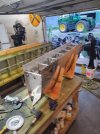
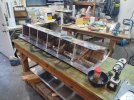
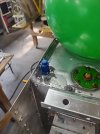
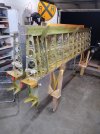
Rounding third base on the fuel tanks. Tank sealant isn't the most fun, but it still beats doing 1100 wing skin rivets.

IMG_20250807_194833045_HDR.jpg
(My cheap phone strikes again)
IMG_20250807_194839018.jpg

Things I've learned:

-MEK smells real, real bad, and I think is really bad for your health, but it does an amazing job of cleaning up the sealant.

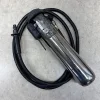
-i bought a used semco gun on ebay for like $75. It's worth 10x that in productivity/ cleanliness/ reduced waste.

s-l300.webp
- Spruce sells empty tubes, followers, and nozzles for the semco. The 2.5 Oz size, with the corresponding short holder for the semco, fit right down between the ribs. They hold 110g mixed sealant, making for easy measuring, and if you bust your ass, that's about how much you can use in the 2 hour application window. Whatever kind of plastic the tubes are made from doesn't stick to the sealant, so if you let it cure in there, it peels out nice & clean the next day.

Screenshot_20250807_205409_Chrome.jpg

I think I'm going to be able to do both tanks with 1qt. of product. The original quart i bought in January which is marked with an August 2025 expiration date...that's my excuse for spending way too much time on them this week... gotta use up that sealant before it goes bad :yes:
 
-MEK smells real, real bad, and I think is really bad for your health,

Relative to other stuff that works, it’s a solvent that is relatively low risk from a toxicity standpoint. So less worry there than you might think, so seal away.

And I think MEK smells great. I used to work in a refinery and the wax side of production used MEK as the process solvent. That unit leaked like a sieve and smelled so good, lol. That was in the early 1990s, but the unit was decades old by then.
Also on MEK smell good bandwagon.
 
Relative to other stuff that works, it’s a solvent that is relatively low risk from a toxicity standpoint. So less worry there than you might think, so seal away.

And I think MEK smells great. I used to work in a refinery and the wax side of production used MEK as the process solvent. That unit leaked like a sieve and smelled so good, lol. That was in the early 1990s, but the unit was decades old by then.
I swear I read somewhere that it's really bad, but Google doesn't seem to think so. Guess I'll sniff some more of it :goofy:I think it smells nasty. Mind, I like acetone, gasoline, ammonia, kerosene, mineral spirits, turpentine. Avgas and diesel are my favorites right behind lilac. Teresa came out and wouldn't even walk in the door because of the smell, and that's with the man door and garage door open and a fan running.

The polysulfide sealer has a similarish smell; I'm guessing that's the thinning agent. Iirc when I thinned some to force through a long tube to do the elevators, MEK was the recommended thinner.

Methyl Ethyl Ketone. It is kind of fun to say :p
 
It's been a minute, but I seem to recall trying to limit my MEK exposure by wearing Chem resistant gloves when using it. That said, all of the other chemicals I've touched and/or inhaled over the years probably negates my paltry mitigation efforts I did for MEK by a wide margin.
 
I wore gloves using it but should have worn a respirator. I waanst the briiitest befoar i starded uzing it but mighta lost some brain sells....cleans gud ansmells gud tho...
 
Methyl Ethyl Ketone. It is kind of fun to say :p
"If you can pronounce it, then it's safe." - The Dunning-Krueger Chemical Handbook

I did my best to limit exposure to MEK. I do not enjoy the smell of it and I get the sense that it's trying to kill my brain cells anytime we're in the same room. But when it comes to cleaning up fuel tank sealant and a handful of other things, it's probably the best product you can buy without a special license. I think it will dissolve cured epoxy.
 
a490qt.jpg

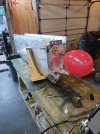
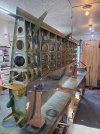
Ugh. 3 weeks of fuel tanks. 65ish hours. Still not done. The left tank checked leak free tonight. I'm waiting on some closed-end blind rivets to install the patch panel i had to cut into the right one to fix the enormous leak i found in it.

IMG_20250823_184737675_HDR.jpgIMG_20250823_153634622_HDR.jpg

In the meantime, I've been working on the next section, which is installing wires and pitot lines into the wings in preparation of closing them up. I might actually finish that section before the tanks.

IMG_20250826_195842806~2.jpg
 
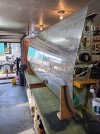
So....I didn't get to go to 6y9 this year due to a shortage of babysitters. Otoh, I did get my grain bin clean out finished this morning, and found a few hours to put in the shop this afternoon. I got the right tank repairs leak checked; finally got a good seal. Got both tanks installed on the wings, finishing section 18, and finished installing the last wiring harness, finishing chapter 19. On to chapter 20: bottom wing skins.

IMG_20250830_172451481_HDR.jpgIMG_20250830_172446498_HDR.jpgIMG_20250830_204856543_HDR.jpg

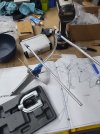
This was last night's project... figuring out the pitot/AOA mast. This is my biggest departure from the plans so far, but i think I have out figured out. Yes, I know that crimp tool is ****. I'll get a better one for the fuel lines.

IMG_20250829_210052226.jpg
 
So....I didn't get to go to 6y9 this year due to a shortage of babysitters. Otoh, I did get my grain bin clean out finished this morning, and found a few hours to put in the shop this afternoon. I got the right tank repairs leak checked; finally got a good seal. Got both tanks installed on the wings, finishing section 18, and finished installing the last wiring harness, finishing chapter 19. On to chapter 20: bottom wing skins.
Do yourself a favor and debur the heck out of the lightening holes in your ribs. Otherwise whoever bucks those rivets will end up with forearms that look like they encountered an angry tiger.
 
Back
Top