Tarheelpilot
Final Approach
- Joined
- Dec 5, 2010
- Messages
- 8,190
- Location
- North Carolina once again.
- Display Name
- Tarheelpilot
- Home Airfield
- Not sure anymore
nope.Yeah, but if the RJ were over the river don't you think they'd have been seen?

nope.Yeah, but if the RJ were over the river don't you think they'd have been seen?
Especially since there was another aircraft on final for 1. My suspicion is the helo crew had the wrong a/c in sight.Not if the chopper pilots weren't looking out. And the rj pilots didn't know to look that way.

Ok, fine.nope.

Ok, fine.
It’s not a game Ed. This is serious business. Lives are on the line. /SWell played sir.

That's exactly what it looks like they were doing. You hear the same thing from every PAT flight on LiveATC prior to the accident. They were requesting visual separation so that the controller would not delay them to provide separation.The ‘knee jerk’ in these PAT scenarios was not a reply of in sight. It was just simply ‘request visual separation’ without having seen traffic.
Lufthansa, IIRC. It was a European airline in any case. It wasn't visual separation that the flight couldn't accept, it was a visual approach at night. It would have been a company restriction that the pilots were required follow.There was an incident at SFO not long ago where the pilot refused visual separation and got vectored around so much while they were trying to build a hole for him that he was on the verge of minimum fuel and diverting to his alternate.
If they did, they would have seen them going around due to an unstable approach.Yeah, but if the RJ were over the river don't you think they'd have been seen?
"Those people are dead because I wasn't the RJ CA flying that visual" is the most main character syndrome, POA bird-pellet to this accident I've read so far. Between that and the manosphere/red-pill adjacent commentary about the helo crew demographics, you folks are something else. I <3 POA.
 This is all to say we all entirely lack context here.
You said the above in response to this:If they did, they would have seen them going around due to an unstable approach.
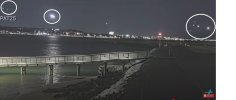
Here's a video from across the river with the landing lights of the RJ shining on the side of the helicopter and towards the camera miles away. Had the RJ been flying up the river rather than across it, these lights would be in the helicopter's windshield — but even a lot closer. So, doing things how I was taught gets you a go-around, worst case; your teachings get you killed:Yeah, but if the RJ were over the river don't you think they'd have been seen?

He’s not in an aircraft cockpit where specific terminology is demanded for clear communication.Well, when a guy says “girlboss” it means…

This is correct. I had a close call during a hoist evolution that the pilot in the right seat was getting qualified. He was a former Army H60 driver and was lacking confidence in himself while hovering over a 95ft cutter.The rank differences have nothing to do with the accident. I have no doubt the IP would’ve used the same verbiage (minus ma’am) to a CW2 sitting next to them. Professional courtesy has nothing to do with the problem here. The problem was the lack of “be explicit, offer assistance and exchange mission information.”
Rank in the Army is not a factor taken into consideration in cockpit ADM. There are still clear lines of authority and the buck stops at the PC. No different than any other service. PCs and Air Mission Commanders are selected based on experience and not rank. It’s a briefed position in writing prior to departure.
Now, that doesn’t mean that if I’m used to addressing my BDE CDR as “sir”, I’m going to magically flip a switch in my head and not address him as such while flying. Also doesn’t mean I can’t eliminate that when it matters. There’s “sir, go ahead and turn right to 270” and there’s “break right!” Two different things that require two different responses. Same goes for crew chiefs in the back. They give instructions to the pilots all the time and they’re the lowest ranking member of the crew. Adding a “sir” or in the case of WOs “Mr (name)” to it isn’t that hard. If that doesn’t happen? Oh well, not a big deal either. Not like they’re going to get a dressing-down after the flight by the PC.
That is indeed some twisted logic.Had the RJ been flying up the river rather than across it, these lights would be in the helicopter's windshield — but even a lot closer. So, doing things how I was taught gets you a go-around, worst case; your teachings get you killed
A bunch. Here's another picture:That is indeed some twisted logic.
Let me summarize your theory. Had the CRJ flight crew flown an improper, unexpected, unsafe, and untrained approach path, the Blackhawk flight crew might have seen the CRJ and maneuvered to avoid? Did I miss anything?
You said the above in response to this:
Here's a video from across the river with the landing lights of the RJ shining on the side of the helicopter and towards the camera miles away. Had the RJ been flying up the river rather than across it, these lights would be in the helicopter's windshield — but even a lot closer. So, doing things how I was taught gets you a go-around, worst case; your teachings get you killed:
We've been back and forth on this in this thread since the accident. Your position is a bit of an outlier with which the NTSB is unlikely to agree. That's okay, though. We don't have to agree.That's why I don't blame the participants; they had a bad system set up for them.

Great insight about "in sight."From the latest NTSB information, it appears that requesting visual separation without seeing, or even making a serious attempt to see, the other traffic was SOP for that unit.

“…From the latest NTSB information, it appears that requesting visual separation without seeing, or even making a serious attempt to see, the other traffic was SOP for that unit...”We've been back and forth on this in this thread since the accident. Your position is a bit of an outlier with which the NTSB is unlikely to agree. That's okay, though. We don't have to agree.
The CRJ did exactly what they were trained to do, what the controller expected them to do, and what the PAT crews should have been familiar with.
The way I see it, the key issue is that a crew (or pilot) should not accept, never mind request, visual separation unless they can confirm that they have the correct traffic in sight, can keep it in sight, and can maneuver to avoid the risk of a collision. From the latest NTSB information, it appears that requesting visual separation without seeing, or even making a serious attempt to see, the other traffic was SOP for that unit.
A few other things have come out but they only had a marginal chance of preventing the accident. The Local controller did not point at the helicopter to the CRJ crew but it would have been difficult for them to see them while making their left turn to final. Additionally, the helicopter position was combined with the Local position which increased the controller's workload but having them split was also unlikely to change the outcome as the helicopter would have still required visual separation without seeing them.
“Coming in from that angle” is the consequence of an aircraft aligning with the extended centerline of runway 33 when approaching from the south. There can be no other angle if an aircraft expects to land on 33. As for the “RJ sneaking up,” ATC informed PAT25 of the CRJ landing 33 two minutes prior to the collision. There was no “sneaking.”You've got PAT 25 (top left) pointed down river at five planes on the "Mount Vernon Visual Runway 1" and one RJ sneaking up on it from left field, out of its field of view. Why is it considered to be on the same flight path? Whoever decided coming in from that angle was necessary should have designed a uniquely different approach, say, the charted "I-295 Visual Runway 33" approach.
... unless they can confirm that they have the correct traffic in sight ...
Is there a link to the Docket?“Coming in from that angle” is the consequence of an aircraft aligning with the extended centerline of runway 33 when approaching from the south. There can be no other angle if an aircraft expects to land on 33. As for the “RJ sneaking up,” ATC informed PAT25 of the CRJ landing 33 two minutes prior to the collision. There was no “sneaking.”
A good perspective of the accident aircrafts’ relative positions is provided in the NTSB’s History of Flight Performance Study (Exhibit 13-A) in the docket. Fig. 17 shows that, for the last 4 miles between the aircraft, the CRJ was pointing or nearly pointing the Blackhawk. Fig. 18, at 1 mile and 15 seconds before impact, shows the CRJ directly pointing the Blackhawk, with the CRJ at about the 11 o’clock of the Blackhawk. At no time from when PAT25 initially said traffic in sight to the collision was the CRJ outside of the Blackhawk’s field of view.
As for the need for a new "I-295 Visual Runway 33" approach,” what would this new approach do differently from the existing circle/visual 33 approach or the existing RNAV 33 approach?
Edit:Is there a link to the Docket?
Same question for daytime.How does one do this at night? And how does the controller know they have the correct traffic in sight?

They don't... And there's no backup. That's why I think this is not a good procedure to allow when there's 70ish lives on the line.How does one do this at night? And how does the controller know they have the correct traffic in sight?
It's much easier to identify aircraft type and airline during the day. At night, everyone is a light.Same question for daytime.
Same question for daytime.
Except that the consensus seems that it’s not the lack of ability to identify the correct aircraft, but the lack of intent.Agreed in principle, but at least you can see the aircraft size, type, and orientation to match the controller's description. At night, you're looking at a moving set of lights in a sea of other lights. That's a pretty big leap of faith to bet hundreds of lives on.
I'd argue the most obvious fix in hindsight would have been to prohibit visual separation at night between these two routes.
It would change the focus of attention from down the Potomac River to the interstate highway east of the river. Looking at the field of vision study in the docket, there are only 22° left of center allowed by those NVGs. When I imagine looking through a visual pipe like that at five airplanes over the river, I can see why they may have thought they had the called traffic in sight.As for the need for a new "I-295 Visual Runway 33" approach,” what would this new approach do differently from the existing circle/visual 33 approach or the existing RNAV 33 approach?

How does one do this at night? And how does the controller know they have the correct traffic in sight?

It can be difficult and, when it is, the crew should not report it in sight. If the pilot(s) can not see him, or keep him in sight, he should immediately notify ATC so that ATC can provide separation.How does one do this at night? And how does the controller know they have the correct traffic in sight?

Bro,This is correct. I had a close call during a hoist evolution that the pilot in the right seat was getting qualified. He was a former Army H60 driver and was lacking confidence in himself while hovering over a 95ft cutter.
We were doing an indirect hoist with a basket with a trailing (lower trailing to the ship's crew, then back off). I lowered the basket to the deck then we backed off. Then it was time to hover back over the deck to pick it up. He was not listening to my commands (forward and right 40, forward and right 20, etc), and decided to start flying away while the basket was on deck. I started to yell over hotmike to get back over the ship to no avail.
I had two options: shear the hoist cable or yank up the hoist cable. I yanked it because the shear took a second or two to activate besides fumbling with the cover switch with safety wire.
At that point we were flying away at 40kts with 70ft of hoist cable out, with the basket, and 100ft of trailine (that was still on deck).
When the pilot says "go on hot mike, conn me in" the aircraft becomes mine at that point. I have the best view while the pilot’s visibility is very limited (left skew about 30-20 deg during deployment and the ship running about 20 kts). This is THE hard and fast rule that the flight mech controls the flight at this point. It doesn't matter if an 0-5 is at the controls. Sometimes during a night rescue during hurricane force winds, the pilot doesn't even see the ship for most of the hoist.
Crew coordination between every person on the helo is extremely important because one split-second hestitation could be life and death.
I (crewmember in back) have had traffic called by ATC that my pilots did not see due to other tasks. They responded to ATC "Traffic in sight" based on my calls over ICS based on the fact I had a visual and if the traffic was an immediate threat or not. Might be based on their perception of my experience and ability, but none the less, as @Velocity173 said, (and I'm gonna mess it up because I don't have the matrix in front of me, but he'll know what I mean..) I offered assistance and cross monitored my pilots and their workload. I am not above taking it further by recommending course deviations to alleviate conflicts. I have a vote even though I'm riding in the back, and I'm not afraid to exercise it.It can be difficult and, when it is, the crew should not report it in sight. If the pilot(s) can not see him, or keep him in sight, he should immediately notify ATC so that ATC can provide separation.
See AIM 4-4-14 Visual Separation
That's because you flew with a good crew.I am not above taking it further by recommending course deviations to alleviate conflicts. I have a vote even though I'm riding in the back, and I'm not afraid to exercise it.
I've flown with bad crews too. Shenanigans have been had after shutdown on the ramp. Bottom line, you have to be assertive.That's because you flew with a good crew.
Plenty of bad crews (here and abroad) where that would be considered unacceptable, unfortunately.
A heli crew smashed into an island 8 years ago because the back crew didn't feel like they had the authority to tell the pilots to change course immediately.
Sounds like a planBro,
I'd love to trade stories some day...
We're not talking about "circling" approaches, this a horse of a different color — a "Charted Visual Approach" as described in AIM 5-4-24. These have been around a long time at various places like Kennedy, La Guardia and Washington, DC. "Circling" is an IFR procedure with obstacle protection based on the turn radius at the different approach speed categories. It is also loosely applied in ATC jargon to aircraft landing under a visual approach after making a partial IFR approach to another runway.dtouri9, this is not 50 years ago. The airspace rules have changed.
Please publish the current chart for a circle to land, runway 33, so we can see just how close to the river the airliner was REQUIRED to be.
I have spent hundreds of hours on sailboats on this part of the Potomac river, and have never seen an airliner over the river to land on 33 except as they crossed it, wings nearly level.
The RNAV 33 approach is over land from NADSE to IDTEK, where their turn toward the river and runway is started.
I am not aware of a published circle to land at 33, but you may.