JOhnH
Touchdown! Greaser!
Doesn't that qualify as "settled science"?This is cited consistently as fact. Folks hear it and regurgitate it as fact.
Doesn't that qualify as "settled science"?This is cited consistently as fact. Folks hear it and regurgitate it as fact.

My thoughts exactly. It was 30 years ago when I first saw this citation. At that time, there were still Beech 18's, DC-3's, and similar aircraft in routine service carrying parts, mail, etc. There are exceptions, but that fleet is mostly retired. As are the big radial powered fire bombers. When I look out on the ramp today, I just don't see many types that couldn't use 94UL. That doesn't mean we can do away with 100LL or an equivalent - everything with a turbo pretty much needs it, as do most engines with a compression ratio of over about 8.5:1. But that statistic is almost certainly out of date.This is cited consistently as fact. Folks hear it and regurgitate it as fact. I still have never seen any substantiation of it with data. If memory serves, it was written 30 or so years ago. Even if they did as good a job as possible gathering data, does it hold today?
But, but, but, it's a STATISTIC! How can you argue with statistics?But that statistic is almost certainly out of date.

Seems like those airframes are old & tired enough by now to not be worth it. They've been buying p2012s with 375 HP turbocharged gas engines. Speaking of operations still burning lots of 100LL.If Delta Hawk gets their 300 hp diesels done, I could see some lucrative STC' for light twins. Cape Air with their 80 or so 402's would probably be a good contract to have.
And flying checks which ended 25 years ago.My thoughts exactly. It was 30 years ago when I first saw this citation. At that time, there were still Beech 18's, DC-3's, and similar aircraft in routine service carrying parts, mail, etc. There are exceptions, but that fleet is mostly retired. As are the big radial powered fire bombers. When I look out on the ramp today, I just don't see many types that couldn't use 94UL. That doesn't mean we can do away with 100LL or an equivalent - everything with a turbo pretty much needs it, as do most engines with a compression ratio of over about 8.5:1. But that statistic is almost certainly out of date.
Seems like those airframes are old & tired enough by now to not be worth it. They've been buying p2012s with 375 HP turbocharged gas engines. Speaking of operations still burning lots of 100LL.

Can Cirrus’ run 94UL? Bonanzas? M-350/Malibus?. When I look out on the ramp today, I just don't see many types that couldn't use 94UL.

 generalaviationnews.com

That's a fair assessment. For myself, I don't say that it's a "fact", but rather the best data available to me without trying to replicate the study- I don't have the time and access to the correct information to do so. I list the citation for the reasons you give: so people can see the "freshness" of the data, does the reporting entity have sufficient standing and data access to present such information, and to show where the data came from, instead of someone pulling it out of their butt, as so many people do in forums.This is cited consistently as fact. Folks hear it and regurgitate it as fact. I still have never seen any substantiation of it with data. If memory serves, it was written 30 or so years ago. Even if they did as good a job as possible gathering data, does it hold today? The notion sounds somewhat believable, but it seems to have become a truth that folks cite as gospel without knowing the source. It has been repeated so many times, it is defacto truth.
I don't see real scientists using that term, except maybe on TV. It seems politics turn otherwise intelligent people into fools. @focal_plane is correct in that it would be nice to have this study done again. I suspect that some of the aircraft that needed 100LL at that time have been replaced with those that can use Jet-A, but I don't have any data to support it.Doesn't that qualify as "settled science"?
Regarding SR-22’s, its IO-550 has 8.5:1 compression. Based on that alone, 94 UL should work. The turbo versions would almost certainly be problematic. Margins would be reduced in either case.Can Cirrus’ run 94UL? Bonanzas? M-350/Malibus?
Note that Cirrus have 3 of the top 5 selling piston planes in the US, and sold almost as many as the rest of the top 10 combined. Doesn’t the entire SR-2x family require 100LL?
10 best-selling piston airplanes in 2024 — General Aviation News
For the 23rd year in a row, Cirrus Aircraft takes the top spot as the best-selling piston airplane.

Agree. In any case, it would be nice to have a resolution to this whole piston engine fuel situation sooner than later so at least this community can move forward, whatever the direction. Uncertainty does none of us any good.That's a fair assessment. For myself, I don't say that it's a "fact", but rather the best data available to me without trying to replicate the study- I don't have the time and access to the correct information to do so. I list the citation for the reasons you give: so people can see the "freshness" of the data, does the reporting entity have sufficient standing and data access to present such information, and to show where the data came from, instead of someone pulling it out of their butt, as so many people do in forums.
I think it would be interesting who would even pay for such a study in todays declining avgas market especially with the military retiring avgas powered equipment. Even the EIA seems to have grouped avgas data into a larger group. But if someone was energetic enough, they probably could dig into the EIA and DOT data bases then tie that data to the FAA registry or mogas STC data for a ballpark number of 100LL users??it would be nice to have this study done again. I suspect that some of the aircraft that needed 100LL at that time have been replaced with those that can use Jet-A, but I don't have any data to support it.
Not too long ago it would have been easy to get a multi million dollar government grant for that.I think it would be interesting who would even pay for such a study in todays declining avgas market especially with the military retiring avgas powered equipment.
You know, I bet it wouldn't take superhuman effort to use logs from flightaware to make this calculation.I think it would be interesting who would even pay for such a study in todays declining avgas market especially with the military retiring avgas powered equipment. Even the EIA seems to have grouped avgas data into a larger group. But if someone was energetic enough, they probably could dig into the EIA and DOT data bases then tie that data to the FAA registry or mogas STC data for a ballpark number of 100LL users??
…or maybe even pull the credit card database info from self-serve 100LL pumps, since every purchase ties to a tail #. Aren’t the vast majority of CC#-enabled pumps operated by one single company?You know, I bet it wouldn't take superhuman effort to use logs from flightaware to make this calculation.
It's probably four or five. And that would probably miss many of the big dollar purchases we are most interested in since they occur at full service FBOs.…or maybe even pull the credit card database info from self-serve 100LL pumps, since every purchase ties to a tail #. Aren’t the vast majority of CC#-enabled pumps operated by one single company?
Or since finished avgas is a listed commodity you could start with it markets forecasts then apply those numbers to your flightaware data results. Regardless, I think it will still be considered "small numbers" in the overall picture. I'm sure GAMI and other similar unleaded developers have done market studies to determine ROI, etc. so the data is out there just not in the public domain.You know, I bet it wouldn't take superhuman effort to use logs from flightaware to make this calculation.
Good point. EIA reports the gross numbers:Or since finished avgas is a listed commodity you could start with it markets forecasts then apply those numbers to your flightaware data results. Regardless, I think it will still be considered "small numbers" in the overall picture. I'm sure GAMI and other similar unleaded developers have done market studies to determine ROI, etc. so the data is out there just not in the public domain.
Maybe AOPA, EAA, or another aviation group?I think it would be interesting who would even pay for such a study in todays declining avgas market especially with the military retiring avgas powered equipment. Even the EIA seems to have grouped avgas data into a larger group. But if someone was energetic enough, they probably could dig into the EIA and DOT data bases then tie that data to the FAA registry or mogas STC data for a ballpark number of 100LL users??
That's probably the easiest way, and probably one of the better ways to get good data. Are the flightaware logs a representative sample? For example, what percentage of VFR flights do they capture? Someone with the appropriate data sets can see what proportion of the actually flying fleet needs 100LL, and the proportion of 100LL that they use. I'm assuming the use of non-100LL is still insignificant.You know, I bet it wouldn't take superhuman effort to use logs from flightaware to make this calculation.
That's another good data source, if you can get it.…or maybe even pull the credit card database info from self-serve 100LL pumps, since every purchase ties to a tail #. Aren’t the vast majority of CC#-enabled pumps operated by one single company?
Come to think of it, that might be an entity with a vested interest in how this situation plays out.
Seems like those airframes are old & tired enough by now to not be worth it. They've been buying p2012s with 375 HP turbocharged gas engines. Speaking of operations still burning lots of 100LL.

A few years ago, I was curious as to what percentage of the general aviation hours was for training, estimating by aircraft type, what I came up with was 60 percent, and of the training fleet, it was dominated by the 172 and PA -28. For owner flown aircraft , the #1 aircraft was the Skylane, followed by Cirrus's SR22 and SR22T. Looking at that same data, I'm thinking it's more along the lines of 60/40 favoring lower octane or 50/50. I don't see that the 80/20 split being valid any longer.The planes that need 100 octane consume most of the fuel, like 70%. Not likely to get availability of Mogas at airports if consumption is 30% of 100LL.

I don't think so. I looked into an auto fuel STC for my Ovation that has a nearly identical engine (IO-550-G) and I did not qualify.Regarding SR-22’s, its IO-550 has 8.5:1 compression. Based on that alone, 94 UL should work.
There's at least three, and probably a couple of additional smaller players.…or maybe even pull the credit card database info from self-serve 100LL pumps, since every purchase ties to a tail #. Aren’t the vast majority of CC#-enabled pumps operated by one single company?
They do sell the data, but Elon Musk probably doesn't have enough money to buy it all. Even a single aircraft's history is in the thousands of dollars. I forget exactly what we used to spend to get daily dumps from three local airports, but it was also a lot.Flightaware already has the data available for purchase as a standard service offering. Linking the tail numbers to engines and then to fuel type should be pretty straightforward.
What's the auto gas octane spec for that STC? I bet it ain't 94. Also, there are RVP issues with auto gas that make it problematic with some low wing aircraft. That shouldn't be a problem if 94UL is the same spec as 100LL, minus the lead. None of that means it'll work, but 94UL has a better chance of success than mogas.I don't think so. I looked into an auto fuel STC for my Ovation that has a nearly identical engine (IO-550-G) and I did not qualify.
Given this has an important topic for years I would have expected these entities to have a rolling study of 100LL usage and by who. But just as they dropped the Primary Non-Commercial category after its first hurdle, I think they've done the same for a similar reason. I think the only group who would perform an updated study would be someone who planned to develop or market an alternative to 100LL. However, I doubt they would make those results public.Maybe AOPA, EAA, or another aviation group?
Couple nits to pick:They do sell the data, but Elon Musk probably doesn't have enough money to buy it all. Even a single aircraft's history is in the thousands of dollars. I forget exactly what we used to spend to get daily dumps from three local airports, but it was also a lot.
It is 94. I just looked, and neither Swift nor Continental will do UL94 on my Mooney or a Cirrus.What's the auto gas octane spec for that STC? I bet it ain't 94.
Interesting. I see they now allow you to select 1, 2, 3, 5, or 10 years as well as "All" and the prices have gone down. It was $2K+ for the full history before, now that's $857.1) I can get a year for my plane for $186. Not sure where "thousands" comes from. So $186 in quantity 1.

That's not per query, that's per "result set" (15 results max). But, probably doable by someone with time and money to spend. (I'd volunteer the time if someone else wants to volunteer the money.2) Their API is .05 a query with a monthly minimum of a grand and discounts apply quickly with volume.
)I doubt the "50 largest" airports are representative. That's where all the Jet-A burning traffic goes, and there would be vanishingly few local flights.It's not free, but it's also not billionaire scale money needed. And if you're willing to make an assumption like "the 50 largest airports will be representative" it might not even crack that thousand dollar minimum.
Swift is testing it's 100r fuel on the tsio-550-k. The only 550 turbo or naturally aspirated Continental says is eligible to run 94ul.I don't think so. I looked into an auto fuel STC for my Ovation that has a nearly identical engine (IO-550-G) and I did not qualify.
There's at least three, and probably a couple of additional smaller players.
They do sell the data, but Elon Musk probably doesn't have enough money to buy it all. Even a single aircraft's history is in the thousands of dollars. I forget exactly what we used to spend to get daily dumps from three local airports, but it was also a lot.
Yeah, that was poor phrasing on my part. I intended the 50 largest metro areas (along with the multiple airports that serve them), not the 50 largest airports themselves.I doubt the "50 largest" airports are representative. That's where all the Jet-A burning traffic goes, and there would be vanishingly few local flights.
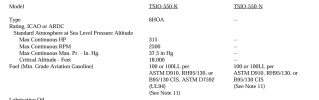
Probably to build baseline data and manage certain testing parameters? But I thought all 550s required 100 octane?Why swift is testing their 100 octane on an engine eligible to run on 94 is beyond comprehension.
I did too. But not according to this article.But I thought all 550s required 100 octane?

 www.avweb.com
And so it does. Using an engine that is already approved to use ASTM D7592 fuel would sure work toward keeping some costs down and maybe even simplify part of the initial flight tests?I did too. But not according to this article.
I enter N12345 when asked by the pump.…t is certainly not true that "every purchase ties to a tail #".
LOL....I never thought of actual pilots doing this. I thought it was only off-road racers that used this trick.....I enter N12345 when asked by the pump.

I enter my actual tail number so they can contact me if there's a problem with the fuel, which I believe is why they ask.I enter N12345 when asked by the pump.
I enter my actual tail number so they can contact me if there's a problem with the fuel, which I believe is why they ask.

So it's been you giving out my number to every robodial database all along!When asked for a phone # I don’t feel like giving out I’ll give 123 456-7890
You can't do that! That's my tractor!I enter N12345 when asked by the pump.
I do buy fuel for it at KHXF, since that's the closest place to my house I can get ethanol free and hey look an excuse to go to an airport!This. And it's also proof to the FAA that you really did buy fuel and it was leaked/vented overboard instead of not taking off with enough...I enter my actual tail number so they can contact me if there's a problem with the fuel, which I believe is why they ask.
Between the avfuel invoice and credit/debit card transaction histories, I think I’ve got that covered.…it’s also proof to the FAA that you really did buy fuel and it was leaked/vented overboard instead of not taking off with enough...

