Small dent on stabilator trim - Disagreement with current mechanic on airworthiness.

Pay the guy, take the plane and his log book sticker. Plane is now legally unairworthy, so if you have to fly to get to another IA, get a ferry permit. Can you burry this annual? Interesting question.

91.417 a You have to keep the record of the annual - just can't have a "do over", pretend it didn't happen.
91.417 b 1 You have to keep this record for a year OR until this work is repeated/superseded.

So.... take the airplane to another IA, re do the annual which repeats/supersedes the previous annual, which at this point you don't have to keep the previous annual record. But when you present the plane and the log books to the new IA, you need to show him the annual you just did.
There is no reason to bury the annual. It’s a legitimate discrepancy on the tail. No reason to avoid or hide the issue.

There is also no obligation to use the current mechanic for clearing the discrepancy if the OP doesn’t desire continuing the business relationship.
 
  • Like
Reactions: WDD
Except he needs an IA signature to continue to operate it as it will be listed as a discrepancy.
I would get the part replaced. They're avialable, and one day, he's going to get distracted find himself near Vne in a left descending spiral and the H-stab will start to vibrate violently and fail. The hard lessons of ownership aren't over after the first annual.....they go on for some years.....
 
Vne is based on when flutter occurs during TC flight testing.
Vne on some airplanes is based on when flutter occurs on some surface, fixed or moveable during TC flight testing, or when predicted flutter margins are demonstrated in cert testing. It may also be based on loads and structure, handling qualities, or any number of other factors.

I wouldn't pass any judgement on changes in Vne and/or flutter boundaries based on what's been posted so far. In this particular instance I would, however, get a second (third/fourth?) opinion for structural integrity alone.

Nauga,
slightly bent
 
So where does it state (regulations, advisories, notices, etc) that if a previous A&P/IA signed it off as airworthy that subsequent A&P/IA's should follow as well?
That there. I have done inspections on airplanes where I found numerous very serious and longstanding defects. It appeared that the previous mechanics (sometimes the same mechanics, year after year) had simply walked around the airplane and signed it off. Structural cracks, frayed cables, seized control cable pulleys, badly worn hinges, serious corrosion that weakened the part.

The OP's sort of dent can act as a trim tab all by itself. What does that do to flutter resistance? I don't know. I do know that the commonly-seen dented Cessna aileron skins can make the airplane fly wing-heavy; they act as trim tabs. People seem to like to squeeze those ailerons.
 
I know this is a Piper but the the Cessna Service Manual Structural Repair Section does provide some guidance when determining negligible or repairable damage or scrap.


If an aircraft is found “ Not Airworthy” during an Annual Inspection
who is responsible for the post maintenance Run-Up?
 
Pretty soon we are going to need a pre annual consultation before the actual annual.
You don't do that now? Or are you the type that simply drops off your aircraft and hopes for the best?

The owner can determine airworthiness. If there are no specs that say otherwise, he can sign off on it in the log book.
Sure, for a pre-flight. But an owner is not authorized to approve for return to service any maintenance discrepancy that is outside of a prevent mx task. Part 43.7.

If an aircraft is found “ Not Airworthy” during an Annual Inspection who is responsible for the post maintenance Run-Up?
If the only record is an annual signed with disc's s it signifies the entire inspection and associated checks were performed to include the run ups. If any part of that annual insp was not completed, than it would require a different record entry than the one listed in Part 43.11(a)(5).
 
If by run up you mean test flight… that is not a requirement ever of the inspection itself. If there is required maint that requires a test flight, it would be the mechanic doing that repair.

If it’s a minor repair, just an AP, if major, an AP/IA. I don’t know if there’s any minor maint that would require a test flight off the top of my head.
 
Owners and pilots are responsible for ensuring airworthiness. That is not the same as having authority to determine airworthiness.
 
Well Piper SL 1095C does cover dents caused by hail, and SL 1320 covers wing and fuselage damage limits. From those you can get an idea of the allowable limits.

One thing that is 100% clear is that ANY crack is airworthy and stop drilling is NOT a permanent repair.

Its hard to see from the photo but does the dent cross any ribs or rivet lines? That would also be an unairworthy limit as the underlying ribs/structure would need to be inspected for damage/cracks.

Call Piper and see if they can give you a concrete damage limit spec, otherwise you either need an A&P to sign off that discrepancy as within limits or repair/replace the part to correct it.
 
WDD Said: "Bonus: If this involves removing the skin, riveting, etc., it is a major repair, which will require an IA to sign the 337. In this case, a private pilot or even a "normal" A&P can't fix it and sign this off as airworthy."

No, if its done IAW the manufacturers MM/SRM/parts then its just a repair. Also an IA isn't needed to do the repair, only to do the paperwork/final inspection.

The key exclusion is "and manufacturing of primary structural members or their replacement," when you purchase a new wing skin or rib you are not manufacturing it. If you just went over to the sheet metal rack, grabbed a random piece of 2024-T3 and beat it into shape then you are manufacturing a part and need a 337 and some sort of documentation that you are in fact making a part that meets or exceeds the original parts strength.
 
Not a Test flight. The run-up referenced is 43.15c2. However; finding a bad
Cylinder, mag , carb etc would render the aircraft Not Airworthy. The List would include the squawk. Would an additional write- up be needed for the missing run-up? Since the IA that did the Annual is NOT approving the aircraft for return to service it seems this is meaningless and the person correcting the discrepancy should be responsible for the run-up.
 
Fun fact: If OP decides to get the repair, he will need to get a shop with an IA available. Just about anything that needs rivers and sheet metal is considered a major repair, needing a 337 and an IA sign off.
 
I don’t know if there’s any minor maint that would require a test flight off the top of my head.
There are some minor jobs like flight control adjustments or a prop governor adjustment. But then you get into the gray areas where some mechanics require a flight and some don't like installation/balance of new tires. The rule basically states the aircraft has to be flown unless the work performed can be conclusively shown on the ground to not appreciably change the flight characteristics or affect the flight operation of the aircraft.

No, if its done IAW the manufacturers MM/SRM/parts then its just a repair. Also an IA isn't needed to do the repair, only to do the paperwork/final inspection.
Not quite. The installer must still determine if the repair is a minor or major. The MM/SRM only come into play as repair guidance or if those manuals have FAA approved sections, then as approved data for a major repair. Perhaps read up on AC 43.210 again for guidance.

Would an additional write- up be needed for the missing run-up?
Depends. The 43.15 rule is applicable to the annual which states to perform those checks prior to the approval for RTS, ie., signature. However, if you don't finish those i-vi run checks, then technically you didn't finish the annual inspection. So your only option is to include them on the Disc List in order to be able to sign the annual with disc. If that makes sense. But since most mechanics I know take care of the 43.15 requirements at the beginning of the annual, haven't heard much issue except for those who forget 43.15 even exists.

If OP decides to get the repair, he will need to get a shop with an IA available. Just about anything that needs rivers and sheet metal is considered a major repair, needing a 337 and an IA sign off.
Not necessarily. If the shop is an FAA CRS there is an exception to repair 337s in Part 43 Appx B(b) that allows a repair station to use the customer's work order in lieu of the Form 337 requirements. But this is for repairs only and not alterations.
 
Show the manual pages that says that.
DId you read my post? I specifically listed the two Piper service letters. :rolleyes::rolleyes::rolleyes::rolleyes::rolleyes::rolleyes::rolleyes::rolleyes:

Seriously, you'all need to read what I post because I put everything you need to know in my answers.

So read the SL's... there will be a quiz
 
Not quite. The installer must still determine if the repair is a minor or major. The MM/SRM only come into play as repair guidance or if those manuals have FAA approved sections, then as approved data for a major repair. Perhaps read up on AC 43.210 again for guidance.
read the second link below... what made you change your mind from 2018? You said the complete opposite in the post below.


If you are doing a replacement with a manufacturers PN there is no repair. The SRM or 43-13 is acceptable data for riveting. You do not need a IA or DER.

Remember, the key part of a MAJOR REPAIR lies in the FABRICATION of a new part... not the replacement of a bad part with a good manufacturer part.

If I make a patch for a hole in a wing skin that's a major repair. If I replace the entire skin with a new manufactures part its a simple replacement.
 
If I replace the entire skin with a new manufactures part its a simple replacement.
Again, no. Straight from the Part 43 Appdx A(b)(1) below with my highlight. The only time its a simple replacement is when you replace the wing assembly just as I stated in 2018. If you're installing an OEM skin with rivets its a major repair. Same if you fabricate that same skin. Part replacement is a separate maintenance task category as listed in the Part 1 definition of maintenance.

"(1) Airframe major repairs. Repairs to the following parts of an airframe and repairs of the following types, involving the strengthening, reinforcing, splicing, and manufacturing of primary structural members or their replacement, when replacement is by fabrication such as riveting or welding, are airframe major repairs."

So read the SL's... there will be a quiz
Those SLs are applicable to hail damage and cracks, none of which is at play in the OPs pic or description. Hail damage is a completely different animal which is why OEMs release separate limits for this type of damage. As for the quiz I think you failed the applicability side.;)
 
DId you read my post? I specifically listed the two Piper service letters. :rolleyes::rolleyes::rolleyes::rolleyes::rolleyes::rolleyes::rolleyes::rolleyes:

Seriously, you'all need to read what I post because I put everything you need to know in my answers.

So read the SL's... there will be a quiz
Neither service letter you referenced applies. The maintenance manual allows patch repairs to be done to the ailerons and flaps. Not the tail. Stop drilling is not approved
 
DId you read my post? I specifically listed the two Piper service letters. :rolleyes::rolleyes::rolleyes::rolleyes::rolleyes::rolleyes::rolleyes::rolleyes:

Seriously, you'all need to read what I post because I put everything you need to know in my answers.

So read the SL's... there will be a quiz
As others have pointed out, those SLs do not apply here. Piper's PA-28 manual, Structures section, says to repair in accordance with AC43.13-1B, and if we look at that, nowhere do we find that it says that cracks are 100% OK. It gives a lot of advice about repairing them.

Cessna gives a lot more detail in their manuals.
 
It's been decades since I did any sheet metal work. I support people maintaining a fleet of airplanes every day.

Honestly, I can't see pretending you don't see the dent.

I don't know if there is any access to the inside of the trim tab from the FWD face, through lightening access holes or something. If there is, get a couple stout boards and rip them to form a matching angle V cradle, set the tab in the cradle, get inside with triangular wood blocks and see if you can carefully knock the dent out. Then if there are no cracks, reinstall it.
 
Due to circumstances I won't get into here, I had to take my plane to a new mechanic for the annual this year. This mechanic sent me an email this morning telling me that the plane is not airworthy due to a small dent in the stabilator trim tab (picture attached). This dent was there when I purchased the plane and none of the three companies that has done an annual inspection in the past has ever seen this as a problem. (It also passed a pre-buy inspection by a different mechanic). Looking for opinions on this, and especially would like any references to Piper specifications on what level of damage would be unacceptable (it is a 1976 Piper Warrior). I've been looking through the service manual and AC 43.13-1B, but so far haven't come across


Damage to the anti-servo tab on Piper Cherokee-series aircraft with a stabilator is
a serious airworthiness issue that can severely affect pitch control. Because the stabilator acts as a single large flying surface, the anti-servo tab is critical for providing artificial feel and preventing the pilot from over-controlling or overstressing the airframe
 
This mechanic wouldn't last long in Alaska...
If things go wrong that a IA let slide the FAA is the least of his problems, I have seen what lawyers and courts have done to a easy IA. Alaska GA aircraft mechanic you might still find a easy IA not too many left that will look the other way anymore, Alaska has more lawyers now.
 
Alaska has more lawyers now.
Your point about GenAv safety is well taken -- but Alaska doesn't even have a law school in the state. I worked with a colleague who wrote for the Alaska Law Review... at Duke (Doook).

Why is the Alaska Law Review at Duke?​

The Alaska Bar Association recognizes a need for a scholarly publication devoted specifically to issues affecting Alaska. Alaska does not, however, have a state law school so the Alaska Bar selected Duke University School of Law to publish the Alaska Law Review.
ETA: Just went down a rabbit hole of getting admitted on reciprocity to Alaska. I think I like Hawaii better. Hawaii made lots of sense to buy extra hours to hit a deadline when you could file by fax to DC and were given the benefit of local midnight. Now with e-file, the deadline is midnight eastern time no matter where you are on the globe.

Maybe that clerkship in the District Court for the Northern Mariana Islands...
 
Last edited:
Actually, only an IA can sign the annual inspection. A mechanic can sign THAT repair off as airworthy.
Not getting picky, but the mechanic doesn't actually state that the airplane is not airworthy. The language they are required to use from 43.11 says "I certify that this aircraft has been inspected in accordance with (insert type) inspection and a list of discrepancies and unairworthy items dated (date) has been provided for the aircraft owner or operator." They just decline to return the airplane to service. It's a point without meaning.

It is up to the owner to handle those discrepancies. When a repair is made, the airplane is returned to service by the regular mechanic.
 
Damage to the anti-servo tab on Piper Cherokee-series aircraft with a stabilator is
a serious airworthiness issue that can severely affect pitch control. Because the stabilator acts as a single large flying surface, the anti-servo tab is critical for providing artificial feel and preventing the pilot from over-controlling or overstressing the airframe
This. All these questions have to have a context. Here we have an anti-servo tab, not a trim tab due to the flying horizontal stab design. I have no idea what the flutter margin is in this new configuration and neither does anyone else here. Maybe Piper engineering could have a say. Otherwise reskin or replace.
 
Maybe I'm just not looking at it correctly, or else need a better picture - but I'm not seeing anything obvious here. Planning to fly one of those tomorrow (wx permitting) - will make sure to look at that trim tab during pre-flight.
 
Maybe I'm just not looking at it correctly, or else need a better picture - but I'm not seeing anything obvious here. Planning to fly one of those tomorrow (wx permitting) - will make sure to look at that trim tab during pre-flight.
Trailing edge of trim tab is creased from presumably hangar rash.
 
I can see where it is a big enough crease to locally change the airflow. Not so much the structure but the location on tab trailing edge.
 
I can see where it is a big enough crease to locally change the airflow. Not so much the structure but the location on tab trailing edge.
It also compromises the compressive strength of that skin. In other words, pressure from below creates tension in the lower skin and compression in the upper. With that crease, it would take less to buckle that tab if the pressure below got high enough. And if it buckles, bad things will happen to the airflow and maybe the whole airplane if the tab flutters and rips the stabilator off.

For the same reason, creases in fuselage skins are a serious matter. Most of our light aluminum airplanes have a monocoque or semi-monocoque fuselage, where the skin takes the majority of the loads.
 
Small changes cab have big effects - Sometimes.
A thin layer of ice will degrade performance- Sometimes.
Even paint can have unintended consequences- Sometimes.

A bud tells of a particular high performance aircraft that flew like a dog.
His A&P uncle claimed he could fix the issue with a piece of sandpaper.
The uncle tapered the trailing edges of the painted leading edge stripe.
Bingo! Problem solved. Perhaps it had acted like ice?

So even paint of some thickness and in particular locations can disrupt
the airflow.
Sometimes.
 
For the same reason, creases in fuselage skins are a serious matter. Most of our light aluminum airplanes have a monocoque or semi-monocoque fuselage, where the skin takes the majority of the loads.
A serious matter, yes, but whether it is actually a detriment depends on where the imperfection is and how the structure was designed. For example whether lowering the buckling strength of a given fuselage ‘shear’ panel with an imperfection is important depends on whether it is also strong enough to carry the required loads in diagonal tension, after it’s buckled.

My airplane’s boxy tail cone side panels will buckle between frames just sitting on the ramp in the sunshine, and then unbuckle again in the shade. That alarmed me the first time I saw it, especially since its a +6/-4 G aircraft but apparently the fuselage design doesn’t utilize the sides as shear panels. An imperfection away from the diagonals of the panels probably wouldn’t have too much effect. I did notice however that a later version of the plane, of which only a couple were made, has a stiffener down the centerline of the panels, vastly increasing the buckling strength. Maybe people didn’t like seeing the previous design buckled just sitting on the ground before they departed.
 
Last edited:
A serious matter, yes, but whether it is actually a detriment depends on where the imperfection is and how the structure was designed. For example whether lowering the buckling strength of a given fuselage ‘shear’ panel with an imperfection is important depends on whether it is also strong enough to carry the required loads in diagonal tension, after it’s buckled.

My airplane’s boxy tail cone side panels will buckle between frames just sitting on the ramp in the sunshine, and then unbuckle again in the shade. That alarmed me the first time I saw it, especially since it’s a +6/-4 G aircraft but apparently the fuselage design doesn’t utilize the sides as shear panels. An imperfection away from the diagonals of the panels probably wouldn’t have too much effect. I did notice however that a later version of the plane, of which only a couple were made, has a stiffener down the centerline of the panels, vastly increasing the buckling strength. Maybe people didn’t like seeing the previous design buckled just sitting on the ground before they departed.
What you seem to be describing are elastic deflections as the skins move from one energy state to another under the influence of heating or cooling. More akin to oil canning.

OP trim tab underwent buckling, which involves large displacements and plastic deformation of the metal which is permanent.
 
Ugh.

As a paint shop / service shop, we see dinged up control surfaces on the daily.

Perhaps I'm a little jaded. A paint job tends to find a million issues often, and we get stuck sharing the bad news. We just stripped an airplane last night, and look what we found upon removing the cowling...it's simply part of the job.

If there's an issue with an airframe / engine component, we share it immediately with the customer and often try to help them source parts or repair what is before us. Many times it's simply less expensive to replace the part in question than to spend the time on a repair. Often reskinning a component doesn't make financial sense versus simply replacing the part with a serviceable one.

I wear 25% skin grafts from being a passenger in an airplane accident where the pilot passed and I got a little crispy - so I tend to take airworthiness issues with a little bit of a different bend. Arguing with customers never gets far, isn't good for business, and all we can do is advise them on a best course of action. I've seen plenty of meanly or maliciously written stickers in logbooks and in my opinion it's just a bad practice.

If the pronounced crease is enough to make a signing authority uncomfortable, perhaps replacing the part is just part of the cost of flying...there are dozens of aircraft salvage yards, and by now, he probably already supplied you with a part number, right?
 

Attachments

  • IMG_4868.jpeg
    IMG_4868.jpeg
    42.7 KB · Views: 52
1774459426064.png

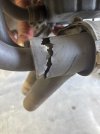
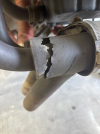
That didn't just happen since the last inspection. It would have been cracked, at least. It's so bad that there are pieces missing. a sign that it has been flying that way for some time.
 
View attachment 151037

That didn't just happen since the last inspection. It would have been cracked, at least. It's so bad that there are pieces missing. a sign that it has been flying that way for some time.
That looks like a Piper arrow exhaust?
I recently helped a AP/IA remove the shroud off the muffler of a arrow II for a annual inspection.
 
Last edited:
Back
Top