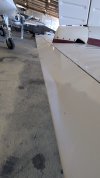
Due to circumstances I won't get into here, I had to take my plane to a new mechanic for the annual this year. This mechanic sent me an email this morning telling me that the plane is not airworthy due to a small dent in the stabilator trim tab (picture attached). This dent was there when I purchased the plane and none of the three companies that has done an annual inspection in the past has ever seen this as a problem. (It also passed a pre-buy inspection by a different mechanic). Looking for opinions on this, and especially would like any references to Piper specifications on what level of damage would be unacceptable (it is a 1976 Piper Warrior). I've been looking through the service manual and AC 43.13-1B, but so far haven't come across anything.

You are using an out of date browser. It may not display this or other websites correctly.
You should upgrade or use an alternative browser.
You should upgrade or use an alternative browser.
Small dent on stabilator trim - Disagreement with current mechanic on airworthiness.
- Thread starter kwarwick
- Start date

bbchien
Touchdown! Greaser!
Whether that's small or not is debatable...that looks like it's 8" x1"....
NOT A MECH.
NOT A MECH.
On older CAR 3 aircraft there are typically no published limits for this type of damage and mostly relied on the mechanic to make that determination with AC43.13 used to repair any damage if found. But in the same manner, have the mechanic cite his reference for making his determination its not airworthy and go from there. Don't be confrontational, simply inquire to "learn" what he used considering no other mechanic made the same claim. Regardless, in the end, its his call and certificate. Unfortunately, the photo doesn't provide contrast of the area to make a specific call but in general I would tend to agree with the previous mechanics unless he has found some hidden damage not shown in the pic like a crack.Looking for opinions on this, and especially would like any references to Piper specifications on what level of damage would be unacceptable (it is a 1976 Piper Warrior). I've been looking through the service manual and AC 43.13-1B, but so far haven't come across anything.
- Joined
- May 15, 2020
- Messages
- 7,770
- Display Name
- Ernie
- Home Airfield
- C81
A question if the plane is still in annual and if the non confrontational approach goes nowhere... Could OP have this shop button it up and take it elsewhere? This mechanic deems it not airworthy. But if he hasn't made a log entry, why not take it elsewhere?On older CAR 3 aircraft there are typically no published limits for this type of damage and mostly relied on the mechanic to make that determination with AC43.13 used to repair any damage if found. But in the same manner, have the mechanic cite his reference for making his determination its not airworthy and go from there. Don't be confrontational, simply inquire to "learn" what he used considering no other mechanic made the same claim. Regardless, in the end, its his call and certificate. Unfortunately, the photo doesn't provide contrast of the area to make a specific call but in general I would tend to agree with the previous mechanics unless he has found some hidden damage not shown in the pic like a crack.
Not really. In general, the proper way would be to for the shop to complete the annual and sign it off with discrepancies, then the owner could get another mechanic to correct or sign off those disc's.Could OP have this shop button it up and take it elsewhere?
>> "have the mechanic cite his reference for making his determination its not airworthy and go from there."
This is my initial plan. I had been hoping to find some reference giving specific metrics on what would cause an area to not be considered airworthy, but so far have found nothing. I will see if there is something definitive the mechanic used to make his determination, or if it is more subjective.
>> "complete the annual and sign it off with discrepancies, then the owner could get another mechanic to correct or sign off those disc's."
This is a distinct possibility, as I suspect I could get the mechanic who completed the annual last year (and initially started it this year) to sign off on it since he did not determine it to be an issue previously.
I'll talk with the current mechanic tomorrow and hopefully determine the best way to proceed.
Thanks for the input!

Daleandee
Final Approach
- Joined
- Mar 4, 2020
- Messages
- 8,354
- Display Name
- Dale Andee
I'm an experimental aircraft builder so my opinion isn't worth anything in regards to certified planes, but my initial take is that this doesn't appear to be a concern.
But the A&P you are paying is the one to make the call and he has the right to do so. You might politely inquire as to what documents and methods he used to arrive at the conclusion he did. The argument that he should accept it because others already have is a non-starter. Perhaps he knows something the others (including myself) don't know.
But the A&P you are paying is the one to make the call and he has the right to do so. You might politely inquire as to what documents and methods he used to arrive at the conclusion he did. The argument that he should accept it because others already have is a non-starter. Perhaps he knows something the others (including myself) don't know.
Tarheelpilot
Final Approach
- Joined
- Dec 5, 2010
- Messages
- 8,190
- Location
- North Carolina once again.
- Display Name
- Tarheelpilot
- Home Airfield
- Not sure anymore
Well. The current mechanic can feel free to document the completed annual inspection and any unresolved discrepancies.I'm an experimental aircraft builder so my opinion isn't worth anything in regards to certified planes, but my initial take is that this doesn't appear to be a concern.
But the A&P you are paying is the one to make the call and he has the right to do so. You might politely inquire as to what documents and methods he used to arrive at the conclusion he did. The argument that he should accept it because others already have is a non-starter. Perhaps he knows something the others (including myself) don't know.
He shouldn’t expect to be paid to fix that sheet metal.

Kenny Phillips
Final Approach
- Joined
- Jul 29, 2018
- Messages
- 6,572
- Display Name
- Kenny Phillips
Interesting. Our Skyhawk got hammered in a hailstorm in the late nineties; took out the wing and tail tips (plastic) and shotgunned the fuselage and wing.
After replacing the plastic, it was signed off as airworthy, with golf ball aerodynamic characteristics.
After replacing the plastic, it was signed off as airworthy, with golf ball aerodynamic characteristics.

Good advice so far on getting the annual completed with discrepancies.
I'm about as big of a "shoehorn everything under the Coleal Letter possible" guy as you'll meet, but i would not sign this off myself. Structures and determining their soundness is really not anywhere close to owner mx. Get another a&p to do it... which may be harder than your think...but if they agree with the IA (or are unwilling to disagree on paper) that should tell you something.
Personally, I've seen Pipers with that exact damage flying around, right or wrong. It's a pretty flimsy part. It will probably eventually crack, but it won't fail catastrophically.
Except he can't legally nor would it fall under prevent mx. However, another mechanic can easily do that if he did not agree with the previous assessment.then you as the owner sign off on the discrepancy and make it airworthy.
Unfortunarely, the subjective-side of airworthy can cause these types of disagreements which tend to be very noticeable during the prebuy process and its subsequent 1st annual by the local guy. But for reference, there are owners out there who would repair such "damage" for the simple reason its not factory condition.

MooneyDriver78
En-Route
- Joined
- Aug 13, 2013
- Messages
- 4,928
- Display Name
- Tom
- Home Airfield
- KSUA
Interesting. Our Skyhawk got hammered in a hailstorm in the late nineties; took out the wing and tail tips (plastic) and shotgunned the fuselage and wing.
After replacing the plastic, it was signed off as airworthy, with golf ball aerodynamic characteristics.
But those were dents, as someone already pointed out, this is a crease (I like to see the bottom view).
MooneyDriver78
En-Route
- Joined
- Aug 13, 2013
- Messages
- 4,928
- Display Name
- Tom
- Home Airfield
- KSUA
Except he can't legally nor would it fall under prevent mx. However, another mechanic can easily do that if he did not agree with the previous assessment.
Unfortunarely, the subjective-side of airworthy can cause these types of disagreements which tend to be very noticeable during the prebuy process and its subsequent 1st annual by the local guy. But for reference, there are owners out there who would repair such "damage" for the simple reason its not factory condition.
Good point about a prebuy, prebuy inspections can be more restrictive than an annual because the guy paying is expecting you to find problems.
Last I checked, Piper stabilators needed a bit of extra attention on their hinges due to risk of flutter. Perhaps the Warrior is not at a high risk of flutter from its lower cruise speeds. But can still see this as a potential concern.
To that crease / dent / whatever. Whether it makes the plane airworthy or not, the photo does make it look like there is possibility of creating turbulence as air exits the stabilator. At a minimum, this might do nothing. Then again it might add just enough vibration to increase wear on the stabilator hinge and risk flutter. Just a thought.
Out of curiosity, is there a concern with fixing the tab? If not, this will likely end a routine debate and remove some level of headache when time to sell.
Yes and no. I've seen a number of prebuys that ended with a signed annual yet a year later during the next annual the buyer receives a large bill from his mechanic to fix the items the prebuy mechanic opined were good. Every mechanic tends to have their standards, some higher and some lower. I tend to let the owner guide where we end up within my standard limits. In the OPs case, the question remains does the new mechanic have a higher standard based on guidance or is he simply pushing his opinion on the matter? However, without more context on the dent or the reasoning behind the discrepancy, hard to offer more comment.prebuy inspections can be more restrictive than an annual
bonefishpete
Cleared for Takeoff
- Joined
- Nov 10, 2024
- Messages
- 1,362
- Display Name
- Bonefishpete
Can’t you simply tell new mechanic to button it up and pay by the hour what was done already. Fly it to a new mechanic?
No log book entries at all? Accepting it’s still in annual.
No log book entries at all? Accepting it’s still in annual.
bonefishpete
Cleared for Takeoff
- Joined
- Nov 10, 2024
- Messages
- 1,362
- Display Name
- Bonefishpete
Exactly what I would do. Otherwise A&P is holding the plane hostage to his opinion.A question if the plane is still in annual and if the non confrontational approach goes nowhere... Could OP have this shop button it up and take it elsewhere? This mechanic deems it not airworthy. But if he hasn't made a log entry, why not take it elsewhere?

- Joined
- Oct 16, 2019
- Messages
- 8,868
- Location
- Atlanta / Marietta
- Display Name
- Vintage Snazzy (so my adult children say)
- Home Airfield
- KPUJ
Pay the guy, take the plane and his log book sticker. Plane is now legally unairworthy, so if you have to fly to get to another IA, get a ferry permit. Can you burry this annual? Interesting question.Can’t you simply tell new mechanic to button it up and pay by the hour what was done already. Fly it to a new mechanic?
No log book entries at all? Accepting it’s still in annual.
91.417 a You have to keep the record of the annual - just can't have a "do over", pretend it didn't happen.
91.417 b 1 You have to keep this record for a year OR until this work is repeated/superseded.
So.... take the airplane to another IA, re do the annual which repeats/supersedes the previous annual, which at this point you don't have to keep the previous annual record. But when you present the plane and the log books to the new IA, you need to show him the annual you just did.
Last edited:
bonefishpete
Cleared for Takeoff
- Joined
- Nov 10, 2024
- Messages
- 1,362
- Display Name
- Bonefishpete
Take the plane back. No annual was done in my opinion.Pay the guy, take the plane and his log book sticker. If plane is now out of date / out of annual get a ferry permit to fly to another IA. Can you burry this annual? Interesting question. The annual inspection was done, and you have to keep that record for a year. Or maybe less than a year if it is "superseded" by a new inspection.

Doc Holliday
En-Route
Take the plane back. No annual was done in my opinion.
How do you know?
Doc Holliday
En-Route
We're right in the middle of "A&P Regulations" at A&P school.
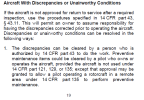
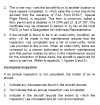
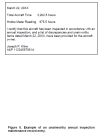
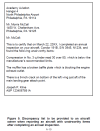
The current IA doing the inspection can finish the paperwork, but will sign off as "unairworthy" and give you a list of discrepancies. Only an IA can sign it as "Airworthy", per our instructor, who double checked with our local FISDO. (I feel like I just pulled a pin on a grenade here).
Which means you can take this to another IA who could do another annual to get another inspection where he might disagree with the previous IA. But you're legally required to keep the annual inspection (all of them) for a year in the log books, so your log book will for at least a year have contradictory annuals. IF you can find a new IA to do that.
Bonus: If this involves removing the skin, riveting, etc., it is a major repair, which will require an IA to sign the 337. In this case, a private pilot or even a "normal" A&P can't fix it and sign this off as airworthy.
My 2C if you're asking - just do the repair.
Doc Holliday
En-Route

Gary Ward
En-Route
- Joined
- Jan 16, 2020
- Messages
- 3,640
- Location
- Lawrenceburg, Indiana
- Display Name
- Challenger1
- Home Airfield
- I67
What would it cost to repair?
I think I would have the current AP/IA repair it and move on with a better aircraft.
I think I would have the current AP/IA repair it and move on with a better aircraft.
bbchien
Touchdown! Greaser!
Wentworth.
bonefishpete
Cleared for Takeoff
- Joined
- Nov 10, 2024
- Messages
- 1,362
- Display Name
- Bonefishpete
Pitfalls of taking your aircraft to a new mechanic.
Three previous annuals and the A&P found no discrepancies? Now this one does?
Previous mechanics found airworthy.
Who is right?
Three previous annuals and the A&P found no discrepancies? Now this one does?
Previous mechanics found airworthy.
Who is right?
- Joined
- Oct 16, 2019
- Messages
- 8,868
- Location
- Atlanta / Marietta
- Display Name
- Vintage Snazzy (so my adult children say)
- Home Airfield
- KPUJ
Nice! What is the source? AC? I'd like to print off, reference the source for class. Appreciate it.
Doc Holliday
En-Route
So where does it state (regulations, advisories, notices, etc) that if a previous A&P/IA signed it off as airworthy that subsequent A&P/IA's should follow as well?Pitfalls of taking your aircraft to a new mechanic.
Three previous annuals and the A&P found no discrepancies? Now this one does?
Previous mechanics found airworthy.
Who is right?
Doc Holliday
En-Route
Here ya goNice! What is the source? AC? I'd like to print off, reference the source for class. Appreciate it.

Tools
En-Route
- Joined
- Aug 6, 2020
- Messages
- 2,919
- Display Name
- Tools
Actually, only an IA can sign the annual inspection. A mechanic can sign THAT repair off as airworthy.
Just because that guy looked at it doesn’t mean it HAS to be recorded. Only has to be recorded (assuming no other maint performed during the inspection) if it’s being used as an annual.
Probable caveat, once that item goes in as not airworthy, it’s not operable until cleared.
There are options, you can choose.
1. Pay the guy for what you already have, and someone else clears the item. Might have to ferry permit…
2. Ignore and take elsewhere, pay the guy for his time but no signature, start from scratch. Assuming previous annual still in effect.
3. Pay the guy for the annual AND repair.
Might be other choices, but I think that’s your major options.
That guy can’t ground your impound your plane (can mechanic lien for funds for inspection completed).
Sure. But all actual work they performed up to that point must be logged in the record. However, depending on where they are at in the annual process it may not be very feasible route to take. As mentioned, have him complete the annual and sign it with disc's will be the simplest and most economical route to take.Can’t you simply tell new mechanic to button it up and pay by the hour what was done already. Fly it to a new mechanic?
They all are at the time they made that airworthy determination.Who is right?
bonefishpete
Cleared for Takeoff
- Joined
- Nov 10, 2024
- Messages
- 1,362
- Display Name
- Bonefishpete
Pretty soon we are going to need a pre annual consultation before the actual annual.
- Joined
- Oct 16, 2019
- Messages
- 8,868
- Location
- Atlanta / Marietta
- Display Name
- Vintage Snazzy (so my adult children say)
- Home Airfield
- KPUJ
I think you can take elsewhere, but I don't think you can "ignore". You can however "make it go away" by supersede, replace.2. Ignore and take elsewhere, pay the guy for his time but no signature, start from scratch. Assuming previous annual still in effect.
But... how much does it cost in time and money to get a ferry permit, re do the annual, vs do the repair? Which at the end of the day isn't a bad thing.
- Joined
- Oct 16, 2019
- Messages
- 8,868
- Location
- Atlanta / Marietta
- Display Name
- Vintage Snazzy (so my adult children say)
- Home Airfield
- KPUJ
Just read this - pure gold. Many thanks / graci.
BONUS: When speaking to a person whose first language is Spanish, I've been told to always end the sentence with "Mucho" to be polite. I was told that to folks who speak Spanish, it will mean a lot to them.

Ed Haywood
Final Approach
I would not pencil whip this one. Damaged trim tabs can depart with catastrophic results. My aircraft service manual has a big warning saying "do not fly with damaged trim tab."
- Joined
- Oct 16, 2019
- Messages
- 8,868
- Location
- Atlanta / Marietta
- Display Name
- Vintage Snazzy (so my adult children say)
- Home Airfield
- KPUJ
Repairing damage to critical flight controls, even if it seems to be working OK now. When you say it out loud, yeah, seems like a good thing to do.I would not pencil whip this one. Damaged trim tabs can depart with catastrophic results. My aircraft service manual has a big warning saying "do not fly with damaged trim tab."

Why wasn't this flagged before by the previous IA's? One of our club planes was taken to a new IA for annual. He found a lot of things needing work that had been approved for several years. So another way to look at this is "Good thing this new IA found this / assessed this to be a real issue that needs to be addressed".
Last edited:

rwellner98
Pattern Altitude
- Joined
- Jul 26, 2009
- Messages
- 1,662
- Display Name
- rw2
This mechanic wouldn't last long in Alaska...
Ed Haywood
Final Approach
even if it seems to be working OK now.
Vne is based on when flutter occurs during TC flight testing. Change the aerodynamic profile of the trim tab and you may discover the hard way that Vne is less.

schmookeeg
Final Approach
- Joined
- Nov 6, 2008
- Messages
- 5,812
- Location
- Alameda, CA
- Display Name
- Mike Brannigan
- Home Airfield
- KOAK
Sell it. Get a boat. Flying a plane you don't want to maintain hurts us all and might hurt you too.

Let'sgoflying!
Touchdown! Greaser!
I’d want that fixed.