
luvflyin
Touchdown! Greaser!
- Joined
- May 8, 2015
- Messages
- 17,444
- Location
- Santa Barbara, CA
- Display Name
- Luvflyin
- Home Airfield
- KVUO

From yesterday's Juan Brown video, he steps through some of the still photographs that (IIRC) show parts of engine #1 on the left side of the runway in roughly the following order: (a) part of the engine nacelle, then (b) a little further beyond, part (all?) of the pylon, then (c) a little beyond that, the engine itself. I don't know if the location of the debris gives a accurate indication as to the order in which things transpired with engine #1, but I do agree that these items will be available for inspection/investigation and I'm sure will yield valuable info.Well, part of the engine is on the runway. The fan appears to be AWOL, the fan shroud material perhaps shredded and ingested. A fan letting go can create an imbalance that could take an engine off, which means that what happened to the mounts proper (at either end of the pylon) is moot.

Very likely to have gone up and over as the engine is still producing thrust and suddenly has no airplane to pull. There is a lot of inertia in the spool which will continue to produce thrust as it slows down.I’m wondering how did it depart the wing. Did it drop and roll? Or did it get launched over the wing? Where is the pylon?
They are very good at this. They can analyze the failure point(s) and determine the cause of the failure. On UA232, they were able to analyze the failed fan hub of the No.2 engine and determine that it was machined from a flawed block of titanium alloy and that failure occurred at cruise altitude.I think the likelihood of finding the cause of the separation will be difficult.
Very likely that the failure occurred in the pylon, not the engine as that is the weakest point. A failure in the engine may have caused the failure in the pylon. The engines are designed to separate at the pylon to try to minimize the damage to the wing during a catastrophic failure.The engine is sitting there on the runway. Go look at the engine mounts on that engine
Did the designing to separate at the pylon happen after AAL191?Very likely to have gone up and over as the engine is still producing thrust and suddenly has no airplane to pull. There is a lot of inertia in the spool which will continue to produce thrust as it slows down.
They are very good at this. They can analyze the failure point(s) and determine the cause of the failure. On UA232, they were able to analyze the failed fan hub of the No.2 engine and determine that it was machined from a flawed block of titanium alloy and that failure occurred at cruise altitude.
Very likely that the failure occurred in the pylon, not the engine as that is the weakest point. A failure in the engine may have caused the failure in the pylon. The engines are designed to separate at the pylon to try to minimize the damage to the wing during a catastrophic failure.

That would make the engine want to go forward, but not necessarily "up and over". The reason AA191's engine went up and over was that the rear pylon fitting failed first, so the engine rotated around the front fitting and pointed up before it fully separated.Very likely to have gone up and over as the engine is still producing thrust and suddenly has no airplane to pull. There is a lot of inertia in the spool which will continue to produce thrust as it slows down.
Yes. The NTSB does some amazing work to get down to the cause of a crash, and in this case they at least have the engine that separated as well as good data from both FDR and CVR.They are very good at this. They can analyze the failure point(s) and determine the cause of the failure. On UA232, they were able to analyze the failed fan hub of the No.2 engine and determine that it was machined from a flawed block of titanium alloy and that failure occurred at cruise altitude.

No, it's been designed that way for a very long time. The AA191 engine also went up and over.Did the designing to separate at the pylon happen after AAL191?

Did the designing to separate at the pylon happen after AAL191?

If so, you can bet the shredders have been running at the MRO facility.This is the crash I've had in mind as the fault with AA 191 was caused by damaged to the engine pylon mounts because the mechanics deviated from manufacturer-recommended installation protocols. I wonder if that's the case here ...

So more like 191 than we thought :-(The NTSB, this afternoon, said that most of the pylon was still connected to the engine.

Millions of flight hours testify that the design is solid.Hard to imagine the rest of these fleets are still flying right now.
My guess since they have the big pieces, they have a basic idea of the failure sequence which does not require the FAA or UPS to stand down the fleet after the initial 24 hrs. Keep in mind, the fan and duct cowling (with evidence of blade strikes) had also separated from the core engine during the failure sequence and was also left on airport property.Hard to imagine the rest of these fleets are still flying right now.
Why? MD-11s entered commercial service in December of 1990. Almost 35 years of service without this failure happening before.Hard to imagine the rest of these fleets are still flying right now.
Not really. As I said, the pylons are designed to be the separation point so as to minimize damage to the wing after such catastrophic failures. If that's where it failed, that would be as expected.So more like 191 than we thought :-(

That's good. I did say the determination of cause will be difficult, but fortunately not impossible. The forensic examiners of the NTSB are thorough.The NTSB, this afternoon, said that most of the pylon was still connected to the engine.


 www.nbcnews.com
Yeah - To some extent I feel like the trijet design with wing-mounted engines needs to be done due to the possibility of one engine failure taking out a second one in this manner. I can't think of any type other than the MD-11 that's still flying in this configuration, though.Hard to imagine the rest of these fleets are still flying right now.
Meh... 11 complete hull-loss accidents out of 200 airplanes built does not inspire confidence. In fact, that's one of the worst accident records of a semi-modern airliner.Millions of flight hours testify that the design is solid.
IIRC, this is a relatively difficult aircraft to land. High speed, sight picture issues, etc. causing several accidents. The accidents have not been of the "ripped an engine off on takeoff" variety, which is what we're looking at here...Meh... 11 complete hull-loss accidents out of 200 airplanes built does not inspire confidence. In fact, that's one of the worst accident records of a semi-modern airliner.
How soon do you think the FAA will ground them all? Aren’t you an MD11 flyer?And...grounded
UPS and Fedex ground MD-11s, the type of plane in Louisville crash
An investigation has been launched into the cause of the deadly Tuesday crash, which occurred as an MD-11 was taking off.
FedEx has followed suit according to multiple sources.
Yep. Looks like ~108 on the US registry; 30 are UPS based in Kentucky, 61 are FedEx based in Tennessee.Fleets are being grounded as I type this
Lotsa 727’s. What about the engines. This one had a GE, right? It’s looking like the engine itself may be the culprit here. How many of this particular GE are out there?Why? MD-11s entered commercial service in December of 1990. Almost 35 years of service without this failure happening before.
We don't ground airplanes until we have identified a specific issue which invalidates the airplane's airworthiness certification.
Since they have the pylon, they can do the metallurgical analysis which will identify the reason for the failure. If they find pre-existing fatigue or stress cracks, expedited inspections or a grounding my be justified. If they found it failed under loads which exceeded the design limits then there is not a reason for a grounding.
Not really. As I said, the pylons are designed to be the separation point so as to minimize damage to the wing after such catastrophic failures. If that's where it failed, that would be as expected.
There is video evidence suggesting a major uncontained fan failure which could turn out to be the proximate cause that resulted in the fire and the engine separation. All we have is the video of the fire and that the fan section was separated at this point. Not enough to draw such conclusions.
There have been other cases of engines separating from transport aircraft including AA191 (DC10), El Al 1862 (747), China Airlines 358 (747), DAL1288 (MD88), China Airlines 301 (727), NWA 5 (727), National Airlines (727), AAL (727), and probably more.
I believe the CF6 is still in production today with variants used on other model aircraft.How many of this particular GE are out there?
This is definitely a "legacy" engine, with roots back to the early sixties. Things are constantly updated as experience dictated (all test and cert documents were published by my group until I retired last year). The GEnx is the replacement (but not retrofit).I believe the CF6 is still in production today with variants used on other model aircraft.

Yep. Looks like ~108 on the US registry; 30 are UPS based in Kentucky, 61 are FedEx based in Tennessee.
So most of them are grounded with just the two carriers pulling them.

Most were landing accidents/hard landings. One was an inflight fire sue to faulty wiring for the inflight entertainment system. One was a Chinese MD11 where a pilot accidentally deployed the slats at altitude.Meh... 11 complete hull-loss accidents out of 200 airplanes built does not inspire confidence. In fact, that's one of the worst accident records of a semi-modern airliner.
When they find evidence of a problem that could affect the rest of the fleet.How soon do you think the FAA will ground them all? Aren’t you an MD11 flyer?
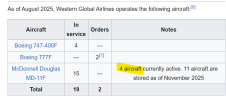
Are the MD10s still flying?FedEx is operating 27 MD-11's and UPS operates 26 of them.
Are the MD10s still flying?

"There are about 70 MD-11s in service operated by FedEx, UPS and Western Global, according to Boeing."

Very prudent thing for brown to do. A safety down until they parse through the mx questions is a good thing for everybody involved. There's more to life than money and neurotic next-day shipping entitlement.
Good optics for Purple to get in on the safety bandwagon. The fleet in question was earmarked for divestment on both carriers anyways; neither cripples their respective operation, given the economic slowdown the govt is intent on papering over by inflating the USD away at W2 earners expense. Digressing. Both are playing good chess here.

What scenario are you seeing where it’s not true?That is not strictly true.
