SDF UPS down

I’m curious about what looks like an issue with number 2. Many seem to think that it’s debris from the number 1 engine causing a compressor stall but I’m not surf the physics support debris from engine 1 already moving 100mph and spinning a few thousand RPM making it from one wing, across the fuselage and all the way over to the other wing and then moves forward somehow to go down the inlet. It may be a compressor stall but I don’t think it’s from the first engine. Could there have been a vehicle or something on the runway that damaged both engines?
One of the videos appears to show a repeating flash at/near the exhaust of the middle engine. That could be a compressor stall and if so, could be because of FOD from the left engine.
 
I’m curious about what looks like an issue with number 2. Many seem to think that it’s debris from the number 1 engine causing a compressor stall but I’m not surf the physics support debris from engine 1 already moving 100mph and spinning a few thousand RPM making it from one wing, across the fuselage and all the way over to the other wing and then moves forward somehow to go down the inlet. It may be a compressor stall but I don’t think it’s from the first engine. Could there have been a vehicle or something on the runway that damaged both engines?
It's a trijet. #2 is in the tail. Very possible debris gets in there. From the video also looks like a lot of smoke & heat at a minimum.
 
I’m curious about what looks like an issue with number 2. Many seem to think that it’s debris from the number 1 engine causing a compressor stall but I’m not surf the physics support debris from engine 1 already moving 100mph and spinning a few thousand RPM making it from one wing, across the fuselage and all the way over to the other wing and then moves forward somehow to go down the inlet. It may be a compressor stall but I don’t think it’s from the first engine. Could there have been a vehicle or something on the runway that damaged both engines?

Completely agree. It was probably something else, and very substantial.
 
number 2 is in the vertical fin at the rear of the fuselage.
 
Consider also that at a high AoA, as it would be at the moment of rotation, the tail engine (2) is more closely aligned with the plume of whatever is coming off the (remains of the) left engine (1). And this will continue if the AoA remains high - as it did with a high deck angle and little to no climb. Sitting at a level deck angle prior to rotation, engine 2 may or may not have been above that plume. If it was above, I would think it would not have been affected as much as it did after they rotated.

But as we saw, this was a catastrophic separation, so the amount of debris being thrown around, and whatever else might have been failing due to that is all a guess at this point.
 
Anyone who has been involved in aviation for long will have no trouble drawing comparisons to the DC-10 crash at ORD 40 years ago. Indeed the similarities are striking, the No. 1 engine left on the runway. The question for investigators is the why. In the ORD crash, the engine pylon was damaged during maintenance due to improper handling of the engine and pylon. Was the failure method in this accident similar, or caused by something entirely different. What was the initial link in the accident chain, a structural failure, catastrophic engine failure, etc. Was it caused by maintenance, or fatigue? I'll be interested to see what the smoking gun in this investigation will be.
 
Anyone who has been involved in aviation for long will have no trouble drawing comparisons to the DC-10 crash at ORD 40 years ago. Indeed the similarities are striking, the No. 1 engine left on the runway. The question for investigators is the why. In the ORD crash, the engine pylon was damaged during maintenance due to improper handling of the engine and pylon. Was the failure method in this accident similar, or caused by something entirely different. What was the initial link in the accident chain, a structural failure, catastrophic engine failure, etc. Was it caused by maintenance, or fatigue? I'll be interested to see what the smoking gun in this investigation will be.
The number 1 engine is NOT on the runway. It happens to be sitting in the grass on the RIGHT side of the runway...that in itself is indicative of how catastrophic the failure was.

The only similarity between this accident and AA 191 is the engine came off. That's about it.

These guys never got out of ground effect.
 
Sorry. Meant number 3 on the other wing. It flashes out the back briefly before the crash.
Where did you see that?

The screen captures I've seen as it is leaving the runway show a separate flame streak coming from the tail (the Number 2 engine) not the right wing.
 
So many possibilities… bad fuel causing problems? The #1 merely succumbing more catastrophically?

#1 engine problems pretty obvious
#2 fairly suspect
#3 maybe suspect?

If just one engine the number of scenarios that prevent a climb become limited. Some crazy control system issue? Over rotate and lose control (doesn’t really look like that)?

If thrust from the other engines suspect, this makes sense with what we got.

So now what coulda happened with thrust from other engines?

If just #2, fod is certainly possible. Could be weirdly coincidently unrelated to #1 failure… but now we’re dipping into REALLY low odds.

If thrust on #3 compromised, about has to be something common to all three engines.

The flight path is consistent with good pilot reaction, which diminishes likelihood of original problem being pilot error related. Doesn’t eliminate it, just sorta skews the likelihood.

I’m in the #1 engine catastrophic failure camp right now. Just can’t form an opinion at all about when that would have been evident in the cockpit.

Whenever I was PM on the takeoff roll to V1, my eyes were always glued to engine instruments. But never experienced so much as a hiccup outside the sim.

Oddly, the reason I left my last airline was because they had THREE no kidding v1 cut engine failures (one being an abort AFTER V1, both fortunately and successfully) in 8 months only operating eight jets (MD80). Just didn’t feel like I really needed to experience that…
 
I've been in a cave, only just learning about this here and now.
Ugh.
How many souls am I praying for?
 
It doesn't even have to be debris to have #2 affected, it could just be smoke. Fighters have had issues with gun gasses being sucked into the engine causing issues, I'd imagine the output from a big fire is similar. Even if it was just a partial power loss on #2, at that weight they would be in a world of hurt.
 
I just saw the video of the takeoff being reviewed frame by frame, and there is clearly a compressor stall and backfire from the No 2 engine just as the aircraft is leaving the ground. So No 1 laying on the ground, and No 2 losing power at liftoff, they had no chance. A fully loaded MD-11 won't climb on one engine.

Still doesn't answer the big question. The "what" seems obvious from the multiple camera angles, its the "why". Why did the No 1 separate from the aircraft starting the accident chain.
 
A news report already has it figured out (we'll see): A fuel leak from the left wing.
It is truly sad. People died. And the so-called news media still has to be first. Not that it matters that few are more ignorant of literally everything on earth. (I'd post a link to Don Henly's 'Dirty Laundry', but that song is too upbeat for this event.)
 
I've been in a cave, only just learning about this here and now.
Ugh.
How many souls am I praying for?
Latest news is at least 9 fatalities and several injured.

UPS press release is only 3 onboard the aircraft.
 
  • Sad
Reactions: WDD
I’m curious about what looks like an issue with number 2. Many seem to think that it’s debris from the number 1 engine causing a compressor stall but I’m not surf the physics support debris from engine 1 already moving 100mph and spinning a few thousand RPM making it from one wing, across the fuselage and all the way over to the other wing and then moves forward somehow to go down the inlet. It may be a compressor stall but I don’t think it’s from the first engine. Could there have been a vehicle or something on the runway that damaged both engines?

#2 is in the tail. Number 3 is under he right wing.
 
When #1 left the wing, it probably took quite a few leading edge devices with it, could have also taken out some of the trailing flaps too9and a part of the wing. Quite a bit of lift loss on left wing.
 
More interesting takes on reddit tbh. Mostly intimates questions about the underbelly of the beast (contract MRO in 121) and what that can/may engender. Others claim the tail in question was on a mx ground delay for 2 hours for the very engine in question immediately prior to the accident sequence. Then one of the threads devolves into the typical accosting of the critic by claiming he's got an axe against contract MRO as a UPS in-house/brand mechanic. In fairness that historically is more typical behavior from 121 employees (in and out of the cockpit) any time they're in contract negotiations. Where everything is broken and they're just.one.crap-schedule rest period away from catastrophe....then the airline is safe and on time again once the TAs are ratified and the senior go back to telling the junior to "get senior". Digressing.

I usually screenshot the posts, but on this one I'm not gonna contribute to the potential doxxing of a de facto whistleblower if the MIF allegations prove substantiated. Everybody can feel free to find the threads on their own and ad hominem/shoot messengers if that's your bend in life.

As an FCF pilot, these mx-intensive topics within an accident sequences are of great interest to me. We have lost many good folks to maintenance failures. Certainly an occupational hazard, but as the designated test dummies within the community, we push the envelope so others can come home. We also rely on a good working relationship with maintainers we hope are maslow hierarchy of needs covered enough to not be compromised. At minimum, keep enough of a moral compass to humanize us when they decide how much effort to put into their "work to live" wrenching. We want to come home too, even if with a bent jet.

I got two peers in my immediate circle working for Brown, one was flying the line and checked in code 1, the other is physically here this week for our mando drill. Hug your families tight and live with a purpose worth dying for to you; the chances of rolling snake eyes in this blasted life are never zero.
 
Now I'm hearing about a 2 hour delay due to work on the left engine as well. I was already thinking MIF, but if this turns out to be true, that's pretty damning.

At this time, there are 825 comments to that post. No clue what video you're referring to.
I wish there was a way to download it. It's the only one I've seen where you can see the plane before it's tilting left. Definitely a lot of fire going on, and looks like it's not high enough to clear things, and while there was a very slight climb, it sure didn't last long. I'm guessing it was taken from the Ford plant.

The number 1 engine is NOT on the runway. It happens to be sitting in the grass on the RIGHT side of the runway...that in itself is indicative of how catastrophic the failure was.
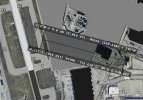
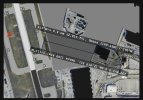
The engine is to the left of the runway, actually just to the left of taxiway B. You can see taxiway lights and the bottom of the tower in the pic:

574887898_10227445030024625_7453271669573181548_n-jpg.146832


And, if you draw a line from the tower through the canted part of the building in the background, you can see about where it was (left edge of the centerline of the ruler):

IMG_1075.jpg

The front of the nacelle is on the right side of the runway, though, right next to the PAPIs.
 
Last edited:
Just came across this video of the accident. Not sure it has been posted here.

 
I wish there was a way to download it. It's the only one I've seen where you can see the plane before it's tilting left. Definitely a lot of fire going on, and looks like it's not high enough to clear things, and while there was a very slight climb, it sure didn't last long. I'm guessing it was taken from the Ford plant.
This one?
 
Maybe the left engine nacelle failed first, engine separated, bounced, and caused collateral damage?

It will be a while before the real facts come out. I’m a bit guilty of speculating here I’ll admit. Wanting to know what happened is probably a human reaction to process bad news.
 
The engine is to the left of the runway, actually just to the left of taxiway B. You can see taxiway lights and the bottom of the tower in the pic:

574887898_10227445030024625_7453271669573181548_n-jpg.146832


And, if you draw a line from the tower through the canted part of the building in the background, you can see about where it was (left edge of the centerline of the ruler):
You’ve got the azimuth right, but is that not on the right side of the departure runway, next to taxiway A? You can see the runway behind it (between the engine and the control tower) and on the right side, partially cropped out, looks like an RVR transmissometer, which is located adjacent to the glideslope array on the west side of the runway.

Position circled, for clarity:
IMG_6985.jpeg
This would make sense for the nacelle debris back by the PAPI on the same side, and account for some of the skid marks seen in the grass.

 
A large fireball removing oxygen from the area will cause a compressor stall to the next engine moving through it…not saying it’s the case on number two but something I have experienced.
Wow I would have never thought of that.
 
A large fireball removing oxygen from the area will cause a compressor stall to the next engine moving through it…not saying it’s the case on number two but something I have experienced.
And there’s video evidence that supports that theory.
 
The engine is to the left of the runway, actually just to the left of taxiway B. You can see taxiway lights and the bottom of the tower in the pic:
I'm no expert on KSDF -- but for Runway 17R, my Google satellite view shows the windsock on the right side of the runway, not the left, and the picture (to me) shows the engine and the windsock on the same side of the runway. I think the taxiway in the foreground is Alpha, not Bravo.
 
NTSB confirmed already the engine departed the aircraft. Granted, hardly a surprising declaration; there's plenty of videos out there already of the aircraft where the left wing is clearly seen as completely devoid of anything resembling an attached engine assembly where one should exist, as it settled over the airport fence and into the general pedestrian areas.

As was highlighted already by others upthread, addtl video evidence back during rotation shows the tail engine coughing small flames, indicative of eating FOD from whatever debris was shrapneling off from the left wing/engine attachments/slats/whatever else. It certainly lines up the inability to climb away, with the functional loss of a second engine's worth of thrust.

The NTSB prelim conference is refuting the online anecdote of there having been immediate maintenance on the engine prior to the accident flight, but they were also vague in that characterization of immediate. No answer that I caught regarding the anecdote about contract MRO engine/pylon work actions in SAT 2 weeks ago.

This one is a tough one for MD11 assigned pilots. No indications of pilot miscontrol yet, the FDR hasn't been combed over yet as far as the public release is concerned. But the optics of plausible deniability have already gotten away from UPS: the engine having departed the airframe is already video confirmed. That's a big time mx red flag. No way I'd strap into an MD-11 until they ground stop and inspect.

We've been in similar situation before in the .mil side. Here, people with the delegated authority to temp-ground the fleet had to fall on their sword and get fired for the recalcitrant leadership, one already prone to rejecting as a matter of principle the idea of ever bartering with their chatel, to admit to the need for safety-priviledged release of information on a need-to-know-basis. This of course in the interest of getting people to regain confidence in the fleet.
 
You’ve got the azimuth right, but is that not on the right side of the departure runway, next to taxiway A? You can see the runway behind it (between the engine and the control tower) and on the right side, partially cropped out, looks like an RVR transmissometer, which is located adjacent to the glideslope array on the west side of the runway.

Position circled, for clarity:
View attachment 146856
This would make sense for the nacelle debris back by the PAPI on the same side, and account for some of the skid marks seen in the grass.
I'm no expert on KSDF -- but for Runway 17R, my Google satellite view shows the windsock on the right side of the runway, not the left, and the picture (to me) shows the engine and the windsock on the same side of the runway. I think the taxiway in the foreground is Alpha, not Bravo.
OK, that does seem possible - was thinking I was seeing the different colors at the edge of the ramp east of B:

574887898_10227445030024625_7453271669573181548_n-jpg.146832


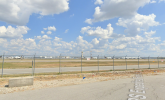
But, I could also be convinced that that's the 1000-footers on the runway right behind the engine, and that the pic was taken from the west side fence of the airport. However, it seems like it's a lot closer to the tower than this view (from Street View along the west edge of the airport along the same azimuth I drew earlier):

Screenshot 2025-11-06 at 4.15.53 PM.png

I was also confused how the LEFT engine would end up on the RIGHT side of the runway... However, it would have been spinning very fast in the clockwise direction on the takeoff roll, and all of that rotating mass probably had plenty of angular momentum for it to roll to the right after it hit the runway.
 
OK, that does seem possible - was thinking I was seeing the different colors at the edge of the ramp east of B:

574887898_10227445030024625_7453271669573181548_n-jpg.146832


But, I could also be convinced that that's the 1000-footers on the runway right behind the engine, and that the pic was taken from the west side fence of the airport. However, it seems like it's a lot closer to the tower than this view (from Street View along the west edge of the airport along the same azimuth I drew earlier):

View attachment 146914

I was also confused how the LEFT engine would end up on the RIGHT side of the runway... However, it would have been spinning very fast in the clockwise direction on the takeoff roll, and all of that rotating mass probably had plenty of angular momentum for it to roll to the right after it hit the runway.
I’m wondering how did it depart the wing. Did it drop and roll? Or did it get launched over the wing? Where is the pylon?
 
OK, that does seem possible - was thinking I was seeing the different colors at the edge of the ramp east of B:

574887898_10227445030024625_7453271669573181548_n-jpg.146832


But, I could also be convinced that that's the 1000-footers on the runway right behind the engine, and that the pic was taken from the west side fence of the airport. However, it seems like it's a lot closer to the tower than this view (from Street View along the west edge of the airport along the same azimuth I drew earlier):

View attachment 146914

I was also confused how the LEFT engine would end up on the RIGHT side of the runway... However, it would have been spinning very fast in the clockwise direction on the takeoff roll, and all of that rotating mass probably had plenty of angular momentum for it to roll to the right after it hit the runway.
Correct. The engine stopped just before the windcone/glideslope shelter between Runway 17R-35L and Taxiway A. So yeah, it crossed over the runway to get there. I designed most of the airfield pavements on that airfield, or worked on them in some fashion or another; I know that glideslope shelter well. Also for the path the aircraft took, it veered slightly left/east when it took off, as you can see the 3 light stations on the UPS building and 1 light station in front (north) of it. That'd be the approach lights for runway 35L and the extended centerline. So it was yawing that direction, it wasn't doing it in an extreme amount; the pilots did a good job with right rudder to compensate for the left engine out. Good thing, too, 'cause there's some scary things to hit if it had veered immediately left on lift-off.
 
I’m wondering how did it depart the wing. Did it drop and roll? Or did it get launched over the wing? Where is the pylon?
After viewing the video of the aircraft crashing left wing first into the ground, I think the likelihood of finding the cause of the separation will be difficult. I hope I'm wrong.

Watching that inferno was tough, knowing the crew didn't have a chance to fight back. May they rest easy.
 
I’m wondering how did it depart the wing. Did it drop and roll? Or did it get launched over the wing? Where is the pylon?
Well, FWIW, on American 191 where the engine went up and over the wing after the rear pylon fitting failed, the engine ended up on the left side of the runway, and it caused other damage to the plane which led to the loss of control.

After viewing the video of the aircraft crashing left wing first into the ground, I think the likelihood of finding the cause of the separation will be difficult. I hope I'm wrong.
I dunno - They found the cause of the separation of the #1 engine on American 191 in 1979, and that one was maybe more challenging in a couple of ways: First, one of the things it crashed into was a storage hangar full of aircraft parts, so the investigators had to determine which parts were on the plane and which parts had been in the warehouse. Second, it was a more catastrophic crash as it had achieved some altitude before losing control and coming back down hard. The engine separation there had taken out some hydraulics, and the slats on the left wing retracted as a result. Also, at the time, the procedure was to fly at V2. AA191's V2 was 153 knots and the plane was at 165 initially, the slat retraction had raised the stall speed on the left wing to 159. As the FO (PF) raised the nose to the flight director to slow down to V2, the left wing stalled and they rolled to 115º and came crashing back down. This was covered in the ATP-CTP course I just took, and as a result of this accident they said that the current practice would be to keep the extra speed and fly at least V2+10.

I'd probably still avoid a flight 191 on any carrier if I were the slightest bit superstitious. In addition to American 191, the bad wind shear crash in Dallas in 1985 was Delta 191, an L-1011.
 
Last edited:
Why
After viewing the video of the aircraft crashing left wing first into the ground, I think the likelihood of finding the cause of the separation will be difficult. I hope I'm wrong.

Watching that inferno was tough, knowing the crew didn't have a chance to fight back. May they rest easy.
Would the cause of seperation be hard to determine? The engine is sitting there on the runway. Go look at the engine mounts on that engine and it will tell you right away what seperated from where when the engine came off. The airplane may be gone but the engine itself will still reveal alot.
 
After viewing the video of the aircraft crashing left wing first into the ground, I think the likelihood of finding the cause of the separation will be difficult. I hope I'm wrong.
The "aircraft" side of the pylon failure may indeed be difficult to find/analyze, but they should have the other part - the engine/nacelle and whatever part of the pylon is still attached.
 
Why

Would the cause of seperation be hard to determine? The engine is sitting there on the runway. Go look at the engine mounts on that engine and it will tell you right away what seperated from where when the engine came off. The airplane may be gone but the engine itself will still reveal alot.
Well, part of the engine is on the runway. The fan appears to be AWOL, the fan shroud material perhaps shredded and ingested. A fan letting go can create an imbalance that could take an engine off, which means that what happened to the mounts proper (at either end of the pylon) is moot.
 
Back
Top