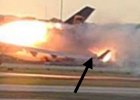
SDF UPS down

My take on it is that #2 had to be ingesting super-heated air from the fire where #1 was which would have derated it's thrust. Even at idle several jet engines have ingested people and equipment now at take-off power think of how much air that engine is pulling in. Plus, it may have eaten some FOD from #1 departure.
Seems problematic:

IMG_7103.jpeg
 
Sadly with that wing fire I don’t know if it would’ve held even in a return to the field.
Without the crew’s full awareness of the magnitude of the fire on the wing and how that would play into deciding on the path to fly in a theoretical return to the field, it’s quite possible that a structural failure of the wing would have occurred over a very densely populated area.
 
I am probably one of a few that have tested superheated oxygen depleted air passing through a turbine engine while flying…and it happened accidentally. Here is the story… supporting the first M-1 tanks fielded in Germany and there first gunnery at Range 301 in Grafenwöhr, I had a Gun platoon who’s job was to support a combined arms exercise dog an pony show for the events over 3 days.

Another Attack battalion that had its second class A accident in a week also at Graf was just shut down and sent home. The III/V platoon leader (Fuel/Ammo) had to babysit their Ammo for the next 30 days till the approved turn in date. A deal was done and we ended up with a Battalions worth of Ammo for our Platoon to shoot.

This is also exactly the time we saw for the first time the Hydra 70 2.75 rocket, a significant upgrade from the dumb Mark 40.
Hydra 70’s were night and day. Fused and leaving the tube supersonic and twice the effective range.

We loaded heavy in our 19 shot pods and several crew, after the fact, when shooting 4 pair at a time, noted a slight droop in N1 right after shooting during practice runs.

For the big event we pushed up all six of our AH-1’s and my job as Platoon leader was to run the engagement and shoot a Quad All. That’s 38 rockets leaving at the same time. The only thing that saved us from the compressor stall we experienced, was 250 feet and a little bit of forward airspeed because we were loaded to max gross and could not hover OGE until we expended ordinance. The engine quickly recovered and it became obvious the rockets were so different that the super heated air with oxygen removed was the problem. As the MTP also for the unit I had to do engine checks after the fact and all were normal. We reported through the Safety Channels and within two weeks a new limitation of pairs only for the Hydra 70 for Hovering fire and no Quad All ever for the AH-1.

Super heated air and FOD I suspect # 2 never stood a chance.
 
So very similar sequence to the AA191 ORD crash, although a different root cause. Metal fatigue versus maintenance induced damage.
Don't think I would rule out induced damage yet. I am curious why it fatigued.
Sort of hope it is some sort of event that induced the fatigue and not a materials or design issue. If not a materials or design issue they may never know what caused it, but will probably be evidenced by not finding any issues with the material or other aircraft.
 
Sadly with that wing fire I don’t know if it would’ve held even in a return to the field.

Without the crew’s full awareness of the magnitude of the fire on the wing and how that would play into deciding on the path to fly in a theoretical return to the field, it’s quite possible that a structural failure of the wing would have occurred over a very densely populated area.

Exactly my thought. How long until that blowtorch disabled wing systems functions (flaps/slats/spoilers/gear/etc) and/or melted the main spar.
 
So very similar sequence to the AA191 ORD crash, although a different root cause. Metal fatigue versus maintenance induced damage.
Fatigue is a symptom. Same for AA191. Root cause of the metallurgical fatigue is attributable to stress initiator from a variety of possible factors that can include maintenance induced damage that happened to AA191. The root cause will take time to investigate and determine, which can include maintenance and manufacturing records. The fatigued part has a story to tell that the materials lab will deduce.
 
As stated above, it's very likely that the #1 engine exiting the chat then took out the #2 engine, and thus they only had one running engine. This has happened on this airframe (DC-10/MD-11) before. Basically debris can get up from engine 1 to engine 2.

The best chance would have been pull them all back and settle, which itself still may not have worked out. May have, but may not have. And as @kayoh190 correctly stated, all of the training is around an engine failure at V1 = go. You can't see the engines from the cockpit, it would have taken extraordinary split second reaction, understanding, decision, and execution to get that one right. One of these engines failing almost never happens. Two at the same time is just not something that's prepared for because of how exceedingly rare it is, although we have seen a few cases of that happening.

That was an immensely awful hand to be dealt.
 
They were pretty much airborne when the engine let go. No way they were going to do any better if they tried to abort. They were dealt an impossible situation.

Fully agree.
 
Not a heavy pilot, but I was wondering the opposite. Why didn't they cut power and let it settle back to the ground? They were only a few feet off the ground when the engine departed.
At the point in the takeoff/speed they were going where it occurred, had they tried to abort (pulling the power back and putting it down already past V1), they would have center-punched the UPS warehouse (the building that they dragged the landing gear across the roof).

Probably even greater loss of life, but they might not have ended up in the petroleum recycle facility so maybe easier to put the fire out?

I don't think there were any good options.
 
The pylon separated just as the wheels left the ground. Rejecting take off was impossible. Flying was impossible. From that moment nothing could be done.

“It is possible to commit no mistakes and still lose.”

I don't think there were any good options.
 
One thing that has been gnawing at me is the stability of the airframe after the engine departs.

Let's assume that there is no damage to the hydraulics and the slats/flaps remain in their takeoff configuration. Let's also assume that #2 and #3 continue to operate at 100% N1.

When the engine departs the airframe, you have a profound shift in lateral CoG, without an inherent shift in axial CoG.

One outcome could be an increase in climbing performance: the aircraft just shed 30k pounds; if the aircraft can maintain a nominal level of climb at max weight and 100% N1 on engine #2 and #3, this would mean that the wings are generating a "constant" lifting force.

Another outcome could be a shift in the wings deflection, which may erode lifting force because the shape of the wing is now inherently more parabolic, because you don't have 30k pounds hauling it down. This could induce an increased left roll as the wings are not providing a balanced lifting force.

Yet another outcome could be that the weight imbalance induces an increased right roll, given the shift in lateral CoG.

Of course, this doesn't even account for the change in yaw caused by the imbalance in drag, as now the left side of the airframe has less drag on it.

A completely academic exercise, but one that quickly escalates beyond my aerodynamic knowledge.
 
I’ve pickled a 2000 lb bomb off a wing station of a 40k lb jet. Could BARELY feel it leave. Not completely apropos, but even that surprised me.

Had SIXTEEN people RUN out the back of 4000 lb jump plane. Also barely noticeable.
 
Let's assume that there is no damage to the hydraulics and the slats/flaps remain in their takeoff configuration. Let's also assume that #2 and #3 continue to operate at 100% N1.
AA191 continued to fly (albeit poorly) after the left engine departed until hydraulic failure(s) resulted in asymmetric slat retraction and loss of control.
With your assumptions it's been demonstrated flyable, but it doesn't seem likely that the first assumption is realistic.

Nauga,
with no easy way out
 
One thing that has been gnawing at me is the stability of the airframe after the engine departs.

Let's assume that there is no damage to the hydraulics and the slats/flaps remain in their takeoff configuration. Let's also assume that #2 and #3 continue to operate at 100% N1.

When the engine departs the airframe, you have a profound shift in lateral CoG, without an inherent shift in axial CoG.

One outcome could be an increase in climbing performance: the aircraft just shed 30k pounds; if the aircraft can maintain a nominal level of climb at max weight and 100% N1 on engine #2 and #3, this would mean that the wings are generating a "constant" lifting force.

Another outcome could be a shift in the wings deflection, which may erode lifting force because the shape of the wing is now inherently more parabolic, because you don't have 30k pounds hauling it down. This could induce an increased left roll as the wings are not providing a balanced lifting force.

Yet another outcome could be that the weight imbalance induces an increased right roll, given the shift in lateral CoG.

Of course, this doesn't even account for the change in yaw caused by the imbalance in drag, as now the left side of the airframe has less drag on it.

A completely academic exercise, but one that quickly escalates beyond my aerodynamic knowledge.

My recollection is a CF6 weighs substantially less than the 30k lbs you have quoted. A quick Google search indicates that a CF6-80C2 (what was on the MD-11) is just under 10k lbs. That's a lot of weight, but when you consider the MGTOW of an MD-11 is >600,000 lbs (again, according to Google) you're talking about roughly 1.5%. Given the fuel capacity of ~250,000 lbs, my guess is it would be within limits to have one engine's worth of fuel imbalance between the wings.

From a purely aerodynamics perspective, I would generally expect the physical loss of an engine to make the aircraft easier to handle because of the lack of drag from a windmilling engine.

I know nothing about the hydraulics on the MD-11, other than there were check valves that got put in place for the DC-10/MD-11 following UA232 and the total loss of hydraulic fluid for all 3 systems. But, if a hydraulic failure resulted in asymmetric retraction of flaps or slats, that would present the more significant control issue if one wing ended up stalled while the other one was not. My thought is that @nauga is likely correct, that the initial assumption of flaps/slats remaining in the takeoff position is unlikely to be the case.
 
I stand corrected in re: weight. I think my mistake was I wrote the number down in kg (14k) and not pounds.
 
Not a heavy pilot, but I was wondering the opposite. Why didn't they cut power and let it settle back to the ground? They were only a few feet off the ground when the engine departed.
Neither am I (well, I am a heavy pilot, just not a pilot of anything "heavy" o_O), but I suspect the answer is "Training". After V1, whatever problems you have, you're trained to take them into the air with you. The reason for that is that V1 is defined as the speed after which you couldn't stop on the runway you have left in any case*. Unless the aircraft has enough power to climb away, you're almost guaranteed to hit something -- you just have to pray that its open ground.

*It almost helps to think of V1 as a distance measurement, but expressed in airspeed because that's the more reliable instrument a pilot has in the cockpit.
 
Last edited:
AA191 continued to fly (albeit poorly) after the left engine departed until hydraulic failure(s) resulted in asymmetric slat retraction and loss of control.
It was flying, and flyable, but the pilots did as they were trained and pitched up to slow to V2, takeoff safety speed, for the initial climb out. V2 was below the stall speed of the left wing with the leading edge device retracted, of which the crew was unaware. Since that accident, the training has changed to maintain your current airspeed, but not less than V2, until acceleration altitude.

The reason for that is that V1 is defined as the speed after which you couldn't stop on the runway you have left in any case*. Unless the aircraft has enough power to climb away, you're almost guaranteed to hit something -- you just have to pray that its open ground.
V1 is defined as Takeoff Decision Speed. Any decision to reject must be made, and the reject initiated by V1.

Thought we don't usually see it, there is a V1min and a V1max. V1min is the lowest decision speed at which you can continue the takeoff and V1max is the highest V1 at which you can reject and stop on the available runway. The actual V1 will be somewhere in between. They are the same only when the runway is the minimum length allowable for your takeoff weight.

The performance calculations optimizes V1, Vr, and V2 based on all of the current conditions. For example, on a slippery runway, a lower V1 prevents a higher-speed reject which could make stopping challenging. A higher-V1 improves second-segment climb, and allows the reject window to be longer, when conditions are favorable.
 
One thing that has been gnawing at me is the stability of the airframe after the engine departs.
Well, they still flew for a little while with wings level, so I don't think it's that big of a deal.

Let's assume that there is no damage to the hydraulics and the slats/flaps remain in their takeoff configuration. Let's also assume that #2 and #3 continue to operate at 100% N1.
Unlikely that all that happened - If it had, we wouldn't be having this conversation.

When the engine departs the airframe, you have a profound shift in lateral CoG, without an inherent shift in axial CoG.
When you say "axial" here, what do you mean?

I think the CG would shift aft and right upon departure of the #1 engine, but unless they were already right at the aft limit I don't know that it would have been particularly significant - Possibly the most significant outcome of that would be Vmc going up slightly with the CG going aft due to the lowered CG-CP arm.

One outcome could be an increase in climbing performance: the aircraft just shed 30k pounds; if the aircraft can maintain a nominal level of climb at max weight and 100% N1 on engine #2 and #3, this would mean that the wings are generating a "constant" lifting force.
It would appear that they weren't getting 100% from both #2 and #3, or again, we'd be having a very different conversation here.

Another outcome could be a shift in the wings deflection, which may erode lifting force because the shape of the wing is now inherently more parabolic, because you don't have 30k pounds hauling it down. This could induce an increased left roll as the wings are not providing a balanced lifting force.
Are you talking about the shape of the wing as viewed from in front or behind? Sure, the tip would probably go up some relative to where it had been without the weight of the engine, but it wouldn't be that big of a change IMO. More lift would be necessary from the right wing as it'd be heavier, but had they been able to climb away from the ground I think they'd have been OK. Not sure what the transport category limits are for minimum controllability, but this doesn't feel like it'd be big enough to take them down on its own.

Of course, this doesn't even account for the change in yaw caused by the imbalance in drag, as now the left side of the airframe has less drag on it.
With the #1 engine out in normal circumstances, there will be *more* left yaw tendency than if the engine departs - We're getting thrust from the right engine in either case, but with the engine departing there is no longer extra drag on the left, so this would actually be beneficial.

V1 is defined as Takeoff Decision Speed. Any decision to reject must be made, and the reject initiated by V1.
I know you already know this @Larry in TN, but for the benefit of everyone else: They've actually changed wording slightly, and no longer call it "takeoff decision speed" - *At* V1, you can no longer decide to reject; You must have *already taken the first action* for the reject to be successful. As such, I guess the FAA no longer calls it "takeoff decision speed" though as I understand it this is a pretty recent thing so there are still some materials with the older wording. There's more about it here: https://skybrary.aero/articles/v1

The updated (yet somewhat klunky) definition: "The maximum speed in the takeoff at which the pilot must take the first action (e.g., apply brakes, reduce thrust, deploy speed brakes) to stop the airplane within the accelerate-stop distance. V1 also means the minimum speed in the takeoff, following a failure of the critical engine at VEF, at which the pilot can continue the takeoff and achieve the required height above the takeoff surface within the takeoff distance."

Thought we don't usually see it, there is a V1min and a V1max. V1min is the lowest decision speed at which you can continue the takeoff and V1max is the highest V1 at which you can reject and stop on the available runway. The actual V1 will be somewhere in between. They are the same only when the runway is the minimum length allowable for your takeoff weight.
... or thrust, for a reduced thrust takeoff.

 
I know nothing about the hydraulics on the MD-11, other than there were check valves that got put in place for the DC-10/MD-11 following UA232 and the total loss of hydraulic fluid for all 3 systems. But, if a hydraulic failure resulted in asymmetric retraction of flaps or slats, that would present the more significant control issue if one wing ended up stalled while the other one was not.

Since that accident, the training has changed to maintain your current airspeed, but not less than V2, until acceleration altitude.
The valve you're talking about @Ted (what we call the "Sioux City Valve") may or may not be germane to this accident.

What did change on the MD-11 since the accident (besides holding what airspeed you have during engine failure like @Larry in TN said) is that the slats are locked out with the loss of hydraulic pressure to prevent them from retracting like happened with AA191.
 
So very similar sequence to the AA191 ORD crash, although a different root cause. Metal fatigue versus maintenance induced damage.
Not really. What doomed the AA191 was the fact that the loss of the engine killed the hydraulic pressure that held the leading edge slats out. This itself wouldn't have been a problem except that they followed procedure and slowed down to V2 which was what doomed it into the fatal roll. After 191, there were mods made to the hydraulic system to prevent this and the procedure now is that if you are above V2, don't slow down.

This sequence looks different, they are generally failing to climb in a more or less level attitude. They scraped the top of the UPS warehouse before dropping hard just beyond it.
 
Well, they still flew for a little while with wings level, so I don't think it's that big of a deal.


Unlikely that all that happened - If it had, we wouldn't be having this conversation.

This is a thought exercise, my dear Kent :)

When you say "axial" here, what do you mean?

Axial refers to the CG along the centerline of the airframe. Lateral refers to the CG along the width of the airframe.

I think the CG would shift aft and right upon departure of the #1 engine, but unless they were already right at the aft limit I don't know that it would have been particularly significant - Possibly the most significant outcome of that would be Vmc going up slightly with the CG going aft due to the lowered CG-CP arm.

Right. I don't think there is much of an axial shift, depending on the location of the axial CG in relation to the engine.

It would appear that they weren't getting 100% from both #2 and #3, or again, we'd be having a very different conversation here.

See thought exercise comment above.

Are you talking about the shape of the wing as viewed from in front or behind? Sure, the tip would probably go up some relative to where it had been without the weight of the engine, but it wouldn't be that big of a change IMO. More lift would be necessary from the right wing as it'd be heavier, but had they been able to climb away from the ground I think they'd have been OK. Not sure what the transport category limits are for minimum controllability, but this doesn't feel like it'd be big enough to take them down on its own.

Good points. From a ratios perspective, I was a) overestimating the weight of the engine (somehow I had it at 14k kilos, not 10k pounds) and b) the ratio of engine weight to the MGTOW of the aircraft. As Ted said to me, this is like losing 16 gallons of fuel from the left tip tank of a 310 (from a ratios perspective)

With the #1 engine out in normal circumstances, there will be *more* left yaw tendency than if the engine departs - We're getting thrust from the right engine in either case, but with the engine departing there is no longer extra drag on the left, so this would actually be beneficial.

That is what I kept going back and forth with. If you lose an engine, and that engine stays on the airframe, you have an absolute left yaw/roll due to the asymmetric thrust AND the drag of the shape of the engine AND the windmilling of the #1 engine. When #1 departed the airframe, you have less drag on the left side, so the asymmetric thrust may not produce as much left yaw/roll. So, in my mind -- what does that do the controllability of the airframe, holding all other items constant. I think this thread has helped settle that in my mind (lower left yaw/roll as a result of the lack of drag on the left side)
 
Good points. From a ratios perspective, I was a) overestimating the weight of the engine (somehow I had it at 14k kilos, not 10k pounds) and b) the ratio of engine weight to the MGTOW of the aircraft. As Ted said to me, this is like losing 16 gallons of fuel from the left tip tank of a 310 (from a ratios perspective)

Minor correction: I said it would be like losing 16 gallons in the wing tank, not the tip tank. The wing tank is further inboard than the tip tank (like the engine in the case of the MD-11) as my rough comparison, so it has less of a moment impacting the roll axis. :)
 
This is a thought exercise, my dear Kent :)


Axial refers to the CG along the centerline of the airframe. Lateral refers to the CG along the width of the airframe.


Right. I don't think there is much of an axial shift, depending on the location of the axial CG in relation to the engine.


See thought exercise comment above.


Good points. From a ratios perspective, I was a) overestimating the weight of the engine (somehow I had it at 14k kilos, not 10k pounds) and b) the ratio of engine weight to the MGTOW of the aircraft. As Ted said to me, this is like losing 16 gallons of fuel from the left tip tank of a 310 (from a ratios perspective)


That is what I kept going back and forth with. If you lose an engine, and that engine stays on the airframe, you have an absolute left yaw/roll due to the asymmetric thrust AND the drag of the shape of the engine AND the windmilling of the #1 engine. When #1 departed the airframe, you have less drag on the left side, so the asymmetric thrust may not produce as much left yaw/roll. So, in my mind -- what does that do the controllability of the airframe, holding all other items constant. I think this thread has helped settle that in my mind (lower left yaw/roll as a result of the lack of drag on the left side)

The drag loss of a windmilling turbo fan is not that great. It is no noticeable difference than that of a seized engine. At least in the simulator.

Also in the simulator, if one main gear fails to extend, there's really no noticeable difference in yaw.
 
moot, the #2 garbage disposal'd. They were going nowhere but down.

Just like the Concorde, some ac types are bound to mothball into the history book by less than dignified circumstances. This will likely be the case for the MD-11.
 
moot, the #2 garbage disposal'd. They were going nowhere but down.

Just like the Concorde, some ac types are bound to mothball into the history book by less than dignified circumstances. This will likely be the case for the MD-11.
I expect a curtain call, like the Concorde had, then a rapid fade.
 
Do large organizations like UPS self insure? I ask because even if the DC10/MD11 series of aircraft are cleared to fly again, due to age and circumstances will it be cost prohibitive to fly due to insurance?
 
Do large organizations like UPS self insure? I ask because even if the DC10/MD11 series of aircraft are cleared to fly again, due to age and circumstances will it be cost prohibitive to fly due to insurance?
I worked in reinsurance a long time ago and always hated the term "self insure". It's kind of a lie people tell themselves. They don't self insure, they simply are not insured. If they think the cost of a loss is something they are fine with, then ok. But it's the old, "outsource the stuff that doesn't make your beer taste better" thing. The vast majority of people and companies that don't buy insurance don't accumulate a reserve fund for a catastrophe, they just cross their fingers and wait (and then go bankrupt when something bad happens).

Depending on the insurance company (and the year!) they can expect to make 2-15% on their portfolio. People have this idea that insurance companies are scammers who make money hand over fist. They don't. It's a commodity in a very regulated industry that, when managed well, can be a predictable investment. But it's definitely more of an investment for predictable returns than shooting the moon.

That said, UPS is big. Google tells me that they have insurance, but even if they don't insure each individual hull, there is basically a 100% chance that they have an umbrella or fleet policy of some sort with a high deductible in the event that they lose an entire fleet, which is the direction this is currently heading. This policy has the benefit of perhaps never paying out, but if it does it will be a huge payout. So it will immediately be cut into pieces, blended with a bunch of other policies and risk profiles and sold into the reinsurance market.
 
moot, the #2 garbage disposal'd. They were going nowhere but down.

Just like the Concorde, some ac types are bound to mothball into the history book by less than dignified circumstances. This will likely be the case for the MD-11.
The 10/11 was already history for passenger service after a number of debacles, not just AA191 but also the loss of AA 96 and the Turkish Air one, and UA 232. This coupled with the disclosure of widespread QA fraud at Douglas pretty much doomed it for any of the major airlines. It got relegated to Cargo and some specialty stuff. This will just put the final nails in the coffin.
 
Hey there’s always Africa
That already happened and did. There were some MD-11 startups there (Margy was considering briefly signing on as a flight attendant for those). Didn't last long.
 
That said, UPS is big. Google tells me that they have insurance, but even if they don't insure each individual hull, there is basically a 100% chance that they have an umbrella or fleet policy of some sort with a high deductible in the event that they lose an entire fleet, which is the direction this is currently heading.
The MD-11 makes up 9% of the UPS fleet, and 4% of the FedEx fleet. Those aren't insignificant numbers, but I would think they're manageable through obtaining contract work by operators of other types and leasing of aircraft that are currently out of service due to market weaknesses.

That being said, the OoS aircraft won't be immediately airworthy, and the availability of contract aircraft is going to be problematic since the Christmas rush is upon us.
 
One of the articles I read was that FedEx and UPS were already phasing out the 11's, and already would have if they could've gotten new planes to replace them.

Juan Brown mentioned that the potentially bigger impact is in aerial firefighting as the 10&11 are finding a third life in that business and there's nothing big enough and cheap enough to replace them.

Do the Qatari's have any more 747's sitting around?
 
The MD-11 makes up 9% of the UPS fleet, and 4% of the FedEx fleet. Those aren't insignificant numbers, but I would think they're manageable through obtaining contract work by operators of other types and leasing of aircraft that are currently out of service due to market weaknesses.

That being said, the OoS aircraft won't be immediately airworthy, and the availability of contract aircraft is going to be problematic since the Christmas rush is upon us.
Yeah, I was talking about the loss of hulls because the fleet gets grounded permanently. But you rightly point out that there are various kinds of loss of income insurance available that can be useful depending in different scenarios.
 
Back
Top