- Joined
- Dec 5, 2010
- Messages
- 6,581
- Display Name
- GeorgeC
In 2017, we bought a Forester. For a variety of reasons, I have disliked the car since day one. It has always seemed heavy on mx for what should be a generic automotive appliance.
Anyway, 9/18/25, wife attempts to drive home from work, finds dead battery, and is unable to jump it. I drive in the next morning, jump it, swap cars, drive it home, and put it on the batteryminder. Over the next few days, I pull the battery and discover corrosion on the battery retaining bracket, so I clean up the metal and repaint it. I take the opportunity to put in an AGM battery. Eventually, the lightbulb in my head goes from "off" to "flicker", and I discover that the alternator has a dead diode. 9/22, I order a new alternator from rockauto. 9/25, local mechanic installs it, and all is right with the world.
A few weeks later, the car battery is dead again. Alternator diodes test good, but there is no output on the alternator. Down the rabbit hole we go, discovering that the one wire going to the alternator is actually a LIN bus connection. Interesting. Eventually, I start wondering what else could have gone wrong, aside from the alternator, and I begin to suspect the "intelligent battery sensor" [1] that is clamped to the negative terminal on the battery. All online parts resources as well as the service manual disavow all knowledge of this sensor on a 2017 Forester. I remove it, fondle it lovingly, clean it up, reinstall, and lo! The ECU now commands the alternator to charge. Problem solved!
..for a few days, anyway. The problem comes back. I buy a brand new battery sensor from a local Subaru dealership and install it, and things work again.
I am getting frustrated. We have The Talk about helping the car across the rainbow bridge. The EV tax credits have expired, but there's an orange turbocharged 2026 Hyundai Kona nearby for a reasonable price. I'd rented a normally-aspirated Kona earlier this year, and while underpowered, it was a nice car. KBB trade-in values on the Forester looked okay.
I happen to look on cars.com and discover that there are some other dealerships east of the Mississippi that have cut their prices to compensate for the loss of the EV tax credit. This changes everything! We started looking at Kona EVs, but none were available locally. There were Kia Niro EVs, though, which is basically the same car.
Despite having only 64k miles, we didn't get anywhere near the KBB trade-in value for the Forester. Maybe the joke's on them, what with the dog hair and the Lucas-like electrical system. In a last act of spite, it threw yet another "check electrical system" warning light on the day of the trade.
The sticker price on the Niro was 43k. After various discounts, rebates, the trade-in, taxes, and assorted FU fees, the bottom line was $30,277. IIRC, that is roughly what we paid for our cars in nominal USD in 2012 and 2017, which is pretty remarkable.
So, the Niro. I like it. The interface design is quite nice; intuitive, minimal bling. None of the "oh, you want me to do X? I'd be happy to do that! Let me do Y and Z for you as well, which you didn't ask for!" that drives me up a (*#$ing wall.
It drives like a car, which is more than I can say about the Forester's craptacular CVT software. Push pedal, objects in mirrors get smaller.
The driver assistance is subtle and unobtrusive.
It's quiet.
Somewhat surprisingly, the car didn't come with a portable level 1 charger, so I picked one up at ye olde autozone. It'll do fine until I can get a proper charger installed in the garage.
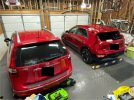
Anyway, 9/18/25, wife attempts to drive home from work, finds dead battery, and is unable to jump it. I drive in the next morning, jump it, swap cars, drive it home, and put it on the batteryminder. Over the next few days, I pull the battery and discover corrosion on the battery retaining bracket, so I clean up the metal and repaint it. I take the opportunity to put in an AGM battery. Eventually, the lightbulb in my head goes from "off" to "flicker", and I discover that the alternator has a dead diode. 9/22, I order a new alternator from rockauto. 9/25, local mechanic installs it, and all is right with the world.
A few weeks later, the car battery is dead again. Alternator diodes test good, but there is no output on the alternator. Down the rabbit hole we go, discovering that the one wire going to the alternator is actually a LIN bus connection. Interesting. Eventually, I start wondering what else could have gone wrong, aside from the alternator, and I begin to suspect the "intelligent battery sensor" [1] that is clamped to the negative terminal on the battery. All online parts resources as well as the service manual disavow all knowledge of this sensor on a 2017 Forester. I remove it, fondle it lovingly, clean it up, reinstall, and lo! The ECU now commands the alternator to charge. Problem solved!
..for a few days, anyway. The problem comes back. I buy a brand new battery sensor from a local Subaru dealership and install it, and things work again.
I am getting frustrated. We have The Talk about helping the car across the rainbow bridge. The EV tax credits have expired, but there's an orange turbocharged 2026 Hyundai Kona nearby for a reasonable price. I'd rented a normally-aspirated Kona earlier this year, and while underpowered, it was a nice car. KBB trade-in values on the Forester looked okay.
I happen to look on cars.com and discover that there are some other dealerships east of the Mississippi that have cut their prices to compensate for the loss of the EV tax credit. This changes everything! We started looking at Kona EVs, but none were available locally. There were Kia Niro EVs, though, which is basically the same car.
Despite having only 64k miles, we didn't get anywhere near the KBB trade-in value for the Forester. Maybe the joke's on them, what with the dog hair and the Lucas-like electrical system. In a last act of spite, it threw yet another "check electrical system" warning light on the day of the trade.
The sticker price on the Niro was 43k. After various discounts, rebates, the trade-in, taxes, and assorted FU fees, the bottom line was $30,277. IIRC, that is roughly what we paid for our cars in nominal USD in 2012 and 2017, which is pretty remarkable.
So, the Niro. I like it. The interface design is quite nice; intuitive, minimal bling. None of the "oh, you want me to do X? I'd be happy to do that! Let me do Y and Z for you as well, which you didn't ask for!" that drives me up a (*#$ing wall.
It drives like a car, which is more than I can say about the Forester's craptacular CVT software. Push pedal, objects in mirrors get smaller.
The driver assistance is subtle and unobtrusive.
It's quiet.
Somewhat surprisingly, the car didn't come with a portable level 1 charger, so I picked one up at ye olde autozone. It'll do fine until I can get a proper charger installed in the garage.