Moonshot

That is a terrible title not really supported by the text at all.

Never judge an article by its click-bait title.
;)

But the article does discuss why finding intelligent life elsewhere is much less likely than the original Drake equation showed.
 
Never judge an article by its click-bait title.
;)

But the article does discuss why finding intelligent life elsewhere is much less likely than the original Drake equation showed.
Honestly the entire article is pretty light on details but reading primarily the actual scientist’s quotes rather than the articles statements, the actual message is more along the lines of “uncertainty rules to the extent that we cannot make probability statements within even several orders of magnitude”. The article’s author latched onto the fact that the scientist came up with a distribution that had a bounds of 30-80 percent chance of no other life but again the scientists themselves say that the underlying inputs have massive uncertainty and those uncertainty compounds. The fact that one instantiation of a distribution happens to pop out 30-80% seems irrelevant to me.
 
Honestly the entire article is pretty light on details but reading primarily the actual scientist’s quotes rather than the articles statements, the actual message is more along the lines of “uncertainty rules to the extent that we cannot make probability statements within even several orders of magnitude”. The article’s author latched onto the fact that the scientist came up with a distribution that had a bounds of 30-80 percent chance of no other life but again the scientists themselves say that the underlying inputs have massive uncertainty and those uncertainty compounds. The fact that one instantiation of a distribution happens to pop out 30-80% seems irrelevant to me.

True, but it demonstrates Drake's original calculation was no more than a WAG.
 
True, but it demonstrates Drake's original calculation was no more than a WAG.
I mean yes of course. No one ever really said it wasn’t. I think the authors point was that the Drake equation is highly sensitive to even small changes in your priors, which themselves are highly uncertain.

Overall a lot of pop-sci and pop-statistics (like polling/election forecasting) articles are ultimately about trying to communicate the notion of uncertainty to the masses. Most people are very unfamiliar with how to deal with uncertainty in the scientific sense and think that probabilities are what they are rather than realizing that all statements of probability are models and models themselves have uncertainty.
 
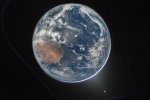
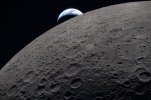
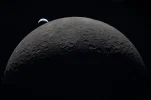
Artemis crew sent back this photo, just after the burn yesterday that pushed them out of orbit.

There are two auroras in the atmosphere, upper right and lower left. The zodiacal light in the bottom right is where Earth eclipsed the Sun.

IMG_9931.jpeg


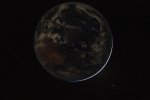
Edit: here’s another version, also from the NASA site.


IMG_9932.jpeg
 
Last edited:
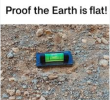
Partly cloudy with a chance of some saying that pic just proves the world is flat... ya know, like a quarter!
 
I was kind of half watching by that time. Did they call it out a few seconds before it happened and say "watch for this, its coming soon" or did they see it happen on the video and react?
They were discussing it for at least a minute or two before actual SRB sep.
 
For those who may have felt that NASA's launch coverage didn't quite hit the mark with respect to conveying just how amazing a launch is, allow me to present a nine-minute meditation on the subject:

 
Amazes me that here we are almost 60 years later, and just trying to figure out how to recreate those missions.
Not recreating the missions.

New missions with new goals.

Long-term exploitation of and presence on the moon.

Setting up for further space exploration. Using the moon as a base.
 
Amazes me that here we are almost 60 years later, and just trying to figure out how to recreate those missions.
Looking at some of the videos beamed back, this is a lot larger than Apollo. 4 crew members and they have a lot of room to float around. So there are larger engines, larger life support, etc. It's a bit more than simply recreating the old missions.
 
Looking at some of the videos beamed back, this is a lot larger than Apollo. 4 crew members and they have a lot of room to float around. So there are larger engines, larger life support, etc. It's a bit more than simply recreating the old missions.
Reminds me of people that say "Tesla! Bah Humbug, they had electric cars back in the 1800s".
Yeah, but they sucked compared to today's Tesla.
 
Last edited:
One thing that’s bugging me…

I’ve heard it said repeatedly on the news that the Artemis crew is the first to lay eyes on the far side of the moon. But several Apollo flights had crewed command capsules in orbit around the moon, so their crew would have also seen the far side as they orbited. I thought I was missing something, but Gemini seems to confirm that.

AM I missing something?
I imagine the Apollo missions landed in the 14 day period where "our" side of the moon is in sunlight. Perhaps the far side is facing the sun now (I'd have to do 10 seconds of work to confirm or deny that), and is therefore much more visible than when it was dark.

But yeah, you're right. It is a bit of hyperbole.
 
One thing that’s bugging me…

I’ve heard it said repeatedly on the news that the Artemis crew is the first to lay eyes on the far side of the moon. But several Apollo flights had crewed command capsules in orbit around the moon, so their crew would have also seen the far side as they orbited. I thought I was missing something, but Gemini seems to confirm that.

AM I missing something?

I imagine the Apollo missions landed in the 14 day period where "our" side of the moon is in sunlight. Perhaps the far side is facing the sun now (I'd have to do 10 seconds of work to confirm or deny that), and is therefore much more visible than when it was dark.

But yeah, you're right. It is a bit of hyperbole.
Have no idea how the CMs orbited back in the day, but it’s quite possible to orbit right along the light/dark border. As such the CM would always remain in contact with Houston.
 
One thing that’s bugging me…

I’ve heard it said repeatedly on the news that the Artemis crew is the first to lay eyes on the far side of the moon. But several Apollo flights had crewed command capsules in orbit around the moon, so their crew would have also seen the far side as they orbited. I thought I was missing something, but Gemini seems to confirm that.

AM I missing something?
IIRC, they're coming by at a higher altitude and different angle. There are some craters near the south pole that they can see into, unlike the Apollo missions.

Coming by at a higher altitude means that more of the surface will be visible to them. Since they're traveling further from Earth than the previous missions, they're higher above the moon, too.

Ron Wanttaja
 
I’ve heard it said repeatedly on the news that the Artemis crew is the first to lay eyes on the far side of the moon.
AM I missing something?

As always, there is nuance.

Because they flew so far away from the Moon, they got to see the entire far side of it at once, instead of the small portion you could see from the typical 60-mile orbit flown by Apollo.

Also, Apollo landings were timed for half-ish Moon phases, so you had some shadows that would offer you some good depth perception for landing.

With the current phase being almost full Moon, they got to see the far side illuminated mostly by Earthshine.
 
I listened a bit just before they had their eclipse, and through that, and with the interviews they did after. Four engineers, between 40 and 50 I think, three of which have already been on board the space station, all of whom have been training for this for years. Point being, they're not kids. All of them seemed completely stunned by the experience of the eclipse and of seeing the moon illuminated by the earth. They mentioned the experience in a way that made it clear that it was beyond what they expected. During the interviews pretty soon after, they're all playing with the microphone floating around in space, and laughing, as they're flying along and passing the 1000 mph mark on the way back.

Looks like they picked a great crew. Hope they have a save trip back, they're going to inspire a bunch of people.
 
As always, there is nuance.

Because they flew so far away from the Moon, they got to see the entire far side of it at once, instead of the small portion you could see from the typical 60-mile orbit flown by Apollo.

Also, Apollo landings were timed for half-ish Moon phases, so you had some shadows that would offer you some good depth perception for landing.

With the current phase being almost full Moon, they got to see the far side illuminated mostly by Earthshine.

Thanks! That appears to explain it, though the commentators certainly could have been more clear on the actual extent of this “first”.
 
With the current phase being almost full Moon, they got to see the far side illuminated mostly by Earthshine.

The far side is never illuminated by Earthshine. But, hmmm, if it's mostly full Moon now, the Sun is not illuminating the far side, except near the terminator. So what are they seeing... the surface illuminated by starshine?
 
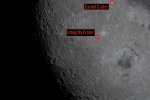
The Artemis crew named two new craters. Integrity is the name of their spacecraft. Carroll is the name of Mission Commander Reid Wiseman’s wife who died of cancer in 2020.

IMG_0156.jpeg
 
Back
Top