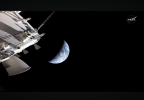
Moonshot

:) Maybe I could have phrased it better. I said I wasn't sure, not that I was certain. There's an emotional implication there that I don't think fits. I believe the great majority of people have genuinely good intentions. But as a group, we're kind of a mess and always have been. If we were cattle, I'd describe it as moving close to being on a feed lot vs happy cows grazing in a field.

I was going to quote that the price of freedom is eternal vigilance, and found out from uncle Google that the concept may go back to an 1790 speech by an Irishman named John Philpot Curran as "The condition upon which God hath given liberty to man is eternal vigilance". Which is maybe a better way to express it. My take on that is that assuming that everything is going to be fine is not a great plan. Extending it a bit, humanity is given the opportunity to survive, but we have to earn it.

Understood. Thanks for the clarification.

The only way we can earn it is by getting off this extremely vulnerable rock.

Humanity has been extremely lucky, but our luck can't hold. We arose on benign planet around a relatively benign star in a relatively benign solar system in a relatively benign region of the galaxy. I hate to bring up the dinosaurs who ruled this planet for 100s of millions of years. Most people think that is ancient history. In the 4 billion year history of Earth, it was yesterday. All of human history is but a few seconds. The solar system has not gotten safer since then, we've just been lucky.

Here's another way we could be wiped out.
 
Last edited:
ha ha...

sort of that thing where a person back then looks older than a person the same age looks now. They acted older and more mature back then too.

What appeared to me as a "steely-eyed missile man" back in the '60s would probably look to me like a non-serious wise-a$$ kid today, now that I'm in my '60s. Probably the white shirts, neckties, and crew cuts had something to do with it, too.
 
She was 46 at the beginning of production. Seemed really old to me, at the time, as I was still in elementary school.

In the early shows, there was a bit of a romance between Dixie and Dr. Brackett. In real life, Julie London (Dixie) was married to Bobby Troup (Dr. Early), but I think the producers decided nobody would believe such a romance in the show so they picked Brackett instead.
 
The only way we can earn it is by getting off this extremely vulnerable rock.
I'll let someone else volunteer to be a test subject for the joy of living in a cave.

Live in this full time for 5 years. It's probably about double the amount of sq-ft a mars pioneer will have per person. So comparably luxurious. You don't have to worry about an HVAC failure killing you because you can end the experiment any time you want by walking out the door. Since no mars base will be self sufficient, I won't demand that you be either. You can door dash any and all supplies you might need. Bonus points if you convince your dasher to go by the pseudonym "NASA".

However, you can't ever leave the tiny house. You can't open windows, in fact, we're going to seal them and you'll be breathing mechanically scrubbed air. You can have a 32kbps connection to the internet, since that's what Mars has. Your door dash orders are going to have a 9 month delivery time, so your taco bell is gonna be cold by the time it gets to you. As with all long term missions, you'll be drinking water optimistically labelled as "recycled".

Enjoy. I'm gonna go fly my 172 to Hard8 for BBQ.

1775830252517.png
 
150 years ago, 400 years ago, some people were happy living in "civilized" areas, developed areas (such as they were at the times). And some people sought opportunities elsewhere and some people sought exploration.

The people that want to explore, let them explore. The people who are happy with the city life or the suburb like, let them stay happy with it.
Totally fair, if it's their money. If one of the handful of people that have a hundred billion bucks wants to spend them launching a mission to the moon, or mars, and live under a rock, more power to them.

However, when they are spending my money, I want ten, or a hundred, or a thousand robotic missions doing better science instead. The point of NASA shouldn't be vanity projects.
 
In the early shows, there was a bit of a romance between Dixie and Dr. Brackett. In real life, Julie London (Dixie) was married to Bobby Troup (Dr. Early), but I think the producers decided nobody would believe such a romance in the show so they picked Brackett instead.
With his gray hair, he looked 70! He was 54 when filming began.

I loved that show as a kid. Too bad all of the shows today about emergency services have all those unrealistic over-the-top situations. I can't watch them.
 
However, when they are spending my money, I want ten, or a hundred, or a thousand robotic missions doing better science instead. The point of NASA shouldn't be vanity projects.
How is esoteric astrophysics studying the life and death of black holes, the source of Hubble's tension or early inflation or the building of massive, expensive gravity-wave detectors or dozens of other wet dream projects serve anyone except the industrial-military complex and a small clique of physicists and astrophysicists? How are they not vanity projects?
 
How is esoteric astrophysics studying the life and death of black holes, the source of Hubble's tension or early inflation or the building of massive, expensive gravity-wave detectors or dozens of other wet dream projects serve anyone except the industrial-military complex
Making the case that gravity physics (which is what all three of those examples boils down to) serves the MIC is gonna be a challenge. I'll look forward to reading your dissertation.
 
There are about 4.5 hrs until splashdown.

This is a screenshot from the live feed.
IMG_0158.png
 
This "front porch" thing is ridiculous. In the interview with the Navy divers, they said that this is designed to stabilize the craft in case of heavy seas. Dude...I'm watching them screw around with this in calm seas and it's taking forever. I can't imagine them trying to put this together in 6'+ seas. We're over an hour since splash down and nobody has been extracted yet. You could've towed the damn thing half way to San Diego harbor by now!
 
I'm REALLY curious what Elon Musk is thinking right now watching this whole thing go down. If I recall correctly, when he executed the rescue mission of our stranded crew on the ISS his company had them out of the capsule and on the ship in much less than an hour. I seem to remember the rescue boats being alongside the capsule in just a couple minutes. None of this SATCOM and 'front porch" BS.
 
I watched the re-entry and splashdown but had to miss the rest. Wonderful up to that point.
 
I watched the re-entry and splashdown but had to miss the rest. Wonderful up to that point.

It was wonderful up to that point. Then it took the USN two hours to open a hatch, drag the astronauts onto a fancy raft, then haul them up one at a time to a helicopter to fly them back to the ship. They could have hoisted the entire capsule and flown it back to SanDiego with less trouble.
 
Here's what the AI says about it.

Artemis II used helicopters for crew recovery instead of boats like Dragon crews due to Orion's design, reentry hazards, and precision needs.

Key Differences​

  • Reentry speed/heat: Orion hits ~25,000 mph lunar return (vs. Dragon's ~350 mph orbital), creating a toxic hypergolic fuel vapor cloud around the capsule post-splashdown. Helicopters hoist crew via basket from the "front porch" inflatable raft above the hazard zone before divers/swimmers approach.
  • Crew fatigue: After 10 days, high-G reentry (~11G), and ocean egress, helicopters get fatigued astronauts to the USS John P. Murtha's medical bay faster (~3,000 yards, minutes vs. boat hours).
  • Splashdown remoteness: 50–80 miles offshore San Diego; Navy helos (HSC-23 Sea Hawks) circle for rapid extraction vs. Dragon's near-shore boat/swimmer handoff.
Dragon uses boats because it's lighter orbital reentry, no toxic residuals, and SpaceX prioritizes swimmer recovery for speed/simplicity. Orion's Apollo-era heritage favors helo extraction for safety. Both end up on ships for checks.
 
A buddy of mine is in charge of SpaceX recoveries. He is a former SEAL Team 6 officer. Naval Academy and Harvard grad. Elon don't F around when it comes to talent.

On a lark, I decided to search for a picture of my buddy doing SpaceX stuff. See if you can guess which one is the former SEAL.

1662988100793.jpeg
 
How is esoteric astrophysics studying the life and death of black holes, the source of Hubble's tension or early inflation or the building of massive, expensive gravity-wave detectors or dozens of other wet dream projects serve anyone except the industrial-military complex and a small clique of physicists and astrophysicists? How are they not vanity projects?
The mountain is climbed because it is there.
 
How is esoteric astrophysics studying the life and death of black holes, the source of Hubble's tension or early inflation or the building of massive, expensive gravity-wave detectors or dozens of other wet dream projects serve anyone except the industrial-military complex and a small clique of physicists and astrophysicists? How are they not vanity projects?
That's pretty much how I felt about Algebra in the 7th grade. I liked geometry much better. My instructor used a diagram of a pool table and various angles using pool balls and queues to demonstrate calculating angles. I still use some of that stuff.
 
That's pretty much how I felt about Algebra in the 7th grade. I liked geometry much better. My instructor used a diagram of a pool table and various angles using pool balls and queues to demonstrate calculating angles. I still use some of that stuff.
That's Calculus and Physics for me. Acing physics because it was describing actual stuff, struggling in Calc because it was all theoretical. This in spite of most of the math being the same in both.
 
vs. Dragon's ~350 mph orbital
Perfect example of AI hallucinating - ISS orbital speed is 17,000mph
After 10 days, high-G reentry (~11G), and ocean egress, helicopters get fatigued astronauts
Another AI aberration. As opposed to an ISS astronaut who could barely stand up after 6 months in orbit?
 
Being able to get so much of the descent on camera was impressive compared to the old days.

But every time they ran out of useful things to say and cut to an interviewer asking somebody how they felt about it, I muted the sound and went to get another beer. Well, not really, that would have left me slobbering drunk. But I did mute the sound.
 
Back
Top