MauleSkinner
Touchdown! Greaser!
Because, you know, dying in a plane crash isn’t a big deal, but losing your airplane in a crash is expensive.As a pilot nothing.
As an aircraft owner everything.

Because, you know, dying in a plane crash isn’t a big deal, but losing your airplane in a crash is expensive.As a pilot nothing.
As an aircraft owner everything.
It's impossible to have all knowledge, but in every case ever -> More is better than less.How Much Systems Knowledge Do We Need?


A recent conversation about the secret life of controllable-pitch propeller systems has me wondering: How much knowledge about of the inner workings of aircraft systems and components does a pilot actually need? Using propeller systems as an example, do we really need to know about flyweights, speeder springs, servo pistons, etc.? Or could we fly just as safely and efficiently if we believed that the blue knob was somehow connected to a pint-size chamber inhabited by a magic elf who cranked the mechanism into compliance with our demands?

Immediate actionsGoing back to the OP's question on constant speed propellers.
You are in cruise flight and the rpm suddenly increases and no longer responds to the propeller control. Why? What can you as the pilot do? What could happen if you do nothing?
It's impossible to have all knowledge, but in every case ever -> More is better than less.
I disagree. Knowing that an uncontrolled increase in RPM on most single engine airplanes is the failure mode when oil pressure is lost gives the pilot the ability to recognize the issues and do the first three bullet points. Knowing that the opposite will happen on most multi engine airplanes gives the pilot the ability to recognize and deal with the issues in those.Immediate actions
- Reduce throttle: Close the throttle to the idle position to reduce engine power and slow the propeller.
- Pitch up: Gently raise the aircraft's nose to increase the angle of attack. This reduces the indicated airspeed and the load on the propeller, which can help decrease RPM.
- Check oil pressure: This is a critical step, as many overspeed events are caused by oil system failure.
- Follow the checklist: Refer to your aircraft's specific emergency checklist for the correct sequence of actions.
- Use speedbrakes (if applicable): On larger aircraft, deploying speedbrakes can help slow the aircraft down more quickly.
My first point is ss a pilot say renting a plane you go by check list pretty much. You really have no knowledge of said aircraft.

It's impossible to have all knowledge,


Is there any good reason for a pilot not to understand the systems they’re operating?Why so? I thought it was a legitimate question.


That response doesn't explain why you thought the question was a joke. To answer your question, a pilot should understand the systems they are operating. Like so many things, an inexperienced person wouldn't know that because of of how other things work. A new pilot may expect that, like a modern car, there is little they can do once the engine stop except get out of the traffic if possible. Good flight instructors get their students out of that mind-set, but there are some that do not. Also, not knowing the OP, the question might also be "why do I need to know all this stuff?" because their instructor may be teaching it without explaining the "whys".Is there any good reason for a pilot not to understand the systems they’re operating?
Obviously, you need to know the systems. There's a legitimate question as to what degree is required to safely operate an airplane. For example, engines require air, fuel and spark to operate. If your engine stops operating or is running poorly, one of those is to blame. Out of fuel, carb ice, bad mag etc. I really don't need to know about flame fronts or valve timing to understand and diagnose these basic issues. There's obviously a bit more than that, but if your engine starts acting funky - Fuel, Air, Spark is good quick mental checklist. If your engine eats a valve in flight, knowing what that is ain't going to help the situation.
The fact that most airplane engines are 4 cycle and have an intake, compression, power and exhaust stroke isn't going to make a lot of difference in your ability to diagnose an issue. Yet that's one of the things taught and tested on.
Knowing more vs less is always better, but there's a good discussion about where that line is drawn.
How would you explain how the blue knob controls the elf to a Cirrus pilot?A recent conversation about the secret life of controllable-pitch propeller systems has me wondering: How much knowledge about of the inner workings of aircraft systems and components does a pilot actually need? Using propeller systems as an example, do we really need to know about flyweights, speeder springs, servo pistons, etc.? Or could we fly just as safely and efficiently if we believed that the blue knob was somehow connected to a pint-size chamber inhabited by a magic elf who cranked the mechanism into compliance with our demands?
How would you explain how the blue knob controls the elf to a Cirrus pilot?

This is a good analogy that addresses the concept. An understanding of clockworks is nut-&-bolt-level knowledge that is meaningless to someone who just wants to know what time it is. Understanding that it’s a mechanical movement with a mainspring that has to be manually wound on a regular basis… well, that’s operation-level knowledge that would be quite essential, if one wishes to know the time.Me, I can’t read a digital watch without understanding how an escape mechanism works…. (Footnote)
*Highlighting the point you don’t always need to ACTUALLY KNOW what’s going on. System knowledge helps you understand and operate better, or may be required to handle malfunctions and abnormalities. The goal isn’t to repair it while flying, but rather, land safely.
My first major airline had once operated Electras. Very similar engines & props to the Herc. One of the crusty graybeards I flew with was aghast that my training class was only six and a half weeks. He blustered, “my class all went to the Electra. We spent an entire week just on the [expletive deleted] propeller.” I wonder if he ever found a use for all of that information.Ah, the mention of speeder springs is good for a long time ago flash back. After UPT some of us were assigned to C-130s. When we were in systems class it was deer in the headlight time once the instructors started in on the props. All of us new pilots were just looking at each other with out a clue of what they were talking about.
No, I’m dead serious! Little blue magic elves run the show. The whole thing about flyweights etc. is a grand conspiracy!I hope this is a joke.
Well, those pilots apparently didn’t know that MCAS even existed. Ultimate systems-knowledge failure. But an in-depth nuts-&-bolts understanding would not have been more useful to them, in the heat of the battle, than solid operation-level knowledge.A perfect example of a lack of knowledge becoming a tragedy, the 737 Max MCAS system.
But that’s not really it, at least, not all of it. More later. Maybe.On the other hand, I once had a pilot come to me wanting a high performance endorsement. He spent a month or more self learning about constant speed propellers, and by the time he came to me to fly had worked himself into an absolute fit about being able to operate one. We started off in the classroom, where I tried to explain some of his misconceptions but he didn't believe me. Then we went flying. After the flight, he remarked, "THAT'S IT?"
Agree with that, Dan. And all that is needed is a very basic understanding of how a carburetor (and the heat system) works. Operation-level stuff. I have been flying my plane for years without knowing a lot about the carburetor. Recently I studied an exploded diagram of the thing and the complexity was almost frightening. Lots worse than even an old Quadrajet. I wish I’d never seen it.Carb ice is one of those things that can't be induced at will to demonstrate it. So the student needs to know what it's all about and the conditions conducive to it, what to do and what to expect. Anything less and he's severely handicapped.
Option two was intended as a rhetorical device, not a choice. Yes, somewhere in between. But where?The question posed makes the standard internet error of forcing a false binary choice. No, you probably don't need advanced engineering knowledge in most cases. Yes, magic-elf level knowledge is probably inadequate. The answer obviously lies in between the two extremes given.
And you confirm that the oil pressure and temperature are normal. What could be the problem?You are in cruise flight and the rpm suddenly increases and no longer responds to the propeller control. Why? What can you as the pilot do? What could happen if you do nothing?
Jeez, the wreckage hasn’t even stopped smoldering yet. Call me old-fashioned, but I’ll wait for the NTSB findings.Read the King Air story being analyzed right now in a parallel thread.
If the pilot had read and understood the POH, most likely they would have not died.
This one resonates with me…This is a good analogy that addresses the concept. An understanding of clockworks is nut-&-bolt-level knowledge that is meaningless to someone who just wants to know what time it is. Understanding that it’s a mechanical movement with a mainspring that has to be manually wound on a regular basis… well, that’s operation-level knowledge that would be quite essential, if one wishes to know the time.


You can if you want to.Rental planes you never know.
What part did you disagree with? Just wondering.I disagree. Knowing that an uncontrolled increase in RPM on most single engine airplanes is the failure mode when oil pressure is lost gives the pilot the ability to recognize the issues and do the first three bullet points. Knowing that the opposite will happen on most multi engine airplanes gives the pilot the ability to recognize and deal with the issues in those.
It’s hard too unless they let you remove the cowling, interior panels. You can ask for log books buy they don’t have to let you.You can if you want to.
“a pilot say renting a plane you go by check list pretty much. You really have no knowledge of said aircraft.”What part did you disagree with? Just wondering.

Best part of owning a plane and doing oil and plugs is it gets you inside look at everything.
I spent two weeks on Electra training. That propeller system does indeed justify days of training. The governor is a huge thing that mounts to the backside of the prop and rotates with it. It has four hydraulic valves on its periphery that sense various factors and feed into the adjustment of the blades. There are electrical systems in it, too, controlled by slip rings and brushes carrying signals from the pilots. It's the green thing, here:My first major airline had once operated Electras. Very similar engines & props to the Herc. One of the crusty graybeards I flew with was aghast that my training class was only six and a half weeks. He blustered, “my class all went to the Electra. We spent an entire week just on the [expletive deleted] propeller.” I wonder if he ever found a use for all of that information.
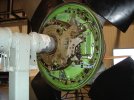
If the governor control cable disconnects from the governor control arm, a spring sends the governor setting to full RPM.And you confirm that the oil pressure and temperature are normal. What could be the problem?
I have been a renter/club member for all of the 35 years I have been flying. I've rented in Massachusetts, Connecticut, Florida, California, North Carolina, South Carolina, New York and probably a few I've forgotten. So far, I have not come across one which would deny a customer the ability to view the aircraft logbooks if they wanted to check something. I figure it would take one checkride discontinuance when the DPE asked the applicant to prove airworthiness and all they had was a dispatch sheet (let alone an investigation into a pilot for flying something unairworthy).You can ask for log books buy they don’t have to let you.
I guess we both disagree with that“a pilot say renting a plane you go by check list pretty much. You really have no knowledge of said aircraft.”

I figured we might.I guess we both disagree with that
No doubt, it’s a marvel of complexity. But if I’m correct, your training was aimed at AMTs who have to diagnose, repair, and overhaul the beast. From a pilot perspective, far less knowledge would be required in order to operate it.I spent two weeks on Electra training. That propeller system does indeed justify days of training.


Not really, pitch runaway is something covered in training... but you gotta understand what the airplane is telling you in order to correct it.A perfect example of a lack of knowledge becoming a tragedy, the 737 Max MCAS system.


Try SCE to Aux.Ernest K. Gann tells a story of an experience in “Fate is the Hunter” that he had while flying a DC-4. The intakes on the cowlings were icing over and the engines were being starved of air. The pilot knew enough about his engines to intentionally backfire the engines throgh the carbs to blow out the buildup of ice in the intakes. If it wasnt for that, that plane would’ve gone down for sure. Knowledge on engine operation above and beyond what the POH needed was what saved the day.
But to what level? At a certain point, more knowledge isn't going to help, and knowledge of anything you can't affect from the cockpit in flight is likely useless.Is there any good reason for a pilot not to understand the systems they’re operating?
This might be a good thread to point out what psychology refers to as “the illusion of knowledge,” the tendency for people to overestimate their understanding of how things work. Interestingly, it’s in an inverse relationship with expertise.


After giving this some thought, it seems that we have to define “thorough comprehension,” for the purpose of flying the airplane. For any combination of pilot and aircraft, there are undoubtedly one or more systems/components for which a true expert could identify significant gaps in the pilot’s knowledge. Using Kritchlow’s example in #74, would you characterize his knowledge of the location of the secondary fuel nozzles as “thorough comprehension?” If so, I would reply by agreeing with Kritchlow’s point that such knowledge was superfluous and entirely useless from a pilot’s perspective, and go on to add that even that level of comprehension would be far from thorough.Judgement exercised without thorough comprehension of the underlying systems involved in the situation is no more valuable than superstition.
I like the way that this reads. But I don’t grasp what you mean when you equate checklists to religion. Would you elaborate?Checklist = religion
Systems understanding = science

