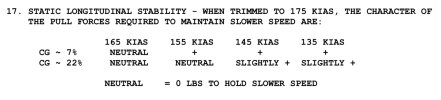
Is stall a pilot problem? Or is it an airplane problem? If you have neutral longitudinal stability, it is an airplane problem. But it is also that particular airplane’s normal operation hence nothing flags it as an airplane problem.
It's a combination, inextricably linked.
The whole purpose of checking out in the aircraft is to learn the quirks. The problem is, pilots tend to revert back to their basic trainer, when it comes to muscle memory. Homebuilts are not required to meet FAR 23 requirements, though the designers often get compliance as close as they can get it. I flew backseat with Dick Van Grunsven when they were developing the RV-8; he complained that the stick force per g was not where he wanted it.
But...again, there's no requirement to comply. All aircraft are compromises, and the designers of homebuilts often focus on performance rather than handling. There are a number of cases where this has bit the pilots (Polliwagon, Wheeler Express, etc.) so it's certainly not unknown in the homebuilt industry.
Some people are willing to accept the compromises for the performance; the owner of a Lancair 235, for example, has the same engine as a Cessna 150 yet owners would be up in arms if it only matched the performance of the lowly Cessna. Yet you have to pay *somewhere*. Unfortunately, pilots have big egos, and may not want to admit that the plane is more than they can handle. They buy fancy sports cars and wrap them around trees, too, but the odds of survival are higher.
The three Lancair Legacy accidents involving stalls give some interesting insight. CHI08FA224 involved a Private pilot with 1700 hours, but only ten in type. CEN12CA263 had a commercial pilot with 750 total hours, but 160 in type.
The most recent, CEN24FA164, is interesting. Private pilot with 476 hours total time, no record of time-in-type. He had his logbook in the airplane....but it wasn't much help.

The writeup is telling....
"The flight instructor who completed the pilot’s flight review on June 10, 2023, reported that the pilot flew to the required standards; however, he noted that without use of the autopilot, the pilot had trouble maintaining the airplane on course. The instructor further reported that he felt the accident airplane was not a good fit for the pilot’s abilities..."
The report on this ends with a section describing the problems inherent with pilots transitioning to high-performance aircraft. It references Advisory Circular 90-190A, "Transition to Unfamiliar Aircraft" (of which I am one of the co-authors) and quotes this segment:
FAA Advisory Circular 90-190A, Transition to Unfamiliar Aircraft, classifies the Lancair Legacy FG airplane as having high-inertia and/or low-drag flight characteristics, meaning that is an
airplane that decelerates slowly when power is removed. This document discusses the inherent risks/hazards of this type of airplane and states in part: Airplanes in this family are generally fast, efficient, and may have significant range; however, the hazard is that unless managed, these airplanes can build excessive speed during critical flight phases such as approach and landing. The risk of unmanaged speed includes overshooting final approach, inadvertent stalls, loss of control, wheel barrowing, and runway excursions.
So, what's to be done?
How do the militaries do it? They weed out those who can't hack it. Not an option in civilian life; an instructor can refuse to sign someone off, but that person can still plop money down on the counter and buy a nice used Lancair or Lamborghini. We don't know why this particular owner decided to buy a Lancair.
What's the alternative? Establish Part 23-like standards for homebuilts? That literally flies in the face of the EAB tradition in the US. IIRC, the Australians test homebuilts, and actually banned the Lancair due to the stability issues and others (believe it was just the early models). The UK has standards homebuilt aircraft have to meet as well.
But not the US. And I don't think the community would allow it, and, at this stage, I don't think the FAA would even try.
Until then, we just have to work on education. After the original article in 2010 came out, someone from LOBO (Lancair Owners and Builders Organization) contacted me to discuss the results. He said the accident rate among those Lancair pilots who took the LOBO-designed training program was much lower than overall.
There are two ways to slice that. One can assume that the training improved knowledge and pilot skills...but one can ALSO assume that someone who seeks out such training is already safety-minded.
I give LOBO a lot of credit, though.
The usual argument against standards is wrong: "We don't want our homebuilts to comply with Part 23, we don't want to fly trucks!"
And, of course, the Pitts Special is a fully-certified airplane. Never flown one, but I have never heard they fly like trucks.
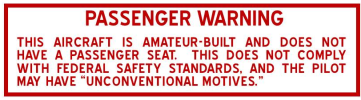
But, still, many popular amateur-built aircraft were also amateur-designed. I fly one. Not every designer is a Van Grunsven, Thorp, or Stits. All of our aircraft are required to have a big "Experimental" sign and a sticker that says they do not comply with airworthiness standards*. All designs are compromises, and those who want their compromises on the side of performance have to understand they may be reaching unfamiliar ground.
The Lancair IV is a good example. High accident rate. High fatality rate.
But...it has performance equal to a WWII fighter, and carries four people. That's a serious attraction.
Ron Wanttaja
*mine is a bit different: