@
Llewtrah381
Looks like I owe you an apology. When I wrote
post #94 I was convinced that your perspective was inextricably mired in a negative opinion of Mike Busch (e.g. blowhard, salesman) and you therefore had no interest in a good faith examination of the topic. But I was wrong: since that post, you've been actively seeking a better understanding of engine operation, the significance of the red box vs. CHT, etc. Mea culpa.
Disclaimer: I am not a scientist, and what I can now recall of chemistry is scant and dubious. The information presented below is may be partly or complete baloney. If so, I trust that someone will set me straight.
When I wrote that a "deep dive into the hidden mysteries of the combustion process in a piston engine" is a "journey that your background has prepared you to undertake," I was not being sarcastic--I was referring to your education in chemistry. I think that the real answers to your questions are rooted in the combustion process itself. Please consider the following: normal combustion within the cylinder takes place as
deflagration, a radical chain reaction driven by chain-branching reactions that results in progressive combustion within a relatively uniform flame front that advances from the point of ignition. At the boundary between the flame front and the unburned mixture is the
end gas, which is being compressed and heated adiabatically by the expanding flame front as well as piston stroke, and also being radiantly heated by surfaces forming the combustion chamber. If the temperature of the end gas increases to certain point the chemistry transitions into high-temperature chain branching, which exhibits high activation energy but produces two radicals from one, causing explosive radical population growth. This is the moment of autoignition, in which the end-gas explodes all at once rather than burning progressively. This detonation event typically occurs in localized areas within the end gas, and when severe it can disrupt the cooler boundary layer gas that insulates the metal surfaces of the piston and cylinder head, causing a rapid rise in piston temp and CHT.
When ROP, the combustion process is liquid-cooled--that is, excess fuel absorbs heat and, in sufficient quantity, prevents the temperature of the end gas from reaching a point at which detonation can occur. As we lean the mixture toward stochiometric, there is less excess fuel to keep the end gas cool, while the ICP increases and peak ICP moves toward TDC. At some point as we approach a stochiometric mixture, there is insufficient excess fuel to cool the end gas enough to prevent detonation (at least, at higher power settings). In addition, Peak ICP moves into a range in which the angular relationship between the wrist pin and crankpin does not allow efficient conversion of heat energy to mechanical energy. CHT and piston temperatures increase, which compounds the condition and may result in thermal runaway. If a part such as a spark plug electrode becomes hot enough, pre-ignition can occur.
Once the mixture is leaner than stochiometric, the combustion process becomes air-cooled. Air (Oxygen) not consumed by combustion absorbs heat and reduces the temperature of the end gas. At this point, the leaner the mixture, the cooler the end gas temperature. CHTs will decrease up to the point at which silence ensues and room temperature is reached. One obvious advantage here is that we are not using excess fuel to cool the combustion process and then dumping it, unburned, out through the exhaust.
The red box (fin) represents a range of fuel/air mixtures in which there is neither excess fuel, nor excess Oxygen, to cool the end gas enough to prevent detonation. Thus detonation is not so much about the specific engine design, but the chemistry of the combustion process itself.
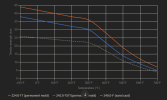
As for CHT limits, I believe that the heads of your O-360 (and many cylinders manufactured by Lycoming, TCM, and Franklin) are cast of A242.0 alloy. As a representative example, below is a graphical depiction the approximate relationship between heat and tensile strength for A242.0, taken from data contained in ASM's
Introduction to Aluminum Alloys and Tempers. Note that the A242 alloy here is tempered per T571 standard--I don't know what the actual temper of the alloy used by Lycoming is.
@
Llewtrah381, I appreciate your genuine interest in this topic and your perseverance in seeking answers to your questions. It has morphed into an interesting thread, with a lot of good information supplied by several members.
As a last reminder, I'm just SGOTI and the preceding is intended for amusement purposes only.