
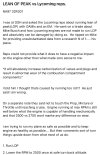
I pulled this from a Facebook group. Lycoming’s take on LOP, per their reps at OSH. Would it void a warranty? The reps take and my mechanics opinion are in alignment here.


Exactly right!It boils down to: Is he really giving you what is best for the engine, or what is best for selling engines? Who lnows, crap shoot.


There are plenty who still feel that way.My mechanic has always encouraged ROP saying the extra fuel burned is cheaper than an engine.
Assuming you’re not going high enough for full rich to cause problems. Does Lycoming documentation really indicate that climbing to 10,000 feet or higher should be done full rich?Not touching any knob in the climb until you reach cruise is solid advice. Leaning in this configuration is a no-no.
On engines with manual control, maintain mixture control in the FULL RICH position for
rated take-off, climb and maximum cruise powers (above approximately 75%). However,
during take-off from a high elevation airport or during climb, roughness or loss of power can
occur from over-richness. In such a case, adjust the mixture control only enough for smooth
operation - not for economy. Monitor instruments for temperature rise. Rough operation due
to over-rich fuel/air mixture is most likely to be encountered at altitudes above 5,000 feet
(1524 meters).


For some of us, every flight is 10K or higher.....wait, if I'm only going to Pueblo for lunch, then I'm at 9500. Things are finally cooling off around here. After all, my ground is higher than Lycoming's "high altitude climb" instructions. Right now, DA at KAPA is 8,050 feet MSL.How many of us are climbing to 10,000 on every flight?
Let's go see what Lycoming says:
According to the official Lycoming Operator's Manual and Service Instruction No. 1094D, the standard recommended procedure for a normally aspirated IO-540 engine during a climb from sea level to 10,000 feet is to maintain a Full Rich mixture setting.
However, Lycoming provides specific criteria and manual adjustments for high density altitudes as you climb higher.
1. Standard Climb (Sea Level to 5,000 Feet)
- Setting: Leave the mixture control lever in the Full Rich position.
- Reason: At high power settings (greater than 75% power), the excess fuel provided by a full rich mixture is structurally required to assist in engine cooling and prevent detonation.
- Monitoring: Constantly monitor your Cylinder Head Temperatures (CHTs). For maximum engine service life, Lycoming recommends keeping CHTs below 435°F (224°C).
2. High-Altitude Climb (5,000 to 10,000 Feet)
As you pass 5,000 feet density altitude, the thinning air will cause a standard full rich mixture to become overly rich. This can cause engine roughness, spark plug fouling, and a significant reduction in climb power.
- Adjustment: Lycoming specifies that for 5,000 feet density altitude and above, you may lean the mixture to smooth out the engine and regain lost power.
- The "Target EGT" Method: Smoothly and slowly pull the mixture control back. Lean the engine just enough to re-establish the same average Exhaust Gas Temperature (EGT) values that you observed during the full-rich takeoff at sea level.
- The Flowmeter Method: If your aircraft is equipped with a calibrated fuel-flow gauge or a placard, lean the control to match the specific fuel-flow target listed for that altitude at climb power.


Is he really giving you what is best for the engine, or what is best for selling engines?

FIFY.It boils down to: IsheMike Busch really giving you what is best for the engine, or what is best for sellingenginessubscriptions to his services? Who knows, crap shoot.


FIFY.
One side makes and sells engines and carries the risks thereof. The other doesn’t make engines, doesn’t do any bench-level testing that I know of, and makes a profit from aggregating (cherry picked) data they didn’t personally do the research to create plus a relatively small N of personal experience. That is, one is an expert in their product and the other is more or less SGOTI on steroids.
Now THAT’s a religious statement!
A "self-sealing" conspiracy theory is a belief system structured so that any evidence against it is reinterpreted as proof of its truth, making it completely immune to disconfirmation. The term describes the closed-loop, circular logic that seals the theory off from external reasoning or factual correction.
Just stirring the pot, man!

True. And kinda proving my point.I would surmise that Savvy actually has more data to back their position than Lycoming.


He talks about the “red fin” and running a “high” CHT. Has he done any tests on engines in a test cell where variables are controlled, to back up his gospel-like assertions? Not to my knowledge but I’m happy to be shown I’m wrong.

Okay Doc, go do your homework, and say hello to Charles Lindberg for me.I’m a physician and was taught since medical school to understand the nature of the study making a point and to know its limits. We did a lot of research “journal clubs” to look past the assertion of an article’s title and see if the study proved the assertion.

That's only true if he can demonstrate that the engine's longevity is significantly affected by running LOP/ROP.My mechanic has always encouraged ROP saying the extra fuel burned is cheaper than an engine.
That's why I run LOP: The folks who brought us LOP before anyone knew of Mike Busch knew their stuff and backed it up with data and explained exactly why it's better to run LOP. The folks who say to run ROP cannot provide any evidence or explanation as to why you should do so.Fair enough but but everything I know about engines tells me LOP should be better for the engine since excess fuel leads to carbon buildup. If I'm wrong I'm wrong but I don't think I've ever heard a good technical explanation of why and it just doesn't make sense.
Not true whatsoever. Pulling back the prop is done for the airport neighbors, not to avoid wear and tear in the climb.Not touching any knob in the climb until you reach cruise is solid advice. Leaning in this configuration is a no-no.
And here, I think you may have hit on the reason Lycoming has to get religious about this. I run LOP on my *Continental* IO-550-G, without GAMIjectors. In fact, it's book procedure for best economy in my 1997 airplane, before APS or Mike Busch became well known. Why? Because it has a balanced induction. My "GAMI Spread" is about 0.3 gph with my bone stock factory engine. Runs LOP beautifully.For those of you who operate LOP, do you do that with an engine as built by Lycoming, or so you modify and/or ensure that fuel flow to each cylinder is balanced?
Huh. How about that.And yet the contental folks had an entire talk on running LOP and doing it correctly.
While Mike Busch didn't personally do the testing, he is good friends with George Braly, who *DID* do a lot of testing. George is the researcher, Mike is the PR department. Plus, Mike likely has more access to GA engine data than anyone else via Savvy Analysis.One side makes and sells engines and carries the risks thereof. The other doesn’t make engines, doesn’t do any bench-level testing that I know of, and makes a profit from aggregating (cherry picked) data they didn’t personally do the research to create plus a relatively small N of personal experience. That is, one is an expert in their product and the other is more or less SGOTI on steroids.
Yeah, I've had plenty of A&Ps tell me I'd never make TBO with my IO-550. I've also had plenty of A&Ps tell me that I shouldn't run LOP. And yes, they're guys that I respect that do fantastic work.Don’t trust busch or savvy. they charge a fortune for service that is completely automated. also have had too many a and p’s i respect tell me lop is quickest way to burn out an engine.
Au contraire. Any of the Garmin systems, at least, DO store OAT, altitude, airspeed, fuel flow, and lots of other stuff that's interesting when it comes to analyzing engine temps. They don't know weight directly, but weight has no affect on "load on the engine" in a propeller powered airplane - The load on the engine comes from the air, the performance one gets out of the airplane is what varies with weight.He has gathered a lot of data from uncontrolled sources. Engine monitors don’t know, let alone report, stuff like ambient temperature, altitude, weight of the aircraft (so, load on the engine) and a host of other parameters.
Mike himself hasn't, but his good friend George Braly, founder of GAMI and Tornado Alley Turbo (among others), has.He talks about the “red fin” and running a “high” CHT. Has he done any tests on engines in a test cell where variables are controlled, to back up his gospel-like assertions? Not to my knowledge but I’m happy to be shown I’m wrong.
Completely agree on 5,000 being nonsense. It's an arbitrary number. Once at some arbitrary number then its ok to start leaning? Ok... How much should I lean? Shrugs.Also, pulling back the mixture in climb to keep the EGTs roughly where they were at takeoff is the only way to keep power where it should be. Lycoming's 5,000 foot thing is absolute nonsense. If you shouldn't lean in the climb below 5,000 feet, then your engine isn't running rich enough on takeoff either, because you're getting richer as you climb unless you start leaning.

if God had meant man to Fly Lean Of Peak he would have given him……… ???I pulled this from a Facebook group. Lycoming’s take on LOP, per their reps at OSH. Would it void a warranty? The reps take and my mechanics opinion are in alignment here.
View attachment 153821
While this is true, and is the reason I cruise at 2300 and change (the minimum recommended by Conti for my engine), and is more efficient, it still results in less power.As far as pulling back on the blue knob. Aside from keeping neighbors happy. It also minimizes friction hp loss.
Tell that to the guy who was at 3000 feet so never leaned it out and ran out of fuel because the performance charts also assume you lean for cruise...I think Lycoming says what they say out of simplicity. It's far easier to make blanket statements to cya. Youre engine is making less than full power because you're overly rich at 4,999 feet. But you're still safe as opposed to the hamfisted operator that doesn't understand how to lean in climb and nukes a cylinder by leaning past the rop

But are you leaning to re-establish the average EGT values that you observed during the full-rich takeoff at sea level?For some of us, every flight is 10K or higher.....wait, if I'm only going to Pueblo for lunch, then I'm at 9500. Things are finally cooling off around here. After all, my ground is higher than Lycoming's "high altitude climb" instructions. Right now, DA at KAPA is 8,050 feet MSL.

I’ve never had the opportunity to fly at sea level. Not in 26 years with the Cherokee. Like I said…my ground is higher than Lycoming’s 5000 ft definition of high altitude. First thing newbies learn out here is how to lean.But are you leaning to re-establish the average EGT values that you observed during the full-rich takeoff at sea level?
Not touching any knob in the climb until you reach cruise is solid advice. Leaning in this configuration is a no-no.
Now, no LOP running? They need to provide data to support LOP ops are bad. I am certain they have tested this. Don't make general statements- show me data that supports your recommendations.
I pulled this from a Facebook group. Lycoming’s take on LOP, per their reps at OSH. Would it void a warranty? The reps take and my mechanics opinion are in alignment here.
View attachment 153821
My point exactly. George has done the original research and has skin in the game. Mike is the salesman with no real risk exposureWhile Mike Busch didn't personally do the testing, he is good friends with George Braly, who *DID* do a lot of testing. George is the researcher, Mike is the PR department
That was my joke/point. I have done 4 sea level takeoffs. Most of us, at least between the Appalachians and the Cascades, aren’t going to get a lot of use out of a technique where the first step is virtually never available to us.I’ve never had the opportunity to fly at sea level. Not in 26 years with the Cherokee. Like I said…my ground is higher than Lycoming’s 5000 ft definition of high altitude.

A "self-sealing" conspiracy theory is a belief system structured so that any evidence against it is reinterpreted as proof of its truth, making it completely immune to disconfirmation. The term describes the closed-loop, circular logic that seals the theory off from external reasoning or factual correction.

if God had meant man to Fly Lean Of Peak he would have given him……… ???
