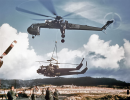
So, how can a helicopter suck? First, to blow well, you must suck. Obviously the helicopter is sucking air from above. You can argue the verb such saying it really is pushing air down below but again, consider a swimmer in a riptide. Is the swimmer sucked or pushed to sea? Yet most all of us say the swimmer is sucked to sea. So on the face of it a helicopter sucks. Further we have recirculation, and this is closer to where our concern lies but not quite there yet. Toward center of disk we have slower rotation on the blade and much less force throwing air down. As a result we don’t increase pressure below the center of disk so much. Hence we tend to get a back current of flow. Similarly, we have rotor vortices like wing vortices thus we also get a bit of recirculation at the tips. Air from below gets sucked up above. Don’t **** out the door of a helicopter. But we’re more looking for the downwash which gets turned into outwash. Here our models lead us astray. We tend to think of this as down and out. Such is readily seen as false though recent research is showing it to be even more false than what we may readily see. For our consideration here, we don’t need to get into the complications exposed by recent research. We can use the simple down and out model and adjust it. If we throw air down, we get a stagnation point below of high pressure where the down met the ground. From here we get the out. The out doesn’t exist independently. It presses into other air. It won’t simply be an out. Much like turbulent flow across out wings, it is going to have back flow. It is going to curl up then back. Picture an upside down mushroom cloud. The new research shows we will also have lots of gusting in this to include opposite direction gusts but for our purposes, the donut is good enough. Near the ground this sounds like a push not a suck, so what gives? Here we need to consider the fixed wing airplane’s aerodynamics. We have a forward velocity to which we have a conservation of momentum. Inertia. And we have stabilities. Directional and longitudinal are our big players here though we should also consider lateral. The plane gets hit by wash from the right. Directional stability abruptly yaw right. The plane has a sudden headwind and updraft. The plane pitches up. The plane is now pointing toward the helicopter while it still has forward velocity. The plane tops the updraft aspect for the outwash curl and now has a momentary tail wind component, pitch drops. Abrupt right yaw with pitch up then forward are all consistent and coherent with encountering wash. Lateral stability, however, suggests a left roll away from the right wind. But directional should be stronger than lateral. And we have a harder time seeing roll in the video for a couple of reasons. The plane already has some bank likely from encountering the left vortex prior to the wash. Such would roll right hence right bank. Next the camera itself. It doesn’t seem to have fisheye or other distortions as the background trees seem consistent, however, our sight line tricks us. We have a little bit of planform view as the plane enters the field of view following the runway. Such is from a bit of right bank. Now we get the sharp yaw right. That same bank but with a more perpendicular heading from the plane gives us much more planform view. Such makes any left roll hard for us to perceive. The helicopter was not three diameters from the runway, wash was definitely over the runway. Yet a statement that the helicopter was well away could lead us to negate this coherence. Meanwhile, yes, a helicopter can readily suck a plane into the rotor system due to the interplay of the plane’s stability dynamics and inertia.I’m copy pasting…
Did the wash do this here? Plausible. Likely. But you could argue the preceding vortex did it and the deal was sealed with that vortex. Such also has coherence and we have past examples of vortices throwing planes around in similar manner. Though such is still a case of helicopter sucking plane into it. And is also a case of helicopter not actually being well away from the runway so as to be in a position to be hit.
Other hypotheses. Botched go around and trim stall. Simply didn’t see the helicopter. Let’s look at the latter first. Didn’t see it so hit it is rubbish. The plane was tracking along the runway until it was in unusual attitude and not in controlled flight. If you’re out of control, seeing and avoiding is irrelevant. The lack of visual could have contributed, however, to Cessna believing he had better spacing or believing there was no wash present. As to botched go around, I’m not buying it. Timing sequence is off as is direction of deviation. The plane already had a flat pitch while along runway as it entered the field of view. This suggests it was already at speed having already powered up while properly managing the nose. It’s flaps were also up suggesting either the approach was no flap or that clean up in go around was already done meaning the time for trim stall and power on stall had already passed. Further the plane went right not left. We generally expect left deviations with inadequate rudder for power. The plane’s rightward was also too aggressive for excessive rudder. Not seeing a botched go around here. Yet the misstatement of the helicopter being well away mistakenly takes us toward botched go around.