C150 hits Helicopter, Carlisle, PA, Fatalities, 8/19/26

Anyone have a wind call?
No AWOS at N94. At the time of the accident, KCXY (15 mi east of N94 and home base of the accident B407), was reporting wind 270/5. Same for the hour before and after the accident.

The N94 windsock is adjacent to the runway 28 threshold so the C150 and B407 pilots should have been aware of the local wind conditions.
 
That would carry the wake vortex from where the helo was hovering to about where the aircraft was upset.
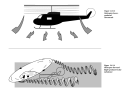
You'll find the wake vortex from forward flight and the downwash (rotorwash) from a hover are different aerodynamic results. The former happens after transitional lift and flows off the blade tips similar to wake vortex off an airplane's wings. It changes to rotor downwash when transitional lift is lost and flows out in all directions below the rotor disk and will be affected by the surface texture. See below. While the forward flight vortex can be altered by the wind, the hover downwash will not move in the same manner. So in this case, given the recommended separation distance/time for helicopter wake turbulence is 2 miles and 2 minutes, if the 150 approach to the runway was in less than a minute behind the 407, they ran into the existing wake vortex once they hit 15 feet and well before the static downwash from the hover position. There are a number of documents on this if you choose to look into further.

1787527352108.png
 
The helicopter pilot in the right seat had a Airline Transport Pilot - AIRPLANE Multiengine/Single Engine land, but did NOT HAVE ANY HELICOPTER rating.
The CFI providing instruction in the left seat had a commercial helicopter license / CFI.

Questions:
WHY was anyone receiving primary helicopter instruction in the Commonwealth of Pennsylvania's State Police helicopter?
WHY is any non-helicopter pilot allowed to receive primary helicopter instruction in Pennsylvania's State Helicopter, and what PSP policies specifically permit this?

WHY was Pennsylvania's state police helicopter flying an 11-mile straight-in to the narrow runway at N94? (It was widened from 40' to 60' maybe 15 years ago, but still a pretty thin runway without a parallel taxiway...not any room for hanging out in the runway environment, which may (may!) cause a trailing aircraft to believe they are landing fully instead of keeping wake turbulence/downwash present. This is certainly not an AIM best practice for rotorcraft or fixed wing.

WHY did the Pennsylvania state police helicopter not exit the runway environment (at least 3 rotor blades away from runway) immediately after landing---or land---or touch and go? Why the stalling around next to an active runway?

WHAT was going on with CTAF conversation between the Helicopter and C-150? There were some witnesses who mentioned extensive back and forth "get off my lawn, we're the official State Police, we can do whatever we want" type of chatter transmitted from Pennsylvania's helicopter.
Yeah, that's not going to go over very well. They might as well get the checkbook out at this point
 
The helicopter pilot in the right seat had a Airline Transport Pilot - AIRPLANE Multiengine/Single Engine land, but did NOT HAVE ANY HELICOPTER rating.
The CFI providing instruction in the left seat had a commercial helicopter license / CFI.

Questions:
WHY was anyone receiving primary helicopter instruction in the Commonwealth of Pennsylvania's State Police helicopter?
WHY is any non-helicopter pilot allowed to receive primary helicopter instruction in Pennsylvania's State Helicopter, and what PSP policies specifically permit this?

WHY was Pennsylvania's state police helicopter flying an 11-mile straight-in to the narrow runway at N94? (It was widened from 40' to 60' maybe 15 years ago, but still a pretty thin runway without a parallel taxiway...not any room for hanging out in the runway environment, which may (may!) cause a trailing aircraft to believe they are landing fully instead of keeping wake turbulence/downwash present. This is certainly not an AIM best practice for rotorcraft or fixed wing.

WHY did the Pennsylvania state police helicopter not exit the runway environment (at least 3 rotor blades away from runway) immediately after landing---or land---or touch and go? Why the stalling around next to an active runway?

WHAT was going on with CTAF conversation between the Helicopter and C-150? There were some witnesses who mentioned extensive back and forth "get off my lawn, we're the official State Police, we can do whatever we want" type of chatter transmitted from Pennsylvania's helicopter.

And why (allegedly) according to witnesses did the helicopter slowly fly down the runway 1800' before exiting (barely) just to the right side of the runway?

Apparently the C-150 entered the downwind and had the right of way (per AIM). Although there was a discussion between the two pilots, the State Police insisted on informing the Cessna that they were going to land straight in and land, following his 11 mile final.

With the C-150 already in the pattern with communications established, the least the State Police could have done was not take a reported 3 minutes over the runway before slowly exiting.
 
Apparently the C-150 entered the downwind and had the right of way (per AIM).
I don't know the position of the two aircraft, but... It's not per the AIM, it's per the Regs.

But I've not read where the 150 had to do an extra loop in the pattern or Go Around. So the Straight In does not seem to be the issue, just coming to a stop and hovering is what's probably going to be a big question by the investigators. And whether or not the 150 should have continued the landing once he turned final and the helicopter was still there is going to be another question.
 
The helicopter pilot in the right seat had a Airline Transport Pilot - AIRPLANE Multiengine/Single Engine land, but did NOT HAVE ANY HELICOPTER rating.
The CFI providing instruction in the left seat had a commercial helicopter license / CFI.

Questions:
WHY was anyone receiving primary helicopter instruction in the Commonwealth of Pennsylvania's State Police helicopter?
WHY is any non-helicopter pilot allowed to receive primary helicopter instruction in Pennsylvania's State Helicopter, and what PSP policies specifically permit this?

WHY was Pennsylvania's state police helicopter flying an 11-mile straight-in to the narrow runway at N94? (It was widened from 40' to 60' maybe 15 years ago, but still a pretty thin runway without a parallel taxiway...not any room for hanging out in the runway environment, which may (may!) cause a trailing aircraft to believe they are landing fully instead of keeping wake turbulence/downwash present. This is certainly not an AIM best practice for rotorcraft or fixed wing.

WHY did the Pennsylvania state police helicopter not exit the runway environment (at least 3 rotor blades away from runway) immediately after landing---or land---or touch and go? Why the stalling around next to an active runway?

WHAT was going on with CTAF conversation between the Helicopter and C-150? There were some witnesses who mentioned extensive back and forth "get off my lawn, we're the official State Police, we can do whatever we want" type of chatter transmitted from Pennsylvania's helicopter.
Clearly this post is a fraudulent attack on the two troopers. Their names have been revealed and any person can look it up on the Faa airman page.

Upon myself doing so, Corman is a commercial rotor pilot and flight instructor. Mills has a rotorcraft rating and commercial fixed wing. Please dont spread false rumors to add fuel to the fire.

On top of this, I’m curious as to how you know who was seated in the right and left seats of the helicopter?

Reading your post again, there were NO witnesses who stated the State Police had “get off my lawn we are the state police” conversations on the CTAF. Was only the normal routine CTAF chatter. You clearly have some sort of vendetta for either the troopers or the state police.
 
Last edited:
Landing into the glare from a setting sun may also have been a factor for both aircraft.
Certainly most of us have "been there and done that" and maybe even wondered how we landed without incident when the sun was at the end of the runway flaring our bug-splattered windshield into oblivion.
Once can use an astronomical program to get the exact alt/az of the sun at the time of the accident. I'm too lazy, but as with most accidents, there are often contributing factors to consider.
 
That would carry the wake vortex from where the helo was hovering to about where the aircraft was upset.
Below is a pic being used in a different discussion to illustrate how the blade tip wake vortex stops as the helicopter transitions into a hover and the blade outflow becomes downwash with a more condensed, smaller circular footprint vs the long trailing wake vortex shown on the water.

1787581723607.jpeg
 
Below is a pic being used in a different discussion to illustrate how the blade tip wake vortex stops as the helicopter transitions into a hover and the blade outflow becomes downwash with a more condensed, smaller circular footprint vs the long trailing wake vortex shown on the water.
Excellent visual.... please explain if I'm wrong.

The big issue in this collision was likely to be the slow forward progress of the low flying helicopter down the runway creating rotor blade tip vortices that ultimately pushed the C-150 down and to the right, while the C-150 initiated an unsuccessful go-around?
 
Below is a pic being used in a different discussion to illustrate how the blade tip wake vortex stops as the helicopter transitions into a hover and the blade outflow becomes downwash with a more condensed, smaller circular footprint vs the long trailing wake vortex shown on the water.

Got it, thanks. If that downwash were overlaid on the crash site at the helo location, the edge would be right about where the C150 gets upset.

There should have been enough crosswind component to move the forward motion vortex off the runway.
 
Clearly this post is a fraudulent attack on the two troopers.
Actually it’s a nearly verbatim critique by a certain YouTube aviation influencer that posts weekly Sunday-night videos with the central claim for this accident that straight-in approaches are bad. Therefore, PSP at fault. After watching the video last night, I came away unimpressed and unconvinced. This was not the Watsonville mid-air.

If you’re going to argue traffic pattern rules for the C150, then the C150 needs to be in the traffic pattern, with a key characteristic being that the C150 is at traffic pattern altitude. For N94, I’m assuming 1K ft above the FE of 510 ft, i.e., 1,000 ft AFE.

Key altitude points for the C150:

Crossing SR34 (Holly Pike) from the SW - 1,990 ft AFE
Potential downwind entry for 28 - 1,815 ft AFE
Crossing midfield - 1,765 ft AFE
Upwind leg - 1,540 - 1,240 ft AFE
Crosswind leg - 1,040 ft AFE
Downwind for 28 - 815 - 615 ft AFE with 615 ft abeam numbers for 28.

If this “pattern” was flown on a check ride, would the student pass?
In my reply I was only addressing the false credentials posted about the two troopers and their false CTAF comment from “witnesses”. The approach, pattern, hover,150 pattern and flight and should he have gone around, I’ll wait for the report to come out and not speculate.
 
I immediately jumped into the conversation and informed him I'm the Mooney you want to follow, and I was only beneath you due you not looking out your window, so you wouldn't run me down. Informed him I'm landing at College Park if he wants to discuss this further. He landed shortly after me, apologized, and asked that I don't take this event any further. Which, I didn't.
I'll take things that didn't happen for $100..Alex
 
In my reply I was only addressing the false credentials posted about the two troopers and their false CTAF comment from “witnesses”.
Apologies for being imprecise with my words. When I said “If you’re going to argue…”, I didn’t mean you. I meant the aviation influencer associated with the post #85 line of attack.

However, identifying the source of this mis-guided analysis is relevant in light of your admonition against “spread[ing] false rumors to add fuel to the fire.”
 
FAR ambiguity for right of way between pattern traffic and straight in final is a known risk factor for midairs. Preference to lower aircraft presents an interesting curve ball with helicopters routinely approaching from a couple hundred feet. I can see an LEO helo becoming accustomed to blasting into uncontrolled fields and expecting traffic to GTFOW.

Regardless of who had ROW to land first, the C150 cannot use landing status to force the helo off the runway. I am not well versed enough in helicopter ops to know what a normal transition from runway to taxi to landing spot is. I do know that when I see a helicopter hovering ANYWHERE on an airfield, I stay the hell away until I am 100% sure it is no longer a threat to me. If that means another lap in the pattern, so be it.

Hopefully this accident did not result from an in-flight Richard measuring contest. What a tragedy.

Accident happened at least an hour before sunset, so I don't think glare was a major factor, especially not looking down on short final. Given reputed CTAF traffic, it seems undisputed that the C150 pilot was fully aware of the helo's presence. Again, I would not land without having it in my sight or having witnessed it departing the runway environment. IMO hovering next to a runway is in the runway environment, given the downwash radius.
 
Last edited:
You'll find the wake vortex from forward flight and the downwash (rotorwash) from a hover are different aerodynamic results. The former happens after transitional lift and flows off the blade tips similar to wake vortex off an airplane's wings. It changes to rotor downwash when transitional lift is lost and flows out in all directions below the rotor disk and will be affected by the surface texture. See below. While the forward flight vortex can be altered by the wind, the hover downwash will not move in the same manner. So in this case, given the recommended separation distance/time for helicopter wake turbulence is 2 miles and 2 minutes, if the 150 approach to the runway was in less than a minute behind the 407, they ran into the existing wake vortex once they hit 15 feet and well before the static downwash from the hover position. There are a number of documents on this if you choose to look into further.

View attachment 154540
The hovering diagram just depicts the initial rotor wash. While the make up of the rotor wash will differ between hovering and forward flight, surface wind will still move the rotor wash laterally across the ground.


Similar to doing a dust landing from a hover the surface wind modify where all your “dirty air” goes. If this Osprey happened to be hovering in calm wind, they’d be engulfed prior to touchdown. A decent headwind makes all the difference. But, if you’re the one who has to land to his right rear, that’s gonna be turbulent.

 
As a 45 yr pilot I’d never heard of these clearances for helicopters.

This is prolly on the cessna guy in the end, but not gonna fault him for not knowing… I could have found myself there it seems.

I wonder if the helo guys know how much they can affect a little guy like that?

I don’t know if I’d have pushed it, but if not it would be “just because” rather than I knew the specific danger.
 
Clearly this post is a fraudulent attack on the two troopers. Their names have been revealed and any person can look it up on the Faa airman page.

Upon myself doing so, Corman is a commercial rotor pilot and flight instructor. Mills has a rotorcraft rating and commercial fixed wing. Please dont spread false rumors to add fuel to the fire.

On top of this, I’m curious as to how you know who was seated in the right and left seats of the helicopter?

Reading your post again, there were NO witnesses who stated the State Police had “get off my lawn we are the state police” conversations on the CTAF. Was only the normal routine CTAF chatter. You clearly have some sort of vendetta for either the troopers or the state police.
No vendetta; facts are important. If Trooper Mills of Pennsylvania now has a commercial rotorcraft-helicopter rating, why isn't the FAA AIRMEN CERTIFICATION INQUIRY aware of it?

If Mills does have a rotorcraft rating, is it only a Private pilot rotorcraft-helicopter certificate? Why on earth would a Pennsylvania State Police helicopter be providing any instruction whatsoever to someone with a Private pilot certificate (or no rotorcraft certificate?) If he is already a helicopter pilot with Pennsylvania State Police aviation section, what are his commercial privileges to do commercial piloting for the State Police helicopters?

Surely, PSP is not in the rotorcraft instruction business, using Commonwealth of Pennsylvania taxpayers' state police resources, any more than state trooper patrol vehicles are used for new passenger vehicle drivers' education. If Mills was manipulating the aircraft controls on an official State Police helicopter mission with the taxpayers' helicopter without being a commercial rated rotorcraft-helicopter pilot, it will be interesting to find out why.

Certificate matters aside, why was the Pennsylvania state helicopter still on the runway, three (3) minutes after its arrival? With "normal routine CTAF chatter," the helicopter pilot(s) would surely have known there was another aircraft in the traffic pattern, and aircraft are expected to exit the runway environment.
Did the Pennsylvania State Police helicopter exit the runway 28 environment without delay, or not ?

And that's ignoring why this instructional flight on a Pennsylvania State Police helicopter was at Carlisle. Was it an official training exercise? Were both people aboard manipulating controls, or only the rated helicopter flight instructor? What was the training following a syllabus or approved training plan? Who released or dispatched the helicopter flight, and for what purpose of flight?

Very glad that NTSB is investigating this, and not Pennsylvania State Police aviation section, or internal affairs.

 
Last edited:
why was the Pennsylvania state helicopter still on the runway, three (3) minutes after its arrival?
The easy answer to that is that the helicopter was not on the runway for 3 minutes after its arrival, which is supported by ADS-B data.

The B407 has two data tags that straddle the end of runway 28. Interpolating gives a runway crossing time of approximately 2251:13Z. The B407 begins to exit the runway at 2251:54Z and reaches its most northerly hover position at 2252:03Z. The NTSB IIC stated that the B407 collision occurred 30-50 ft off of the runway surface. This can be confusing because the NTSB IIC also stated (incorrectly) that the collision occurred above the runway surface. But you can clearly see in the collision video that the B407 is clear of the runway surface at the time of the collision.

Based on the above time tags, the B407 was above the runway surface for no more than 50 seconds.
 
I don’t know if I’d have pushed it, but if not it would be “just because” rather than I knew the specific danger.

Yes, but you are an old pilot, not a bold pilot, as the saying goes.

I don't know the specific danger either, but I'm pretty sure both of us would look at a helo hovering at the edge of a runway and guess the air nearby might be a bit crazy and we should stay away.

wide berth.gif
 
No vendetta; facts are important. If Trooper Mills of Pennsylvania now has a commercial rotorcraft-helicopter rating, why isn't the FAA AIRMEN CERTIFICATION INQUIRY aware of it?

If Mills does have a rotorcraft rating, is it only a Private pilot rotorcraft-helicopter certificate? Why on earth would a Pennsylvania State Police helicopter be providing any instruction whatsoever to someone with a Private pilot certificate (or no rotorcraft certificate?) If he is already a helicopter pilot with Pennsylvania State Police aviation section, what are his commercial privileges to do commercial piloting for the State Police helicopters?

Surely, PSP is not in the rotorcraft instruction business, using Commonwealth of Pennsylvania taxpayers' state police resources, any more than state trooper patrol vehicles are used for new passenger vehicle drivers' education. If Mills was manipulating the aircraft controls on an official State Police helicopter mission with the taxpayers' helicopter without being a commercial rated rotorcraft-helicopter pilot, it will be interesting to find out why.

Certificate matters aside, why was the Pennsylvania state helicopter still on the runway, three (3) minutes after its arrival? With "normal routine CTAF chatter," the helicopter pilot(s) would surely have known there was another aircraft in the traffic pattern, and aircraft are expected to exit the runway environment.
Did the Pennsylvania State Police helicopter exit the runway 28 environment without delay, or not ?

And that's ignoring why this instructional flight on a Pennsylvania State Police helicopter was at Carlisle. Was it an official training exercise? Were both people aboard manipulating controls, or only the rated helicopter flight instructor? What was the training following a syllabus or approved training plan? Who released or dispatched the helicopter flight, and for what purpose of flight?

Very glad that NTSB is investigating this, and not Pennsylvania State Police aviation section, or internal affairs.

Just an educated guess here, but most federal, state, county and municipal operations are under public use. So the grade of pilot certificate, aircraft maintenance, etc don't fall under the FAA regulations.
 
The big issue in this collision was likely to be the slow forward progress of the low flying helicopter down the runway creating rotor blade tip vortices that ultimately pushed the C-150 down and to the right, while the C-150 initiated an unsuccessful go-around?
Slow or fast not the issue, but a consensus is as the 150 turned on final he interacted with the 407 blade tip vortex which caused the unusual attitude and flight noted by the IIC and the aircraft was already unstable or LOC prior to entering the video frame and well before near any hover downwash.

If that downwash were overlaid on the crash site at the helo location, the edge would be right about where the C150 gets upset.
Except you can’t overlay the picture example to the 407 as the pic aircraft is more than twice the size and weight of a 407. The pic was to show how the blade tip vortex remains in the area and affecting the water surface well after the 212 moved on and was in the processes of converting to a hover where the vortex stopped.

If you want to something scalable, at best the 212 hover downwash area in the pic is about 1.5 blade lengths outboard of the rotor disk, which for a 407 would be about 25 feet or so. And per the IIC the 407 was 35 to 50 feet from the runway.

The hovering diagram just depicts the initial rotor wash. While the make up of the rotor wash will differ between hovering and forward flight, surface wind will still move the rotor wash laterally across the ground.
I think that would be dependent of the surface make up. If the 407 was hovering over concrete vs the 6 inch grass there may be some movement but still not at the volume or speed to suck in the 150. And as noted in other discussions if it was hover downwash that upset the 150 it would have lifted the right wing up vs roll it right which a blade tip vortex would do.

Several people have stated after reviewing the video its obvious the hover downwash does not reach the runway as the grass remains calm in that area vs the grass under the 407. Regardless, word is the final approach is also on video and hopefully they’ll be able figure this out quickly.

No vendetta; facts are important.
If facts are important, perhaps determine if the State Troopers operated under Public Use, Part 91, or Part 135 before asking your questions?
 
Surely, PSP is not in the rotorcraft instruction business, using Commonwealth of Pennsylvania taxpayers' state police resources, any more than state trooper patrol vehicles are used for new passenger vehicle drivers' education.

I work for a state agency in another state and we train our pilots in state aircraft, both fixed wing and rotor. Including some people who hadn't even an hour of training prior to being assigned as a pilot.
 
The answer to that is self evident.
Sorry, you are totally correct on that one. So the I guess then the question is what changes in training, if any, will come out of this? And is it really an issue with training or the people involved in this incident?

As I said in an earlier post, I'm not sure if I would have continued. I'm not a CFI, but a few 1000 hrs in various SEL. So have I just gone to enough seminars or been around enough helicopters or discussions about helicopters to know that it didn't look like a good place to be. And it's been years (decades), but I still remember a C150 being a squirrely little plane in crosswinds (great plane to spin though). So a helicopter right off the edge of the runway??? I know nothing about the pilot, but there are a lot of pilots out there with their CFI, Inst, Comm, that have very few hours and actual flying experience. Was that the case here? Maybe we'll find out, maybe we'll never hear.
 
Slow or fast not the issue, but a consensus is as the 150 turned on final he interacted with the 407 blade tip vortex which caused the unusual attitude and flight noted by the IIC and the aircraft was already unstable or LOC prior to entering the video frame and well before near any hover downwash.


Except you can’t overlay the picture example to the 407 as the pic aircraft is more than twice the size and weight of a 407. The pic was to show how the blade tip vortex remains in the area and affecting the water surface well after the 212 moved on and was in the processes of converting to a hover where the vortex stopped.

If you want to something scalable, at best the 212 hover downwash area in the pic is about 1.5 blade lengths outboard of the rotor disk, which for a 407 would be about 25 feet or so. And per the IIC the 407 was 35 to 50 feet from the runway.


I think that would be dependent of the surface make up. If the 407 was hovering over concrete vs the 6 inch grass there may be some movement but still not at the volume or speed to suck in the 150. And as noted in other discussions if it was hover downwash that upset the 150 it would have lifted the right wing up vs roll it right which a blade tip vortex would do.

Several people have stated after reviewing the video its obvious the hover downwash does not reach the runway as the grass remains calm in that area vs the grass under the 407. Regardless, word is the final approach is also on video and hopefully they’ll be able figure this out quickly.


If facts are important, perhaps determine if the State Troopers operated under Public Use, Part 91, or Part 135 before asking your questions?
Well sure, the grass will reduce outflow vs a hard surface but with 10 kts of wind, it’ll still get blown to the runway. It’s not going to stay stagnant around the helicopter. It’s not going to disturb the grass outside the disk either because it’s going to rise. No different than a dust cloud. Also, even while the aircraft is IGE stationary hover, its still producing tip vortices and the tail rotor thrust is being ejected toward the runway. All of that combined with 10 kt surface wind pushing it.

A hovering helicopter should be treated like a structure. On a windy day a structure can produce mechanical turbulence. For fixed wing guys that are used to open areas it’s generally not an issue. For rotor wing, I’m intimately aware of the effects on landing to an elevated helipad (increased wind) near structures. It’s like night and day between landing with calm wind vs a breeze flowing around a wall, building, etc. In this case, we have a breeze flowing around a helicopter creating its own mechanical turb.

Years ago instructing in 60s, I was out at Enterprise Airport (EDN) doing slopes with students. There was a flight school C172 in the pattern doing T&Gs to rwy 23. Each time the C172 reported final, we landed and stayed flat pitch until they passed. Now, the slope area is in tall grass and around 300 ft NW of the centerline of the runway. You’d think that any rotor wash would be negligible by the time they got to the runway. Nope, they reported that they were getting blown all over the place because of us…I just thought it was poor landing technique. Anyway, airport manager chewed us out over Unicom and then one of the TH-67 IPs flying an IAP wanted my callsign. I was done training there for the day.

It could very well be sun or mechanical failure. I just think wake turb is the most logical explanation. I also think that a different aircraft or a more experienced pilot could have made all the difference. A C150 handles like a dump truck. I know, got my PPL in one. Combine that with slow airspeed (lack of responsiveness), and a disruption in airflow is a recipe for disaster.
 
Except you can’t overlay the picture example to the 407 as the pic aircraft is more than twice the size and weight of a 407. The pic was to show how the blade tip vortex remains in the area and affecting the water surface well after the 212 moved on and was in the processes of converting to a hover where the vortex stopped.

If you want to something scalable, at best the 212 hover downwash area in the pic is about 1.5 blade lengths outboard of the rotor disk, which for a 407 would be about 25 feet or so. And per the IIC the 407 was 35 to 50 feet from the runway.

I think that would be dependent of the surface make up. If the 407 was hovering over concrete vs the 6 inch grass there may be some movement but still not at the volume or speed to suck in the 150. And as noted in other discussions if it was hover downwash that upset the 150 it would have lifted the right wing up vs roll it right which a blade tip vortex would do.

I think you are overstating the extent to which the behavior of disturbed air can be predicted. That rotorwash does not just vanish after it hits the ground. It moves outward and interacts with terrain, winds, and structure in variable ways, as Velocity describes.

IMO pilot error on the part of the C150. Failure to avoid whirleygigs.
 
Last edited:
Well sure, the grass will reduce outflow vs a hard surface but with 10 kts of wind, it’ll still get blown to the runway. It’s not going to stay stagnant around the helicopter. It’s not going to disturb the grass outside the disk either because it’s going to rise. No different than a dust cloud. Also, even while the aircraft is IGE stationary hover, its still producing tip vortices and the tail rotor thrust is being ejected toward the runway. All of that combined with 10 kt surface wind pushing it.

A hovering helicopter should be treated like a structure. On a windy day a structure can produce mechanical turbulence. For fixed wing guys that are used to open areas it’s generally not an issue. For rotor wing, I’m intimately aware of the effects on landing to an elevated helipad (increased wind) near structures. It’s like night and day between landing with calm wind vs a breeze flowing around a wall, building, etc. In this case, we have a breeze flowing around a helicopter creating its own mechanical turb.

Years ago instructing in 60s, I was out at Enterprise Airport (EDN) doing slopes with students. There was a flight school C172 in the pattern doing T&Gs to rwy 23. Each time the C172 reported final, we landed and stayed flat pitch until they passed. Now, the slope area is in tall grass and around 300 ft NW of the centerline of the runway. You’d think that any rotor wash would be negligible by the time they got to the runway. Nope, they reported that they were getting blown all over the place because of us…I just thought it was poor landing technique. Anyway, airport manager chewed us out over Unicom and then one of the TH-67 IPs flying an IAP wanted my callsign. I was done training there for the day.

It could very well be sun or mechanical failure. I just think wake turb is the most logical explanation. I also think that a different aircraft or a more experienced pilot could have made all the difference. A C150 handles like a dump truck. I know, got my PPL in one. Combine that with slow airspeed (lack of responsiveness), and a disruption in airflow is a recipe for disaster.
Yep. A slow Cessna is an uncontrollable Cessna. I have a propeller in the corner of my office as a testament to that.
 
Except that is not how the Probable Cause process works. There will be "singular" cause with contributing circumstances, or they were unable to determine the cause. No 50/50 splits. And based on what the NTSB IIC stated this morning of the unusual flight path of the 150 while circling the airport, and the unusual approach to the runway prior to the collision, the 150 may simply have hit the 407 on his own. Who knows at this point. But it was implied they had watched additional video than what is currently in the public domain. Now the civil side sure and bound to happen regardless what the probable cause.


A lot of airports and cities have restrictions where helicopters can operate which can limit where they can operate.

Nobody ever said the process was right. Sidney Dekker you read.
 
It’s not going to disturb the grass outside the disk either because it’s going to rise.
I think you are exaggerating the extent to which you can predict the behavior of disturbed air. That rotorwash does not just vanish after it hits the ground. It moves outward and interacts with terrain, winds, and structure in variable ways, as Velocity describes.
I think the only thing being a bit exaggerated here is the volume and force of the downwash (rotorwash) of a Bell 407 in a stabilized 4 foot hover over a grass infield and 35-50 feet from the runway. And having spent many hours working in that specific rotorwash and others, I think I'll stick to my SWAG. Regardless, time will tell.

Nobody ever said the process was right.
Sure they have as the process works exactly as it was designed to: find a probable cause. And not assign blame as others may think it should.
 
Last edited:
I think the only thing being a bit exaggerated here is the volume and force of the downwash (rotorwash) of a Bell 407 in a stabilized 4 foot hover over a grass infield and 35-50 feet from the runway. And having spent many hours working in that specific rotorwash and others, I think I'll stick to my SWAG. Regardless, time will tell.


Sure they have as the process works exactly as it was designed to: find a probable cause. And not assign blame as others may think it should.

Except often there is no such thing as a probable cause, only confluences.
 
Interesting choice of words. Have any examples of such confluences?

I could hit several other F-35 crashes here too with Hill, Eglin, Eielson, South Carolina.

AF 447

Boeing MCAS had many other factors playing

American Airlines 587 Nov 2001 with the dithered rudder inputs amplifying but also needing the wake to trip the copilot to doing such while also having a dampener malfunctioning as well as having a maneuvering speed published value well above the speed tolerable for a full rudder extension.

Aircraft are complicated but flying is complex. Complex generally means you’re getting confluence. In addition to Sidney Dekker, check Dave Snowden with Cynefin. While you’re at it, have a listen to both Todd Conklin and the British produced piece. Look also for Ron Butcher Survival First and Georgina Poole The Second Story.


Last edited:
Back
Top