C150 hits Helicopter, Carlisle, PA, Fatalities, 8/19/26

No vendetta; facts are important. If Trooper Mills of Pennsylvania now has a commercial rotorcraft-helicopter rating, why isn't the FAA AIRMEN CERTIFICATION INQUIRY aware of it?

If Mills does have a rotorcraft rating, is it only a Private pilot rotorcraft-helicopter certificate? Why on earth would a Pennsylvania State Police helicopter be providing any instruction whatsoever to someone with a Private pilot certificate (or no rotorcraft certificate?) If he is already a helicopter pilot with Pennsylvania State Police aviation section, what are his commercial privileges to do commercial piloting for the State Police helicopters?

Surely, PSP is not in the rotorcraft instruction business, using Commonwealth of Pennsylvania taxpayers' state police resources, any more than state trooper patrol vehicles are used for new passenger vehicle drivers' education. If Mills was manipulating the aircraft controls on an official State Police helicopter mission with the taxpayers' helicopter without being a commercial rated rotorcraft-helicopter pilot, it will be interesting to find out why.

Certificate matters aside, why was the Pennsylvania state helicopter still on the runway, three (3) minutes after its arrival? With "normal routine CTAF chatter," the helicopter pilot(s) would surely have known there was another aircraft in the traffic pattern, and aircraft are expected to exit the runway environment.
Did the Pennsylvania State Police helicopter exit the runway 28 environment without delay, or not ?

And that's ignoring why this instructional flight on a Pennsylvania State Police helicopter was at Carlisle. Was it an official training exercise? Were both people aboard manipulating controls, or only the rated helicopter flight instructor? What was the training following a syllabus or approved training plan? Who released or dispatched the helicopter flight, and for what purpose of flight?

Very glad that NTSB is investigating this, and not Pennsylvania State Police aviation section, or internal affairs.
Hahahaha. Your personal vendetta shows through more and more with each post “Northeast Aviator”. But in case you have forgotten, you’ve already criticized your initial posting which is below:

The helicopter pilot in the right seat had a Airline Transport Pilot - AIRPLANE Multiengine/Single Engine land, but did NOT HAVE ANY HELICOPTER rating.
The CFI providing instruction in the left seat had a commercial helicopter license / CFI.

Questions:
WHY was anyone receiving primary helicopter instruction in the Commonwealth of Pennsylvania's State Police helicopter?
WHY is any non-helicopter pilot allowed to receive primary helicopter instruction in Pennsylvania's State Helicopter, and what PSP policies specifically permit this?


So what happened to your quote, the pilot in the right seat did not have any helicopter rating but was Atp etc? Clearly a mistake you made in your post or you just like to post non factual information along with “witnesses information” (which doesn’t exist), the psp helo said “get off of my lawn, we are psp”. Still curious to learn from you, who was sitting where and who was manipulating the controls at the time since you have all the answers? You seem to know ALOT about PSP, aviation unit and internal affairs, yet hide behind your keyboard.

See you next time you’re at AVP on the ramp. I’m sure you’ll still gladly share your thoughts in person..
 
Last edited:
The hovering diagram just depicts the initial rotor wash. While the make up of the rotor wash will differ between hovering and forward flight, surface wind will still move the rotor wash laterally across the ground.
Been waiting for someone much smarter than me to say this. I see this every single day on the flightline when I have panels open and aircraft are taxiing by or hovering. I watch that windsock like a hawk to see if I will be downwind or how that rotorwash may affect me.

Except if they are Little Birds. They are of no concern to me and are an annoyance.
 
The easy answer to that is that the helicopter was not on the runway for 3 minutes after its arrival, which is supported by ADS-B data.

The B407 has two data tags that straddle the end of runway 28. Interpolating gives a runway crossing time of approximately 2251:13Z. The B407 begins to exit the runway at 2251:54Z and reaches its most northerly hover position at 2252:03Z. The NTSB IIC stated that the B407 collision occurred 30-50 ft off of the runway surface. This can be confusing because the NTSB IIC also stated (incorrectly) that the collision occurred above the runway surface. But you can clearly see in the collision video that the B407 is clear of the runway surface at the time of the collision.

Based on the above time tags, the B407 was above the runway surface for no more than 50 seconds.
Hovering the helicopter off the 60' foot wide runway surface isn't good enough if a helicopter is still hovering less than three rotor widths of the runway edge.
 
Hahahaha. Your personal vendetta shows through more and more with each post “Northeast Aviator”. But in case you have forgotten, you’ve already criticized your initial posting which is below:

The helicopter pilot in the right seat had a Airline Transport Pilot - AIRPLANE Multiengine/Single Engine land, but did NOT HAVE ANY HELICOPTER rating.
The CFI providing instruction in the left seat had a commercial helicopter license / CFI.

Questions:
WHY was anyone receiving primary helicopter instruction in the Commonwealth of Pennsylvania's State Police helicopter?
WHY is any non-helicopter pilot allowed to receive primary helicopter instruction in Pennsylvania's State Helicopter, and what PSP policies specifically permit this?


So what happened to your quote, the pilot in the right seat did not have any helicopter rating but was Atp etc? Clearly a mistake you made in your post or you just like to post non factual information along with “witnesses information” (which doesn’t exist), the psp helo said “get off of my lawn, we are psp”. Still curious to learn from you, who was sitting where and who was manipulating the controls at the time since you have all the answers? You seem to know ALOT about PSP, aviation unit and internal affairs, yet hide behind your keyboard.

See you next time you’re at AVP on the ramp. I’m sure you’ll still gladly share your thoughts in person..
I'm glad that you think this tragedy is worthy of laughing, or that a discussion represents a "vendetta." Better just laugh it off?

You also ask, what happened to a quote? Please scroll up if you are having trouble finding anything. I didn't say the the helicopter pilot literally said "get off my lawn," I said that was the type of chatter in the back and forth.
Are you stating both of the helicopter pilots had commercial or ATP rotorcraft-helicopter ratings?
Since you claim to be more more knowledgeable: What was the purpose of the Pennsylvania State Police helicopter mission and reason for dispatch?
Why was the Pennsylvania State Police helicopter loitering either over the runway or within three rotor diameters of Rwy 28's 60 foot width for minutes? Is loitering within the runway environment representative of professionalism for Pennsylvania State Police?
Are Pennsylvania State Police helicopter pilots paid for their services, and if so, do they all hold Commercial rotorcraft ratings?
Whole thing is a tragedy yet your false statements in an attempt to add fuel to the fire makes you laughable, not the situation.

Can you explain why you said one of the pilots did not have. a rotor certificate? Only ATP/commercial etc?

I certainly don’t claim to be more knowledgeable but there are facts I know which are not relevant to the investigation. Maybe you can explain to us their dispatch procedure since you are aware of them yet try not to reveal too much.
 
Clearly this post is a fraudulent attack on the two troopers. Their names have been revealed and any person can look it up on the Faa airman page.

Upon myself doing so, Corman is a commercial rotor pilot and flight instructor. Mills has a rotorcraft rating and commercial fixed wing. Please dont spread false rumors to add fuel to the fire.
Fraudulent attack...no. I don't consider myself a hired State Police helicopter pilot without a commercial rotorcraft-helicopter rating.

Commercial fixed wing held by a trooper is fantastic, but not relevant to the helicopter flight in question. Either the state police pilot had a commercial helicopter certificate or an ATP helicopter certificate, or.... none of the above.
I was only replying to your original post where you stated one pilot does not have a rotorcraft certificate. Where do you get that info, since you felt the need to post it? Actually you haven’t responded to any of your factual statements I questioned.
 
Whole thing is a tragedy yet your false statements in an attempt to add fuel to the fire makes you laughable, not the situation.

Can you explain why you said one of the pilots did not have. a rotor certificate? Only ATP/commercial etc?

I certainly don’t claim to be more knowledgeable but there are facts I know which are not relevant to the investigation. Maybe you can explain to us their dispatch procedure since you are aware of them yet try not to reveal too much.
You are free to laugh if you like. What was the role of Trooper Mills on this flight? If he is hired to be a helicopter "pilot" for his job which is described as pilot, does he hold a Commercial Rating for rotorcraft-helicopters (or ATP) at the time of this flight, or not? There is no laughing matter for this tragedy in my book.
 
I was only replying to your original post where you stated one pilot does not have a rotorcraft certificate. Where do you get that info, since you felt the need to post it? Actually you haven’t responded to any of your factual statements I questioned.
I provided a link in an earlier post.
 
You are free to laugh if you like. What was the role of Trooper Mills on this flight? If he is hired to be a helicopter "pilot" for his job which is described as pilot, does he hold a Commercial Rating for rotorcraft-helicopters (or ATP) at the time of this flight, or not? There is no laughing matter for this tragedy in my book.
Still waiting for your response to this quote you posted and how you know who was sitting in each seat:

The helicopter pilot in the right seat had a Airline Transport Pilot - AIRPLANE Multiengine/Single Engine land, but did NOT HAVE ANY HELICOPTER rating.
The CFI providing instruction in the left seat had a commercial helicopter license / CFI.
 
You are free to laugh if you like. What was the role of Trooper Mills on this flight? If he is hired to be a helicopter "pilot" for his job which is described as pilot, does he hold a Commercial Rating for rotorcraft-helicopters (or ATP) at the time of this flight, or not? There is no laughing matter for this tragedy in my book.

State police usually train officers to be pilots, not pilots to be officers. Usually a sworn officer with many years on the street will be allowed to apply for a pilot position, then will be sent to flight school on the state's dime. I know the LSP tried recruiting me in college with the promise of a flying position after completing 3 years on the highway.
 
Been waiting for someone much smarter than me to say this. I see this every single day on the flightline when I have panels open and aircraft are taxiing by or hovering. I watch that windsock like a hawk to see if I will be downwind or how that rotorwash may affect me.

Except if they are Little Birds. They are of no concern to me and are an annoyance.
Yep we damaged an MI-17 at Bagram on the ramp. In parking with a stuck tail wheel locking pin. Had to pick it up to a hover and taxi back. Probably 25-30 kt winds (windy season) took our rotor wash and hit an MI-17 parked at our 7 o’clock. Both clamshell door hinges broke and the doors slammed against the side of the fuse denting it. Then what transpired was a 30 minute conversation between the civ contractor and our safety officer about who is going to cover their costs! I felt bad for them but it was a helicopter ramp.

I’ve been upwind many times as well and the opposite is true. You can sit there with doors open and barely get a whiff of a departing / arriving helicopter.

Seen so much damage from rotor wash through the years. Broken windows from FOD(including my own), roof damage, flying chunks of asphalt, trees broken in half, motorcycles flipped over. Even flipped a couple porta potties in the field. Not as bad as this though.


I volunteered a couple of time to be a "Duck" for rescue swimmer training. A Duck is just someone playing victim in the water but wearing swim gear similar to what the swimmers wear.

My first time during a moonlit night about 20nm off of Ft Meyers I was dropped off. The H3 came back into a hover near me to drop the RS off. The rotor wash was extremely violent and and I turned my back to everyone. It was so bad that the wind and spray was driven into my snorkel and I couldn't breathe. It was weird being on the other end of a hoist
 
State police usually train officers to be pilots, not pilots to be officers.
I’m sure it varies by locality but in the DC area, it is common to have civilian pilots paired with LEO flight officers. In my local PD, the civilian pilot is paired with a LEO who is also a paramedic. The NCR interview transcript from the DCA mid-air investigation provides a good overview of DC area police helicopter ops.

Not sure I see the upside of training LEOs to be pilots unless operating single crew member.
 
Aircraft are complicated but flying is complex. Complex generally means you’re getting confluence.
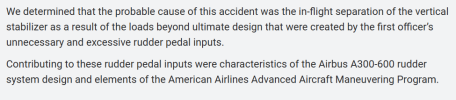
Interesting group of examples, but only one is applicable to the topic discussed above: the NTSB Probable Cause process. So, in the American Airlines 587 probable cause below, where do you see your implied confluence?

1787673447452.png

Except if they are Little Birds. They are of no concern to me and are an annoyance.
Well, if a Little Bird is considered an annoyance, then a 407 would also be considered an annoyance as they both share very similar rotor disk loading and downwash velocities at 27 kilograms/meters sq’d vs 30 kg/m loading and 21 meters/second vs 22 m/s velocity, respectively.
 
Interesting group of examples, but only one is applicable to the topic discussed above: the NTSB Probable Cause process. So, in the American Airlines 587 probable cause below, where do you see your implied confluence?

View attachment 154565


Well, if a Little Bird is considered an annoyance, then a 407 would also be considered an annoyance as they both share very similar rotor disk loading and downwash velocities at 27 kilograms/meters sq’d vs 30 kg/m loading and 21 meters/second vs 22 m/s velocity, respectively.
There is a problem here in that you can’t take NTSB giving a probable cause and declare it the only applicable example as the whole point here is that the NTSB making singular probable cause statements is in error given the nature of confluence.

As to the specific AA 587, where do I see confluence? In that the rudder dampener was malfunctioning thus allowing the pilot flying to make full throw rudder deflections that would not normally have been available while also having misunderstandings of maneuvering speed with textual definition of such being any axis while numerically everyone’s Va is calculated by the positive side of the longitudinal pull; in this instance the published Va far exceeded the speed at which full throw rudder could safely be made. You’d think perhaps changing the value of Va for that type plane might be a factor. NTSB report mentioned the rudder dampener but while mentioning both the speed maximum rudder was safe and the much faster Va, NTSB never connected those two.

To be clear, that is wake plus too much rudder dithering and at a frequency that amplified forces, plus errant rudder dampener, plus misunderstanding of Va, plus misrepresentation of Va’s value. This is a confluence. All the pieces together had to be present in the way they were for the event to occur. You could also say the debrief for excessive rudder usage not being assertive enough to the pilot flying was also a part of this.
 
Last edited:
Well, if a Little Bird is considered an annoyance, then a 407 would also be considered an annoyance as they both share very similar rotor disk loading and downwash velocities at 27 kilograms/meters sq’d vs 30 kg/m loading and 21 meters/second vs 22 m/s velocity, respectively.

RE little birds, and any helo, I prefer to always consider each a size larger than it actually is. There but by the grace of god go I…

 
Yep we damaged an MI-17 at Bagram on the ramp. In parking with a stuck tail wheel locking pin. Had to pick it up to a hover and taxi back. Probably 25-30 kt winds (windy season) took our rotor wash and hit an MI-17 parked at our 7 o’clock. Both clamshell door hinges broke and the doors slammed against the side of the fuse denting it. Then what transpired was a 30 minute conversation between the civ contractor and our safety officer about who is going to cover their costs! I felt bad for them but it was a helicopter ramp.

I’ve been upwind many times as well and the opposite is true. You can sit there with doors open and barely get a whiff of a departing / arriving helicopter.

Seen so much damage from rotor wash through the years. Broken windows from FOD(including my own), roof damage, flying chunks of asphalt, trees broken in half, motorcycles flipped over. Even flipped a couple porta potties in the field. Not as bad as this though.


That's a fantastic display of airmanship there! 10/10! And this is how Helicopter Chess was born!
 
Well, if a Little Bird is considered an annoyance, then a 407 would also be considered an annoyance as they both share very similar rotor disk loading and downwash velocities at 27 kilograms/meters sq’d vs 30 kg/m loading and 21 meters/second vs 22 m/s velocity, respectively.
Sorry, my statement was more about the derogatory nature that my community views the H-6 community and their tiny, wimpy helicopters... Sorry for the lack of context.
 
Uh…. I gotta ask? I GOTSTA!!

Tools
Without overtly asking
Just typical field stuff. They put porta potties too close to aircraft parking and I flipped them over. Fortunately no one inside.

Same exercise, I’m approaching an ISU-90 van (big box of supplies) to sling it. Suddenly out the 10 o’clock I see my plt ldr frantically waving us off. Our rotor wash was slinging bags of trash from a bin to our left like projectiles. I could not believe how much garbage was strewn all into the woods. It just wasn’t a good FTX for me that year.
 
Last edited:
I was hoisting a woman off a cruise ship in the Bahamas one night. She was pregnant and bleeding, so the ship called for help.

Anyway, we were in a hover lowering a rescue swimmer and a stokes litter. Before I knew it, hundreds of paper hats were floating and flying around in our rotor wash. The ship's crew decided to watch the action. We backed off so the swimmer could assess her on deck while the co-pilot yelled at the Captain to have his people get rid of the hats. The last thing we wanted was to fod one, maybe both engines during the hoist.

It was literally a huge galaxy of hats all around us. We were in a +-100' hover over the ship.

You mean rotors suck things in? That’s impossible. Rotors don’t suck. That’s not how physics works.

(That’s snark to which you wouldn’t recognize unless you read Fffflats in the comments thread including sub-comments here and seen the replies especially those of the host:
)
 
There is a problem here in that you can’t take NTSB giving a probable cause and declare it the only applicable example as the whole point here is that the NTSB making singular probable cause statements is in error given the nature of confluence.
Except the only problem I see is you don’t understand the purpose of the NTSB investigation and that you somehow believe the probable cause is something more than just a safety conclusion on the cause of an accident. No confluence required.

Sorry, my statement was more about the derogatory nature that my community views the H-6 community and their tiny, wimpy helicopters... Sorry for the lack of context.
Good try, but whether its derogatory or a case of envy, a Little Bird would still only be an annoyance to a 150, just as a 407 would be in that scenario. ;)
 
Except the only problem I see is you don’t understand the purpose of the NTSB investigation and that you somehow believe the probable cause is something more than just a safety conclusion on the cause of an accident. No confluence required.
Seems I do understand the purpose of an NTSB investigation though I see a blatant flaw in their approach; things don’t work so simply and there is almost never one answer one glaring piece. We’re not debating purpose nor function, we are debating means and quality of product. In this there is a problem as their approach leaves them with less quality and therefore they fail to meet their means and purpose. You’re looking at how they do things and claiming that any criticism of such is a rejection of why they do things and/or a misunderstanding of why they do things, and that is poor argument on your part. You may not realize you’re doing it but you are deflecting and creating a straw man. You’re not actually addressing the actual concern.

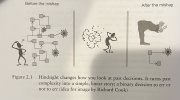
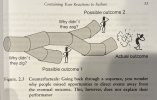
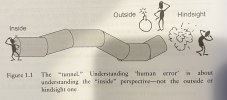
Most accidents don’t have a singular cause. The whole cheese model isn’t at one thing, it is at the many things together, the whole chain is remove any link not one link. Though separately I think both models fail seeing how it isn’t a chain, rather we wear suits of chain mail. This is why Dekker has made his “in the tunnel” of localized rationality analogy and suggests instead of looking for a root (funny how they seek a singular root while roots actually branch out and sometimes entwine) instead of a root we should be asking “why did what they did make sense to them at the time the did it?” Five Whys can really continue as infinite Whys all the way back to the Big Bang. Whys is a fair start, but it isn’t an end. Attributing one thing as the probable cause wrongly discounts all the other pieces. Look back at that F-35 article, see how they all tied together, not just one thing. Again, AA 587 wasn’t as clear and simple as described. It wasn’t simply the pilot flying using excessive rudder after flying through wake. It was also the rudder dampener which also works as a limiter not functioning. It was also the numerical value for maneuvering speed being written for positive longitudinal not considering yaw and roll. It was spacing that put them through wake. Even this case that looked clear had some confluence. You can label a probable cause all you want, that doesn’t make the other factors any less causal. Contributory isn’t merely contributory.


Just because I say it is inadequate and wrong doesn’t mean I don’t understand it. You don’t have to accept something to understand something. Confluence isn’t required but more often than not it is at play. And NTSB misses it because they use flawed methods. Showing the confluence does not make it any less a conclusion about safety. Though it makes it a better conclusion about safety. If you find confluence, you have more avenues to improve safety.

Survival needs to be actions taken in parallel; to avoid losing you tend to need to be working against factors and hazards in parallel. Serial work, as probable cause type reports drive, is for finite games and winning but fails to not lose and does poorly in infinite games. Think about the asymmetry between prey and predator. Prey needs to succeed every time and in all ways while predator only needs to succeed on occasion. Serial improvement one thing at a time is much more fitting to a predator, but we’re worried about survival hear and in such we’re much more like the prey. Multi-factor in parallel while we need to address all coherences until we can render some coherences incoherent. To be fair, we will never know an entirety of a confluence, but appreciating such will always be closer to reality than attributing one thing as probable cause.


It is confluence which apparently is something Reason understood when he made the cheese model but to which we completely misunderstood taking his model to mean something else entirely.

PreAccident Investigations podcast Swiss cheese Actually episode:

Command and Control podcast Synchronization as Coupling episode:

Some of Dekker’s sketches:

IMG_4136.jpeg
IMG_4138.jpeg
IMG_4137.jpeg

May not seem it at first glance, though this one actually fits quite well here too: https://medium.com/cancer-systems/looking-for-the-missing-pieces-in-the-cancer-puzzle-c943393f332

Aircraft are engineered ordered deterministic systems; aircraft are complicated, but flying is complex. Engineering approaches don’t fit to explain flying and cannot fit to finding failures in flying. (Learn Cynefin)
 
Good try, but whether its derogatory or a case of envy, a Little Bird would still only be an annoyance to a 150, just as a 407 would be in that scenario. ;)
No envy here, just a little flight line rivalry. :)
 
1787765649585.png
you're telling me brother....thing about hindsight is, it and a $1.20 gets me a [half a, inflation 2026 updated] cup of coffee. :biggrin:
 
Seems I do understand the purpose of an NTSB investigation though I see a blatant flaw in their approach;
Not really. If you actually understood the purpose of an NTSB investigation you wouldn’t have spent the time posting what you did. And while you believe the NTSB uses a flawed approach, the NTSB investigative process and methodology is actually considered the international benchmark for aircraft accident investigation and is taught to 100s of people, both domestic and foreign, every year at the NTSB Training Academy. It simply is what it is.
 
Not really. If you actually understood the purpose of an NTSB investigation you wouldn’t have spent the time posting what you did. And while you believe the NTSB uses a flawed approach, the NTSB investigative process and methodology is actually considered the international benchmark for aircraft accident investigation and is taught to 100s of people, both domestic and foreign, every year at the NTSB Training Academy. It simply is what it is.
So do you have any answers to the shortfalls illuminated in the NTSB approach? Have any counters against the other ways shown? Pointing to accolades isn’t really an argument.
 
So do you have any answers to the shortfalls illuminated in the NTSB approach?
What shortfalls? The NTSB investigative process simply follows its applicable statutory and regulatory requirements, and by extension, ICAO Annex 13 requirements. Nothing more.

Have any counters against the other ways shown?
No. But those references tend to be used at the risk-management level or by plaintiff’s attorneys in my experiences. Are you involved in either?
 
The helicopter pilot in the right seat had a Airline Transport Pilot - AIRPLANE Multiengine/Single Engine land, but did NOT HAVE ANY HELICOPTER rating.
The CFI providing instruction in the left seat had a commercial helicopter license / CFI.

Questions:
WHY was anyone receiving primary helicopter instruction in the Commonwealth of Pennsylvania's State Police helicopter?
WHY is any non-helicopter pilot allowed to receive primary helicopter instruction in Pennsylvania's State Helicopter, and what PSP policies specifically permit this?

WHY was Pennsylvania's state police helicopter flying an 11-mile straight-in to the narrow runway at N94? (It was widened from 40' to 60' maybe 15 years ago, but still a pretty thin runway without a parallel taxiway...not any room for hanging out in the runway environment, which may (may!) cause a trailing aircraft to believe they are landing fully instead of keeping wake turbulence/downwash present. This is certainly not an AIM best practice for rotorcraft or fixed wing.

WHY did the Pennsylvania state police helicopter not exit the runway environment (at least 3 rotor blades away from runway) immediately after landing---or land---or touch and go? Why the stalling around next to an active runway?

WHAT was going on with CTAF conversation between the Helicopter and C-150? There were some witnesses who mentioned extensive back and forth "get off my lawn, we're the official State Police, we can do whatever we want" type of chatter transmitted from Pennsylvania's helicopter.
I’m no fan of the government, especially post patriot act and “war on drugs” LEO.

That said wherever you read this information did it ever cross your mind that it was so dumb it actually didn’t happen. A little skepticism is required these days…

Then again you may believe it’s true. That would be good intel as well.
 
What shortfalls? The NTSB investigative process simply follows its applicable statutory and regulatory requirements, and by extension, ICAO Annex 13 requirements. Nothing more.


No. But those references tend to be used at the risk-management level or by plaintiff’s attorneys in my experiences. Are you involved in either?

The whole point of NTSB investigations is risk management paid forward. So, why would you not want such? As I’ve already said, the big shortfall is that many factors combine in confluence, there typically is no singular root probable cause. Thinking there is such leads to insufficient conclusions and recommendations. Hence failure to pay forward in subsequent risk management.

There is a bit of irony here too that you cite NTSB as adhering to legal regulation while also using the idea of attorneys to deflect against other methods.

What NTSB investigations have you been involved with?
 
The primary fault is the helo pilot hovering next to the runway. Good thing the NTSB took over the investigation from the state police

While better than self investigating, I’m not sure NTSB is good here given they’ve already made a statement “the helicopter was well clear of the runway.” Such is not a fact, it is a conclusion, it is an errant conclusion, and it skews all sorts of views and understandings.
 
What NTSB investigations have you been involved with?
Involvement is irrelevant to making valid criticism. You also are failing to address the criticism. Such is an appeal to expertise logical fallacy.
 
Below is yet another video on the subject with talking heads providing absolutely nothing new to the discussion. But “I like to hear myself talk,” I am a pilot after all, so after the video I’m copy pasting my comments. Give you a chance to point to flaws in my thinking and show me an idiot. Size limits mean a running series of pastings.

 
I’m copy pasting my comments. Give you a chance to point to flaws in my thinking and show me an idiot. Size limits mean a running series of pastings.
It isn’t “right now the facts are…,” it is at present what we think are facts. Difference. One just because you don’t know something yet doesn’t make it any less fact. Two what you think you may know as a fact could be wrong. But yes, generally there are bits of data you call facts while analysis upon them gives information and information derived from correct facts could be right or wrong though typically information from incorrect facts will tend to be wrong. Weird thing here, right and correct are not synonymous though I’m now using correct in two different ways and perhaps also using right in two different ways. Here using correct as to veracity of fact and right as to appropriateness of information. Elsewhere, however, we can see right as of a set of appropriate to include in other contexts moral whereas correct would be more fitting compliant. Example of this latter, a correct answer may be what a book says but the book could be in error making the right answer different than the book. FAA’s models for both longitudinal and lateral stabilities are examples of these, the book is wrong yet to be correct you have to give the book answer. I don’t know if we could use a different set of terms to the former while still making distinction between a sense of right and correct veracity and appropriateness. Perhaps we need four words instead of two, but I only know of the two. Where should an investigation be looking here? We already see what happened, less time on that. More time to why did the pilot of the Cessna attempt the landing, why did it make sense, why did the pilot of the Cessna not land previously on what appeared to be a setup to the other direction runway? Why did the helicopter pull into the grass by the runway, why did that proximity seem ok to them? What were our localized rationalities in each cockpit? There is also little point to waste time on the bureaucracy in this case in terms of checking maintenance logs, inspection requirements, pilots’ credentials, it is obvious none of these sorts of things were at play. Such becomes process for process’ sake. As to “wait until we get all the data please” such is a Sisyphean task, you will never get all the data. Thinking you can get all the data is actually pretty arrogant and leads to thinking you can and will actually know what happened. In most incidents, you’ll never know what happened, you’ll only ascribe something to it, attribute to it. You can still pull value from such attributions, but they aren’t truth. Maybe a little John Boyd Destruction and Creation here along with Sidney Dekker Field Guide on ‘Human Error’ plus Georgina Poole The Second Story. You can already make some conclusions now without all the facts as you can readily spot incoherences in hypotheses and reject some of the hypotheses. You can also already make coherent hypotheses so as to seek to render them incoherent and subsequently reject. In this way, throwing them up isn’t jumping the gun. It is only jumping the gun if you subsequently seek to confirm instead of trying to falsify. On this jumping the gun, see point two below.

In this case we can already draw useful lessons even if they turn out not to match the given situation. One we all suck at appreciating helicopter vortices and wash. In this 3-3-2 is inadequate, vortices take three to five minutes to dissipate so really you’re looking at 3-3-5. Similarly, you should treat a helicopter as a size larger than it actually is. In this also note helicopter vortices can be painted horizontally over runways making landing after and taking off before points of arrival and departure difficult. Glide paths as diagonal lines tend to intersect horizontal lines. Wash is different than helicopter motion produced vortices, rotor vortices are like wing vortices but wash really is like a microburst. But it is worse as it is ongoing and it turns out to be more chaotic than we thought. It ain’t the donut, that is merely the average of the wash over time. CAA along with Sophrodyne is doing interesting research here aimed at eVTOL though hitting all rotorcraft by default and has produced CAP 2576 and CAP 3075. British Aeronautical Society has produced a nice article from these An Ill Wind while Sophrodyne has presentations available here on YouTube. Having said this I think the inaccurate averaged donut model will be good enough to explain the interplay fixed wing and rotor dynamics as to how a helicopter can suck in an airplane. Two is there was definitely a lack of consideration on the part of the helicopter. Generally the helicopter should have gone to the east ramp so as not to paint the runway. But it was a training flight, understandable they might want the runway, ok, you have every right to it as anyone else does. But you don’t have a right to monopolize it. Being off of it but alongside it is still using it if your wash extends three diameters. Hovering near it is inconsiderate. “Well off the runway surface” is rubbish and this statement from the NTSB representative shows a lack of appreciation for the extent of wash from the part of the investigators. The wash actually tends to be faster outside the helicopter disk. And it can have intense momentary gusts. The helicopter was not well off the runway. Such is incorrect and could lead to wrong conclusions. Well off the runway is an errant “fact.” You might even consider such a statement as “jumping the gun” and “not waiting for all the facts.” “Well off the runway” is actually a(n errant) conclusion not a fact. Three you cannot always go around. An earlier go around would have been great. But likely caught in a vortex the rejected landing go around put the plane further into vortex then into wash which sucked the plane into the helicopter. This goes to show go arounds carry their own risk and the decision to use them is a risk balancing. Had the pilot accepted the vortex induced wrecked landing, it would have been more survivable. There are other situations in which you cannot always go around. “You can always go around” is an oversimplified and therefore poisonous mantra. Four there rarely is a probable cause, more often you have confluence. Failure to provide adequate spacing for vortices, which is ultimately what will be attributed here is insufficient. Seems simple and apparent in this case yet to ascribe such glosses over the helicopter wash as distinct from the vortex and the helicopter’s apparent lack of consideration. While fewer strands of entwinement, there is still confluence here. NTSB’s processes striving to narrow down to a singular point continue to be silly. “Even what here seems a simple accident, many factors come into play,” yes, confluence, not singular root cause.

There are a couple great podcasts folks should listen to. Todd Conklin’s PreAccident Investigation episode Swiss cheese Actually. In it we learn Reason did not mean what we all took from his model. And that both his meaning and the one we all took have validity. The other is the British produced Command and Control podcast with Synchronization as Coupling episode. Pairs well with Conklin’s Swiss cheese actually. And really gets to the notion of confluence while understanding there is distinction between complicated and complex. Aircraft are complicated while flying is complex.

“Listen to the authority….” How un-American is that?
 
Last edited:
Back
Top