Barked at for flying the ODP

May have missed it above, but I'd assume you were on CTAF, then taking off and following the ODP, then when at an appropriate distance from the airport or as directed by ATC you're going to dial up their frequency and call? Asking because ATC isn't on CTAF here, so I don't know how they'd call you first. Again, maybe I'm missing something obvious.
Typical departure from nontowered is to contact ATC once stabilized in the enroute climb configuration. Until you do, your airport is closed to other IFR departures or approaches.

Generally speaking, TRACON does not monitor CTAF. Take a look at the Seattle TAC and try to imagine the controllers monitoring typical local traffic at all those airports.

Between the two, my guess is that you are not really “missing” anything. That the call came after @LowHrsMan checked in.
 
Even though I think the question has been adequately answered here, this would be a great show topic for the fellas at Opposing Bases. As an IFR student myself, I've learned a couple things reading through this discussion.
 
It could. All the controller had to do was ask the on course heading assign it with direct.
But it wasn't assigned. This wasn't about what "coulda," happened. It's what did happen.

THE ONLY WAY you would turn to the filed course on that clearance was if you had solid visual conditions to maintain your own terrain clearance. Neither the DVA or ODP would provide that and the controller didn't issue anything that would.
Actually it’s not the only way,but if you think it is that fine
 
But it wasn't assigned. This wasn't about what "coulda," happened. It's what did happen.

THE ONLY WAY you would turn to the filed course on that clearance was if you had solid visual conditions to maintain your own terrain clearance. Neither the DVA or ODP would provide that and the controller didn't issue anything that would.
Are you saying following an ODP would not provide terrain and obstacle clearance?
 
If explicit directions are not provided in the clearance, then the pilot should reply with their plans.
Except, "Cleared as filed" is an explicit direction.

Due to the proliferation of low-altitude radar coverage which, has allowed nearly immediate vectoring on departure, us pilots have been conditioned to expect ATC to provide guidance from the ground up. In much of the country, that is how it usually works but that's isn't the system, that is a shortcut to the system which reduces pilot workload and increases operational efficiency and system capacity.

The IFR system is built on a foundation where pilots handle their own terrain and obstacle separation from the ground up while ATC only provides separation from other aircraft. That is the procedures which we have been discussing and that are outlined in the AIM guidance.

The only time you need to clarify "cleared as filed", followed by "Released" or "Cleared for Takeoff" is if you, as the AIM describes, can not maintain terrain and obstruction clearance visually and need to use an ODP which differs from your "cleared as filed" routing.

Anybody remember the thread on the Red Board from the Bonanza pilot departing GCN IFR who was given "cleared as filed", "cleared for takeoff", and "Contact Albuquerque Center", from GCN tower, who continued on runway heading right through the SFAR 50-2 and flight free zones while waiting for a vector?
 
Yeah, it has a Diverse Vector Area, but that doesn’t mean they have to use it. In this scenario, they didn’t. They did not assign him a heading to fly.
Let me run this one by you: how does the pilot know that ATC is issuing a radar vector? Generally speaking, from the pilot's perspective, three things are necessary for a vector. Assigned heading, assigned altitude, and the words, "radar contact." Until we hear that third piece, how do I know that "on departure, fly heading..." or, in the case of a Class G surface area, even, "upon entering controlled airspace, fly heading..." involves a transfer of responsibility for terrain and obstruction separation? Is it just because I have looked at the TPP before takeoff and, if the heading is in the DVA, it's a vector? I have noticed that there is language in the 7110 about obtaining pilot concurrence for the turn. "“Verify right turn after departure will allow compliance with local traffic pattern,”or “Verify this clearance will allow compliance with terrain or obstruction avoidance.”
 
New IFR student here. My CFII has told me that when departing using an ODP, include that intention in the comments of the flight plan when filing. Otherwise, with an ‘as filed’ clearance, ATC will expect me to fly direct to my first named fix and not use the ODP.
 
New IFR student here. My CFII has told me that when departing using an ODP, include that intention in the comments of the flight plan when filing. Otherwise, with an ‘as filed’ clearance, ATC will expect me to fly direct to my first named fix and not use the ODP.
Whether putting it in the remarks is a good idea or not can be discussed, but everything after the word Otherwise in your post is is incorrect. If there is an ODP listed, there is a reason for it. Unless you have some other way to obtain obstacle clearance, you'd best fly it, and only obnoxious and dangerous controllers will be surprised if you fly the ODP.
 
Due to the proliferation of low-altitude radar coverage which, has allowed nearly immediate vectoring on departure, us pilots have been conditioned to expect ATC to provide guidance from the ground up. In much of the country, that is how it usually works but that's isn't the system, that is a shortcut to the system which reduces pilot workload and increases operational efficiency and system capacity.
That may apply to most or many, but not all. There are airports around here, particularly but not limited to those just east of the Berkshires and also in VT, NH, northern NY, where you don't have either radio or radar coverage until you're 1-2K AGL, and there are things to run into below that. Which is why this thread is interesting to me. We'll get cleared as filed from non-towered, from a release via phone, and a frequency to call once we're in the air and have switched from CTAF.

Yep, that will hold IFR traffic, but these are small airports and it's not a big deal. We'll get the reverse when coming in. The question is "do you want to cancel now, or on the ground?", because they know they're going to lose both radio and radar before we get in. So if it's really VFR and we're practicing, we might cancel in the air. But if it's IFR, or marginal, we're going to stay IFR, switch to CTAF, and then cancel on the ground via phone. That's more normal than not where I fly. Like I said, I'm not even a beginner at this, just working on my IFR, but it seems to me to be a great area to learn in, as we get actual flyable IFR all the time...and there are airports around here where if you're in a PA-28-150 or a typical 172, you probably need to follow the departure procedure to keep the flight quiet if the ceilings are low.
 
New IFR student here. My CFII has told me that when departing using an ODP, include that intention in the comments of the flight plan when filing.
I agree with that or, these days, telling the controller you plan to do so, as a best practice in dealing with the system.
Otherwise, with an ‘as filed’ clearance, ATC will expect me to fly direct to my first named fix and not use the ODP.
But that should not be the case. Unless we are dealing with one of the exceptions - assigning a procedure or radar vectors from the ground - using an ODP is the pilot's prerogative and ATC should be expecting a pilot to not want to run into a mountain ridge or tower. "Should be" is the reason for the best practice.
 
I'm glad OP posted this. It's interesting. My experience with IFR is very limited, but around here it's always been one of two things: Controlled field, with a heading given and then some combination of vectors and handoff. Uncontrolled field, usually contacting for release by phone because radios don't work, and always a directive to contact X frequency after departure, because I'm on CTAF before I'm on the runway at the uncontrolled airport.

May have missed it above, but I'd assume you were on CTAF, then taking off and following the ODP, then when at an appropriate distance from the airport or as directed by ATC you're going to dial up their frequency and call? Asking because ATC isn't on CTAF here, so I don't know how they'd call you first. Again, maybe I'm missing something obvious.
Even thought KWPT is untowered, clearance delivery is a frequency, probably due to close proximity to the KSEA class B. The CD frequency was scratchy but readable.
I switched from CTAF to Seattle Approach shortly after takeoff, around 1200 AGL. My climb rate was 800 fpm, so it was not very long after takeoff.
The initial check in with ATC was routine, the drama started about 5-7 mins after the initial call.

LHM
 
you don't have either radio or radar coverage until you're 1-2K AGL, and there are things to run into below that. Which is why this thread is interesting to me. We'll get cleared as filed from non-towered, from a release via phone, and a frequency to call once we're in the air and have switched from CTAF.
That's when you have to make the determination as to whether or not you can maintain separation visually or if you will need to fly the ODP. If that ODP has a different ground track than your filed/cleared routing, let the controller know that you will be flying it.
 
That's when you have to make the determination as to whether or not you can maintain separation visually or if you will need to fly the ODP. If that ODP has a different ground track than your filed/cleared routing, let the controller know that you will be flying it.
Yeah, that's why I'm following along on this thread. I'm thinking it hasn't come up with anything I've done here, in part because not only is the first 1k-2k feet below their radar coverage area and radio coverage area, it's also probably way below their minimum vectoring altitude. So it's effectively a non-issue here. In my head it's 1 - avoid flying into mountain, 2 - follow ATC directions...in that order and so far that's always been without conflict.

And as I say that, I'm realizing that I may very well be following the ODP up to an altitude where I'm positive that I'm clear of terrain for the turn to whatever the course is, and then turning on that course, rather than necessarily following ODP to a particular point and then turning to filed course. I'm not suggesting that this is necessarily appropriate procedure, but if it's safe and if the local control kind of expects it, it seems reasonable to me. It also seems reasonable that ATC couldn't assign that, because unless they assign the full ODP they wouldn't have any way to know that you're going to maintain clear of terrain during some turn to a random course somewhere along the ODP path.

Or in other words, by the time I pop up on their radar and give them a call, I'm clear of terrain and headed where they expect me to, and they don't seem to care how I got there. Reading this thread it seems that this wouldn't be the case everywhere and it would be good to be specific on departure procedures.
 
:sigh:
New IFR student here. My CFII has told me that when departing using an ODP, include that intention in the comments of the flight plan when filing. Otherwise, with an ‘as filed’ clearance, ATC will expect me to fly direct to my first named fix and not use the ODP.
Sometimes ATC will expect you to fly direct to the first named fix. It happened here. It has happened other times at other places. But it is incorrect, those Controllers who do that are wrong. I would not recommend relying on the comments in the flight plan to get your intention across that you plan on doing the ODP. It’s very unlikely the Controller will even see that. You should do that verbally when getting your Clearance. Maybe someday all Controllers will get it right and we won’t have to worry about this any more.:sigh:
 
I operated out of KSHD where the departure procedure is essentially climb runway heading to roughly 1200 AGL before turning right (when leaving rwy 5) or 2200 AGL before turning on course (for rwy 23). Center doesn't expect any different. If you want to VCOA, you have to be approved.
 
This can be a localized type of deal. At uncontrolled fields with an ODP that for whatever reason the locals or majority of ifr flying out do not use very often the controllers see something they are not "use" to. When you are flying an ODP just tell them when you first check on even if you say that is what you will do while on the phone getting a clearance.
 
Let me run this one by you: how does the pilot know that ATC is issuing a radar vector? Generally speaking, from the pilot's perspective, three things are necessary for a vector. Assigned heading, assigned altitude, and the words, "radar contact." Until we hear that third piece, how do I know that "on departure, fly heading..." or, in the case of a Class G surface area, even, "upon entering controlled airspace, fly heading..." involves a transfer of responsibility for terrain and obstruction separation? Is it just because I have looked at the TPP before takeoff and, if the heading is in the DVA, it's a vector? I have noticed that there is language in the 7110 about obtaining pilot concurrence for the turn. "“Verify right turn after departure will allow compliance with local traffic pattern,”or “Verify this clearance will allow compliance with terrain or obstruction avoidance.”
I think the concept of ‘initial heading to fly for aircraft that will be radar vectored’ is well explained in the AIM as is radar vectoring. I am not going to go look for paragraph numbers right now.
 
I think the concept of ‘initial heading to fly for aircraft that will be radar vectored’ is well explained in the AIM as is radar vectoring. I am not going to go look for paragraph numbers right now.
I haven't been able to find anything in the AIM (main discussion is ¶5-2-9) that suggests that the incredibly common "upon entering controlled airspace, fly heading 123" is a radar vector, even if the clearance included began with "via radar vectors." And recall that being on radar vectors means we are precluded from flying the ODP (AIM 5-2-9.b.)

I have a thought of what the answer is, but I'm only certain enough at this point to apply it to myself.
 
Last edited:
I haven't been able to find anything in the AIM (main discussion is ¶5-2-9) that suggests that the incredibly common "upon entering controlled airspace, fly heading 123" is a radar vector, even if the clearance included began with "via radar vectors." And recall that being on radar vectors means we are precluded from flying the ODP (AIM 5-2-9.b.)

I have a thought of what the answer is, but I'm only certain enough at this point to apply it to myself.
This video gives 2 perspectives, the pilot and the controller. It's consistent with what my CFIs told me (which doesn't necessarily mean it's correct).
 
This video gives 2 perspectives, the pilot and the controller. It's consistent with what my CFIs told me (which doesn't necessarily mean it's correct).
I agree with everything in the video (which pretty much tracks what I wrote in my article) except one. From a pilot standpoint, I can’t agree that controller responsibility (that can in any way be relied on by the pilot) arises upon giving any clearance other than “as filed." The AIM refers to "radar vectors" as an exception to our prerogative to fly an ODP. and I don't agree that every assignment of a heading given is a "radar vector." An instruction to "when entering controlled controlled airspace fly heading" is not a radar vector.

One of the complications is, from an ATC standpoint, a controller may vector an aircraft below the MVA/MIA if a certain degree of "separation from prominent obstacles shown on the radar scope" can be maintained or in a DVA. We know about the DVA, but we don't know what the controller's radar scope is showing. So, I'm not betting on that without my independent verification.
 
I haven't been able to find anything in the AIM (main discussion is ¶5-2-9) that suggests that the incredibly common "upon entering controlled airspace, fly heading 123" is a radar vector, even if the clearance included began with "via radar vectors." And recall that being on radar vectors means we are precluded from flying the ODP (AIM 5-2-9.b.)

I have a thought of what the answer is, but I'm only certain enough at this point to apply it to myself.
Ok. I don’t see in the AIM where a distinction is made between initial heading to be flown for aircraft that ‘will be’ vectored and headings assigned when they are being vectored. But that does not make a distinction about what the pilot must do. Either way, the heading is an ATC instruction and the pilot must comply with it. Whether the heading was assigned to be flown upon departure as it would be in a Surface Area(controlled airspace) or when entering controlled airspace, usually 700 AGL, sometimes 1200 AGL and could even be higher in very rare circumstances, does not change that.

Yes, you cannot be on a vector ‘and’ an ODP as you said above “…And recall that being on radar vectors means we are precluded from flying the ODP (AIM 5-2-9.b.)…”. ATC is prohibited from putting an aircraft back onto an ODP after they had been vectored off of it. They are TERP’d out and flight checked from a precise point, the runway. Joining them from a random point could upset obstruction clearance.

ATC can also not use Diverse Vector Area altitudes, which allow vectoring below the MVA(minimum vectoring altitude) for an aircraft starting from a random point in the air. They are also TERP’d and I’m pretty sure flight checked from the runway.
In the absence of something published to the contrary, I start from the proposition that not every assigned departure heading is a "radar vector" that precludes my use of an ODP, as specific exception to following the instruction exactly. The lack of consistence in the way people deal with it is why I think it is a solid SOP is to inform ATC when you plan to fly it.

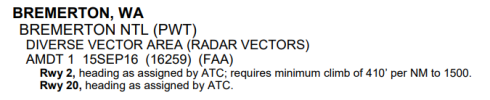
Take @LowHrsMan's Bremerton example. Before departure, I have checked the TPP. Although there is a published ODP, there is also a DVA.
1779633283697.png
I have absolutely no problem in that situation accepting an assigned heading and altitude as a "radar vector", so long as, if departure is off Runway 2, I can meet the climb gradient. I think the controller was probably correct questioning the pilot in that situation. I say "probably" because don't know the exact wording of the clearance). OTOH, if, as stated, the clearance was simply "cleared as filed," at least according to the controller in @MRC01 's linked video, flying the ODP was the right thing to do ;)

That, in a nutshell, is the real problem.
 
Either way, the heading is an ATC instruction and the pilot must comply with it.
"When" the pilot must is the question, isn't it?
Whether the heading was assigned to be flown upon departure as it would be in a Surface Area(controlled airspace) or when entering controlled airspace, usually 700 AGL, sometimes 1200 AGL and could even be higher in very rare circumstances, does not change that.
Here, you've zeroed in on the problem, which is a lack of clarity on the part of ATC's chosen phraseology, not the AIM's. "When entering controlled airspace" is technically an impractical and baseless location to know. The earth isn't flat and controlled airspace is defined based on AGL altitudes. As a departing aircraft climbs out over a river valley it can go in and out of controlled airspace, so should the pilot comply with the so-called "ATC instruction" the first time entering controlled airspace, or the next time? The controller doesn't necessarily have radar coverage and positive identification at either location. So, it isn't a valid instruction in the first place.

And what about the surface area departure? An assigned heading for traffic by a tower conducting VFR operations during marginal conditions might make good sense to ATC, but to the pilot departing, the obstacle he can't visually see out there in the murk might be concerning and therefore he is planning to fly a different heading according to the ODP. The pilot should not accept the heading.

A DVA is based on a diverse departure gradient, AFAIK, so is an exception and moot point. Call it what you want, a "radar vector" or "assigned heading when able", it doesn't matter. Either way, a climb at 200' per NM is compliant.
 
Last edited:
In the absence of something published to the contrary, I start from the proposition that not every assigned departure heading is a "radar vector" that precludes my use of an ODP, as specific exception to following the instruction exactly. The lack of consistence in the way people deal with it is why I think it is a solid SOP is to inform ATC when you plan to fly it.

Take @LowHrsMan's Bremerton example. Before departure, I have checked the TPP. Although there is a published ODP, there is also a DVA.
View attachment 152225
I have absolutely no problem in that situation accepting an assigned heading and altitude as a "radar vector", so long as, if departure is off Runway 2, I can meet the climb gradient. I think the controller was probably correct questioning the pilot in that situation. I say "probably" because don't know the exact wording of the clearance). OTOH, if, as stated, the clearance was simply "cleared as filed," at least according to the controller in @MRC01 's linked video, flying the ODP was the right thing to do ;)

That, in a nutshell, is the real problem.
I agree it is a solid SOP to inform the Controller. This one is kinda like the doing or not doing the HILPT if you are Direct to an IAF/IF thing. Controllers get it wrong often enough that you should always verify.

The OP was pretty explicit that he was Cleared as Filed and he filed KPWT OLM. The semantics of vector, radar vector, fly heading does not change things. Fly heading is an ATC instruction. Ya gotsta comply with it. I can’t imagine someone saying ‘yeah. he told me fly heading ### but I decided it didn’t count because he didn’t say vector’ and getting away with it.
 
I agree 99%.
The 1% - What does the prerogative to fly an ODP without a clearance to do so mean?
Exactly that. If you haven’t been given other instructions, such as a SID or a heading to fly, you can do the ODP and you don’t need a specific clearance to do it.
 
Exactly that. If you haven’t been given other instructions, such as a SID or a heading to fly, you can do the ODP and you don’t need a specific clearance to do it.
I guess out understandings are a little different and reflects a number of other discussions I've seen on the subject.
 
"When" the pilot must is the question, isn't it?

Here, you've zeroed in on the problem, which is a lack of clarity on the part of ATC's chosen phraseology, not the AIM's. "When entering controlled airspace" is technically an impractical and baseless location to know. The earth isn't flat and controlled airspace is defined based AGL altitudes. As a departing aircraft climbs out over a river valley it can go in and out of controlled airspace, so should the pilot comply with the so-called "ATC instruction" the first time entering controlled airspace, or the next time? The controller doesn't necessarily have radar coverage and positive identification at either location, either. So, it isn't a valid instruction in the first place.

And what about the surface area departure? An assigned heading for traffic by a tower conducting VFR operations during marginal conditions might make good sense to ATC, but to the pilot departing, the obstacle he can't visually see out there in the murk might be concerning and therefore he is planning to fly a different heading according to the ODP. The pilot should not accept the heading.

A DVA is based on a diverse departure gradient, AFAIK, so is an exception and moot point. Call it what you want, a "radar vector" or "assigned heading when able", it doesn't matter. Either way, a climb at 200' per NM is compliant.
Yeah. ‘When entering controlled airspace’ is much misunderstood. Many seem to think that it somehow, in and of itself, ensures obstruction clearance. What it is about is that ATC cannot ‘control’ in uncontrolled airspace. When the floor of Controlled Airspace is low enough that obstruction clearance is an issue, the Controller has to take into account that the heading they assign ensures obstruction clearance. So, where is the plane when it climbs into controlled airspace? The controller can’t pin that down until the target is radar identified. Until then, it’s just a guess that the plane will have been separated from obstruction.
 
"When" the pilot must is the question, isn't it?

Here, you've zeroed in on the problem, which is a lack of clarity on the part of ATC's chosen phraseology, not the AIM's. "When entering controlled airspace" is technically an impractical and baseless location to know.

The "upon entering controlled airspace" phraseology isn't there to tell you that's where you need to turn, it's to cover the fact that ATC is not "controlling" aircraft outside controlled airspace. While you can do what you want (subject to the general IFR rules) below controlled airspace, it would behoove you to get on the heading as soon as practicable.
 
The "upon entering controlled airspace" phraseology isn't there to tell you that's where you need to turn, it's to cover the fact that ATC is not "controlling" aircraft outside controlled airspace. While you can do what you want (subject to the general IFR rules) below controlled airspace, it would behoove you to get on the heading as soon as practicable.
Pilots don't care where controlled airspace is, they care where obstructions are. A better phraseology might be, "Upon clearing all obstructions, fly heading..."
 
Pilots don't care where controlled airspace is, they care where obstructions are. A better phraseology might be, "Upon clearing all obstructions, fly heading..."
But that's not the point. The point is that they can't give headings in uncontrolled airspace. Pilots need to understand just what services they are getting in a given situation. The fact that in the original problem here, they were ***NOT*** given any terrain separation service, the ODP becomes the only sure-fire way to not hit things in instrument conditions.
 
Yeah. ‘When entering controlled airspace’ is much misunderstood. Many seem to think that it somehow, in and of itself, ensures obstruction clearance.
That sounds like we agree that it's not a "radar vector" that preclude a pilot choosing to fly the ODP.
 
But that's not the point. The point is that they can't give headings in uncontrolled airspace. Pilots need to understand just what services they are getting in a given situation. The fact that in the original problem here, they were ***NOT*** given any terrain separation service, the ODP becomes the only sure-fire way to not hit things in instrument conditions.
So why do most new instrument pilots seem to treat "Upon entering controlled airspace" as an edict? If it were so clear, as you say, that it is just a reminder of the controllers' area of authority, why is it so misunderstood?
 
Lets play when entering controlled airspace. Here are six airports where the floor of controlled airspace is 14,500. Have fun.

1779718961162.png
 
Last edited:
So why do most new instrument pilots seem to treat "Upon entering controlled airspace" as an edict? If it were so clear, as you say, that it is just a reminder of the controllers' area of authority, why is it so misunderstood?
I agree that it's commonly misunderstood. I think it's because the regs are complex enough that instrument training cannot cover everything - as shown by valuable discussions like this one. Instrument training covers so many different topics it can only go so deep. It covers enough for the basics to fly in the system and pilots learn the rest as they go, hence the phrase, "license to learn". An IFR student could ace his knowledge test and still not know the answer to the question discussed here.
 
Lets play when entering controlled airspace. Here are six airports where the floor of controlled airspace is 14,500. Have fun.
Do any of those have an instrument approach? If not, no ODP, either. Would likely have to provide your own obstruction separation until climbing to the MIA. ATC isn't going to give a "fly heading" in a departure release.
 
So why do most new instrument pilots seem to treat "Upon entering controlled airspace" as an edict? If it were so clear, as you say, that it is just a reminder of the controllers' area of authority, why is it so misunderstood?
They don’t understand that “upon entering controlled airspace, fly heading…” is the same as “fly heading…” when you’re already in controlled airspace. It’s acceptable to be on a different heading prior to a ATC requirement to turn.
 
Sometimes ATC (either due to an accident or some regulatory boondoggle) has to put things in the clearances by rule, that shouldn't need to be stated. "Everybody" knew that when you were cleared for an approach, you had to be established on a published segment before using the altitudes on that segment... well except for the pilots TWA 514. "Everybody" knew that taxi instructions to runway involved crossing everything BUT the destination runway, but that got more elaborate over time.
 
I guess out understandings are a little different and reflects a number of other discussions I've seen on the subject.
I think you may be keying in on 'or radar vector' in this from 5-2-9-a

"...ODPs are recommended for obstruction clearance and may be flown without ATC clearance unless an alternate departure procedure (SID or radar vector) has been specifically assigned by ATC..."

Like if they say fly heading, but don't say for vectors, then it doesn't apply.

This from 5-2-8 b. 3.
3. Pilots operating in a radar environment are expected to associate departure headings or an RNAV departure advisory with vectors or the flight path to their planned route or flight..."
 
Last edited:
Back
Top