Aspen EFD1000 Installed in C414 — Now Found to Be Non-Compliant (Looking for Input)

kep5niner

Pre-takeoff checklist
Joined
Oct 5, 2018
Messages
402
Display Name
Pete
I’m the owner of a 1970 Cessna 414, and recently discovered a serious compliance issue with an Aspen Evolution EFD1000 installation that dates back to 2016.

That installation was done by an FAA Repair Station. They were later sold and is now operating with a different name, but under the same CRS number.

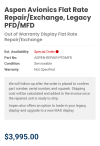
The Aspen unit installed is P/N 910-00001-001. I contacted Aspen Avionics this month about an unrelated question, and their tech support verified that this part number (-001) corresponds to the EFD1000 Pilot, which is certified only for Class I and II aircraft under STC SA10822SC.

Because the Cessna 414 is a pressurized Class III aircraft (MTOW >6,000#), Aspen confirmed that this unit is not certified or legal for installation in this airplane. The correct Class III-approved models are P/N 910-00001-003 (EFD1000 Pro Class III) or the EFD1000 C3.

After contacting the repair station, their maintenance manager acknowledged the prior installation but said no records remain from that period and emphasized that they can’t offer “warranty” coverage for work done nine years ago. He expressed regret if it was installed in error but questioned how the aircraft had “flown for nine years without an issue.”

My concern isn’t warranty—it’s airworthiness and regulatory compliance under Part 43 / 145, since the repair-station certificate itself is continuous and still active under the same operation.

I’ve documented everything, including Aspen’s written confirmation, and I’m working toward a compliant resolution—most likely an upgrade to a Class III-approved unit.

I’m posting this mainly to:
  • See if anyone else has encountered similar Aspen EFD1000 class-compliance issues, and
  • Ask whether others have had success getting repair-station participation or FAA guidance in correcting legacy installations like this.
Any insights from others who’ve been through a similar situation—especially on FAA/FSDO involvement, or whether Aspen offers an upgrade credit path for cases like this—would be greatly appreciated.
 
I don't know if they will give you an upgrade credit going class 1 to 3, but might if you go 1000Max class 3, which just got approved recently.
We've only done 1 class 3 install at our CRS, so can't answer the rest of your questions-we ensured we had the correct parts ordered before beginning the work.
 
What are the installation differences?
Talk to the manager again about performing the mods. Remind him that he bought the assets and liabilities of the old repair station, and a non-compliance that gets escalated to the FSDO is probably not in his best interest. What else is it out there put out by them that is not compliant, and how deep is he willing to let the FAA dig?

You'd be out of pocket on a -003 unit, though. But you might be able to sell/trade in the -001 and offset some of the costs.
 
What else is it out there put out by them that is not compliant, and how deep is he willing to let the FAA dig?

Sure you want to go kick that rock over? What else might the FAA discover on this airplane that could affect the current owner and airworthiness of the aircraft?

Remind him that he bought the assets and liabilities of the old repair station, and a non-compliance that gets escalated to the FSDO is probably not in his best interest.

145.219 Recordkeeping.​


(b) A certificated repair station must provide a copy of the maintenance release to the owner or operator of the article on which the maintenance, preventive maintenance, or alteration was performed.

(c) A certificated repair station must retain the records required by this section for at least 2 years from the date the article was approved for return to service.

The CRS only needs to keep records going back 2 years. The repair mentioned in the OP goes back further than that. You're going to have a hard time convincing a judge that the present owners of the CRS are responsible for this job when they had no records of it when they purchased the company.

Unfortunately for the OP he must decide on how much money he's willing to put up for legal expenses versus how much it will cost to correct this situation and include in that the time of non use of his aircraft.
 
Any insights from others who’ve been through a similar situation—especially on FAA/FSDO involvement

You are putting your aircraft and yourself under a review by the FAA. How deep will it go? Depends.

Do you really want to go there? Or have your plane corrected and flying? If you decide to go the legal route I'd be willing to say the legal cost will outweigh the cost to correct the situation plus downtime while it plays out, plus no guarantee you would prevail.

Like Harry Callahan says "Do you feel lucky"?
 
Sure you want to go kick that rock over?
The repair station has a lot more to lose.
That's why it would probably be in their best interest to keep the FSDO out of it.

What else might the FAA discover on this airplane that could affect the current owner and airworthiness of the aircraft?
He seems dilligent enough in his paperwork review that I doubt the airplane is a mantenance wreck. And right now the airplane is not airworthy specifically because of something that repair station did.

(c) A certificated repair station must retain the records required by this section for at least 2 years from the date the article was approved for return to service.
Record keeping and liability are two separate things. If that plane has a mishap because of a bad install, the repair station won't be off the hook two years later.
 
The STC limitations and conditions sections CLEARLY state that the install is approved for Class I and Class II aircraft only.

Also never forget FAR 91.7
 
Last edited:
Ask whether others have had success getting repair-station participation or FAA guidance in correcting legacy installations like this.
Based on what you have posted, its a conformity issue which should have been originally caught at the CRS, however, it was also missed at each subsequent annual with the last IA assuming the current regulatory responsibility and not the CRS.

So if your intent is to get someone to offset the cost of the -003 your limited in scope short of a civil action which comes with its own costs. And given its been 9 years, seeking FAA guidance would only address the original CRS issue and your IA's last annual issue with no provision to offset the cost of the -003.

If it were me, I would seek out a shop that would give you trade-in credit for the -001 and apply it to the -003 install. And call it good, But I would also inform your IA on the issue so he can learn from this also.
 
The repair station has a lot more to lose.
That's why it would probably be in their best interest to keep the FSDO out of it.

Like what? At worse the CRS would get a letter of correction and be asked to amend their CRS Manual with a procedure to make sure this doesn't happen again, or if the CRS has an SMS program to submit the problem and provide the FSDO with a mitigation. That's it.

To fine the CRS would require elevating the issue to region and if this is an isolated case, that won't happen.

He seems dilligent enough in his paperwork review that I doubt the airplane is a mantenance wreck. And right now the airplane is not airworthy specifically because of something that repair station did.

And we are back to that age old issue of who is responsible for maintenance performed on an aircraft. The owner has found a discrepancy in his paperwork and it's up to him, not the CRS, to get it corrected.

Record keeping and liability are two separate things. If that plane has a mishap because of a bad install, the repair station won't be off the hook two years later.

The OP needs to consult an actual lawyer, not SGOTI of what's actually involved here. As previously stated, the owner will have to decide if the cost of legally pursuing this is worth it. But trying to use the FAA to get a legal remedy isn't going to work. The FAA cannot demand or order the CRS to redo the job to correct it.
 
If it were me, I would seek out a shop that would give you trade-in credit for the -001 and apply it to the -003 install. And call it good, But I would also inform your IA on the issue so he can learn from this also.
I like this answer for the OP. However, could the OP have a one-time field approval (337) to make it legal? After all, he's been test flying the thing for the past nine years.
 
The repair station has a lot more to lose.
That's why it would probably be in their best interest to keep the FSDO out of it.
I would assume that a repair station gets periodic base inspections by the FAA already. Another visit would be no big deal, and it certainly wouldn’t resolve anything for the OP.

The only records that exist are with the airplane, and I certainly wouldn’t invite the FAA to audit the logbooks of a 50+ year old airplane, regardless of how well I think it’s been maintained. Even if it was otherwise perfect, the only result would be that the OP can’t fly his airplane until this issue is corrected.

The real risk is probably in the OP no longer having an IA, since he triggered an inspection of THAT facility.
 
However, could the OP have a one-time field approval (337) to make it legal?
Not really as the core major alteration is beyond the scope of a FSDO Field Approval so he would need to purpose a One Time STC which would be cost prohibitive. I'm still curious how the original CRS Work Order, Form 337, and logbook entry is worded.
 
Not really as the core major alteration is beyond the scope of a FSDO Field Approval so he would need to purpose a One Time STC which would be cost prohibitive. I'm still curious how the original CRS Work Order, Form 337, and logbook entry is worded.
The differences in class approval can't be approved by a designated engineering representative (DER), perhaps with some additional modification?
 
The differences in class approval can't be approved by a designated engineering representative (DER), perhaps with some additional modification?
Sure. But the only entity that could approve the class change at the "field" level as you imply would be Aspen via an internal Engineering Order (EO). Major alterations come in two flavors: major change to type certificate and no major change. Only the FAA Certification Branch can approve major change to TC as in this case. If the original EFD1000 install was not considered a major change TC then there could be a "possibility" of a FSDO field approval with DER approved data. But even that would probably not be a cheap alternative either.
 
Sure. But the only entity that could approve the class change at the "field" level as you imply would be Aspen via an internal Engineering Order (EO). Major alterations come in two flavors: major change to type certificate and no major change. Only the FAA Certification Branch can approve major change to TC as in this case. If the original EFD1000 install was not considered a major change TC then there could be a "possibility" of a FSDO field approval with DER approved data. But even that would probably not be a cheap alternative either.
I'm ignorant of the issues between classes, so relying on intuition. Perhaps, since pressurization is involved, the modification needed might be simply drilling a weep hole in the case to equalize pressures in the event of a sudden decompression.
 
Like what? At worse the CRS would get a letter of correction and be asked to amend their CRS Manual with a procedure to make sure this doesn't happen again, or if the CRS has an SMS program to submit the problem and provide the FSDO with a mitigation. That's it.

To fine the CRS would require elevating the issue to region and if this is an isolated case, that won't happen.


And we are back to that age old issue of who is responsible for maintenance performed on an aircraft. The owner has found a discrepancy in his paperwork and it's up to him, not the CRS, to get it corrected.


The OP needs to consult an actual lawyer, not SGOTI of what's actually involved here. As previously stated, the owner will have to decide if the cost of legally pursuing this is worth it. But trying to use the FAA to get a legal remedy isn't going to work. The FAA cannot demand or order the CRS to redo the job to correct it.
Actually in the current environment he would get a letter of noncompliance, preceding his removal as a Repair Satiaon. Then you have no resources... this happend to me with Poplar Grove in 2018, who missed AD M-zero and returned by so called' OH engine as an OH when what they had really done was a repair. They dodged me for a month but ultlimately, were good for it.

But I had to neogtiate. They elected to keep their business a certified RS, and made good.
 
Last edited:
If you want to keep flying and keep costs reasonable, bite the bullet (your own $$ to go compliant). Keep everything under your own control, don’t involve anyone else - FAA, repair station, IA- unless you can withstand the risk of delays, uncertainty, and additional cost.

Sorry for your dilemma. Which brings up an interesting point - we don’t know what we don’t know and are not expected to be experts. Those who were supposed to be experts messed up (more than one expert and more than one occasion). This could have happened to anyone. How do I know if my GPS NavCom installed in my certified is not for experimental? My engine monitor? Never would have thought to question my experts (I didn’t even think this was a “thing”). What about pre-buys…is this something folks look at?
 
Actually in the current environment he would get a letter of noncompliance, preceding his removal as a Repair Satiaon. Then you have no resources... this happend to me with Poplar Grove in 2018, who missed AD M-zero and returned by so called' OH engine as an OH when what they had really done was a repair. They dodged me for a month but ultlimately, were good for it.

But I had to neogtiate. They elected to keep their business a certified RS, and made good.

I disagree. There’s a huge difference in what happened to you and what’s being discussed by the OP.

Under the compliance philosophy if the CRS is willing to cooperate with the FAA, the agency can’t remove their certificate. Most entities now also operate under an SMS program as well.

Given that this was 9 years ago and the (assumed) only paperwork available is held by the aircraft owner complicates matters. Previous owner accepted the work, including the associated paperwork. As mentioned above the aircraft has had several annuals since then, then the aircraft changed owners and the present owner accepted the paperwork as well.

As previously stated the owner would probably be better off negotiating a deal with the CRS to correct the issue. Threatening the FAA or legal will only complicate the situation.
 
Sounds like they new company got stuck with an issue, as no fault of their own. But you might have a discussion to confirm that they are still liable after buying the original shop.

Regretfully, they may not be. But if your attorney believes they are, just have them reach out to them "politely" to see "how they want to resolve this issue?" Hopefully they would prefer to just replace your unit with the correct one and not end up paying a bunch of legal fees and then ultimately fixing the issue.
 
OP I didn’t see it anywhere but did you own the aircraft 9 years ago when the avionics was installed?
 
The only real solution is to remove the STC for the non-pressurized unit and buy the proper unit/STC.

Currently it appears Aspen is giving a rebate of ~$5300 on a single display EFD1000 and a NEW EFD1000 Class III is $13000.

You have two options: Ignore it (I've been told this would be bad) or pay the $8k+ to make it legit.

The latter is probably your cheapest and fastest solution. A civil action will require at least a few grand for a retainer and until then your A/C is grounded. And even if you did 'win' you burned a bridge that you really didn't need to.
 
Your responses have been helpful. I just bought the airplane this year, and the previous owner only had it 2 years.

Everyone I’ve talked to / emailed, to include the original shop from 2016 (current CRS holder, rather), is not jumping up and down and volunteering to take care of it. But from the sounds of it, I’ll be time an money ahead to absorb the cost myself to make it right.

But I have serious heartburn about that course of action. It’s not who’s right, but what’s right, and I’m a man of principal.

There will be no love lost for the AP/IA that completed the last annual. That was actually the pre-buy in conjunction with the annual - local to the seller, not me. And he took me for a ride, and I found many things after the fact that were not right (above and beyond this Aspen issue).
 
yup, you're another victim of lawfare economics, and the "economies of scale" perversion. To say nothing of witnessing in real time how your fellow owner participants feel about it. Beat wife syndrome.

And make no mistake, everybody always ceding the just position for the expedient one, is why nothing will get better for you or anybody else in this space. You know it, I know it, which is why you're feeling the way you are. "It's just money" is of course the cope around here, and give it a minute and the "if you can't afford it..." poorshaming brigade will show up to set us "straight". Nobody would accept that consumer treatment at the dealership, let alone the coffee line at the drive-thru, but when it comes to private airplanes, it's all of a sudden A-OK. BL, it's not about money; it's the principle, don't let these elitists shame you into handwaving it away just because "you can afford it".

This is a prime example of inspector negligence. In a sane world, you'd have legal recourse to clawback the restoration cost of the misrepresentation of the aircraft as legally airworthy from the poeople who benefitted from representing it to you in the current condition. If said representation means nothing but placebo as it's clear in this example, why are people on here harping about pre-buys all the time? Don't answer that I'm being rhetorical.
 
I'm ignorant of the issues between classes, so relying on intuition.
No clue on differences. But even if it was a simple as changing the decal on the 1000 it still would fall only to Aspen to fix this at the field level.

There will be no love lost for the AP/IA that completed the last annual.
This is why having your mechanic involved in any prebuy is paramount. However, since this last IA signed the annual that is still valid, he's fresh meat since he gave you a signed unairworthy aircraft and owns it. So if anyone has any principal to defend its him. Buts its your choice whether you want him to defend it.
 
Your responses have been helpful. I just bought the airplane this year, and the previous owner only had it 2 years.

Everyone I’ve talked to / emailed, to include the original shop from 2016 (current CRS holder, rather), is not jumping up and down and volunteering to take care of it. But from the sounds of it, I’ll be time an money ahead to absorb the cost myself to make it right.

But I have serious heartburn about that course of action. It’s not who’s right, but what’s right, and I’m a man of principal.

There will be no love lost for the AP/IA that completed the last annual. That was actually the pre-buy in conjunction with the annual - local to the seller, not me. And he took me for a ride, and I found many things after the fact that were not right (above and beyond this Aspen issue).

Is it possible the right avionics was originally installed then at a later date the unit was swapped out?
 
The part numbers / SNs in the logbook entry from 2016 match what’s in the airplane now.
 
The part numbers / SNs in the logbook entry from 2016 match what’s in the airplane now.
I was curious so I went right to the top, Google AI: What are the physical differences between Aspen Evolution EFD1000 and EFD1000 C3?

"AI Overview
​
There are no physical differences between the EFD1000 and EFD1000 C3 because the "C3" designation is a software and certification update, not a new hardware model. The EFD1000 C3 uses software that is further qualified for use in larger, Part 23 Class III aircraft (those weighing over 6,000 lbs but not classified as "Commuter Category"). The EFD1000 is the original model, while the C3 is a version of the EFD1000 series that has been updated to meet the more rigorous certification requirements for this class of aircraft.
  • EFD1000: The original Aspen Evolution Primary Flight Display (PFD) model.
  • EFD1000 C3: A version of the EFD1000 that has been updated with software qualified to the more stringent RTCA DO-178 Level B standard. This makes it suitable for installations on Part 23, Class III aircraft.
In summary, the physical size, shape, and core components of the display units themselves are the same. The difference is the software and the certification it has received to be used in a specific type of aircraft."​

So, I hope somebody with a kind heart can update the software and data plate for you. Who knows, the manufacturer might simply have shipped the wrong box by accident?
​
​
 
Last edited:
Don't go nuclear - involve a lawyer, FISDO, etc. A nuke will destroy the target as well as the person setting it off.

"Funny" part of this is that in reality, the certified part is probably physically identical to what you currently have except for the sticker, paper work, and higher invoice amount. EDIT: @dtuuri in above post typed that in faster and better that I.

Seems like the consensus is to change out this 9 year old avionics for something that legal. Maybe use this time to look at choices for replacement. Anything you'd like better, something more modern; a Garmin whatnot?
 
A pre-buy should have caught this as a pre-buy is not an annual and you look at different things during each inspection. If the STC was installed properly the ICAs should have been added to the POH/AFM and that should have sent up red flags... the STC explicitly states that the unit is not for CLASS III A/C.

If the ICA was not updated IAW the STC verbiage then you really have an open and shut case against the CRS, they 100% failed to comply with STC and their sign off is legally stating that they did exactly what the STC required... and we clearly see they didn't. As stated before the new owners got not only the assets, but the liabilities. All you really need to do is read 43.5(b) and (c) showing they did not comply with the FARs.

If you want to be 'made whole' your option is to offer them a chance to correct the issue (or pay a settlement) in writing, certified main return receipt and if they refuse then correct the issue on your dime and sue in small claims court (usually the max small claims court value is usually about $5k. Once you win (and you will win) put a lien on thier business. That's genereally easy to do at the courthouse and costs less than $50 once you have a judgement.

Serivce fee is usually $50-150, court cost is generally $100-ish so for about $250 you get the satisfaction of being a thorn in thier side.

The only downside is that there is possibility that you are outed to the FSDO. While the CRS did make an error, FAR 91.7 put the onus on the pilot to ensure that the AC is airworthy.
 
Last edited:
Stuff happens. It is not realistic to expect a business owner to incur the cost for mistakes the previous owner made 9 years ago, unless an explicit warranty was provided for that duration.

It is also not realistic to expect an IA to cross check eligibility for every piece of equipment ever installed in an aircraft ... especially when the pre-buy engagement almost certainly started with the question "how much does a pre-buy cost?"

We have a term around here: AMU, which stands for Aviation Maintenance Unit. An AMU for most of our planes is one thousand bucks. You own a cabin class pressurized twin. Your AMU is TEN thousand bucks. Get used to it.

IMO your best bet is to find an avionics shop that sells used stuff, and see what kind of trade-in you can get to upgrade to the proper EFD. If the hardware is the same, it should be close to a drop in replacement, in which case your labor cost should be minimal.
 
It is also not realistic to expect an IA to cross check eligibility for every piece of equipment ever installed in an aircraft
While it might not seem realistic, that is exactly what the IA is taking responsibility for when he signs an annual inspection. And that eligibility goes back to the original issuance of the AWC, not only for the previous 365 days. Just because the previous mechanics actually screwed up doesn't give him a pass.
 
While it might not seem realistic, that is exactly what the IA is taking responsibility for when he signs an annual inspection. And that eligibility goes back to the original issuance of the AWC, not only for the previous 365 days. Just because the previous mechanics actually screwed up doesn't give him a pass.

In theory, there is no difference between theory and reality. In reality, there is.
 
99.99% of folks aren’t going to ever find this type of a mixup that many years down the road…. Prebuy, annual, or anything else.
 
99.99% of folks aren’t going to ever find this type of a mixup that many years down the road…. Prebuy, annual, or anything else.
I'd put it more toward 30-40% of these type issues are found. But it is directly related to who performs the aircraft conformity. The last one I caught was an IFD550 that wasn't properly installed.
 
We have a term around here: AMU, which stands for Aviation Maintenance Unit. An AMU for most of our planes is one thousand bucks. You own a cabin class pressurized twin. Your AMU is TEN thousand bucks. Get used to it.
As a Class III 414 owner I can confirm Ed’s statement. However I’m not going to get used to it. I am sure the owner 9 years ago knew exactly what was going on. Aspen’s price for the exact same unit but class 1 or 2 was significantly less than class 3. So he did the “rational” thing and apparently the shop went along to keep the business. Is there a software difference? Maybe, maybe not. But even if there is, it can’t justify the size of the upcharge. The manufacturers are encouraging cheating and losing business by this pricing “strategy”. You can be certain there are many class 3 planes out there flying exactly like the OP’s.
I would like to buy a Garmin GI275 as a backup instrument for my plane and would do so immediately at the cost of the class 1 and 2 unit. But Garmin charges $4195 for that and $7895 for class 3. And for the privilege of paying almost double they DISABLE all but the PFD function on the class 3 unit. (In my suspicious mind this is probably the only software change.) And so Garmin loses my business and gets me badmouthing them in forums like this one.
I realize this is just a rant, but you gotta call a spade a spade.
 
In theory, there is no difference between theory and reality. In reality, there is.
Exactly. Someone buys a lifter (bolt, whatever) from NAPA and assembles it into the engine during a rebuild that's signed off by an IA. Is every successive IA supposed to do a complete tear-down of the engine to verify compliance with the parts/assembly manual?

I don't think so.
 
Last edited:
Exactly - three words used a lot in aerospace and beyond: root cause analysis.
Just because 9 other IA's missed doesn't mean the original installer is off the hook.

To the "suck it up and move on" crowd: would you do the same if a surgeon botched something up in you that only becomes apparent years later? Now his son bought the practice. Would you just say "eh, I guess I'll have to bend over, nothing else I should do", or would you engage with the practice to fix their mistake? And if they told you to go pound sand, would you just go away or would you tell them your lawyer is a phone call away and ready to serve them?
 
Back
Top