Any Traffic in the Area, Please Follow the AIM

Even better than all the snarky responses to ATITAPA? The controller(s) who have starting responding to "with you" with "and also with you." :rofl:

Prayer Clearance_ And Also With You.png

I've found that the process of composing my thoughts and responding to other people's questions helps clarify my own thinking in a way that simply reading someone else's monologue doesn't. Even when nobody agrees with me, the exercise itself is worthwhile.
True! At one point I extensively used a piece of software whose first line support was a user forum. It got to the point where anticipating the questions that would be asked on the forum meant that I'd start writing a post and in the process of answering those questions I'd find the issue myself. Works here too.

My instructor used “any traffic in the area, please advise.” That was back in the mid-90s, and I am guilty of having used that phrase myself back then. It basically means, “I just switched to this frequency - what did I miss?” More recently, I started hearing “last call.” The first time I heard it, I thought, “Hmm, that’s interesting. He is saying that he is switching frequencies and won’t be listening anymore".

Neither of these strikes me as particularly bad, nor are they significant contributors to frequency congestion. Why the FAA felt it was important enough to intervene and issue a guidance is beyond me. There are much bigger things to worry about in aviation.
The reason ATITAPA was a problem was that with the right amount of traffic you'd end up having everyone try to answer at once, resulting in heterodyning and zero communication actually occurring, even when people thought it had.

For that reason, it's much worse than "last call" IMO.
 
Think "Road Rage", but in an airplane. No reason it couldn't happen. Same sort of personality.

The problem is, it's the only explanation that fits the facts. Conflict regarding who had the right-of-way, the twin driver came barrelling at low altitude at a much higher speed than needed for a normal approach.

Ever been "bumped"? I have. Really sounds like this might have been what was planned.

Ron Wanttaja

From where do you draw that? It isn’t the only explanation that fits. It is actually an unlikely explanation. There is nothing to indicate such was planned.
 
Every once in a while (not often any more) I hear a request for "airport advisory"...
 
I mainly use "the active" to **** off the guys who spend energy thinking about what other people say on the radio.
You probably meow on guard then too, huh? :mad2:

And you didn't mention this one... but another DumbSh*t pop quiz for those that call off the Fixes...:D Do you also think you have the Right of Way over those in the pattern cuz you're might be IFR? Well, I hate to bust your bubble, but your CFII messed up on that one too, you DO NOT. Traffic in the pattern has the Right of Way over IFR and Straight In aircraft.
No, they do not. 91.113(g) states that aircraft on final have the RoW. Generally, an aircraft on an IFR approach is going to be on final long before they conflict with anyone in the pattern. If you're in the pattern on a base leg, you'll probably land first unless you're on an overly long final in an overly slow aircraft, but otherwise it's best to extend your downwind for 30 seconds and come in behind the aircraft on final.

The difficulty is defining "cut off". If someone calls a ten-mile straight in while I'm abeam the numbers, am I "cutting him off" if I turn base and land? If I'm sitting with my engine shut off by the time he finally touches down?
Nope... And that's just the thing. An aircraft on 10 mile final doesn't need "right of way" over an aircraft on a short VFR base. They shouldn't conflict. Nobody is saying that the guy on downwind should extend out until they have a 5+ mile final to accommodate the guy on the straight in. Turn, land, vacate, done.

The rules say that aircraft on final have the right of way, and too many folks assume that if they use the magic word ("Final") everyone has to get out of their way.
I've never encountered anyone that thinks saying final on the radio means everyone has to get out of their way. If there's someone who's not on final and will be in the way, then yes. Again, in most circumstances both aircraft can land. When that's not true, generally someone extends their downwind for 20-30 seconds and that's plenty to resolve the conflict. The fights about this stuff seem to mainly happen on the Internet.

I would argue the root cause is the lack of a clear definition of "final" applicable to both VFR and IFR flight.
That certainly contributes. And the new version of 90-66 certainly muddied things more than it clarified them.

IMO it could be resolved by defining final approach as "aligned with the runway and descending below pattern altitude."
Ah, but whose pattern altitude? Pattern for twins and turbines is generally 1500 AGL, which is also where they tend to be on a 5-mile final.

We had a long PoA thread about this issue a few years ago after the accident where the twin on straight in clobbered a trainer on base. This particular regulatory ambiguity will continue to kill people until fixed.
What kills people is when they make the decision that they'd rather be right than alive.

It does add something. “Joining the 45 to the downwind” says that I am aware of the traffic already on downwind and will maintain separation.

“Joining the 45 to the downwind... any traffic please advise” conveys something different: “I just arrived on frequency and may not be aware of the traffic in the pattern, so if I am in conflict with someone, please say so.”

You may disagree with whether that is a useful or desirable message, but that is different from saying the phrase adds nothing.
It adds nothing. If there is any traffic that is in the area and hasn't heard you transmit yet, just making the position call is going to get them to pipe up. ATITAPA doesn't add anything.

Since I had AC 90-66C open I looked for Final and found:
APPENDIX A. TRAFFIC PATTERNS
5. Final approach. A flight path in the direction of landing along the extended runway centerline from the base leg to the runway.

So in regards to that 10 mile "Extended Final" and actually being on "Final to Land" it is from that point where you would have turned from Base to Final. So it would appear that anything else is just you headed for the airport and I've always contended that is not part of the Pattern. Looks like the FAA has finally clarified that.

That's a great definition of final approach for those who are in the "TRAFFIC PATTERNS". Meaningless for someone who is on a straight in final.
 
That's a great definition of final approach for those who are in the "TRAFFIC PATTERNS". Meaningless for someone who is on a straight in final.
"Straight in final?"

I'm planning a flight from Hayward, CA (HWD) to Oakland (OAK). HWD lies almost directly under the OAK ILS30 final approach course, and the threshold of OAK R30 is only a few degrees to the right of the extended centerline of HWD R28L. So, if I depart HWD R28L with the intention of landing on R30 at OAK, at what point am I on a "straight in final"--initiation of takeoff roll? Liftoff? Reaching OAK pattern altitude? You might think that's an absurd stretch, but given the other posts on this topic, maybe it isn't.

Straight-in approach and final approach are different things. IFR approach procedures and VFR traffic patterns are different things. FAA guidance apparently does not fully resolve the ambiguity regarding just how long the final approach leg of a standard traffic pattern may be, as reflected by this thread.

Y'all be careful out there.
 
Think "Road Rage", but in an airplane. No reason it couldn't happen. Same sort of personality.

Ron Wanttaja

From where do you draw that? It isn’t the only explanation that fits. It is actually an unlikely explanation. There is nothing to indicate such was planned.
I never said it was "Planned". No one takes their pick 'em up truck onto the street planning to shake their fist and swerve at random cars on the street. They get triggered by people who somehow offend their ego.

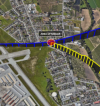
The midair happened at 150 feet up, a few hundred feet from the runway threshold.
1791591414680.png
The twin was traveling almost twice its normal approach speed, and had gear and flaps up. He obviously wasn't intending to land...so why continue the descent?

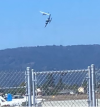
One hundred and fifty feet up, for cripes' sake.
1791592137979.png
Unless you want to claim the pilot had suffered a seizure or something (nothing indicated on the autopsy), the only possible explanation is that it was deliberate.

This looks like a "bumping" gone bad.

Ron Wanttaja
 
Generally, an aircraft on an IFR approach is going to be on final long before they conflict with anyone in the pattern. I
Okay... I had written you a long reply as to why you're incorrect on your premis... But then I got thinking that you've been reading all of these (and other) posts. Then it hit me...

Okay Fine!!! You got me! I get now you're pulling our chains by keep going around in circles! :p :cool:
 
Last edited:
From where do you draw that? It isn’t the only explanation that fits. It is actually an unlikely explanation. There is nothing to indicate such was planned.
Some of the commentary in the weeks following the accident suggested that the ground speed of the twin on final was such that there's no way he could have gotten stopped on the runway. I haven't analyzed the data myself, so I'm not sure.
 
I never said it was "Planned". No one takes their pick 'em up truck onto the street planning to shake their fist and swerve at random cars on the street. They get triggered by people who somehow offend their ego.

The midair happened at 150 feet up, a few hundred feet from the runway threshold.
View attachment 155622
The twin was traveling almost twice its normal approach speed, and had gear and flaps up. He obviously wasn't intending to land...so why continue the descent?

One hundred and fifty feet up, for cripes' sake.
View attachment 155623
Unless you want to claim the pilot had suffered a seizure or something (nothing indicated on the autopsy), the only possible explanation is that it was deliberate.

This looks like a "bumping" gone bad.

Ron Wanttaja
That graphic and photo really tell a story!

What does "bumping" usually mean? Just flying close enough to get someone's attention without making physical contact?
 
That graphic and photo really tell a story!

What does "bumping" usually mean? Just flying close enough to get someone's attention without making physical contact?
Flying beneath a slower airplane and zooming up suddenly in front. The slow airplane gets bumped by the wake of the other plane. Plus giving the pilot a heart attack.

Like I mentioned, it was done to me. An RV as I was flying home from the Arlington Fly-In.

Ron Wanttaja
 
The problem with a teardrop is nobody performs them correctly. People want to overfly and make a descending turn direct to downwind. Fly past 2miles. Descend. THEN turn.View attachment 155596
Fly two miles past... What, exactly? How wide is the traffic pattern? And what altitude are you overflying?

I ask because, as a bizjet pilot, when I have to fly a traffic pattern, we're generally at 200-220 KIAS on downwind if we're flying a downwind, and we're gonna be at 1500 AGL and maybe 2-2.5 miles from the runway. Are you flying 4.5nm out at at least 2000 AGL before you turn? If so, you're in a tiny minority... Yet in a tangle with a bizjet you're probably not going to survive. Splat. But that's the problem with almost all of these arguments, the FAA has not defined anything very well at all.

AC 90-66C goes on to describe the "Final" they are talking about as from where you would turn from Base to Final. So calling a 5 or 10 mile "Final" would be inaccurate.
First off, they are defining it in a section entitled "TRAFFIC PATTERNS". Yes, the Final leg of a VFR traffic pattern is inside the base leg. But that is certainly not the definition of "Final Approach" in all circumstances - After all, there's something called a "Final Approach Fix" on many IFR approaches that is generally 5-6nm and sometimes more away from the runway threshold, and that entire leg is also called final approach. Your justification for your definition here just doesn't hold water.

But more to 91.113... It also specifically says "...When two or more aircraft are approaching an airport for the purpose of landing, the aircraft at the lower altitude has the right-of-way, but it shall not take advantage of this rule to cut in front of another which is on final approach to land or to overtake that aircraft..."
Go back to the beginning of the reg, where it says "Aircraft, while on final approach to land or while landing, have the right-of-way over other aircraft in flight or operating on the surface." (emphasis mine)

Of course, I think this whole argument is a little silly as it seems to happen only on the Internet and never in real life, where we tend to treat each other with respect and almost all the time a slower airplane will give way to a faster one.

My home base is similar to Watsonville in terms of aircraft mix and number of operations. One thing I have begun to hear from jet operators on straight in approaches is reporting time "10-mile final, 2 minutes out." Among all the nonsensical radio calls we've been talking about, this stands out to me as somehting useful.
Yep. I started doing that about as soon as I got some real world jet experience, maybe because of some of our prior PoA "discussions" on this subject. ;) 10 miles is gonna be 3 minutes or less for us most of the time.

Coming down final at 300 knots sounds more like a strafing run than a landing approach!
Well, we can't go faster than 250 KIAS below 10,000, but you'd better believe that we're doing 250 until we need to slow down, and above 10 we're going to be going faster.

Where do I sign up for this?
Depending on your certificate and experience level, your local flight school, an ATP-CTP provider, or any number of aviation job sites. AirlineApps, BizJetJobs, ClimbTo350, etc...

Ah OK, that is surprising. It seems like a pretty simple concept. Fly over the pattern. Descend. Turn back to 45.
It's just that there's no definition of where "the pattern" is.

I've heard those calls too. But most of the corporate jets I see are not that much faster than a Skylane on final, may be 50% faster - 100 knots instead of 75 knots.... Their cruise speed, however, is different.
The speed range is fairly wide. The 182 I used to fly was 80mph on final, or 70 knots. My Mooney is 75. The TBM I used to fly was 80-85 depending on weight. The jet I fly now tends to land at around 125. But, keep in mind that the speeds before landing may be a fair bit higher, and that most of the profiles for bizjets are geared towards fitting in with airline traffic at busier airports, where we generally have to maintain 170-180 knots until the FAF or a 5-mile final. We can hit that 5-mile mark anywhere from 150 to 220.

But 10 miles in 2 minutes is impressive. That's a 300 knots final approach. How long is the runway?
I'm guessing it comes from the avionics - I know ours only show whole minutes, so 2 minutes and 59 seconds still shows as 0:02... And 10 miles in 2:59 is only 201 KTAS.
 
Every once in a while (not often any more) I hear a request for "airport advisory"...
Yeah, I've been flying for twentymumble years and I think I've been to one, maybe two, airports where that was even still a thing. (KRYV, FWIW. They can even get your clearance for you...)

I'm planning a flight from Hayward, CA (HWD) to Oakland (OAK). HWD lies almost directly under the OAK ILS30 final approach course, and the threshold of OAK R30 is only a few degrees to the right of the extended centerline of HWD R28L. So, if I depart HWD R28L with the intention of landing on R30 at OAK, at what point am I on a "straight in final"--initiation of takeoff roll? Liftoff? Reaching OAK pattern altitude? You might think that's an absurd stretch, but given the other posts on this topic, maybe it isn't.
Probably when you start your descent? But who cares?

Okay... I had written you a long reply as to why you're incorrect on your premis... But then I got thinking that you've been reading all of these (and other) posts. Then it hit me...

Okay Fine!!! You got me! I get now you're pulling our chains by keep going around in circles! :p :cool:
Staying in the pattern, one might say. :rofl:
 
What kills people is when they make the decision that they'd rather be right than alive.

One of the big lessons I took away from the previous Watsonville discussions was never to bet my life on an expectation that the other pilot will interpret right-of-way in the pattern the same way I do.
 
Last edited:
Fly two miles past... What, exactly? How wide is the traffic pattern? And what altitude are you overflying?

I ask because, as a bizjet pilot, when I have to fly a traffic pattern, we're generally at 200-220 KIAS on downwind if we're flying a downwind, and we're gonna be at 1500 AGL and maybe 2-2.5 miles from the runway. Are you flying 4.5nm out at at least 2000 AGL before you turn? If so, you're in a tiny minority... Yet in a tangle with a bizjet you're probably not going to survive. Splat. But that's the problem with almost all of these arguments, the FAA has not defined anything very well at all.
Yes, but since you mentioned arguments that are mostly online, the real world problem seen daily isn’t the airplane flying at 1500 AGL two miles out before beginning a straight ahead descent to pattern altitude before turning failing to account for the jet on a wider, higher downwind.

It’s the airplane flying a literal teardrop descending into the pattern.

While I appreciate the value of brevity, IMO 90% of the problems with the FAA‘s long-preferred method for pattern entry from the upwind side would be solved if we stopped calling the crossover-and-return-on-the-45 a “teardrop” entry. it’s neither a “teardrop” nor a pattern “entry.”
 
Here is to why our traffic pattern designs are stupid and there is reason for avoiding strict adherence:


Aircraft of vastly different speed don't mix well in a traffic pattern.
 
Fly two miles past... What, exactly? How wide is the traffic pattern? And what altitude are you overflying?

No technique is universally applicable. Teardrop entry is an option which works well in some situations, not so much in others.

Personally I would not use it at an airport with regular bizjet or turbine usage, for exactly the reasons you identify.

IMO it is good for situations with multiple light trainers in the pattern. Trying to jam a direct entry into a conga line of student pilots nose to tail on downwind can cause confusion. Less disruptive to fly over them, see where they are on downwind, then descend and turn back to a 45 merge, which they have all been taught to expect.

I guess I appreciate it because in the old days I was taught I was supposed to circle the airfield 5 miles out if I arrived opposite the pattern. What a PITA that was.
 
Here is to why our traffic pattern designs are stupid and there is reason for avoiding strict adherence:
When someone claims that a long established SOP is "stupid," their credibility is immediately undermined.

Any airport traffic pattern must accommodate all manner of aircraft, operating at a wide range of speeds and having different maneuvering characteristics. So we pilots have to do pilot stuff in order to make it work safely and efficiently for all, and that would be the case no matter what kind of traffic pattern or scheme were established.

It is also why U-2s had to go one way while the SR-71 went the other; ever notice while helicopters are to avoid traffic patterns, theirs is still same side with only the aircraft of all flavors that lack radios go the other side? Why do you suppose that is?
 
Fly two miles past... What, exactly? How wide is the traffic pattern? And what altitude are you overflying?
Yep. There are also often terrain, obstruction, or airspace issues that arise if you keep flying past the pattern too far. The former can be exacerbated if we follow the PHAK advice to descend to pattern altitude prior to the turn. Either way, we don’t always have the 3-6 miles of space it takes to maneuver for the 45. It is definitely not one-size-fits-all.

Seems like traffic pattern entry should take a higher level of focus on the “preflight actions” we’re all required to do. Unfortunately, a lot of folks get trained to their local airport bubble and that’s about it. This could use a lot more scenario-based training, but it’d probably require some CFIs to step outside their own personal bubble - for example, there are things that are difficult to teach about flying in California if you’ve only flown in the Midwest.

Heck, there are things that are difficult to teach about some airports within any region if you’ve haven’t been there personally. Yet, that certificate doesn’t limit us to any specific airport or region, so we’re free to go apply what little we know universally...
 
Yep. There are also often terrain, obstruction, or airspace issues that arise if you keep flying past the pattern too far. The former can be exacerbated if we follow the PHAK advice to descend to pattern altitude prior to the turn. Either way, we don’t always have the 3-6 miles of space it takes to maneuver for the 45. It is definitely not one-size-fits-all.
Yep. And the funny part is, usually the "pattern police" that insist you MUST do what the PHAK says are the same ones who insist that they can't do a partial-power stabilized approach because "WhAt If EnGiNe FaIlUrE waaaaah". Whoops, I just opened another can of worms.

Seems like traffic pattern entry should take a higher level of focus on the “preflight actions” we’re all required to do. Unfortunately, a lot of folks get trained to their local airport bubble and that’s about it. This could use a lot more scenario-based training, but it’d probably require some CFIs to step outside their own personal bubble - for example, there are things that are difficult to teach about flying in California if you’ve only flown in the Midwest.
I think the old graphic that @EdFred made should be in the PHAK. It shows entering the pattern on any leg depending on where you come from, and IIRC it's pretty much what I do. The other day, I went to @06C with Cowman. Listened and spoke. There were two in the pattern and a third entering. I was coming from the north and winds were out of the SSE so everyone was using runway 11. I lined up to just fly right onto the base leg. The two in the pattern were no issue, and the third guy was at my 9 o'clock and entering on the 45 when we were about 3-4 miles north of the airport and I was going 45 knots faster than he was (ADS-B is a handy tool). Given that information, I was gonna beat him by a mile (actually, a fair bit more) so I just stayed on base. If I'd have maneuvered for the 45, I'd have needed to fly a gigantic pattern to avoid running over him on final.

The system works when everyone just cooperates and stays out of each other's way.

Heck, there are things that are difficult to teach about some airports within any region if you’ve haven’t been there personally. Yet, that certificate doesn’t limit us to any specific airport or region, so we’re free to go apply what little we know universally...
Luckily, there's enough commonality that we can fly anywhere safely enough to learn about a particular local area.
 
Luckily, there's enough commonality that we can fly anywhere safely enough to learn about a particular local area.
The standard works well enough for the majority of non-towered fields. It’s a good jumping-off point for airports that don’t fit the norm and in those cases there’s definitely room for applied knowledge. It makes for great lesson material.
 
Yep. And the funny part is, usually the "pattern police" that insist you MUST do what the PHAK says are the same ones who insist that they can't do a partial-power stabilized approach because "WhAt If EnGiNe FaIlUrE waaaaah".
Well you see... if you go to idle with an engine that is in flight, it is a know fact that the engine will have a 90% greater chance of failing. I know this is a fact because every single one of the guys at the old local airdrome that we'd fly into for lunch would take a moment from ranking landings to tell us!!!!!!

As for the "Pattern Police" I'm afraid I might side with them **IF** there are other planes in the pattern. I expect planes to go a certain way and if I have spotted one headed towards an airport, I *ass*u*me* they are going to enter the 45 for the same runway everyone else is using (or possibly do a *correct* overhead if we're on the other side). But if there aren't other planes in the pattern, all bets are off!!!
 
Back
Top