Any Traffic in the Area, Please Follow the AIM

Food for thought: Santa Paula get particularly busy with the restaurant and Saturdays. No “overhead,” but no forty-fives either. Deep crosswind entry and long downwind entry, that is all. Note also the proximity of the ridge to the southeast. Outside extended upwind to crosswind, yep. Works fine.

IMG_1695.jpeg
 
Mine were loaded with references. You’d also be hard pressed to say they were lacking in savvy too. Did you see any naked opinion anywhere in mine?
Is this a test?
An overhead entry is one of the best ways to both spot your interval and work into a busy pattern. The overhead entry is essentially an outside upwind to crosswind. Add the energy depleting turn and you have the overhead break. They’re not cosmic. Put resolving interval to the upwind crosswind instead of downwind base with everyone extending deep. Put the traffic all forward quarter not merely forward hemisphere. And have it in a manner that you will see contrast traffic vs background to which the forty-five to downwind doesn’t accomplish.

Or call it an outside upwind to crosswind entry and they’ll readily get it while having no change to what it actually is. And also stop training to the lowest common denominator. For all you strict rules adherents out there, should probably know the rules.
It is in the AIM and also it is in the AC 90-66.
 
Great, call overhead break in a busy pattern full of student pilots.
Umm.... to be clear.... An Midfield Overhead Pattern Entry is NOT IN ANY WAY related to an Overhead Break. And unless it is confirmed there is NO ONE in the pattern, no one should be doing an Overhead Break as you are correct, not too many people will have a clue if you were not trained on it, so no foul on any other pilots for not knowing what's coming. Just cuz it's fun to do, does not make it safe to do.

If you are unclear on the relatively new Overhead Pattern Entry, below is a good review. Starts off with the original pattern and then down lower gets to the new Overhead Entry (not Break :D). Biggest issue or what's a lot of people above are talking about the incorrect usage is people miss that you're suppled to keep flying AWAY from the airport, then turn back to enter a normal 45 degree entry - in most cases. But similar to the Straight In that is okay in some low traffic times, there is a way you can turn directly into the Pattern, but again, only supposed to be used if there is NO conflicting traffic. (But if you're sure you're the only one there, the FAA gets that you're not going to waste your time flying out and back to the airport.)
https://www.boldmethod.com/learn-to-fly/maneuvers/changes-to-non-towered-pattern-procedures/
 
I am very familiar with a midfield entry (don't see the word overhead anywhere in that) or the eternal favorite "teardrop" entry. Not what I was responding to.
If you are unclear on the relatively new Overhead Pattern Entry, below is a good review. Starts off with the original pattern and then down lower gets to the new Overhead Entry (not Break :D)
To be clear - this is the post I was responding to which describes an overhead break
An overhead entry is one of the best ways to both spot your interval and work into a busy pattern. The overhead entry is essentially an outside upwind to crosswind. Add the energy depleting turn and you have the overhead break.
 
To be clear - this is the post I was responding to which describes an overhead break
So truly an Overhead Break. Great maneuver, but really hard to always fit in with all the other Non Towered Airport traffic.

I can easily see a situation where someone is calling an Overhead Break on the radio and someone is thinking they're doing and Overhead Pattern Entry and pretty much ignores them. They check the Final and Base and see nothing so the pull out onto the Rwy for departure. Sure, the guy doing the Break **should** see them. But just not worth the confusion IMHO.
 
Not as such. They pulled the plug on the red board. That was the last straw for me. I canceled my AOPA membership then.
I danced in celebration. One of the nastiest forums I’ve ever come across. AOPA did well to put an end to it. Just a handful of mean old bastards yelling at everyone. It was an absolutely awful place.
 
Food for thought: Santa Paula get particularly busy with the restaurant and Saturdays. No “overhead,” but no forty-fives either.
With the no 45s and the mention of the preferred downwind and out the pattern crosswind entries, sounds like Canada.
 
AI thumbnails get an immediate "don't recommend channel" from me.

I've noticed that thumbnails are notoriously bad even on channels that I like!
 
Nor does it prevent me from being wrong.

As they say, opinions are like a-holes; everyone has them."
I don't want to butt in (pun intended) but I believe the adage is wrong. I know someone who unfortunately has a stoma. Which I don't believe would be an a-hole.

Now, back to the regularly scheduled poop flinging.
 
I have not been here very long at all but I’ve gotten plenty of it.

There is some truth to this. Name recognition and frequency of posting do seem to matter somewhat. I've had situations where many disagreed with something I say, only to have someone with a more familiar name come along later and say essentially the same thing - and get a bunch of thumbs up.

Though I've been in aviation discussion groups since the early '90s, I've never been a frequent poster, so these don't bother me much. I don't come here to get my ego stroked. I come here to learn.

I've found that the process of composing my thoughts and responding to other people's questions helps clarify my own thinking in a way that simply reading someone else's monologue doesn't. Even when nobody agrees with me, the exercise itself is worthwhile.
 
I got enough things to get ****ed off about without adding what people say on the radio to the list.
I suspect it will not come as a surprise to anyone to learn that I don't need to be ****ed off about anything to be motivated to express an opinion about it!
 
Now if he really wants to make the world a better place, maybe he can help stamp-out the gratuitous misuse of overhead patterns at busy GA airports (except when operationally necessary, which is uncommon).
I once had to take evasive action on a 45-degree entry to Half Moon Bay when somebody did an overhead entry and ended up head-to-head with me!
 
Is this the Captain Ron who used to get crucified here? The one who became POAdeleted or something like that?
I don't think so. He used to have a photo in his thumbnail on another board, and I don't think it looks like him. Also, his reaction when I posted this on yet another board is not consistent with it being him.
 
Or call it an outside upwind to crosswind entry and they’ll readily get it while having no change to what it actually is. And also stop training to the lowest common denominator. For all you strict rules adherents out there, should probably know the rules.
It is in the AIM and also it is in the AC 90-66.
If someone called "outside upwind to crosswind entry" when I'm about to launch I'm gonna hold short and try to figure out what he said and is gonna do.

Per ac90-66. (4 full pages after "normal" pattern operations)

Pilots should be aware of the other types of approaches to land that may be used at an airport when a pilot indicates they are doing so, which may or may not be initiated from the traffic pattern.

9.12.5.3 An Overhead Approach. An overhead approach is normally performed by
aerobatic or high-performance aircraft and involves a quick 180-degree turn
and descent at the approach end of the runway before turning to land

(described in the AIM, Paragraph 5-4-27, Overhead Approach Maneuver).

Per the referenced

a. Pilots operating in accordance with an IFR flight plan in Visual Meteorological Conditions (VMC) mayrequest ATC authorization for an overhead maneuver. An overhead maneuver is not an instrument approachprocedure. Overhead maneuver patterns are developed at airports where aircraft have an operational need to conduct the maneuver. The existence of a standard overhead maneuver pattern does not eliminate the possible requirement for an aircraft to conform to conventional rectangular patterns if an overhead maneuver cannot be approved.

So yeah. My apologies if I'd be a bit confused.
 
I danced in celebration. One of the nastiest forums I’ve ever come across. AOPA did well to put an end to it. Just a handful of mean old bastards yelling at everyone. It was an absolutely awful place.
Unfortunately, they nuked the good along with the bad. There were historically some truly illuminating discussions that I am no longer able to link to.
 
AI thumbnails aren’t all the same. This one is AI but clean(ish) and not offending to my eyes. I have a large YT channel and I can’t create thumbnails to save my life. Would you rather I spent 4 hours to create a crappy one or 5 minutes creating a good one and spending the rest of the time creating good content? AI is about how you use it.

What's the name of your channel? I'd like to check it out.
 
Opinions about traffic calls seem to come and go like fashion trends, and I think we sometimes blow these things way out of proportion.

My instructor used “any traffic in the area, please advise.” That was back in the mid-90s, and I am guilty of having used that phrase myself back then. It basically means, “I just switched to this frequency - what did I miss?” More recently, I started hearing “last call.” The first time I heard it, I thought, “Hmm, that’s interesting. He is saying that he is switching frequencies and won’t be listening anymore".

Neither of these strikes me as particularly bad, nor are they significant contributors to frequency congestion. Why the FAA felt it was important enough to intervene and issue a guidance is beyond me. There are much bigger things to worry about in aviation.

On the other hand, I do hear calls that seem nearly useless, such as “clear of the active,” or “we are crossing SEYOS, inbound,” with no indication of which runway they just exited, or where SEYOS is. And then there are the extended conversations with the FBO about catering, rental cars, and other arrangements that really can tie up a frequency.
 
Neither of these strikes me as particularly bad, nor are they significant contributors to frequency congestion.
My guess is you haven't been into a REALLY busy airport, or one that has two or three near by on the same Freq. A large number of the needed transmissions will result in a squeal and be unreadable. But then to add in all of this BS just makes it dangerous.

On the other hand, I do hear calls that seem nearly useless, such as “clear of the active,” or “we are crossing SEYOS, inbound,” with no indication of which runway they just exited, or where SEYOS is.
Often unnecessary, and I'll admit to doing it out of habit sometimes. But then if you fly into an Apt where the those lined up on the Taxiway trying to depart can't see the planes getting off the Rwy at the other end, it sort of becomes obvious why you hear it. As for SEYOS or any other intersection call out when doing a practice approach, I couldn't agree more. Really dumb CFIIs passing on really dumb habits to their students/learners. Give the distance and if you're landing "Straight In" or if it will be a "Low Approach."

And you didn't mention this one... but another DumbSh*t pop quiz for those that call off the Fixes...:D Do you also think you have the Right of Way over those in the pattern cuz you're might be IFR? Well, I hate to bust your bubble, but your CFII messed up on that one too, you DO NOT. Traffic in the pattern has the Right of Way over IFR and Straight In aircraft.
 
What's the name of your channel? I'd like to check it out.

A problem with Ron’s recent videos isn’t AI thumbnails. It is that he let background AI images play rather than simply talking or providing his own images to go with the discussion. If you simply listen, you’re ok, but if you watch these AI visuals, they’re not simply wrong, they’re loony. I guess at least they’re so wrong that anyone will readily see such and recognize that they have bad SA. Recognized bad SA is better than unrecognized. But no SA is better than bad. Just talking with no images would have been better.
 
What's an "STA"?

Wondered that myself. At first thought is it a typo for SFA being simulated flameout aka PO180? My AI search assistant suggests STA is Straight In Approach. Though how it got that I don’t know while it referenced the FAA abbreviations tool, https://www.faa.gov/about/abbreviations, which did not show me STA. Nor did the Part One Abbreviations and Definitions document ForeFlight provides under FARs tab. In context, however, straight-ins not recommended makes sense. Such works if no one is there but would be a nightmare on a Saturday morning. Other sites seem to recognize this abbreviation though where they’re actually getting it, I don’t know, but it fits.
 
I once had to take evasive action on a 45-degree entry to Half Moon Bay when somebody did an overhead entry and ended up head-to-head with me!

You’d have to draw that out to me because I don’t see how such happens. Even if two planes were headed to opposite runways, the outside upwind leg isn’t displaced anywhere near downwind spacing. A “teardrop” to the forty-five done too close, however, could though this too doesn’t make sense as the downwind from such would be too tight. Perhaps someone who doesn’t know what the initial is and where it is essentially S-turning with their “overhead” leg being the middle of the S? But this doesn’t make sense either as their turn radius would either displace them outside the downwind or well inside the runway in the break leg. An actual overhead entry with a break is merely an outside upwind to crosswind with the turn being energy dissipating. Generally that turn is a 180 turn as opposed to a square leg, but it is still merely an upwind to crosswind to downwind. Nothing fancy. And such isolates traffic forward hemisphere from the initial with such shifting toward forward quarter as one closes with the airfield. Yes, you may have someone aft of this to whom you are working your interval spacing, but at that point you’re tracking them as opposed to searching and detecting. The overhead does not conflict with a normal pattern as it is outside of such. The break is a crosswind and a crosswind is a normal part of a pattern.
 
I don't want to butt in (pun intended) but I believe the adage is wrong. I know someone who unfortunately has a stoma. Which I don't believe would be an a-hole.
I think they still have one; it's just inop.
I've found that the process of composing my thoughts and responding to other people's questions helps clarify my own thinking in a way that simply reading someone else's monologue doesn't. Even when nobody agrees with me, the exercise itself is worthwhile.
:yeahthat: I think it annoyed my fellow engineers sometimes... I'd ask for input on a design problem, and by the time I finished describing the problem to them the solution had become obvious to me.
 
Opinions about traffic calls seem to come and go like fashion trends, and I think we sometimes blow these things way out of proportion.

My instructor used “any traffic in the area, please advise.” That was back in the mid-90s, and I am guilty of having used that phrase myself back then. It basically means, “I just switched to this frequency - what did I miss?” More recently, I started hearing “last call.” The first time I heard it, I thought, “Hmm, that’s interesting. He is saying that he is switching frequencies and won’t be listening anymore".

Neither of these strikes me as particularly bad, nor are they significant contributors to frequency congestion. Why the FAA felt it was important enough to intervene and issue a guidance is beyond me. There are much bigger things to worry about in aviation.
The point for most is that they are useless. If you switch to or monitor the CTAF at least 10 miles out, you haven’t missed anything. Or is it that you want every other airplane there to give you a recap of the last 10 minutes? Sorry, but I’m not at a 122.7 or 122.8 airport and there’s still a lot of congestion from the other busy nontowered that uses it about 60nm away.

The YouTube created “last call”? Worthless. Nothing but frequency congestion. Ron’s “You promise?” is perfect.
On the other hand, I do hear calls that seem nearly useless, such as “clear of the active,” or “we are crossing SEYOS, inbound,” with no indication of which runway they just exited, or where SEYOS is. And then there are the extended conversations with the FBO about catering, rental cars, and other arrangements that really can tie up a frequency.
Other than the use of “the active,” I disagree. If they want to mention which runway or just clear of the runway when there is only one strip doesn’t matter to me. Being on the ground and clear of the runway pavement is all I care about from an airplane on the ground.

Calling SEYOS? I absolutely want a VFR position call understandable by that solo student pilot. So, yes, “10 mile straight in” beats SEYOS every day of the week.

Yes, UNICOM calls for UNICOM purposes can be an issue. If it’s a significant one at yours, the answer is to separate UNICOM from CTAF, not to complain about UNICOM.
 
Being on the ground and clear of the runway pavement is all I care about from an airplane on the ground.

This brings another point, those on the ground don’t have priority. You often don’t need to call your taxi plan. Such eats radio time from those in the air. Personally I like to only use the radio for taxi if I see a potential conflict developing so as to resolve it beforehand, or if need be, during, as well as to call out taxi situations that have lines of sight obscured. If I can see from the present ramp to hold short and I don’t have a potential beak-to-beak from someone else clearing, I’m not calling my taxi. If I have to cross a runway, obviously that is a call, as is being cleared on the far side, but these wait till I’m ready to do the one and have completed the other. Radio time is a limited resource. We should be considerate to it.
 
This brings another point, those on the ground don’t have priority. You often don’t need to call your taxi plan. Such eats radio time from those in the air. Personally I like to only use the radio for taxi if I see a potential conflict developing so as to resolve it beforehand, or if need be, during, as well as to call out taxi situations that have lines of sight obscured. If I can see from the present ramp to hold short and I don’t have a potential beak-to-beak from someone else clearing, I’m not calling my taxi. If I have to cross a runway, obviously that is a call, as is being cleared on the far side, but these wait till I’m ready to do the one and have completed the other. Radio time is a limited resource. We should be considerate to it.
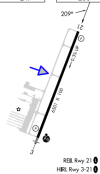
I agree. An example from my home base, a fairly busy Class G; busy enough that we're getting a Tower. Excess calls are a PITA.Here's the runway snapshot (it hasn't bee updated for the new runway entrances). If Runway 3 is being used, I almost never make a taxi call, unless it's because there's a ramp issue. You are not conflicting with any one coming or going to or from the runway.

OTOH if Runway 21 use in use, landing aircraft are generally getting off at the arrow and taxi on the main taxiway until the FBO exit. That means conflicts between aircraft taxiing to and from21 regularly conflict. The taxi calls in that case are helpful to resolve them before they happen.

1791377943611.png
 
I do hear calls that seem nearly useless, such as “clear of the active,” ... with no indication of which runway they just exited

I use this frequently, but always in situations where the runway is obvious. Mainly when an aircraft is following me on final or holding short for takeoff. They don't need to be told which runway, as they are already lined up on it. They just need confirmation I'm out of the way.
 
I use this frequently, but always in situations where the runway is obvious. Mainly when an aircraft is following me on final or holding short for takeoff. They don't need to be told which runway, as they are already lined up on it. They just need confirmation I'm out of the way.

Though we could also abbreviate to simply “Keene, N1234 Clear. Keene.”
 
The point for most is that they are useless. If you switch to or monitor the CTAF at least 10 miles out, you haven’t missed anything. Or is it that you want every other airplane there to give you a recap of the last 10 minutes? Sorry, but I’m not at a 122.7 or 122.8 airport and there’s still a lot of congestion from the other busy nontowered that uses it about 60nm away.

The YouTube created “last call”? Worthless. Nothing but frequency congestion. Ron’s “You promise?” is perfect.

Other than the use of “the active,” I disagree. If they want to mention which runway or just clear of the runway when there is only one strip doesn’t matter to me. Being on the ground and clear of the runway pavement is all I care about from an airplane on the ground.

Calling SEYOS? I absolutely want a VFR position call understandable by that solo student pilot. So, yes, “10 mile straight in” beats SEYOS every day of the week.

Yes, UNICOM calls for UNICOM purposes can be an issue. If it’s a significant one at yours, the answer is to separate UNICOM from CTAF, not to complain about UNICOM.

What I meant was that “clear of” is an important call, but “the active” is useless. I always say “clear of 20.” That conveys that I just landed on 20 and have vacated the runway.

In some cases, ATC doesn't give you a frequency change until you are almost in the traffic pattern, so listening to CTAF for 10 minutes before arriving may not always be practical. “Any traffic please advise” doesn't require a recap of everything that happened in the last 10 minutes. If an airplane says, “I'm one mile out, joining the 45 to the downwind... any traffic please advise,” only potentially conflicting traffic needs to say something. If there is no conflict, then don't say anything. Nevertheless, the last time I used that phrase was probably 15 years ago, mostly because of all the negative publicity surrounding it.

“Last call” is new to me. I first heard it about three years ago. It adds may be 500 ms to the call, so I don't see why it is considered so terrible. Perhaps it isn't particularly useful, but responding with snarky comments on the radio only adds more frequency congestion - which is supposedly the reason for discouraging these phrases in the first place.
 
In some cases, ATC doesn't give you a frequency change until you are almost in the traffic pattern, so listening to CTAF for 10 minutes before arriving may not always be practical.

Second radio? Monitor function on the first? If IFR into the non-towered, I generally try to have both Approach and CTAF up throughout building SA prior to “switch,” and listening while ready to talk again with Approach on a missed.
 
What's an "STA"?
Straight in approach, in this context, I believe (can also denote-"scheduled time of arrival")

It's no longer 1970, when writing things out took valuable "bandwidth"
it's past tme for the FAA to go to plain text-esp for weather/condition reporting.
Sure I know "BR" means "mist", but why expend the mental energy? It's less safe than "mist"
 
At a non-towered airport, there's no such thing as "the active". Clear the runway if there's one or clear all runways if there's more than one. Runway X can be helpful for those further out wondering what runway is in use.
 
In some cases, ATC doesn't give you a frequency change until you are almost in the traffic pattern, so listening to CTAF for 10 minutes before arriving may not always be practical.
Sorry to hear you only have one radio with no monitor switch. The ability to monitor another frequency is worth the price in situational awareness. My SOP into a towered airport, both VFR and IFR is, once I get the "1-mnute weather," COM 2 goes to the CTAF. I teach it on every dual cross country flight where I don't hear a pilot doing it, regardless of experience level. .

My favorite example is in a video where my approach clearance IFR was delayed due to an IFR departure from my home base. I knew the flight departed before ATC did.

No, I have three radios. But my listening bandwidth is not able to keep up with a busy ATC chatter, talking to the student, and listening to CTAF and creating a mental picture of traffic in the pattern all simultaneously. Listening to AWOS while talking to ATC is reasonable, but AWOS plays a prescribed format, not random people announcing things. I would love to see someone demonstrate this unique capability. Before you say it, there is no such as multitasking while listening. The human ear can only pay attention to one source at a time.

WIth a quiet ATC, and a quiet CTAF, I agree, listening to multiple frequencies is useful. But we are talking about busy frequencies, which is the whole point of this thread - shaving off a fraction of a second by avoiding saying 'last call'. If the frequency is that congested where saying 'last call' is taking up valuable time, I don't think it is possible to listen to that and ATC and the student simultaneously and make sense of anything.
 
Last edited:
I would love to see someone demonstrate this unique capability.

Two radios plus two channels on the network that act like radios plus a radar, an EW warning system, a targeting pod, the link picture, interfacing with weapons systems… listening to multiple isn’t unique, it’s pretty common.

I’m long since in that environment but I do set ATC in primary while CTAF goes in the back radio such that I can listen. Yes, with busy frequencies. Might not catch everything, though the volume to the active radio is louder so not gonna miss there, and hearing enough to get a mental picture developing. And I do it with students while not only teaching them, and also getting them to do the same.

It isn’t just my bandwidth I’m working with, it is also helping preserve a little of everyone elses’.
 
And you didn't mention this one... but another DumbSh*t pop quiz for those that call off the Fixes...:D Do you also think you have the Right of Way over those in the pattern cuz you're might be IFR? Well, I hate to bust your bubble, but your CFII messed up on that one too, you DO NOT. Traffic in the pattern has the Right of Way over IFR and Straight In aircraft.

You are correct, but I would hope that people in the VFR pattern would not cut off an IFR aircraft on a straight in approach just because they can.
 
Back
Top