Another pilot bails

murphey

Touchdown! Greaser!
PoA Supporter
Joined
Aug 21, 2008
Messages
12,628
Location
Colorado
Display Name
murphey
Home Airfield
KFTG
Neighbor at the airport has a cherokee like mine. We joke that the two are "cousins" because the serial numbers are fairly close. He bought it about 15 years ago, bought the hangar at the airport at the same time. He sold both this past month. The hangar cost about $40K, he sold it for "six figures" but didn't provide any details.

I asked why and his answer while very reasonable, might be forecasting the next few years of the aging population, if it's not already happening.
1) $$$ is out of sight. Battery for the ELT (we have the same) is $130 when 2 years ago, it was about $35.
2) The A&P/IA he used for 10 years got transferred to Chicago (United)
3) His backup A&P/IA died before covid.
4) He doesn't like the A&P/IA he had to use this year, and really hated how much it cost.
Note: He's a cheap guy, altho he & his wife take a cruise every year.
As a note: I can understand and sympathize. Last year the A&P/IA I use was charging $125/hr. This year, $140/hr.
5) He thinks 100UL is going to damage, possibly destroy the engine (Lycoming 360 A4A)

He flys about 75-100 hrs a year but only took a few trips more than 3 hours in all the time he owned the cherokee.
Never went to OSH because his wife doesn't like crowds, despite my explanations. But asked about it once in a while.
Never joined EAA, AOPA, Colorado Pilots or any other aviation organization
No clue who did his BFRs, as I don't think he ever talked to either of the two (now three) schools on the field.
Mostly just poked holes in the sky. Didn't even go for the $100 breakfast/burger very often.
His wife is still working - project manager at the university medical center but he retired a couple years ago because his employer went bankrupt.

Personally, I don't consider that plane airworthy, as he & his wife painted control surfaces with auto spray paint and AFAIK, didn't strip the old paint, and never had the control surfaces balanced properly. Which means the IA just signed off without checking. I let him use mine once for his BFR because his was in the shop. Only once.
He put blinky wing lights on it but never added shoulder harnesses, which was the very first update I did to my cherokee.
 
It doesn't sound like cash was the issue, but if it was, he could have borrowed against the equity in the hangar and used the money to do everything he needed to do to the plane. Still would have made a boatload when he sold them both.

Sounds like we might be better off on the ground.
 
I've said it before. You've got to really love it to do it. Having a community helps. Having a "mission" helps A LOT.

The only thing in that story that surprises me is the 75-100 hours/yr. I don't understand how anybody flies those kind of hours in their local area unless they're doing aerobatics.

$140/hr is above average, but is it out of line? Shop rate to get my tractor worked on is $150. Most auto shops are higher than that.
 
The only thing in that story that surprises me is the 75-100 hours/yr. I don't understand how anybody flies those kind of hours in their local area unless they're doing.

Some people just love to fly. I understand that some need a mission, but for me, flying IS the mission
 
Exactly what is the question?

Or is it just a rant about nothing?
 
Exactly what is the question?

Or is it just a rant about nothing?
We allow threads that don’t ask questions.

As far as this discussion goes, I’m curious how the aging pilot population is really distributed through the ages. For every retiree who bails out of GA, how many younger pilots are joining? Asked another way, and with less room for anecdote and selection bias, what is the ratio of 60-year-old GA pilots to 40-year-olds? (I figure 40 is roughly the average age for when a person who wants to fly but isn’t a complete spendthrift decides he can finally afford it.)

I don’t think one man prioritizing cruises with the wife over flying in circles solo because she doesn’t like to travel in small planes is much of a nail in the GA coffin. Particularly if that man has let things slip: cheap on maintenance, possibly skipping flight reviews, etc.
 
I wonder how old the fellow is. That may be a factor, as more and more older pilots run into insurance limitations.
 
It doesn't sound like cash was the issue, but if it was, he could have borrowed against the equity in the hangar and used the money to do everything he needed to do to the plane. Still would have made a boatload when he sold them both.

Sounds like we might be better off on the ground.
He did make a boatload on each.
 
I've said it before. You've got to really love it to do it. Having a community helps. Having a "mission" helps A LOT.

The only thing in that story that surprises me is the 75-100 hours/yr. I don't understand how anybody flies those kind of hours in their local area unless they're doing aerobatics.

$140/hr is above average, but is it out of line? Shop rate to get my tractor worked on is $150. Most auto shops are higher than that.
A couple hours every other week for the last year or two. For the 10 years before that, he was doing the same almost every week. N, E and S, but never over the hills. He has relatives in New Mexico, and we often talked about flying to Sante Fe (I've done it often, never need to go over 10.5 from Denver) but it never happened. Basically, the price tag this past year convinced him to quit because he doesn't like to spend $$$. His wife keeps working because she likes it.
 
We allow threads that don’t ask questions.

As far as this discussion goes, I’m curious how the aging pilot population is really distributed through the ages. For every retiree who bails out of GA, how many younger pilots are joining? Asked another way, and with less room for anecdote and selection bias, what is the ratio of 60-year-old GA pilots to 40-year-olds? (I figure 40 is roughly the average age for when a person who wants to fly but isn’t a complete spendthrift decides he can finally afford it.)

I don’t think one man prioritizing cruises with the wife over flying in circles solo because she doesn’t like to travel in small planes is much of a nail in the GA coffin. Particularly if that man has let things slip: cheap on maintenance, possibly skipping flight reviews, etc.
She loves to fly in the cherokee. But the publicity and stories about how many airplanes and how many people at OSH, she assumes the crowds are like being crammed into an elevator or a home Broncos game. They don't socialize with others at the airport, either.
 
Interesting observations - good conversation starter.

1) Maybe his reference point on what is "expensive" is stuck. With the past inflation event, even I'm having a time adjusting to spending amounts on money on things vs years back. It's my frame of reference. Rational vs emotional. I used to always change my own oil, and once in a great while would treat myself and spend $20 at an oil change place.

2) Cheap and safe flying just don't go together. I had a pre buy once on a seller who was "economical". I actually prayed that he either scrapped it or sold it to someone who rebuilt it. It is possible to "cheap" a plane so bad it can't be brought back.

3) I don't think it's aging of the population - I just think some people get tired out of things.

4) If they don't socialize at the airports, hate crowds, they would hate Oshkosh - good call on their part. Nothing wrong with that - everybody doesn't have to like everything I like, etc.
 
1) $$$ is out of sight. Battery for the ELT (we have the same) is $130 when 2 years ago, it was about $35.
SIDE RANT: My ELT battery is out of date. Replacement is going to be a few hundred dollars for essentially alkaline D cells put in a small case. The kicker is that the A&P had to call around to find NOS because the ELT is discontinued, batteries aren't made for it anymore, and in two years at next battery replacement time I'll have to buy a new ELT. Did I mention I could make a perfectly functional new ELT battery with $10 worth of D cells from Walmart?
 
ELT's should be optional IMO
Actually, somewhat agree. It's mandated by law / set in stone from the 70's, and ideally the FAA should be allowed to update the requirements/performance with today's technology. From what I've read/AV Web videos, etc., the 121.5 ELT's don't' do a lot to help you.
 
Actually, somewhat agree. It's mandated by law / set in stone from the 70's, and ideally the FAA should be allowed to update the requirements/performance with today's technology. From what I've read/AV Web videos, etc., the 121.5 ELT's don't' do a lot to help you.
Like many rules, this one came about because a Congressman was discommoded. Actually, lost without a trace.

And ELTs ARE optional...if you fly the right aircraft. My Fly Baby is a single-seater, no ELT required. Though a previous owner installed one, and I keep the battery up to date. But won't replace it if it craps out.

Ron Wanttaja
 
Our ELT battery is now just a hair over $400 for two lithium D cells stuck to a chunk of plastic with silicone. I could rebuild it with $30 in parts. I'm sure by the time we have to buy another one (3 years, I think) it will top $500.
 
SIDE RANT: My ELT battery is out of date. Replacement is going to be a few hundred dollars for essentially alkaline D cells put in a small case. The kicker is that the A&P had to call around to find NOS because the ELT is discontinued, batteries aren't made for it anymore, and in two years at next battery replacement time I'll have to buy a new ELT. Did I mention I could make a perfectly functional new ELT battery with $10 worth of D cells from Walmart?

So what’s wrong with an owner produced part?

My ELT battery pack is a bunch of 9V Energizer batteries wired together and wrapped in cardboard and tape. I’m considering assembling my own next time.
 
I think if GA was falling apart the prices on used aircraft would be falling from lack of demand. Instead they're way up from just 5 or 6 years ago.

OTOH I recently was talking to my mechanic who's shop rates are $80/hr. He is fully aware the going rate is higher but he believes if he raised his rates even a little that a lot of local pilots would just hang it up and walk away. So he's keeping them low to keep his business thriving. As a customer I appreciate that but I worry about him staying in business.

There seem to be a lot of people like him running GA businesses who do their best to keep things affordable. I am suspecting as those guys die out and their kids or some aviation corp take over the business things rapidly get expensive and unfriendly. I've now seen the corporate buyout version of that play out at two FBOs where I've been based.

I still see new people getting into it though. I'm currently working on a commercial rating with the eventual goal of becoming a CFI and through various discussions I know I won't be making bank doing that. I'm justifying it as more gas money for my plane and a way to stay proficient without draining my own bank account. But like so many others I'm really only doing this because I like it- there are certainly more profitable things I could do with my time instead.
 
We allow threads that don’t ask questions.

As far as this discussion goes, I’m curious how the aging pilot population is really distributed through the ages. For every retiree who bails out of GA, how many younger pilots are joining? Asked another way, and with less room for anecdote and selection bias, what is the ratio of 60-year-old GA pilots to 40-year-olds? (I figure 40 is roughly the average age for when a person who wants to fly but isn’t a complete spendthrift decides he can finally afford it.)

I don’t think one man prioritizing cruises with the wife over flying in circles solo because she doesn’t like to travel in small planes is much of a nail in the GA coffin. Particularly if that man has let things slip: cheap on maintenance, possibly skipping flight reviews, etc.

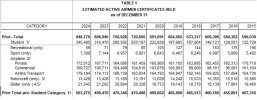
The pilot population had been slowly declining until the late 2010's, it has been increasing since then. From the 2024 Airmen Statistics:

2024-Airmen-Statistics.jpg
You'll note that the number of student pilots is growing rapidly. Student certificates no longer expire, so the total keeps increasing. If you're interested in student activity, you may want to look at the number of student starts, which is in table 22 of the 2024 Airmen stats, available here. They peaked in 2023, but were still high in 2024.

Looking at the sport, private, and airline transport rating, sport saw modest growth, private saw a very small gain, commercial was up by 8 percent, and airline transport had a big gain. Looking at these numbers, it appears to me that the number of pilots who are non-revenue flying has grown by a small amount.

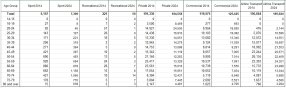
I was looking at the composition of the pilot population by age, last year versus 2014. I combined the 2014 and 2024 numbers from table 12, which is pilots by age and category:

Pilot-comparison-2014-2024.jpg
Overall, we've seen a small increase of sport pilots and a modest decrease in private pilots, a moderate gain of commercial certificate holders, and an impressive increase in the number of airline transport rated pilots.

The age composition of pilots has changed as well. The number of private and commercial cert holders in the 16 to 24 age range has ballooned, while those in the 50 to 64 age range as decreased substantially, and the number in the 70+ group has grown.
 
I think if GA was falling apart the prices on used aircraft would be falling from lack of demand. Instead they're way up from just 5 or 6 years ago.

OTOH I recently was talking to my mechanic who's shop rates are $80/hr. He is fully aware the going rate is higher but he believes if he raised his rates even a little that a lot of local pilots would just hang it up and walk away. So he's keeping them low to keep his business thriving. As a customer I appreciate that but I worry about him staying in business.

There seem to be a lot of people like him running GA businesses who do their best to keep things affordable. I am suspecting as those guys die out and their kids or some aviation corp take over the business things rapidly get expensive and unfriendly. I've now seen the corporate buyout version of that play out at two FBOs where I've been based.

I still see new people getting into it though. I'm currently working on a commercial rating with the eventual goal of becoming a CFI and through various discussions I know I won't be making bank doing that. I'm justifying it as more gas money for my plane and a way to stay proficient without draining my own bank account. But like so many others I'm really only doing this because I like it- there are certainly more profitable things I could do with my time instead.
I teach college for the same reason. One class each semester covers the hangar, insurance, and annual.
 
Maintenance costs are a major factor. While some repairs are tied directly to safety, others are inflated simply because they fall under the category of aviation. For example, our club plane recently developed a brake fluid leak, which was traced to the landing gear pivot. Although the pivot itself was mechanically sound, there was no way to simply fix the leak by splcing in a new brake line (which is what I do in my car). We had to replace the whole pivot - an eye-watering $14,000 repair bill for what began as a relatively minor issue. A flying club can spread such costs across members, but for individual owners, repeatedly absorbing expenses like this can quickly become unsustainable.
 
Maintenance costs are a major factor. While some repairs are tied directly to safety, others are inflated simply because they fall under the category of aviation. For example, our club plane recently developed a brake fluid leak, which was traced to the landing gear pivot. Although the pivot itself was mechanically sound, there was no way to simply fix the leak by splcing in a new brake line (which is what I do in my car). We had to replace the whole pivot - an eye-watering $14,000 repair bill for what began as a relatively minor issue. A flying club can spread such costs across members, but for individual owners, repeatedly absorbing expenses like this can quickly become unsustainable.
I'm afraid to ask -- what kind of aircraft? I've never heard of such an expense!
 
So what’s wrong with an owner produced part?

My ELT battery pack is a bunch of 9V Energizer batteries wired together and wrapped in cardboard and tape. I’m considering assembling my own next time.
Interesting - exactly how would a person make their own part and install it without getting it certified/STC/etc?
 
Interesting - exactly how would a person make their own part and install it without getting it certified/STC/etc?
Owner produced parts.

Alternatively, you can take the most common approach: reverse engineering the part you are replacing.

If I crack open my ELT battery and I find six Energizer Lithium D cells in series, I should be able to replace them with six other cells and put a new expiration date on the pack.

 
Maintenance,insurance and associated cost rising every year. Could put some older pilots on a fixed income out of aviation. You have to truly love flying .
 
So what’s wrong with an owner produced part?

My ELT battery pack is a bunch of 9V Energizer batteries wired together and wrapped in cardboard and tape. I’m considering assembling my own next time.

While you are at it, consider whether you could install it yourself as preventative maintenance.
 
The dude dumped a cherokee and a hangar for large money. That there were people ready to buy tells me GA is fine.

If he had been trying to sell this horse and barn for months with no takers, that'd spell doom for me :D
 
Last edited:
I'm afraid to ask -- what kind of aircraft? I've never heard of such an expense!
Cessna single retracts. Saddles in the early 210s, embedded brake lines in the 182/172RG, to say nothing of the pivots themselves. This has been known for decades, the only difference is the cost-basis for the same repair continues to do Mars-bound gravity-assists courtesy of Powell's M2 Theft-a-thon in 2020. No different than the cost-basis of your arrow's powerpack through the last 20 years. They're all known quantities.

And they're going to the pile, with the proliferation of TAA (for revenue, think your Arrow and 172RGs) and clean fairings (think Cirrus wheel pants and fixed gear EABs); the legacy carrying costs of supporting these wobbly legs don't pencil out. When I bought wobbly legs way back in the day, the price delta vs people overpaying for fixed gear cherokees was significant. But with the passage of time, that carrying cost has negated the discount.
The only thing in that story that surprises me is the 75-100 hours/yr. I don't understand how anybody flies those kind of hours in their local area unless they're doing aerobatics.
work commute. I had one, I consider a sub 200NM radius commute, "local". I also had a personal 420NM radius commute every other weekend, but I concede that one as not local.

I have the former again, and I've been trying to cover it with an airplane that will essentially only see the same two runways twice a weekend for at least 3 years. That's 120 hours for the year guaranteed, to go "nowhere". As you said, it's all about the use case.

In the case of the OP anecdote, yeah for that use case I'd exit too. In a way, I did two years ago, though my circumstances were slightly different. I do find the EAB proposition cheaper enough for me to pencil out compared to my previous situation with fac built, especially now that I have a legal out from inspection authority 'captive audience' dynamics. And I do intend to eventually pivot to 'local aerobatics' use case in .mil retirement, so twofer.
 

This sounds next to impossible :​

​

The part must be properly designed​

An owner-produced part is a replacement for an FAA-approved part; it is not an alteration. Therefore, you need to have design data to ensure that you are producing a part that is equivalent to the original. The simplest solution would be to get access to the manufacturer’s original drawings, although most aircraft manufacturers will not release this data.
The produced part must conform to the design
Once you have the approved design data in hand, you now need to produce the new part and prove its conformity to the original. This includes the materials used, manufacturing processes, assembly, and testing. Using an FAA-approved facility means that you’ll have easy traceability for all of this. Otherwise, it’s up to you to document conformity.
If you're talking about a forged crankshaft, yeah, I can see it being pretty tricky.
But if it's 3-4 name brand 9V batteries wired together in series? I can see writing that spec up in an afternoon. Pretty sure lots of suppliers, including digi-key and I'm pretty sure McMaster, will supply you with documentation on parts sourcing back to the manufacturer.
 
Does the FISDO or someone need to approve, or do you just put this documentation in the log book?
 
But if it's 3-4 name brand 9V batteries wired together in series? I can see writing that spec up in an afternoon. Pretty sure lots of suppliers, including digi-key and I'm pretty sure McMaster, will supply you with documentation on parts sourcing back to the manufacturer.
In shrink wrap, sure. But if we're talking about cells potted in some mystery-epoxy and encased by some sort of bomb-proof plastic, I have questions.
Does the FISDO or someone need to approve, or do you just put this documentation in the log book?
Normally it's the mechanic but @Ed Haywood raises a good question about combining the two regs (owner produced part + preventive maintenance).
 
Back
Top