Air India 787 Crashes in Western India

If you are settling, it’s easy to think it’s because of power loss. I saw that two days ago giving an emergency procedures simulator. Gave a chip lt, student though he lost his engine.

Settling after takeoff can be cause by more than loss of power.

Deploying the rat may be the only thing he could muster up thinking he had a dual engine failure.

Really, if he did have a dual engine failure, it really doesn’t matter what he did…
 
So… on take off incorrectly set power/too low, took an intersection departure and ran short of runway and lifted off, retracted flaps instead of gear, manually deployed RAT instead of pushing engine levers forward???
 
Believe it or not, ya. ALL incidents are wildly unlikely… ANY link in that chain breaks, doesn’t happen.

Think about the effect of 8000 hours of reduced power takeoffs… now put yourself in startle response mode.
 
So… on take off incorrectly set power/too low, took an intersection departure and ran short of runway and lifted off, retracted flaps instead of gear, manually deployed RAT instead of pushing engine levers forward???

I think the intersection takeoff hypothesis has already been disproven. Further review of ADS-B and video showed the aircraft backtaxied to the end before departure.

I find it highly unlikely in the less than a minute from wheels up to crash that the pilot would have manually deployed the RAT. That isn't an immediate action item in any training or checklist to my knowledge, and would be completely out of the norm. If indeed the RAT was deployed, which from the sound in the video it is my opinion it was, it was automatic and likely due to dual engine failure.

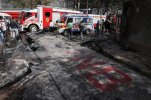
So then the question is, did both engines fail and why? Looking at the wreckage, I'd assume the black boxes survived, and were hopefully new enough to be fully functioning. If so we should have some preliminary information rather quickly.
 
So then the question is, did both engines fail and why? Looking at the wreckage, I'd assume the black boxes survived, and were hopefully new enough to be fully functioning. If so we should have some preliminary information rather quickly.
Media is reporting one of the two have already been recovered.
 
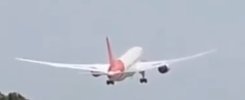
Can anyone explain the two areas of contrast on the upper surface of each wing, behind the engines? On a normal takeoff, I’d assume we’d see the slots of flaps at or above certain extension settings, but do these look like partially deployed spoilers to anyone else?

IMG_5771.jpeg
 
FWIW, the lone survivor was interviewed and his recount describes the engines spooling up shortly before impact. As to what degree of accuracy?
 
There is probably some residual heat coming out of the engines. That could cause a slight apparition because you are looking between the horizontal stabilizer and the wing.

Just a guess on my part.

But on second look, the flaps split slightly behind the engines.
 
FWIW, the lone survivor was interviewed and his recount describes the engines spooling up shortly before impact. As to what degree of accuracy?
It will be interesting to hear if he's reporting the RAT noise.

The black boxes seem likely to explain this one.

It's still absolutely mind boggling that someone, literally, walked away from this one. I remember seeing the early report of a survivor and thinking that it was obvious BS.
 
Someone on reddit mentioned that the 787 abnormal checklist memory items for dual engine failure/stall involves cycling both engine 1/2 fuel cutoff switches and manually deploying the RAT:

Is this true?
Would the engines relight after cycling?
 

Attachments

  • Screenshot 2025-06-13 at 5.02.45 PM.png
    Screenshot 2025-06-13 at 5.02.45 PM.png
    307.3 KB · Views: 38
Can anyone explain the two areas of contrast on the upper surface of each wing, behind the engines? On a normal takeoff, I’d assume we’d see the slots of flaps at or above certain extension settings, but do these look like partially deployed spoilers to anyone else?

View attachment 141939
Totally paraphrasing what I read elsewhere but am too lazy to look up again, so someone feel free to correct me: low speed lateral control is augmented by spoiler deployment, and the spoilers pre-deploy slightly to increase control fidelity.
 
Care to elaborate your opinion based upon your operating experience on transport category jets?
I put out a hypothesis. If you can contribute on why you think it’s “no” then we can build on that.
 
I'll let @Doc Holliday speak for his own opinions, but mine is that the described sequence of events would represent an exceptionally incompetent flight crew.
The 1100 hour total time first officer would lend credence to that.
 
In the A320 I seem to remember that loss of both main AC busses in flight would cause the rat to deploy automatically. However it would disconnect electrically on approach at some predetermined point. And if you had to go around that was part of the procedure to turn the rat back on manually. Never flew a 787 so don't know for sure.
 
Can anyone explain the two areas of contrast on the upper surface of each wing, behind the engines? On a normal takeoff, I’d assume we’d see the slots of flaps at or above certain extension settings, but do these look like partially deployed spoilers to anyone else?

View attachment 141939
They do to me, maybe. Like they are Fowler Flaps. They start by extending out. Not until later do they they start downward. @Larry in TN commented on this earlier. It’s typical on long runways, which this was, to have minimal flaps. Shorter runways need more to reduce ground run. But the trade off is reduced climb performance with more flaps. Makes sense. Like when going around in a lot of planes, after throttles in, carb heat off and mixture rich you dump so many degrees of flaps, right now
 
Someone on reddit mentioned that the 787 abnormal checklist memory items for dual engine failure/stall involves cycling both engine 1/2 fuel cutoff switches and manually deploying the RAT:

Is this true?
Would the engines relight after cycling?
Not all airlines have memory items. Some have quick action cards, etc. The same procedure is used on the 757/767. Fuel cutoff cycle and deploy the RAT. The RAT will auto deploy with dual failure but the checklist redundantly requires manually deploying the RAT. It’s a guarded push switch that illuminates once deployed.
 
I'm not sure why multiple people find double engine failure to be so impossibly unlikely. Birds seem to be the most common way of knocking a commercial jet out of the air, with two recent major incidents (Sully and last years Jejun flight) and dozens of instances of single engine failure.

The only video of the takeoff roll that I've seen has an airport structure inconveniently obscuring the when birds might have been ingested, so no evidence to support the idea at this point. But also no reason to think it's impossible. Especially since the single survivor is being reported as saying there was a loud bang. Which eliminates explanations like the engines being dialed back manually (suicide) or automatically (automation failure).
I don't know that anyone has said "impossibly unlikely", but I'll say it's unlikely because these things are specifically designed to have as few common points of failure as possible. Of course there are some, but the primary one seems to be the two guys up front and the system that they were using to set power.

Re birds, that seems unlikely because there's no film of it, because the aircraft seemed to be slow and long climbing out (to me anyway), and because the pilot didn't mention it, like Sully and jejun did. I'm glad the one fellow survived, wish there were way more, and sure he's probably a great guy, but I wouldn't put much stock into anyone's memory of the event after what he went through.

Reading through the comments from people that fly these and things that size, I'm kinda wondering what it would feel like taking off if the magic power box was told it was 32F and the plane was empty with min fuel. Which goes back, I think, to that Air Florida thing in DC many years ago that someone mentioned.

That “Air Florida thing” was frozen over engine probes that gave wrong engine thrust (EPR) readings.
 
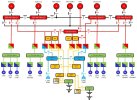
Here's the simplified schematic of the system.
Looks redundant to my simple mind. Maybe the single point electrical failure was a short circuit neuron in the FO's brain that caused him to raise flaps instead of gear.
 
That “Air Florida thing” was frozen over engine probes that gave wrong engine thrust (EPR) readings.
Thanks. Didn't mean to minimize it. I was a teenager when that happened, and was somewhat routinely flying in the winter in the NE. I remember watching the footage of the parks helicopter doing the rescue. Remembered it as not having engine de-ice set, sitting a while after de-ice, and not going to full thrust for some reason...didn't know the details.
 
It’s probably the camera angle on the 1st video but the jet appears to drift toward the left during departure. Anyone else notice this? No visible yaw, just drifting.
Also saw that the OAT was 43C. If this is true they probably couldn’t use an assumed temp setting. They may have been at max n1/epr for the conditions. I know there’s differences among the Boeings when it comes to applying reduced thrust. Not sure how the 787 accomplishes it.
 
The 1100 hour total time first officer would lend credence to that.
I don’t know. I’d like to think even I wouldn’t have made THAT many incredibly poor judgment calls with my fraction of the FO’s hours and none in anything bigger than a 120 knot bugsmasher. And there were two pilots there. The captain had 8200 hours; one would think the carrier wouldn’t have plopped him into the left seat of a Dreamliner if he hadn’t managed to exhibit some degree of competence.

It’s not like either of them would have confused the controls for the flaps, gear, throttles, or RAT (if it can be deployed manually, I don’t know). They’d have to have just been off in la-la land and forgot how to fly. Not impossible, but kind of difficult to imagine.
 
Startle response… and 8200 hours of no real problems creates ONE HELL of a complacency issue.
There is no easy solution for that except tons of simulation time … or something like AI.
 
I don’t know. I’d like to think even I wouldn’t have made THAT many incredibly poor judgment calls with my fraction of the FO’s hours and none in anything bigger than a 120 knot bugsmasher. And there were two pilots there. The captain had 8200 hours; one would think the carrier wouldn’t have plopped him into the left seat of a Dreamliner if he hadn’t managed to exhibit some degree of competence.

It’s not like either of them would have confused the controls for the flaps, gear, throttles, or RAT (if it can be deployed manually, I don’t know). They’d have to have just been off in la-la land and forgot how to fly. Not impossible, but kind of difficult to imagine.
For the record, I agree that it seems very difficult to imagine such a rapid-fire sequence of incorrect/poor/incompetent decisions was the root cause of this accident. Pilot error could end up being the determination, but even if so, I don't see it being quite that egregious. Then again, Asiana 214:

The National Transportation Safety Board determines that the probable cause of this accident was the flight crew's mismanagement of the airplane's descent during the visual approach, the pilot flying's unintended deactivation of automatic airspeed control, the flight crew's inadequate monitoring of airspeed, and the flight crew's delayed execution of a go-around after they became aware that the airplane was below acceptable glidepath and airspeed tolerances.
There is no easy solution for that except tons of simulation time … or something like AI.
AI "pilots" sound great. You can be their first passenger.
 
Back
Top