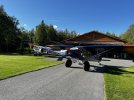
Wow, a turbine Cub!

Same Turbotech TP-R90 engine as in the Wasatch SD3, another MOSAIC LSA.
 
If they could get this (and the 250/400hp variants) approved and available soon, it couldn't come at a better time.
This 140 hp version will be selling in 2027, which is pretty soon.
 
140hp? Hard pass for me. It’s an interesting development but it’s 100hp short of being desireable. But I have a 240hp Supercub, so I’m biased.

I'm curious, does 140 hp from a turbine equal 140 hp from a piston engine in terms of true performance? What is the weight difference between this specific turbine versus an IO-320/360/390?
 
I'm curious, does 140 hp from a turbine equal 140 hp from a piston engine in terms of true performance? What is the weight difference between this specific turbine versus an IO-320/360/390?
HP is calculated mathematically from torque output. Torque is what turns props. That’s the origin of “there’s no replacement for displacement.” A tuned up 180hp O-320 can’t match a stock O-360 for takeoff and climb. I don’t expect a high revving little turbine will, either. We’ll see, but at over $600K to buy one of these planes? I won’t hold my breath.
 
I'm curious, does 140 hp from a turbine equal 140 hp from a piston engine in terms of true performance? What is the weight difference between this specific turbine versus an IO-320/360/390?
O-320 is about 100lbs heavier than this turbine.
 
HP is calculated mathematically from torque output. Torque is what turns props. That’s the origin of “there’s no replacement for displacement.” A tuned up 180hp O-320 can’t match a stock O-360 for takeoff and climb. I don’t expect a high revving little turbine will, either. We’ll see, but at over $600K to buy one of these planes? I won’t hold my breath.

That was along my lines of thought, different types of engines rated at the same horsepower can have drastically different torque values. I wasn't sure how torque varies changing from a piston to a small turbine.

I'd also be curious the responsiveness of this little turbine. Doing some of the things people do with these type of airplanes often requires quick throttle response, flying on the deep back side of the power curve. If it takes that turbine a couple of seconds to spool and catch up at the wrong moment, that could be bad.

I'm still intrigued by the project. I'm certainly not the prime customer by any means, but wouldn't turn one down if it was given to me.
 
140hp? Hard pass for me. It’s an interesting development but it’s 100hp short of being desireable. But I have a 240hp Supercub, so I’m biased.

Maybe a twin turbine cubcrafter contraption in 2029 will tickle your fancy and make your 240hp seem piddling. :)
 
A tuned up 180hp O-320 can’t match a stock O-360 for takeoff and climb.
I'm having a bit of an issue with that statement... Power is (simplified) torque×RPM. At the same RPM, similar power means similar torque. For a constant speed prop, both engines will deliver very similar performance.
For a fixed pitch prop, since the take-off/climb RPM isn't redline RPM, if the smaller engine has a different torque/power curve, the performance might be different. Fixable by ensuring the prop is pitched to take advantage of that specific engine's power curve.


I'd also be curious the responsiveness of this little turbine.
I suspect it's quite good, actually. Especially if it's a free turbine turboprop, the gas generator section will be spinning at 70%+ RPM at idle. Doesn't take much to spool up and provide full power. Otherwise turbine helicopters would be in big trouble.
 
I wonder if JetA availability will be a factor...a lot of the small airports that are kinda backcountry-adjacent don't see much, if any, jet traffic.
 
For a fixed pitch prop, since the take-off/climb RPM isn't redline RPM, if the smaller engine has a different torque/power curve, the performance might be different. Fixable by ensuring the prop is pitched to take advantage of that specific engine's power curve.

The situation is often not fixable with a fixed pitch prop. If the smaller displacement engine that makes the same torque/power at peak RPM does it by sacrificing torque/power at lower RPM, it is impossible to install a fixed pitch prop that will match both the top speed and (reduced RPM) climb performance of the larger displacement engine. The only way the two engines will generate the same aircraft performance in every flight regime is if they are both equipped with a variable pitch propeller.
 
Last edited:
If the smaller displacement engine that makes the same torque/power at peak RPM does it by sacrificing torque/power at lower RPM
75% power on an O-360 is at 2450 RPM. Take-off and climb RPMs are usually higher than that.
I doubt that any form of engine tuning that manages to generate the same power at 2700 RPM from an O-320 will be that far off when the engine turns 250 RPM less.
 
I'm having a bit of an issue with that statement... Power is (simplified) torque×RPM. At the same RPM, similar power means similar torque. For a constant speed prop, both engines will deliver very similar performance.
For a fixed pitch prop, since the take-off/climb RPM isn't redline RPM, if the smaller engine has a different torque/power curve, the performance might be different. Fixable by ensuring the prop is pitched to take advantage of that specific engine's power curve.


I suspect it's quite good, actually. Especially if it's a free turbine turboprop, the gas generator section will be spinning at 70%+ RPM at idle. Doesn't take much to spool up and provide full power. Otherwise turbine helicopters would be in big trouble.
HP is stated at peak power. Torque can be stated at peak as well, but the torque curve is a better indicator of performance. That’s well demonstrated in high performance cars. In airplanes all you have to do is fly a 180hp O-320 and next to a similar plane with a 180hp 0-360. Which produces better performance is easy to judge. Another example, take a gas pickup against a diesel pickup of similar rated horsepower. Which is better at pulling a trailer? No contest.

I don’t know a lot about turbines, especially this one with its efficiency technology. At $690K for a lightweight 2-place toy airplane, I don’t care much. If somebody comes up with a 300 hp variant that supports a STOL prop and burns 10 GPH? I’d be more interested.
 
This could be a game changer, depending on the specs, of course:
A bold step on the part of CubCrafters, but I don’t know what game a $690,000 Cub is going to change.

At least we have a flying test bed for the engine and a nice publicity move for CubCrafters. But at that price, will they sell enough to truly prove the engine’s viability?

I am hopeful that the engine will succeed. But a $700k Cub. . . that is the very antithesis of Cubness.

What I want is not a shiny new $700k Cub; I want a shiny new $70k Cub.
 
Last edited:
They are claiming 5.2hr endurance on 44 gallons. For a turbine. That feels rather game-changing to me.

The overpriced cub game made no sense to me back at the 150K mark, much less the various iterations of CubCrafters since then, where they apparently traded ceconite coverings for virgin unicorn wool over time. What is the piston one, 500K? This seems like a relative bargain.
 
They are claiming 5.2hr endurance on 44 gallons. For a turbine. That feels rather game-changing to me.
That is piston engine fuel burn in a turbine. Amazing if true.
I know you can configure turbines to use exhaust heat to pre-heat combustion air, recovering a great deal of energy and improving fuel consumption, but that comes at the expense of a lot more complexity and a loss of reliability. And even so, I find it hard to believe that fuel burn number.
 
They are claiming 5.2hr endurance on 44 gallons. For a turbine. That feels rather game-changing to me.

The overpriced cub game made no sense to me back at the 150K mark, much less the various iterations of CubCrafters since then, where they apparently traded ceconite coverings for virgin unicorn wool over time. What is the piston one, 500K? This seems like a relative bargain.
The engine maker is claiming 5gph at 50% power and that it will burn Jet-A, Diesel, UL91, 100LL, Bio-Fuel or $20 bills borne from broken dreams. I'll bet that the airframe isn't TC'd/STC'd for some of those, though.
 
Yes, I've had my heart broken before by aviation claims too. Just saying, if they're achieving anything close to their claims, that's game-changing and I'm gonna want an E-AB with several of those things on it, fry shut-up-and-take-my-money style. :D
 
HP is calculated mathematically from torque output. Torque is what turns props. That’s the origin of “there’s no replacement for displacement.” A tuned up 180hp O-320 can’t match a stock O-360 for takeoff and climb. I don’t expect a high revving little turbine will, either. We’ll see, but at over $600K to buy one of these planes? I won’t hold my breath.
Torque may turn the prop, but it's power that makes the plane climb. But yes, a smaller faster turning prop will be less efficient even if the power is the same. Presumably since the turbine has to have a gear reduction, they'd choose the ratio for best performance.
The engine maker is claiming 5gph at 50% power and that it will burn Jet-A, Diesel, UL91, 100LL, Bio-Fuel
I know some turbines can run on a variety of fuels, but mixing them can be an issue... for example, both gasoline and kerosene are safe and non explosive in a sealed tank, but a mixture of the two can explode.
 
A bold step on the part of CubCrafters, but I don’t know what game a $690,000 Cub is going to change.

At least we have a flying test bed for the engine and a nice publicity move for CubCrafters. But at that price, will they sell enough to truly prove the engine’s viability?

I am hopeful that the engine will succeed. But a $700k Cub. . . that is the very antithesis of Cubness.

What I want is not a shiny new $700k Cub; I want a shiny new $70k Cub.
Given that Rotax 916 is $65K (plus prop and install), the days of anything for $70K in aviation are over.
 
Yes, I've had my heart broken before by aviation claims too. Just saying, if they're achieving anything close to their claims, that's game-changing and I'm gonna want an E-AB with several of those things on it, fry shut-up-and-take-my-money style. :D
If they can develop their 250hp version with similar weight savings and fuel consumption, that would be pretty slick on an rv14 or even a 10
 
Have y'all looked at Cessna 172 prices lately? Or your food at the grocery?
Stuff is nearly double what it used to be. Yeah, this is a pricey plane, but it's also in the context of serious inflation.
 
Everything about the engine sounds too good to be true. If the reheating tech was truly viable, it’s hard to believe that the big names in this game wouldn't be all over it. We shall see.
 
Everything about the engine sounds too good to be true. If the reheating tech was truly viable, it’s hard to believe that the big names in this game wouldn't be all over it. We shall see
Nail on the head. The tech isn't new, it's been tried many times and does greatly increase efficiency. The temperatures, pressures, and motion have just been too much for the metallurgy available. So reliability isn't there, even on ground based equipment where weight isn't an issue.

I don't know a lot about it but my opinion is that it's not going to be reliable. With lots of maintenance and short TBO's. They would have to either find new metallurgy that's suitable. Or maybe develop modern electronic controls to regulate the process and keep it inside the boundaries of reliable operation. Metallurgy and electronics are advancing every day so it's certainly possible.
 
That was along my lines of thought, different types of engines rated at the same horsepower can have drastically different torque values. I wasn't sure how torque varies changing from a piston to a small turbine.
Torque is increased by reduction gearing. It's not free, since you lose RPM, and torque times RPM is what HP is all about. But as Dana notes:
Torque may turn the prop, but it's power that makes the plane climb. But yes, a smaller faster turning prop will be less efficient even if the power is the same. Presumably since the turbine has to have a gear reduction, they'd choose the ratio for best performance.
It does have to have gear reduction, since turbines, especially small turbines, turn at amazing speeds that are of no use unless they're reduced to raise the torque and lower the RPM. That outfit could choose a ratio that would turn a large, low-speed prop to match the Cub's speed and give it spectacular takeoff and climb performance due to the greater efficiency of a large prop.
 
I'm curious, does 140 hp from a turbine equal 140 hp from a piston engine in terms of true performance?
In general, the turbine power band is more stable and linear than the piston power band. Couple that with the turbines lighter weight and it is simply a more efficient package.

Doesn't take much to spool up and provide full power. Otherwise turbine helicopters would be in big trouble.
FWIW: all engines "droop" when load is applied. How the engine reacts to that load is all in the fuel control system even in turbine helicopters. With hydro-mechanical based controls, there was usually a droop or anticipater mechanical linkage that would add fuel to manage the anticipated load. With digital controls like FADEC, any engine droop became almost non-existant due to the speed of those controls.

Everything about the engine sounds too good to be true. If the reheating tech was truly viable, it’s hard to believe that the big names in this game wouldn't be all over it.
Turbine regenerative technology has been around for many decades. The problem has been to design... a produce the systems to fit into aircraft turbines and smaller. Turbotech achieved this with their first engine for a electrical generator. And GE accomplished the same in their new model the Catalyst which powers the Beech Denali. Now the move is to make micro-turbines with regen tech to power hybrid propulsion systems for e-aircraft projects.

And just to note cost of the TP-R90 is <$100k which is pretty impressive in my book.
 
Turbine regenerative technology has been around for many decades. The problem has been to design... a produce the systems to fit into aircraft turbines and smaller. Turbotech achieved this with their first engine for a electrical generator. And GE accomplished the same in their new model the Catalyst which powers the Beech Denali. Now the move is to make micro-turbines with regen tech to power hybrid propulsion systems for e-aircraft projects.
The Turbotech is the first implementation in an aircraft powerplant that I am aware of. It's an elegant package with a recuperator that is compact, lightweight, and allows for an aerodymically efficient installation. As for the Catalyst, I am not aware of a version that features a regenerator/recuperator section. Got a link handy?
And just to note cost of the TP-R90 is <$100k which is pretty impressive in my book.
Certainly a 140hp, sub-200lb turboprop engine that burns about the same amount of fuel as an O-320*, has an advertised TBO of 3000 hrs, and costs just under $70k, is cause for celebration. The development program was not burdened by the costs associated with a certification program, but will its in-service performance, reliability, and maintenance requirements meet market expectations? We'll see.

*The Turbotech website does not give us much to go on as far as specifications are concerned, but if my math is correct (ha) the BSFC at 50% power with 19 l/h fuel flow works out to about 0.47 lb/hp/hr for an efficiency of about 29% (kerosene, 6.67 lb/gal), whereas an O-320 at 50% power should deliver about 0.44 for an efficiency of about 31% (ROP, avgas). By comparison, an IO-550, 65%, LOP, can achieve approximately 0.35 for an efficiency of about 38%.
 
Turbine regenerative technology has been around for many decades. The problem has been to design... a produce the systems to fit into aircraft turbines and smaller. Turbotech achieved this with their first engine for a electrical generator. And GE accomplished the same in their new model the Catalyst which powers the Beech Denali. Now the move is to make micro-turbines with regen tech to power hybrid propulsion systems for e-aircraft projects.

And just to note cost of the TP-R90 is <$100k which is pretty impressive in my book.

Nitpick. I watched some of the early interviews with Turbotech, and even some engineering professors (I believe mechanical) who talked about the history regenerative turbines and some of the nice features Turbotech managed to put in the package.
They all claimed it was less about design of the regenerative package as it was the material science for the regenerative package, and the technology / engineering to allow a hotter/smaller hot section which significantly reduced exhaust gas issues fouling the "radiators" which previously limited the life of the regenerative packages.

As for price, I agree! That is why I said they have the potential to give DeltaHawk a real run for their money.

Reminder, I am, way, way, as in the next galaxy over in terms of knowledge base. I am in IT (FinTech specifically), so I am going off what I understand.

Tim
 
To me the selling point is reliability and high power to weight ratio. The fail is efficiency and cost.
 
To me the selling point is reliability and high power to weight ratio. The fail is efficiency and cost.
The efficiency is somewhat mitigated by lower fuel costs and the lower installed weight of the turbine which allows you to carry more fuel. And if the 3000 hour TBO is true, the capital cost may be worse, but the reserve and maintenance expenses should bring the turbine cost in-line or below that of a recip.

I'm kinda like a Missourian on this. Show me...
 
Does the power loss due to density altitude occur at the same rate with the Turbotech as a naturally-aspirated piston engine? If it's flat-rated like other turboprops, then the breakeven point against a 180hp O-360 would be at around 7000 DALT.
 
I'm having a bit of an issue with that statement... Power is (simplified) torque×RPM. At the same RPM, similar power means similar torque. For a constant speed prop, both engines will deliver very similar performance.
For a fixed pitch prop, since the take-off/climb RPM isn't redline RPM, if the smaller engine has a different torque/power curve, the performance might be different. Fixable by ensuring the prop is pitched to take advantage of that specific engine's power curve.


I suspect it's quite good, actually. Especially if it's a free turbine turboprop, the gas generator section will be spinning at 70%+ RPM at idle. Doesn't take much to spool up and provide full power. Otherwise turbine helicopters would be in big trouble.
If it’s a free turbine the spool will be longer. Would be better if it’s not a free spool like a garret. Would be much louder on the ground but essentially no lag in power.
 
Back
Top