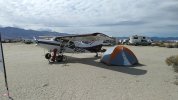
Wow, a turbine Cub!

I suspect it's quite good, actually. Especially if it's a free turbine turboprop, the gas generator section will be spinning at 70%+ RPM at idle. Doesn't take much to spool up and provide full power. Otherwise turbine helicopters would be in big trouble.

Flew Huey helicopters 1980's.

Turbine ran at 6600rpm all the time. Governor control for throttle when making collective, torque pedal, cyclic changes.

Once you spool it up, no more need to mess with throttle unless doing emergency governor operations with IP on check ride. Autorotation's yes, we would roll the throttle off, rolling it back on before actual landing, for hovering at 3 foot.
Mike
 
Juan Brown had a piece on it. NOT a free turbine. Seems like you'd make a lot of friends taxiing around making bunch of noise blowing a lot of dirt around. No beta, no reverse it appeared.

It is also in a toy airplane, it is an 800 pound "Cub". I am not sure how much smaller it is than a normal PA-18, I have seen them up close but not side by side. They are small.

I have a sneaking suspicion that the $70k overhaul will end up being quite a bit more than $70k.

At the price its listed at, you could buy the nicest C-180 you could find and a super nice PA-18 as well. Or go buy a new R44 and land as short as you want.
 
And I thought the Rotax powered Carbon Cubs were expensive! Near $700K for a cub is just "plane" crazy. Some folks just have waaaaay too much disposable cash!
 
It is also in a toy airplane, it is an 800 pound "Cub". I am not sure how much smaller it is than a normal PA-18, I have seen them up close but not side by side. They are small.
A Carbon Cub is right about the same size as a Piper Super Cub. The lightness comes from the use of composites.
 
WOOSH

That's the sound of a rocket being launched past the turbine cub. WOOSH = Wisconsin Organziation Of Spacemodeling Hobbyists. :D
 
I am trying to research the turbine... Does anyone know the track record and reliability? Does anyone think there is a path to other turbine engines in light GA?
 
I am trying to research the turbine... Does anyone know the track record and reliability? Does anyone think there is a path to other turbine engines in light GA?
Turbotech is probably one of the leading developers of these new micro-turbines and is backed by Safran. However, micro-turbines have been around for decades but were notoriously not fuel efficient until Turbotech came up with their version. There are also a number of other micro-turbo developers out there, but they are concentrating more on turbo-generators for hybrid propulsion units in the e-aircraft industry vs installing on small GA airplanes. However, I think given where the industry is going, you may see more hybrid electrical retrofit kits for small airplanes in the future than direct turbine retrofits as this technology matures at a fairly fast rate.
 
Turbotech is probably one of the leading developers of these new micro-turbines and is backed by Safran. However, micro-turbines have been around for decades but were notoriously not fuel efficient until Turbotech came up with their version. There are also a number of other micro-turbo developers out there, but they are concentrating more on turbo-generators for hybrid propulsion units in the e-aircraft industry vs installing on small GA airplanes. However, I think given where the industry is going, you may see more hybrid electrical retrofit kits for small airplanes in the future than direct turbine retrofits as this technology matures at a fairly fast rate.
Thanks for the background, this is exciting technology, and I look forward to seeing how it matures.
 
Turbotech is probably one of the leading developers of these new micro-turbines and is backed by Safran. However, micro-turbines have been around for decades but were notoriously not fuel efficient until Turbotech came up with their version. There are also a number of other micro-turbo developers out there, but they are concentrating more on turbo-generators for hybrid propulsion units in the e-aircraft industry vs installing on small GA airplanes. However, I think given where the industry is going, you may see more hybrid electrical retrofit kits for small airplanes in the future than direct turbine retrofits as this technology matures at a fairly fast rate.
Nitpick. Regenerative turbines have been around for many decades.
Turbotech claims to have solved the primary issues with regenerative turbines. So they claim better efficiency. Working backwards from a few posted numbers, a few people have calculated the BSFC somewhere around 0.5; this is better than ROP for most avgas engines, but not as good LOP for avgas ICE.

Tim
 
Regenerative turbines have been around for many decades.
True. But those were very heavy. Turbotech found a way to dramatically lighten the regenerative aspect which made it useable for aircraft applications. Regardless, there is zero comparison on several levels between recip and turbines in a direct drive scenario. Now use a that Turbotech for electrical power generation in a hybrid propulsion setup and an avgas recip comes nowhere close to those efficiency numbers. And Turbotechs main priority is on the hybrid side with these direct drive installations simply an attempt to expand their market.
 
At the price its listed at, you could buy the nicest C-180 you could find and a super nice PA-18 as well. Or go buy a new R44 and land as short as you want.
That's the best summary on this product I've seen. Yeah, they will sell a bunch of planes to folks that have way too much money and want the latest toy on the market. No cub pilots making a living with their planes will buy one, and they won't appear in the average pilot's hangar. I'm assuming the tubotech CFO and marketing director looked at the potential sales and decided there's enough of a niche market to go for it. I'll be happy to look at them when they land at the same airport I'm parked at, but I will never be a customer. I just don't have the disposable income to make it work for me. Besides, my mission calls for a plane that can easily haul my bicycle and my camping gear and get into backcountry strips. The turbine cub isn't that plane. 20191018_124132.jpg
 
Last edited:
Now use a that Turbotech for electrical power generation in a hybrid propulsion setup and an avgas recip comes nowhere close to those efficiency numbers.
No part of that statement is correct. A direct drive turbine converts expansion energy to rotating energy with energy loss in the form of heat. A recip does the same but a little more efficiently. A Hybrid converts the rotation to electricity wasting more on heat, then back to rotation, again loosing energy to heat. In an average car around town it works because energy is recovered during deceleration. A direct drive car will get better economy than an equal weight hybrid at the same highway speed.

Aircraft require near constant thrust. So a Hybrid aircraft would drink fuel. I believe the drive for hybrid aircraft propulsion centers around V-TOL designs. For that application multiple motors are lighter than multiple engines but batteries are low energy density (ie heavy). Using an ICE engine to supply the electricity will extend the range for a given weight. But a good old helicopter would still be more efficient.
 
No part of that statement is correct.
Except the current flying aircraft with hybrid-electrical propulsion don’t agree with that statement. So much so, most legacy turbine OEMs are designing/building their own versions of turbo-generators to power the next generation of eVTOL, eSTOLs, and eCTOLs. For example, Safran’s TG600 turbo-gen is one such new, purpose-built hybrid unit and will be installed in the production version of the Electra EL-9, 9 pax, eSTOL aircraft. Plus the actual data I’ve seen of their ops does not match your narrative at all. Is what it is.
 
No part of that statement is correct. A direct drive turbine converts expansion energy to rotating energy with energy loss in the form of heat. A recip does the same but a little more efficiently. A Hybrid converts the rotation to electricity wasting more on heat, then back to rotation, again loosing energy to heat. In an average car around town it works because energy is recovered during deceleration. A direct drive car will get better economy than an equal weight hybrid at the same highway speed.

Aircraft require near constant thrust. So a Hybrid aircraft would drink fuel. I believe the drive for hybrid aircraft propulsion centers around V-TOL designs. For that application multiple motors are lighter than multiple engines but batteries are low energy density (ie heavy). Using an ICE engine to supply the electricity will extend the range for a given weight. But a good old helicopter would still be more efficient.
Toyota announced a few years ago the Renaissance engines; the basic premise is an engine tuned for a single speed connected as a range extender (e.g. serial hybrid) is more efficient.
Turbines work the same way. You can maximize efficiency by tuning for a more limited power range.

So even though airplanes spend a very portion of their power settings fixed at a cruise value, they actually have to work across a broad range. By having effectively two points, idle and max efficiency/power you actually can make the engine significantly more efficient, and easier to build. With modern gensets the power lose across energy transitions is less than the efficiency loss to support a broad power band.

I have yet to understand why, but at this point enough engineers have stated it I believe them.

Tim
 
Now that the buzz about the Turbine Cub has lessened a bit, I now introduce the Piper PA-11 Jet Cub, or as I call it, "The JUB".

PA-11 Jet Pic.png

Please send me your deposits to secure yours asap.
 
Turbines work the same way. You can maximize efficiency by tuning for a more limited power range.
This. And increasing the combustion cycle temps also lead better efficiency which is what the regenerative systems do. Most turbogenerators, like APUs in airliners, even bypass the idle stage and run at a governed power level with minimal variation. So when efficiencies are compared, the average ICE runs at about 20-40% efficiency, turbo-gens at 50%, and on the electric side a typical e-motor will be greater than 90% efficiency. And with the new turbo-gens like the TG600 above which will offer a 15% increase in fuel economy plus the new e-motors being closer to 97% it will be interesting how all that comes togather in the near future.
 
Back
Top