The myth of spiraling slipstream?

Spiraling slipstream: is it real?

  • Yes

    Votes: 35 72.9%
  • No

    Votes: 2 4.2%
  • Don’t know

    Votes: 5 10.4%
  • Don’t care

    Votes: 6 12.5%

  • Total voters
    48

NorthEast Ohio

Pre-takeoff checklist
Joined
Jul 4, 2020
Messages
253
Display Name
NorthEast Ohio
So I’m reading the October issue of AOPA magazine, where an entire article is dedicated to why spiraling slipstream is a myth and mathematically is not possible. So, in this month’s issue a letter to the editor from an Ag pilot states that spiraling slipstream is very real, and they have to rig the sprayers to compensate. e.g. more sprayers on the right side.

What say you?
Douglas Adams had an opinion: "Oh, that was easy," says Man, and for an encore goes on to prove that black is white and gets himself killed on the next zebra crossing."
 
Is the slipstream the reason the top of one front mounted canard and bottom of the opposite side end up with more bugs?
 
Maybe we've been building wind tunnels wrong for the last century and a half and don't need flow straighteners after all.
Oh, it's much worse than that.

Consider that in Monism, the philosophical idea - expanding on Plato's model - everything stems from the one true universe, and all subdivisions of the whole are mere arbitrary constructs. This is popularly exemplified by Zeno's paradoxes - that an arrow shot towards a target never arrives because it travels 1/2 the distance in 1/2 the time and that is divisible into 1/4 - 1/4, 1/8 - 1/8, ad infinitum. So, it turns out that both Newton and Bernoulli were wrong and air itself does not move. I can "prove" all of this mathematically.

I know, I know, but it was great fun in math class "proving" to my teacher that he did not exist.
And I'm with Bernoulli because I like pasta much more than figs.
 
Last edited:
That's funny. I googled it and found an AOPA article that tells what it is! Left Turning Tendencies

From the article:​

Spiraling slipstream​

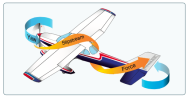
Imagine a boat propeller and the vortex of water that spirals back as the boat moves forward. That’s spiraling slipstream. The propeller creates a spiral of air that spins about the airplane, eventually contacting the left side of the rudder. As power is increased and the propeller spins faster, the force on the rudder is stronger, causing more of a yawing motion to the left.

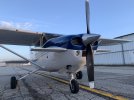
I submit my evidence that a spiral of air does in fact spin about the airplane...
52938868240_a1d1615fc9_b.jpg
 
Oh, it's real. Just not as dramatic as the tightly-wound corkscrews that spin like tornadoes behind the propeller, as depicted by CFIs when you allow them access to a whiteboard and a marker.
Being a bit odd, I just got this vision of the late John Madden as a CFI doing this on a telestrator.

"Okay, Pat, let's look at p-factor right here. Now, you got your prop right here, Number 72, a nice wood Sensenich with a pretty metal edge all lacquered and polished up. I mean, I tell you, this prop is really the go-to prop for all of your 65's. And they pretty much wrote the book. Lead the league in use if not performance. So Boom! We have a successful start and this prop, number 72, I tell you, he just goes spinning around. Pushing air like this (starts drawing spirals on telestrator). Boom! Into the cowling and door. Boom! Into the fabric of the wing. Boom! Against the rear fuselage. Boom! Against the empennage. I tell you, Pat, it's a force, and you just have to use your feet to stay centered. It's a good practice. And I mean when you've got a good practice, you know, then it's good practice in a proper airplane, and if someone misplaced your tailwheel, it's still good."

To me the fact that he hated to fly just makes this funnier.
 
Last edited:
So I’m reading the October issue of AOPA magazine, where an entire article is dedicated to why spiraling slipstream is a myth and mathematically is not possible.
I don't get the magazine, can you tell us who wrote it and whether or not they show some math to disprove it?
If there is downwash from a rotating and translating airfoil there will be what is commonly referred to as a spiraling slipstream.

Nauga,
skipping the membership drive once again
 
That's funny. I googled it and found an AOPA article that tells what it is! Left Turning Tendencies

From the article:​

Spiraling slipstream​

Imagine a boat propeller and the vortex of water that spirals back as the boat moves forward. That’s spiraling slipstream. The propeller creates a spiral of air that spins about the airplane, eventually contacting the left side of the rudder. As power is increased and the propeller spins faster, the force on the rudder is stronger, causing more of a yawing motion to the left.

I submit my evidence that a spiral of air does in fact spin about the airplane...
52938868240_a1d1615fc9_b.jpg
Is that Mid-America's Stinson A?
 
I don’t know. I don’t recognize the author’s name: Whovid Whatterson.
But then I noticed above the title of the article are the words: “aerodynamics/opinion.”
I always thought aerodynamics was a science, not opinion.
It's 2025. Opinions count more than facts.
 
Anecdotally with a Stinson 108, if you’ve got an oul leak, it will often show up on the wheel strut and cuff on the left side, which is definitely not aligned with where the oil is coming from so I think that it’s being pushed that way by the spiraling slipstream.

Come to think of it, I’ve noticed that on the Super Cub, too.
 
I don’t know. I don’t recognize the author’s name: Whovid Whatterson.
But then I noticed above the title of the article are the words: “aerodynamics/opinion.”
I always thought aerodynamics was a science, not opinion.
A couple of years back, an old friend (a retired Aeronautical Engineer) sent me an article he'd written about this exact phenomenon. His name isn't "Whovid Whatterson," but who knows, maybe he published under a pseudonym.

I'm just a poor, knuckle-dragging space engineer, but one of his arguments was very compelling: Out of 19 aerodynamics books he consulted, not one quantified the effect. If it is an actual phenomenon, it should be possible to compute its impact to a given engine/propeller/airframe combination. No such analysis exists.

Ron Wanttaja
 
Anecdotally with a Stinson 108, if you’ve got an oul leak, it will often show up on the wheel strut and cuff on the left side, which is definitely not aligned with where the oil is coming from so I think that it’s being pushed that way by the spiraling slipstream.
Oh, I don't deny that the slipstream spirals....
1763585407070.png
... but based on my friend's write-up, I question whether it has significant effect on the airplane's aerodynamics. The torque effect probably overwhelms anything else.

Ron Wanttaja
 
Pulling one out of a box of old discarded memories...
If it is an actual phenomenon, it should be possible to compute its impact to a given engine/propeller/airframe combination. No such analysis exists.
For starters, it is discussed and can be seen in the power-on results in this report on the NASA Technical Reports server (and in a few old farts' reference libraries :-) ). The pressure distribution and normal force plots for power-on configurations show a pronounced asymmetric characteristic for a wing mounted close to the propeller, in both theoretical and experimental results. A tail farther aft would certainly have a less dramatic effect, but that depends entirely on configuration - the effect is there nonetheless.
... but based on my friend's write-up, I question whether it has significant effect on the airplane's aerodynamics. The torque effect probably overwhelms anything else.
Agreed - but there's a difference between insignificant (for a particular configuration) and non-existent.

ETA: @GeorgeC 's comment on wind tunnel flow straighteners is spot-on.

Nauga,
right-booted
 
Fly a hammerhead and you will feel the existence of slipstream. Try it in the wrong direction and you will get proof of its aerodynamic significance.
 
Oh, I don't deny that the slipstream spirals....
View attachment 147316
... but based on my friend's write-up, I question whether it has significant effect on the airplane's aerodynamics. The torque effect probably overwhelms anything else.

Ron Wanttaja
The helical contrails describe the path of the propeller tips through the air. I am reminded of a jackscrew and ballnut assembly: the jackscrew represents the propeller and its threads represent the helical contrails, and the ballnut represents the air that the propeller acts on, including the slipstream. The jackscrew revolves within the ballnut, and the resulting motion of the ballnut is axial along the longitudinal axis of the jackscrew.
 
Many years ago I came across a photo (not a drawing) of a man holding one end of a 25-foot length of red plastic surveyor's tape close to the cowling of a 172, not far behind the spinning propeller. That tape followed the airflow, and so it ran along the fuselage, curving up and over the tailcone ahead of the vertical fin. This was photographic proof of that spiralling slipstream. I cannot find anything like that photo on any image search.

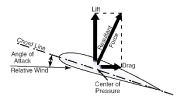
Here are the force vectors of a propeller blade. They are no different than a wing's airfoil's forces:

1763592338022.png

Between the lift and drag forces we get a resultant force. The air off that prop blade is going to be in a direction opposite to the resultant, meaning that it is not aligned with the propeller's rotational axis. It is offset and creates the spiralling slipstream. If it was aligned with the axis, there would have to be no drag, an impossible situation.

Just because you see it in print somewhere does not mean it is true. Which is why I wish I could find that picture.
 
Last edited:
I’ve not read that article yet. But I fear my perception will be the author isn’t mathematically inclined
 
Oh, I don't deny that the slipstream spirals....
View attachment 147316
... but based on my friend's write-up, I question whether it has significant effect on the airplane's aerodynamics. The torque effect probably overwhelms anything else.

Ron Wanttaja
I believe you have the correct answer. Spiraling slipstream exists, but it doesn't have the significant impact (particularly compared to other effects) that many have been lead to believe.

I've seen countless CFIs try to use spiraling slipstream hitting the side of the vertical stab as a key reason you need right rudder on takeoff.

Except how do you explain the V-tail Bonanza? You need as much if not more right rudder than any other comparable HP powered single with a traditional vertical stab.

And if spiraling slipstream was such a huge driver, then I would need a ton of right rudder when taking off in a Beech 18 or B-25. But I don't. Yet, they both have non-counterrotating props and twin vertical stabilizers behind each engine.
 
Wharton hasn’t really figured out how to quantify antagonistic labor relations, and so that’s pretty much ignored…
 
Makes me want to go put yarn an tape all over my plane just to see...
 
Good one AOPA. Explain why you need right rudder to control yaw at the top of a hammerhead with zero airspeed, P-factor, or gyro precession.
 
Oh, it's real. Just not as dramatic as the tightly-wound corkscrews that spin like tornadoes behind the propeller, as depicted by CFIs when you allow them access to a whiteboard and a marker.
Lol, oh the instructors might have thought you might not have gotten it, if they didn't exaggerate the sketch Lol.
 
I've seen countless CFIs try to use spiraling slipstream hitting the side of the vertical stab as a key reason you need right rudder on takeoff.

Except how do you explain the V-tail Bonanza? You need as much if not more right rudder than any other comparable HP powered single with a traditional vertical stab.

And if spiraling slipstream was such a huge driver, then I would need a ton of right rudder when taking off in a Beech 18 or B-25. But I don't. Yet, they both have non-counterrotating props and twin vertical stabilizers behind each engine.
The V-tail Bo gets the spiralling slipstream on the underside of the left ruddervator and the top side of the right. That creates a net force to turn the nose left. It is no different than those two surfaces acting as if there were the usual fin and horizontal stab and their movable surfaces. Can a pilot tell that he's flying a V-tail? I couldn't when I briefly flew one.

Those twins with the twin vertical surfaces get the spiral rotating around the entire surface, which is close to the center of the slipstream. You need the fin offset from the center of the slipstream to get it on just one side.

1763659139702.png

Most textbooks show it this way. This is greatly exaggerated. The photo I mentioned earlier had the tape following the slipstream from the left side, back under the wing, rising along the side of the fuselage and just clearing the front of the vertical stab. The angle at which it would impinge the stab was small, maybe three degrees, but that's all it takes. The phenomenon is most pronounced at high power and low forward speeds. In cruise it is quite small.

There are three other forces that turn the nose left. The propeller torque reaction twists the fuselage to the left and forces the left wheel harder onto the surface, creating more drag. With the nose up relative to the propeller's rotational axis, the downgoing blade has a higher AoA than the upgoing, so it pulls harder. In most airplanes, that means the right side gets more thrust and that pushes the nose left. In a taildragger, raising the tail on takeoff creates a gyroscopic precession and makes the propeller try to turn to the left, forcing the whole fuselage to angle left.

It's all backwards to that in an airplane with a prop that turns the other way. In my Auster, with its Gipsy Major engine that turned counterclockwise as seen by the pilot, I had to use a bootfull of left rudder on takeoff and in the climb.
 
Back
Top