The myth of spiraling slipstream?

Spiraling slipstream: is it real?

  • Yes

    Votes: 35 72.9%
  • No

    Votes: 2 4.2%
  • Don’t know

    Votes: 5 10.4%
  • Don’t care

    Votes: 6 12.5%

  • Total voters
    48
It's all backwards to that in an airplane with a prop that turns the other way. In my Auster, with its Gipsy Major engine that turned counterclockwise as seen by the pilot, I had to use a bootfull of left rudder on takeoff and in the climb.
And none of that left rudder was needed to counteract engine torque?

Ron Wanttaja
 
Yep. My canards get buggy on opposite surfaces. Is that why?
I have to scrub bug guts off of the underside of the upper wing where intuition says bug guts shouldn’t oughta be. My hypothesis is that the prop acts like a baseball bat and the unfortunate bug, when it collides with the prop blade, becomes a hard line drive launched tangentially to the propeller’s plane of rotation. But I have not yet received grant funding to conduct a formal study.
 
And none of that left rudder was needed to counteract engine torque?

Ron Wanttaja
The engine torque was part of the need for left rudder. All four forces are working in the same direction, and an opposite-rotating prop means opposite rudder.
 
The photo I mentioned earlier had the tape following the slipstream from the left side, back under the wing, rising along the side of the fuselage and just clearing the front of the vertical stab. The angle at which it would impinge the stab was small, maybe three degrees, but that's all it takes. The phenomenon is most pronounced at high power and low forward speeds. In cruise it is quite small.
This is well stated, Dan. I think the image you posted [that I deleted here for brevity] was taken from the PHAK which states that the spiral is “very compact” at high RPM and low forward speeds. I suggest that the characterization very compact might be overstating the case, and would substitute relatively compact. For singles, at very low forward speed the propwash impinges on a portion of each stabilizer, and its effect on the vertical stab is to push against the tail with a resulting yawing moment about the vertical axis while inducing (from interaction with all stabilizers) a rolling moment about the longitudinal axis. As airspeed increases the angle between the chord line of the stabilizer and the spiraling propwash decreases (you estimated approximately 3 degrees). In this case, the greater of the effects of the propeller slipstream on the stabilizers is to locally influence the AoA seen by their airfoils.
 
Last edited:
Not understanding why there is such debate. It's obvious to aerobatic pilots. Should also be obvious to tailwheel pilots. On the takeoff run, if you quickly raise the tail high to a level zero AOA attitude, you still need rudder to keep the airplane from veering off the runway. And once stabilized in that attitude, there is zero P-Factor or gyroscopic precession. There's only one remaining force (slipstream) that continues to yaw the airplane. Propellor torque will cause a little extra drag on one tire, but that force is not enough to cause such a need for rudder. About anyone who's flown a J-3 Cub has screwed around with raising the tail right away just for the helluvit, since it's so light and easy to do. Asymmetric tire drag at those speeds on pavement ain't much.
 
And none of that left rudder was needed to counteract engine torque?
None? Not likely; however, in what axis is the primary reaction to engine torque? ;)

its effect on the vertical stab is to push against the tail with a resulting yawing moment about the vertical axis...
The spiral slipstream causes a change in local AOA at the vertical stab (among other things), which produces the yawing moment. Attributing it to 'pushing' leads to the fallacy of 'Bernoulli vs. Newton'

Nauga,
going with the flow
 
I've only learned of spiraling slipstream (actually three out of the four "left turning tendencies") since I've been helping out with groundschool instruction. It was all just chalked up to P factor. But, you wonder how much torque, spiraling slipstream and gyroscopics actually contribute. It would be hard to tell them apart. Except for gyroscopics, which is transient and works both ways. I've never been conscious of it though.
 
None? Not likely; however, in what axis is the primary reaction to engine torque? ;)


The spiral slipstream causes a change in local AOA at the vertical stab (among other things), which produces the yawing moment. Attributing it to 'pushing' leads to the fallacy of 'Bernoulli vs. Newton'

Nauga,
going with the flow
Would you say that that holds true with the airplane stationary?
 
Like I mentioned, a friend once had me edit his (unpublished) refutation of the spiraling slipstream.

One interesting bit of trivia on this subject: He was an aerospace engineer, working at the FAA's Mike Monroney Aeronautical Center in Oklahoma City. As you might expect, they have a pretty good library on aeronautics. He found that the first mention of the spiraling slipstream effect was in a book published forty years after the Wright brothers' first flight. The author's degree? Economics.

This meant that almost every fighter aircraft that flew in WWII was designed by engineers ignorant of the effect. Do we REALLY think the designers of the P-51 were ignorant of such an effect...if it existed? Or, like me, did they figure that the torque effect overwhelmed any effect of the spiraling slipstream?

Now...it should be noted that the author with the economics degree was one Wolfgang Langeweische. And, in fact, books published AFTER "Stick and Rudder" discussed the spiraling slipstream effect. But...again, no one computes it. No one provides the algorithms needed to determine what the effect on a given design would be...at least until FORTY YEARS AFTER "Stick and Rudder" was published (NASA report posted by Nauga).

Seems like the aeronautical engineering crowd wasn't really sold on the idea.

Ron Wanttaja
 
Would you say that that holds true with the airplane stationary?
Yes. As drawn in this thread, even when static the slipstream is moving aft and pilot's right at the vertical. It's not a single point of impingement on the left side of the vertical, it's air flowing past it leading edge to trailing edge with a right 'wind' component, inducing lift. (ETA: and of course drag)

Nauga,
vectored
 
Last edited:
No one provides the algorithms needed to determine what the effect on a given design would be...at least until FORTY YEARS AFTER "Stick and Rudder" was published...
Mr. Navier and Sir Stokes would beg to differ :)

There are lots of effects that are conventionally neglected when designing conventional airplanes...and I've personally had to go back and analyze a few when we found unexpected behavior doing something 'different' with the airplanes (sea story to follow...later). I agree that the spiral slipstream is not the major player in most people's left turning tendency game, I take issue with what started the thread, "an entire article is dedicated to why spiraling slipstream is a myth and mathematically is not possible." [emphasis added]

Nauga,
somewhat unsteady
 
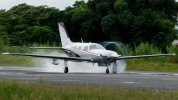
Whoever wrote that article never had to wash the soot off of a turboprop. It is not the same on both sides and the elevator ;-)

But if one needs a visual representation.

24412_1489122873.jpeg
 
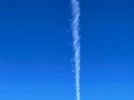
Another cool one. This is a contrail from a Piper M600 that was 1000 feet above me crossing the ocean. Don't see too many single engine contrails. But definitely spiraling.

IMG_7733.jpeg
 
The hammerhead is an excellent maneuver to feel and understand the various forces discussed here.

1. During the pull to vertical, slight left rudder will be needed to offset gyroscopic precession and being faster than neutral yaw speed. But you won't notice it without a sight gauge.

2. During the vertical up, increasing right rudder is needed to offset slipstream, and right aileron is needed to offset torque. You will very much notice uncorrected yaw at the top.

3. When airspeed approaches zero, you will hear a rumbling sound. This is the slipstream drumming on the left side of the fuselage. It sounds like a drum is because of the prop blade pulses. The sound is very distinct, and is your signal to pivot. That sound is proof that spiraling slipstream exists and that it becomes compact when airspeed is slow.

4. When you kick rudder left, you will have plenty of control authority to quickly yaw 180 degrees, even at zero airspeed. That is because the rudder catches more of the slipstream.

5. If you try to kick right, you will have much less authority, AND you will be fighting the slipstream. The result will be a tail slide or uncontrolled sideways fall to the right, and probably a spin if you keep ham-handing it.

6. After you kick left and start to yaw, you will have to add full right aileron to offset torque and the lift generated by your right wing as it moves forward.

7. As the aircraft yaws left, you will have to apply about half forward stick to offset gyroscopic precession, which wants to raise the nose. This force is felt very strongly.

8. When you finish the 180 kick, you will have to momentarily apply right rudder to stop the yaw. You can neutralize pitch and yaw, but will have to hold in a small amount of right aileron to offset torque until airflow over the wings is restored.

 
Last edited:
It's all backwards to that in an airplane with a prop that turns the other way. In my Auster, with its Gipsy Major engine that turned counterclockwise as seen by the pilot, I had to use a bootfull of left rudder on takeoff and in the climb.
The one time I got to fly a Tiger Moth, I almost messed us up because I had an instinct to be ready to punch in some right rudder...
 
The engine torque was part of the need for left rudder. All four forces are working in the same direction, and an opposite-rotating prop means opposite rudder.
You know, someone should design a round engine that actually spins in the opposite direction of the propeller to counteract those two forces.

:) :) :)
 
7. As the aircraft yaws left, you will have to apply about half forward stick to offset gyroscopic precession, which wants to raise the nose. This force is felt very strongly.
In a steep turn, that prop's gyroscopic precession is also felt. It's why it's much easier to keep the nose up in a left steep turn than in the right steep turn, where you will have to pull harder.
 
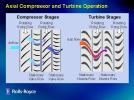
Perhaps one of our resident engineers could confirm or deny, but wouldn’t spiral slipstream be the same thing that requires turbine engines to have stators?
 
Dan Thomas said:

"In a steep turn, that prop's gyroscopic precession is also felt. It's why it's much easier to keep the nose up in a left steep turn than in the right steep turn, where you will have to pull harder."


That is the reason my instructor taught me to do all steep turns to the left.
 
Last edited:
Yes. As drawn in this thread, even when static the slipstream is moving aft and pilot's right at the vertical. It's not a single point of impingement on the left side of the vertical, it's air flowing past it leading edge to trailing edge with a right 'wind' component, inducing lift. (ETA: and of course drag)

Nauga,
vectored
I hadn’t thought much about the case of a stationary airplane, but that description does fit the description (so to speak).

Someone mentioned Navier & Stokes, and someone else Laplace, so it looks like I’d better get off the train at this stop.
 
Can't we just find a judge to overrule spiral slipstream and move on?
 
Seems to me, a non-engineer, that we have readily available high quality pressure sensors and such, that it would be relatively simple to measure this effect on an actual aircraft.
 
I can’t quickly find a photo, but the leading edge of the vertical stabilizers on my Citabrias were clearly offset a few degrees to the left. My working assumption was that was just enough to offset the effects of the spiraling slipstream in normal cruise flight. Was I wrong?

Gemini gives this explanation, along with p-factor:

1. Spiraling Slipstream Effect

The propeller creates a column of air, or slipstream, that spirals around the fuselage in the direction of the propeller's rotation.

• This spiraling airflow strikes the left side of the vertical stabilizer and rudder (for a clockwise-rotating propeller).

• The force of the slipstream pushing on the left side of the tail pushes the tail to the right, which in turn yaws the nose of the aircraft to the left.

• By offsetting the vertical stabilizer's leading edge slightly to the left, it creates a small angle of attack relative to the airflow. This generates a small side force on the vertical stabilizer that is directed to the left, which helps to counteract the nose-left yawing moment caused by the slipstream, reducing the amount of rudder input the pilot needs to maintain straight flight
.
 
Last edited:
I can’t quickly find a photo, but the leading edge of the vertical stabilizers on my Citabrias were clearly offset a few degrees to the left. My working assumption was that was just enough to offset the effects of the spiraling slipstream in normal cruise flight. Was I wrong?
Not just your Champion. Every technical drawing that I've looked at for a light single propeller driven aircraft dictates a small offset.
 
I can’t quickly find a photo, but the leading edge of the vertical stabilizers on my Citabrias were clearly offset a few degrees to the left. My working assumption was that was just enough to offset the effects of the spiraling slipstream in normal cruise flight. Was I wrong?

Nope, you are not wrong.

Also note you have a rudder trim tab to fine tune the offset. The effect of the vstab offset and trim tab is to trim your aircraft for neutral yaw at one specific speed. At speeds above that, you will need more left rudder. At speeds below, you will need more right rudder. You will feel any uncorrected yaw as roll, due to yaw-roll coupling.

Very common among Citabria-variant pilots to think their airplane is mis-rigged or has a "heavy wing", when really they just don't know the neutral yaw cruise speed.
 
Last edited:
Not just your Champion. Every technical drawing that I've looked at for a light single propeller driven aircraft dictates a small offset.
Just try to find that offset on any Cessna single. It ain't there.

Lots of Pipers and others have it, though.
 
Sometimes the offset is built into the engine mount, or as a combination of the two, or so I have been told.
Yes. Very visible on Piper singles and many other airplanes:

1763746782826.png

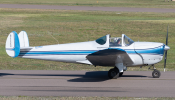
Some also have the engine tilted down to reduce the AoA differential between upgoing and downgoing prop blades. The Ercoupe is a classic example of that:

1763747178873.png

1763747238470.png
 
Some also have the engine tilted down to reduce the AoA differential between upgoing and downgoing prop blades. The Ercoupe is a classic example of that:
In my experience that's more to compensate for pitch changes due to thrust, particularly when the flaps and/or horizontal tail are heavily 'blown', but I'm not particularly familiar with the design details of the Ercoupe.

Nauga,
pitching power
 
In my experience that's more to compensate for pitch changes due to thrust, particularly when the flaps and/or horizontal tail are heavily 'blown', but I'm not particularly familiar with the design details of the Ercoupe.

Nauga,
pitching power
The Ercoupe had no rudder pedals, so no means of eliminating prop-induced yaw and slip in the climb. If the pilot cranked in right aileron to get some right rudder, the airplane banked. So they mounted that engine at a downward angle, and IIRC it was also angled to the right a bit as well, as it is with some other aircraft. That made it track better, and easier to fly.
 
Back
Top