Reuse oil?

dcat127

Pre-takeoff checklist
Joined
Jun 30, 2020
Messages
205
Display Name
Electro
So I went down the rabbit hole on YouTube watching grease monkeys that are adding additional filtration or centrifuging engine oil on their trucks and are running the oil for much longer than the manufacturer's recommended interval. The theory seems to be that engine oil's lubricity far outlasts a normal oil change interval, the main reason to change it is to get rid of the contaminants. They are not doing this without data, as they are getting regular oil tests done. I mean ok, ok, every now and then they may blow up an engine, but that is likely unrelated, regardless what is an engine every now and then in the face of advancing science.

Seeing how expensive aviation oil is, why don't we run it through a centrifuge every 50 hours and put it back in? Aircraft engines typically use more oil than an automotive engine, so the makeup oil added between oil changes likely adds more than adequate replacement of the oil. I mean it would save me like $100 per oil change, I could pay off decent quality centrifuge in like 50-75 years, and everything after that would be pure profit. Or I could sneak into North Korea's nuclear refinery in the evening after they go home and "borrow" their centrifuge, I hear they have a decent setup.

My Pa32 POH says that if the engine is used with a full flow oil filter that you may change the filter every 50 hours, and only replace the oil every 100 hours. This also seems to be a nod to the idea that it is more about removing the contaminants than it is about the oil wearing out.
 
In large frame gas turbines, ie GE 7FA, the turbine oil is almost never changed. Continuously cleaned & tested. Additives topped up as they are used up. Occasionally a large, specialized cleaning unit is brought in during shut downs to polish up the oil. The volume and cost of the oil makes it viable.
 
The lubricity of the oil will be maintained, if not grossly overheated, but, as mentioned, the additive package will become depleted. WHen this happens, the buffering effect against acids produced will be diminished (TBN, or total base number will drop). You can replenish the additives after 'cleaning' the oil via filtration/centrifugation and reuse as mentioned by @Kiddo's Driver . I agree with @AvNavCom , that juice ain't worth the squeeze. We looked in to that many years back in regards to large diesel engines in our sportfisher and came to the same conclusion.
 
This also seems to be a nod to the idea that it is more about removing the contaminants than it is about the oil wearing out.
That and maintaining the additive package levels. But keep in mind oil change intervals are only recommendations. There are also no limitations I'm aware of that would prevent you from "cleaning" your oil as well. However, once cleaned that oil must meet the required specification in order to be used. And by the time you clean that oil and bring it back to spec, you'll be money ahead just to buy a case of new oil. If you want to save a buck, buy it in bulk.

In large frame gas turbines, ie GE 7FA, the turbine oil is almost never changed.
Except there is zero comparison to an aircraft recip engine or even an aircraft turbine engine. Industrial turbines are completely different on many levels which is why they can run years on the same oil.
 
The rise of the Interwebs has caused a proliferation of theories from people with a tendency to overthink things and too much time on their hands. There is a psychological type whose favorite phrase is "everything they ever told you about X is wrong."
 
A waste oil heater would let you use it twice, but I wouldn't want to be near its exhaust.

It's probably best to just pour it down your well, or have a little nip of it every morning to keep the measles and polio and smallpox away.

gaia.jpg
 
The rise of the Interwebs has caused a proliferation of theories from people with a tendency to overthink things and too much time on their hands. There is a psychological type whose favorite phrase is "everything they ever told you about X is wrong."
The underwear part is true though....right?
 
It's always been my understanding that there are additive packages in oil that react with combustion byproducts to neutralize and suspend them in the oil. Eventually those get used up and then you get engine eating corrosive compounds in your oil.

In my case I have an outdoor wood burning furnace that I "recycle" my used oil a little bit at a time in over the winter. My dad used to keep the stuff around as a cheap lubricant for farm machinery as well. I really wouldn't want to put it back into an engine, not worth the effort and risk IMO.
 
What happened to shearing the long chains and change in viscosity, which was previously discussed widely?
No longer?
Seems like my oil gets very watery after 30-50 hrs.
 
quoting post # 9, I forgot to add the quote

that seems like a joke now...but yeah, I'm not so convinced that doing this is really such a bad thing ...on a very limited basis of course. I remember a few years ago after one of the big oil refinery leak in the gulf of Mexico America reading some stuff about how some bacteria or something that would eat the spilled oil. Anyway, nature has a way of decomposing a lot of things.
I can't even guess how many gallons of oil were dumped along the back wall of my dad's garage when I was a kid. It's a big number. It went on for many years.
The way we're taught today that area should be a wasteland where nothing grows.... his nearby household deep water well should be a poluted and undrinkable sewer. Neither of those things are true. You can't tell anything was ever dumped there by looking anyway... weeds and grass are growing without problem. They were even just a few years after stopping the oil dumps. The well water tests just fine.
 
The rise of the Interwebs has caused a proliferation of theories from people with a tendency to overthink things and too much time on their hands. There is a psychological type whose favorite phrase is "everything they ever told you about X is wrong."
As I gently remind people from time to time, the Internet lets any idiot post anything they please, no matter how wrong it is. In fact we now have a plethora of “social media” platforms that encourage and reward it. Most idiots take full advantage of this.

Put another way: pick any subject. Let’s assume that 10% of the people in the world are truly knowledgeable and know what they’re talking about. It follows that as much as 90% of what you can find on line ranges from casually uninformed to utter BS.
 
Engine overhaul costing 40K to 60K now seems like a really dumb idea.
 
Engine overhaul costing 40K to 60K now seems like a really dumb idea.

I was thinking the same. My experimental engine isn't nearly that costly and yet it gets fresh oil & filter at 25-30 hours. Oil & filters are some of the cheapest and best insurance that an owner can purchase for their engines and pretty easy to install ... :dunno:
 
As I gently remind people from time to time, the Internet lets any idiot post anything they please, no matter how wrong it is. In fact we now have a plethora of “social media” platforms that encourage and reward it. Most idiots take full advantage of this.

Put another way: pick any subject. Let’s assume that 10% of the people in the world are truly knowledgeable and know what they’re talking about. It follows that as much as 90% of what you can find on line ranges from casually uninformed to utter BS.
Sturgeon's Law, often stated as "Ninety percent of everything is crap," is an adage coined by science fiction author Theodore Sturgeon. - Wikipedia
 
As I gently remind people from time to time, the Internet lets any idiot post anything they please, no matter how wrong it is. In fact we now have a plethora of “social media” platforms that encourage and reward it. Most idiots take full advantage of this.

Put another way: pick any subject. Let’s assume that 10% of the people in the world are truly knowledgeable and know what they’re talking about. It follows that as much as 90% of what you can find on line ranges from casually uninformed to utter BS.

10% seems insanely generous.
 
The theory seems to be that engine oil's lubricity far outlasts a normal oil change interval
Multi-grade oils will get sheared and their properties will degrade. And I don't think the average owner can do a used oil analysis cheaper than buying 8 quarts of fresh oil, when you add having to get additive packages and viscosity modifiers, especially at the amounts the average owner would need. Plus sll the other equipment. I'm sure it can work for a large trucking operation with a centralized maintenance department, processing multiple drums of used oil a day. But not for the average pilot, and not even for the typical small FBO maintenance department.

What happened to shearing the long chains and change in viscosity, which was previously discussed widely?
Exactly.
 
This snark typed while commando.
That's the fifth day, while it's being laundered.
A waste oil heater would let you use it twice, but I wouldn't want to be near its exhaust.

It's probably best to just pour it down your well
The local A&P heated his hangar with waste oil collected from the airport tenants.

Back in the 1980s, the airport I was based at requested people pour used oil on the dirt access road to keep the dust down.
 
My grandfather always changed the oil on grandma’s car every 3000, as it was always a fairly new Impala or Caprice. That used 3000mi oil then went into his beater Chevy pickup, so that’s use #2. That twice used oil when drained from the truck was then cut 50/50 with herbicide and used for weed control on the farm. Waste not, want not lol.
 
The local A&P heated his hangar with waste oil collected from the airport tenants.
Did he live in a place that actually got cold? Unless there is a flight school with 5+ planes I don't see the math on this. A waste oil heater would burn at least a two-three gallons an hour, 8 hours a day 5 days a week = 70 gal a week / 280 gallons a month minimum.

But wait, he can get oil during the summer... ok, sure. Got a 1000gal+ tank? Even a 500gal is gonna run out in < 2 months.

I tried to run my M35A2 off used oil. Even in a city of 15,000 people I could never get more than a few hundred gallons. The days of garages or restaurants giving 'free' oil away are long gone... and this was around 2010.
 
Disclaimer, do not use this as advise for aircraft engines, but I’ll never forget a discussion (argument more like it) between my dad and my uncle about oil changes. Mid 1980’s, my dad was a strick by the book oil changer, my uncle was a director of the board of a major well known motor home manufacturer and against changing oil. My uncles argument was that over the course of the life of the engine, the decreased fuel efficiency from cylinder wear, timing chain wear, valve seat rebating, and so on that it was actually more cost effective to not change the oil at all after the first few initial ones after engine break in, but instead defer the cost of doing so and use it to rebuild the engine when it wears out. (If it were not for him actually being in a position that had the data from performing actual tests on exactly this when formatting their RV’s warranty policy and performing a cost/return analysis of including free oil changes as part of the warranty program and determining it was a net loss I would say it sounds insane). Also to note, an rv was and is a major investment for most buyers, so the assumption that the buyers would pay for it them selves to protect their investment being a factor in that decision can’t be ruled out, but he was pretty forceful in stating it was in the long run cheaper to not do it.

Personally I run my non aircraft engines oil a long time, then “down grade it” to another engine after it goes through the old gas station style “bulk oil” tank set up in the shop. Car and truck oil goes to lawn mower, old loader tractor, garden tiller, the extra and used from those go to the total loss hit and miss engine and two cycles (outboards and chainsaws.
 
Did he live in a place that actually got cold? Unless there is a flight school with 5+ planes I don't see the math on this. A waste oil heater would burn at least a two-three gallons an hour,
New England so yes, it gets cold. I assume there's a backup source of heat. But the FBO's planes, plus a charter service, plus ~100 hangar tenants, that's a fair amount of oil.
 
Both Fram and AeroFrantz had certified bypass filters for aircraft.

These were really “ oil cleaners “ that filtered a small amount of oil

and returned it to the sump. The problem with selling these is it always led

to a discussion of how long the oil will last rather than how long the engine

will last. “ Guaranteed to keep your oil analytically clean or your money

back” is how they were sold. It’s been 50 years and no one taken me up on

it.

The Bell 47 guys liked it as engine oil circulated through the transmission

as well.
 
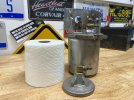
My grandfather installed Frantz toilet paper oil filters on his vehicles, and I helped him change the, uh, media. This was in the 60s. The one memory I have about them is that it was impossible to change the roll without oil going everywhere.

1000004524.jpg
 
When I was a Machinist Mate in the Navy I remember one of the least enjoyable jobs was cleaning the disks of the lube oil centrifuge. It's like these new "bagless" vacuum cleaners, rather than just disconnect the bag and toss it in the trash you have to now disassemble the thing and clean all the parts then take a shower to get all of the dust off yourself.
 
My grandfather installed Frantz toilet paper oil filters on his vehicles, and I helped him change the, uh, media. This was in the 60s. The one memory I have about them is that it was impossible to change the roll without oil going everywhere.

View attachment 140908
This can't possibly be true...ok I googled it, it does actually exist. I'm not quite sure if this is so stupid that it is genius or so genius that it is stupid.

Ok I gotta ask, for the more thrifty among us, do you recommend using the tp for it's normal use before or after using it to filter oil?
 
New England so yes, it gets cold. I assume there's a backup source of heat. But the FBO's planes, plus a charter service, plus ~100 hangar tenants, that's a fair amount of oil.
Math still doesn't add up. Average GA pilot flies 20 hours a year. Less in cold areas. If you are generous and assume that 50% of the AC in hangars are actually flown, even with the 'charter' (if they fly turboprops/turbines then they are draining no oil, only replenishing) you're looking at maybe 200-300 gallons a year. Less than a month in a NE Winter hangar.

Not trying to start a fight, but having been in the 'burn used oil' club for a few years I have to laugh when I hear people say that they do it, or know people that claim to. Its not easy, no one gives you free oil in sufficient qty and storage is a PITA. My best year I got 400 gallons oil...in a year. Filled two large totes. Straining it is a PITA. Filters clog, water grows algae and tanks get sludged up. Burning wood is even worse.

I will HAPPILY pay for propane for heat. Autozone can take my used oil.
 
Years ago folks would take a pipe or tile and pack rags or cloth hard into one end. Put used oil in the other end and catch it over the week or however long it took to filter through. I never tried it but my grandpa said it would come out looking about brand new.
 
Years ago folks would take a pipe or tile and pack rags or cloth hard into one end. Put used oil in the other end and catch it over the week or however long it took to filter through. I never tried it but my grandpa said it would come out looking about brand new.
I use a 5 gallon glass carboy, and a very big plastic funnel. The the end of the funnel is wrapped in cloth to seal to the carboy and has an over sized sisal rope hammered into the neck, that’s covered by about fifty layers of paper towel. Only oil that gets through is by capillary wicking through the rope, about a pint a day slowly drips through. The funnels big enough to hold about 8 quarts, but even black oil drips out looking like new. I wouldn’t put it in an airplane or new car, but have used “used” oil for years in my farmall, and yard equipment. (Little bottles of additives are available but I’ve never bothered. Also my engines never get started without running long enough to get the oil hot and drive out any water. I think that is actually the most important thing. Not getting the oil up to and holding it for a while at operating temps is what ruins it/ let’s bad things accumulate).
 
Last edited:
The Frantz and it’s STC’d counterpart performed very well.

Oil moved lengthwise through about 4 1/2 inches of the media.

This enabled removal of extremely small contaminants that a Full-flow

is unable to do. In addition it would remove and hold about a cup of water.

We had a demo unit and would introduce contaminants and water into

a simulated crankcase. Pumping the mix through the Full- flow had no

appreciable effect. When diverted through the AeroFrantz the oil returned

to it’s original non-contaminated state.


So why don’t we see more of these?

1. Cars now use unleaded fuel and improved oils.

2. The “TP” used had to be non-biodegradable. That industry changed too.

3. Marketing left a lot to be desired.


Nearly all trucks have BOTH Full- flow and bypass filters. Few cars

and aircraft do.
 
Back
Top