I don't work at the meatball engine company anymore, but when I did, I worked in the group that supported the CF34. Most of the work was on the -8s (like what
@SixPapaCharlie now flies - CRJ 700/900/1000 and ERJ 170 engine) and the -10s (Embraer 190 and ARJ21 engine). It's important to note that the -3s (Challenger and CRJ 100/200 engines) are completely different from the -8s and especially the -10s. The -10s are basically a CFM56 (737 engine) that got put on a Xerox machine with a scale of 75%. The -8s were a "growth" development from the -3s to originally support the larger CRJ models, but were really more like a new design. They were all put under the same team, among other reasons, to make it easier for the OEMs who were consuming the engines on what amounted to the same platform. The -3s, -8s, and -10s share no components. The -3s are fully mechanical engines, while the -8s and -10s are FADEC controlled.
@Tools asked the question of whether the CF34-3s in this Challenger shared anything in common with the TF34. The answer is yes. The original CF34-1 (go back to earlier Challenger 600 series planes, used right after the ALF engine) was itself effectively a civilian derivative of the TF34. Certain items were changed for cost/practicality/use of the engines in civilian vs. military applications. The -3s were pretty similar to the -1s, I forget the specific changes made. This is an engine that has been around in some form or another since well before I was born and there is a tremendous amount of service history on it in military (TF34), civilian/GA (Challenger) and airline/121 (CRJ) applications.
Yes, for the sorts of military operations where TF34s were used (these engines were designed for landing on aircraft carriers - i.e. high salt environment, and have very strong bearings to handle those repeated impacts) it doesn't surprise me that a compressor wash/rinse was a daily item both because of the environment and also because the maintenance burden was minimal. The only time I've seen that done to some degree as a daily item was on off shore helicopters that are flying lower and right over the ocean. For fixed wing, even in more corrosive environments (like south Florida or the Caribbean), I've never seen a daily or even weekly wash as a requirement. Some form of hours is the norm.
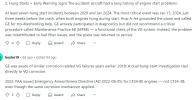
As someone who used to look at these photos from engines that had had failures, I can tell differences between the accident engines and the "clean" engines, but it's not like you're looking at some bucket of compressed rust that's been at the bottom of the ocean. The corrosion inside the bore holes of the VSVs is of particular note, and it is also something that is completely invisible to a borescope, and also in an area where a compressor wash may or may not have successfully reached.
The data indicates that these engines had never come off wing of the aircraft, with something pushing 10k hours. This is normal. Engines of this level are very reliable and designed for long time on wing. On these engines, they become due for a "performance restoration" (basically a hot section inspection) on condition basis. From memory, the performance restoration is triggered by margin between redline T5 (ITT) and the T5/ITT temperature observed on takeoff. That may have been the -8s and -10s, again it's been a while. But I will say that 15k was a fairly typical number that we saw engines come in. 10k hours on a Challenger, I would completely believe those engines had not had cause to get pulled off wing, and weren't even necessarily all that close to needing it. There are life limited parts, but my recollection is that those don't come into play until later, more like the 25k hour range.
Given that, you have two engines that would, in fact, have had what amount to identical hours, cycles, environmental exposure, and conditions - exactly the sort of scenario that would potentially set this aircraft up for this sort of highly improbable failure when combined with a plane that had lived its life in this more corrosive environment of south Florida and the Caribbean.
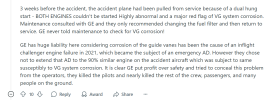
On a Part 25 aircraft, the statistical probability that is required is a chance of a dual engine failure less than 10^-9. With every engine failure that occurred, we had to run the models to determine if we were above or below that number, and if above, we had to make changes to get back below it. I was in many of those meetings. We tend to think that probability is equal to 0. However it is not equal to 0, it is just very close to 0. Very low probability events can still happen. You do end up lowering your probability of a dual engine failure by having split engines on the aircraft (engines with different times/cycles/histories). There have been situations where this was intentionally done on certain aircraft fleets to mitigate/lower this risk when there was a known issue, although this is obviously impractical on a new aircraft and generally something that's more done in larger fleets. It is also very, very rare to have any cause to do this and this single event would not be a cause to do that. The document from GE indicates some changes to be made which look to be appropriate, and undoubtedly there is going to be more emphasis looking at hung starts and indications of issues with VSV actuation.
It's easy to Monday morning quarterback a lot of things - the engine limitations, the pilots decisions, the potential leading indicators of hung starts that didn't result in a deeper investigation. It would've been very likely that the miracle on the Hudson (another highly improbable dual engine failure, albeit for different reasons) had ended this way, were it not for a combination of luck and skill - and I would argue luck more than skill.
This is very sad, I think we can all agree on that. What comes to mind me above all else is:
"It is possible to commit no mistakes and still lose."