Oil change results in me messing up.

Yes, the FAA could make things clearer, but as a general rule of thumb, if the maintenance action will require a TIG welder, a bucking bar, or an engine hoist, in most cases it’s not considered PM.

100% agree. But that does not concern me as much as the other extreme, where pilots are afraid they cannot replace a spade connector on the OT sensor because it is not explicitly listed in Part 43 Appendix A.

Every time a PM question comes up in PoA, several people make the argument that the list in Appendix A is exhaustive.

The Coleal LOI recommended revising AC 43-12A. The FAA never did that. IMO that has allowed a situation to persist where the plain language of the regulation appears to be different than the enforceable meaning. Pilots should not have to search for legal interpretations to understand the core intent of a regulation. The FAA should fix that.
 
if the maintenance action will require ... an engine hoist, in most cases it’s not considered PM.
With the notable exceptions of changing a nose tire, or repacking the nose bearings, or servicing the nose strut.
 
Pilots should not have to search for legal interpretations to understand the core intent of a regulation. The FAA should fix that.
True. But keep in mind the Coleal LOI was about a pilot checking tire pressure on a transport category airport during a preflight and not about Part 43 preventive mx. That topic is spelled out in Part 43 Appdx A(c) and in AC 43.12A. What the guidance does provide are subjective routes people may take to further define that existing guidance. No different than the 2nd half of the airworthy definition is subjective to the person making that determination. And its also the reason the FAA bears the burden to prove you are wrong in your subjective take on the guidance. So it can cut both ways.
 
Seems like the way it is now it's all arguably legal until the FAA decides it's not... and seeing how they operate I suspect that might be intentional.

The problem with things being left as exemplary vs having a specific list is the wide variation in skill/experience between pilot owners. I've put on more crimp-on connectors for various non-aviation things than I can count and to me it's not a complex thing. It's barely more difficult than turning a screw to me and certainly less complicated than say changing oil or repacking a wheel bearing which we are explicitly allowed to do. Maybe to other people who are more intimidated by electrical stuff/have never crimped on something like this feel differently.

The safe answer is always of course to get an A&P to do it but for someone who doesn't have an A&P readily available when something this simple comes up what's a pilot owner to do practically speaking? Try to convince an out of area mechanic to come out to crimp on one connector? Good luck. Ferry the airplane in a presumably unairworthy state(no temp guage)? Or just do this really simple repair and stand on the interpretation of it being allowable owner maintinance knowing how unlikely it is anyone will even know? I'm pretty sure I know what I and most mechanically inclined airplane owners are going to do...
 
The Coleal LOI recommended revising AC 43-12A. The FAA never did that. IMO that has allowed a situation to persist where the plain language of the regulation appears to be different than the enforceable meaning. Pilots should not have to search for legal interpretations to understand the core intent of a regulation. The FAA should fix that.

While I agree from a philosophical standpoint, from a practical standpoint I fear that any "fix" from the FAA will result in things being more restrictive. The FAA has no real motivation to do anything other than tighten restrictions, as there is no down side to doing so and no up side to loosening them.

IANAL, but I spent a lot of years writing, reading, and interpreting proposals, specs, SOWs, and contractual documents as a defense contractor, and I know you've done the same. We always treated appendices as informational, not binding parts of a spec or contract, so if there's a conflict the main document takes priority. I may be wrong (and often am), but it seems to me this is a similar situation, and the Coleal LOI implies as much when they wrote that the definition of PM is controlling, not the list.

The actual regulation that enables a pilot to do PM on his own aircraft is 14 CFR 43.3(g). That paragraph uses the term "preventive maintenance" and the regulatory definition of the term is included in 14 CFR 1.1. Nothing in the actual regulation invokes the list in the Appendix. The AC is, of course, advisory, not regulatory.

The document heirarchy is then 14 CFR 43.3(g) > 14 CFR 1.1 > Appendix A(c) > AC 43-12A. In event of conflicting language, the regulatory statement and definition take precedence over an appendix and certainly over an advisory circular. I believe that's pretty much how FAA legal looked at the situation, and that's why they recommended that the AC be corrected.

I suspect the FAA didn't like that answer and so they never bothered to follow through with the AC.

You're quite right that pilots shouldn't have to search all this out. From the FAA's standpoint, though, if pilots don't dig into it they'll limit themselves to the appendix list, and that's pretty much what the FAA would prefer anyway, so why would they bother to fix it?

 
TLDR, so did the plane go to the scrap yard already or did a hangar fairy repair the loose wire??

Has OP woken up to the fact that he needs a Cessna 195 tail dragger yet?
 
Nothing in the actual regulation invokes the list in the Appendix.
Or... if you read Part 43.3(a), it refers to the applicability of the Appendix lists and the Part 1 definition is applied in support "as used in this chapter, unless the context requires otherwise:"

From the FAA's standpoint, though, if pilots don't dig into it they'll limit themselves to the appendix list, and that's pretty much what the FAA would prefer anyway, so why would they bother to fix it?
I dont believe the FAA cares either way, as its more how far a pilot, mechanic, or even an ASI chooses to follow the path. If the FAA wanted a more black and white system they would have used a system like the EASA or wrote more definitive rules. While the FAA system is not perfect, its the most flexible regulatory system in the world, which provides additional "paths" if you are not satisfied with the initial take of those rules. However, most stop here and in the case of preventive mx limit themselves to the Appdx A list and AC 43.12 verbatum and call it a day. And there is nothing wrong with that either.
 
Last edited:
With the notable exceptions of changing a nose tire, or repacking the nose bearings, or servicing the nose strut.
The easiest way to service the MLG on my aircraft is to remove the plate covering the gap between the tank and the wing and using an axle strap lift the wing with an engine hoist high enough to service the tire/strut/brakes
 
There’s a long list of things where it’s best not posted about on the web. It’s the same as filming certain antics, then thinking they’ll get a kick out of it when you post.

One that comes to mind is some young guys fishing in SC, they caught a small gator. They took pictures & maybe video of them pretending, or actually pouring a beer in the gator’s mouth. I’m not sure, but I don’t think they harmed or killed the critter. After the pictures posted there was a mini uproar where the Fish & Game officials had to investigate for animal cruelty. No I’m not saying it should be routine behavior, but I don’t consider it a biggie.

As far as airplane fixes go, can I do it correctly? Is it a safety of flight issue? That’s where I start.
 
They took pictures & maybe video of them pretending, or actually pouring a beer in the gator’s mouth. I’m not sure, but I don’t think they harmed or killed the critter. After the pictures posted there was a mini uproar where the Fish & Game officials had to investigate for animal cruelty
Animal cruelty? Did they feed it Bud Light?
 
I suspect the FAA didn't like that answer and so they never bothered to follow through with the AC.

Probably. Having worked in a federal agency, and worked with a dozen or so, it is remarkable how effective the bureaucracy can be in killing ideas it dislikes.

I met with the acting head of a federal agency last week. We have a contract he has been trying to plus up to analyze a large set of data. It is high priority enough that he must report progress weekly to a cabinet member.

He asked ME for advice on how to make it happen. He has been beating on his KO for two months with no result. And this isn't even a case of an agency pushing back. This is just garden variety inertia.
 
"Can I crimp on a new connector?"

Followed by 3 pages of back and forth over interpretations of the rules with about a dozen different opinions.

The #1 reason why I went E/AB. :)

Nah, you just wanted a weird airplane that flies backwards. ;)
 
I do agree these discussions can get too rabbinical. As a practical matter, the FAA is never going to know or care. If an A&P has a problem, he can easily inspect the connector and log it as conforming. Worst case, he cuts it off and crimps another one on.

But the fact that the OP thought he had "messed up" illustrates the problem, which is largely one of pilot/owner education. I'm not generally a Saavy fan, but I will say Mr Busch does a good job of putting out materials on this.
 
:yeahthat:

And if a benevolent hangar fairy did the work, there would be no log entry and even the A&P would never know.

Yabbut now the FAA Internet intelligence team knows about it and has logged it with the NSA, so the N number is on a watchlist forever.
 
Followed by 3 pages of back and forth over interpretations of the rules with about a dozen different opinions.
I find its more an ongoing example of the differences in how people understand how the FARs work. In the real world, this decision is usually over in less than 5 minutes: either the pilot repairs the connector per prevent mx and signs it off, or the pilot calls a mechanic to fix it.
 
What was the FAA’s (or CAA’s) thinking when they wrote Appendix A and specifically allowed us to fix or change out a landing light but not a nav light or beacon?
 
Landing lights had a 10-hr lifespan. Pilots would've rioted if they needed an A&P every 10 hrs.
 
The repair is simple and have been crimping connectors since I was about eight years old. But you'd be surprised how many people mess up something as simple as crimping on a connector - since have zero knowledge of the OP's skill or experience, technically the repair should be done by an A&P or under their supervision. Real life, fix it and hope it works, since oil temp for any air cooled engine it's one of the required instruments.

Usually how this goes in our 60 year old aircraft is like this: comes in with broken connector. Try to strip back old wiring to put on new connector. Find out it's either too short now or the closer look reveals broken insulation or other issues. Trace it back to its source or splice with the plan to splice in new wire. Find out during tracing that there are four other weird wiring issues, two of which might be left alone, but two of which are airworthiness issues. Run new wire(s), clean up some old mess, make logbook entry, explain to customer why it's a two hour job. Two weeks later find out the temp indicating system is once again broken for another reason. Send out gage pack. More hours.

As for incandescent landing lights, I heard tell that GE made equivalent bulbs for tractors. YMMV.
 
What was the FAA’s (or CAA’s) thinking when they wrote Appendix A and specifically allowed us to fix or change out a landing light but not a nav light or beacon?
I believe the first “preventive maintenance” list came out in the early 1950s under the CAA, which was developed from the previous CAA “routine” mx category. As I understand, the pilot prevent mx list was written in such a restrictive manner to remain in compliance with ICAO Annex 1, 6, and 8 requirements as there is no prevent mx or pilot performed mx guidance in those Annexes.

Interestingly, the EASA, after decades of not allowing similar abilities, released Part ML (L for light) in 2020 to finally allow pilot/owner performed mx and the ability of owners to manage the airworthiness of their aircraft. Their mx list is very similar to the FAA list, but it is limited to private aircraft <6000lbs max weight and requires a specific maintenance program to be registered with the national CAA. This and other differences were one of the reasons so many people in the UK, EU, and other countries N-registered their aircraft so they could enjoy the same flexibility US pilot/owners have for 70+ years. However, the EU, etc. are slowly copying key parts of the FAA rules so that one day they can hopefully stop the use of N-reg by non-citizens outside the US. Its a very hot topic across the pond at times.
 
Usually how this goes in our 60 year old aircraft is like this: comes in with broken connector. Try to strip back old wiring to put on new connector. Find out it's either too short now or the closer look reveals broken insulation or other issues. Trace it back to its source or splice with the plan to splice in new wire. Find out during tracing that there are four other weird wiring issues, two of which might be left alone, but two of which are airworthiness issues. Run new wire(s), clean up some old mess, make logbook entry, explain to customer why it's a two hour job. Two weeks later find out the temp indicating system is once again broken for another reason. Send out gage pack. More hours.
Buy a car assembled at Abingdon-on-Thames ... you get very good at wiring very quickly. :cool:
 
Landing lights had a 10-hr lifespan. Pilots would've rioted if they needed an A&P every 10 hrs.
25 hours. But I had them fail at as low as 4 hours. Those were cowl-mounted on the Cessnas, where they get vibrated to death. Cessna had formerly mounted them in the wing leading edges where they belonged. When they went back into production in 1996, they put them back in the wings. I finally fixed the problem by installing Whelen LED lights. Lasted forever.
 
Can anyone point to the correct connector that was used originally or should be used now?
And the correct crimper to use?
PIDG style terminals and an appropriate cycle controlled type crimper. Autozone $3.99 Chinesium squeeze as hard as you can crimpers should be tossed in the trash.

I have a Greenlee 45500 crimper, and use Ancor insulated marine terminals with unitary adhesive heat shrink on all my stuff. I also use Ancor marine wire, it's a tinned fine strand with 105°C rated insulation. These materials make wiring bulletproof.
 
Last edited:
Buy a car assembled at Abingdon-on-Thames ... you get very good at wiring very quickly. :cool:
Let’s see, my car from there uses a 6 volt coil in a 12v system with a resistor, and a wire in that path failed. Got dragged home by a friend. Plus the smoke that came out of the dimmer circuit which somehow was tied into the lighter. Burned hand debugging, many splices to get critical melted bit back up. Printed an external led lighting system and abandoned. Does have 100k miles on original engine and transmission.

The Conventry car has been very reliable.
 
If your sensor has a flat flange style stud instead of a threaded stud, ring terminals won't work. You need a TE PIDG Faston terminal. Measure the flange to get correct width. Most likely it is 1/4", in which case you want this:


Technically you should pay hundreds of dollars for a professional mil spec crimper. Practically, this will do just fine:

Klein crimping tool

Wire should be MIL-W-22759. Order from Aircraft Spruce if you need it.
 
I did my first oil change today on my newly bought, but hardly new, 1965 Piper Cherokee 140. It went well, kind of. When I got back and inspected for any leaks, I noticed the wire above the oil filter was disconnected. I think when I was messing around with the safety wire, I pulled it from its connector. I believe this is the oil temp sender wire. As an owner and a pilot, I was thinking I could simply go to NAPA, buy a female connector and simply reattach the wire.

I'm not sure if I should though. I feel like this is minor, but I cant be sure. Any opinions?
That may be an oil pressure activated switch connected to your hour meter (Hobbs) if you have one. FARs allow simple maintenance items such as this to be completed by the owner. Pick up a high quality spade connector and a rachet crimper, then test the connection by pulling on it. You might secure the wire with a zip tie to prevent the same thing happening again.
 
Thanks for crimper recommendations. Many of them look the same with different names on them?

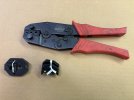
I have had this MSD crimper for 25 years. It was originally used to crimp ends on spark plug wire sets used on my mags on a top alcohol dragster. I forget what it cost back then.

A couple years ago bought 2 sets of dies for insulated and non insulated wire ends. I remember the dies costing some pretty big bucks. I keep it at home but now I think it would be approved for aviation use?IMG_6736.jpegIMG_6739.jpeg
 
Last edited:
25 hours. But I had them fail at as low as 4 hours. Those were cowl-mounted on the Cessnas, where they get vibrated to death. Cessna had formerly mounted them in the wing leading edges where they belonged. When they went back into production in 1996, they put them back in the wings. I finally fixed the problem by installing Whelen LED lights. Lasted forever.
My landing light only lasted about 20 hrs when I bought my plane with lights in the cowl.
It has been 1500+ hrs since I installed LED and they are still going strong. My taxi light stays on all the time so it has 1500 hrs on it now. Best money spent on the plane.
 
Last edited:
Let’s see, my car from there uses a 6 volt coil in a 12v system with a resistor, and a wire in that path failed. Got dragged home by a friend. Plus the smoke that came out of the dimmer circuit which somehow was tied into the lighter. Burned hand debugging, many splices to get critical melted bit back up. Printed an external led lighting system and abandoned. Does have 100k miles on original engine and transmission.

The Conventry car has been very reliable.
Yes, for a reason known but to the Prince of Darkness himself, the main "30" wire runs to the lighter first ...

I replaced all incandescents with LEDs, which required small ballast resistors, but resulted in much brighter lighting.

And 6v coils work better. :cool:
 
Last edited:
My landing light only lasted about 20 hrs when I bought my plane with lights in the cowl.
Interesting. We used the same bulbs in helicopters which also had Pulse Lite systems installed and we would get 100+ hours on those bulbs.
 
That may be an oil pressure activated switch connected to your hour meter (Hobbs) if you have one.
Nope. It's an oil temp sensor. It's on the oil filter adapter, to measure inlet oil temp as per the TCDS.

The Hobbs pressure switch is normally found in a tee mounted on the firewall, in the tube to the pressure gauge.
 
Let’s see, my car from there uses a 6 volt coil in a 12v system with a resistor, and a wire in that path failed. Got dragged home by a friend. Plus the smoke that came out of the dimmer circuit which somehow was tied into the lighter. Burned hand debugging, many splices to get critical melted bit back up. Printed an external led lighting system and abandoned. Does have 100k miles on original engine and transmission.

The Conventry car has been very reliable.
Yes, for a reason known but to the Prince of Darkness himself, the main "30" wire runs to the lighter first ...

I replaced all incandescents with LEDs, which required small ballast resistors, but resulted in much brighter lighting.

And 6v coils work better. :cool:
So being involved in aviation wasn't enough pain for you two, and thus had to add to your burdens by owning British automobiles?

This is self flagellation cubed.

:biggrin:
 
Interesting. We used the same bulbs in helicopters which also had Pulse Lite systems installed and we would get 100+ hours on those bulbs.
I should have said "I only had the plane less than 20 hours before the landing light burnt out"
I don't know how many hrs was on it when I bought it.

The guy I bought the plane from had a large hangar with 4 planes in it. 2-210s, couple 172. I worked in it for about 6 months on his 172 with supervision from his IA.
He didn't like to throw stuff away it seemed? Because I bet you there was about a dozen old landing light bulbs laying around from years earlier.
 
So being involved in aviation wasn't enough pain for you two, and thus had to add to your burdens by owning British automobiles?

This is self flagellation cubed.

:biggrin:
Indeed but only squared as have two - one Abington and one Coventry made car. The latter is really fun to drive though as frame on body car, it does it very differently.
 
Thanks for crimper recommendations. Many of them look the same with different names on them?

I have had this MSD crimper for 25 years. It was originally used to crimp ends on spark plug wire sets used on my mags on a top alcohol dragster. I forget what it cost back then.

A couple years ago bought 2 sets of dies for insulated and non insulated wire ends. I remember the dies costing some pretty big bucks. I keep it at home but now I think it would be approved for aviation use?View attachment 152506View attachment 152508

Those will be fine.
 
Inspection of the wire, insulation and proper preperation of the wire to crimp, while most would say are 'common sense' there is more to it for a PROPER repair. If the conductor is nicked or a strand is broken then a new end must be prepared, possibly a large splice to ensure proper operation.

There is only one 'comparable' item (as used in the Colleal AC) that would apply in Pt 43 PM: Trouble shooting and repairing broken circuits in landing light wiring circuits. Not-for-hire Pt 91 AC are not required to have a landing light under 91.205 but an oil temp gauge IS required. I would hazard to guess that the SPECIFICALLY allows electrical work on ONLY the landing light as it is NOT a required item under 91.205... but the oil temp IS.

Is the FAA gonna start revoking certificates? No. But if you want total freedom, buy an E/AB and get out of part 43 totally.
 
Back
Top