MOSAIC does NOTHING to lower the cost of GA

I was told there would be a lower cost to flying:
Joking memes aside, if I understand your position correctly, your main objection is that SPs will still be paying the same rates for the same aircraft, and therefore there are no cost-savings to GA flying. I think we're going to have to wait until next October to begin to see how that shakes out. I don't see the current certified fleet getting any cheaper to buy/rent, but it's plausible we'll see some European and (eventually) domestic LSAs which are cheaper and have lower running costs (fuel consumption, maintenance, etc.) than their normal category certified counterparts. Possibly that lower cost of flying may appear there in the rental fleets.

That said, now that SPs have access to the current training fleet of 172s and Cherokees but can get a ticket in half the hours, there are definite savings for GA training. If the primary mission is learn sufficient skills for sunny-day VFR away from major airports, SP is very much a great value that saves a lot of money to achieve the goal. Additional privileges can be added a la carte only if desired, which again saves money.

Bigger picture, I think that focusing on cost is missing the major benefits of MOSAIC (irrespective of what EAA/AOPA may be trumpeting as lower-cost flying). Personally, if MOSAIC achieves nothing more than ensure I can continue to fly my Cherokee with just a driver's license, then that's a win in my book should I find myself in such a situation. I think that MOSAIC lowers the barrier to entry into flying as a hobby, which is something we desperately need. It also conceivably opens to the door to more modern aircraft that don't cost half a million dollars. From a medical perspective, MOSAIC will help to continue the good work we're getting from BasicMed: showing that medical standards for recreational GA flying don't need to be as onerous as those for commercial/ATP/military flying.

All in all, I think MOSAIC doesn't really have any negative effects for the likes of you and I, and may possibly benefit a bunch of people in various small ways, financial or otherwise. Sounds like a win to me.
 
… it seems the impression on forums like this is that it’ll make flying more affordable. I’m not sure I’m seeing that...

That’s a relative outcome, I think. The sub-$100K 250-hp six place retract turbine will remain a pipe dream because, well, engineering and production isn’t cheap.

I see MOSAIC as a last ditch effort to extend the life of hobby aviation in the US. The fact remains the majority of pilots are primarily in the revenue space or trying to get there. MOSAIC isn’t going to change that.
 
I was at OSH when FAA administrator proudly announced MOSAIC becomes law. I was amazed at the excitement of the crowed, and realized after talking to a few that most didn’t really understand what was in final draft. Perhaps most were just excited that something new had happened to GA since Kittyhawk.

I think significant commercial factor will be kit builders manufacturing factory built versions in to the self-certifying LSA category, allowing some competition to legacy CAR3 and part 23 manufacturers that have enjoyed little competition for decades. This will likely lower overall cost to participate in GA and grow our numbers. This could substantially reduce new career pilot training debt considering the ridiculous cost of renting old c172s and pa28s.

Much of LSA cert basis is ASTM which mimics part 21, so I don’t think there will be revolutionary new tech in terms of propulsion or other game changing tech as certain cost will not likely be that much less. But LSA expands possibilities of performance based criteria (essentially, you can propose your own method to demonstrate compliance with certain regulations for approval) but for critical components this doesn’t always lower cost or time as burden is on you to convince FAA it’s an equivalent level). Also, using existing components allows argument of reliable service history in other aircraft thy can significantly lower cert costs. … so expect to see same previously certified rotax or o320’s engines for a while.

Anything that lowers cost and allows more folks to fly is great in my opinion. FAA tried this decades ago by introducing a new special airworthiness category called primary, designed to lower costs of legacy as well as new aircraft. It would allow an owner to swap their standard AWC for new primary, which would allow owners to perform more maintenance tasks, ECT.. however, if you wanted to install any meaningful mordernization such as a new prop or engine design, you would have to go through the traditional certification process. Cessna made a 2 seater in primary but later scrapped the model, including the unsold planes. I believe Icon was certified under primary and a CUB knock off, but primary is mostly considered a failure due to FAA st ce that it was ment for simple old tech. Canada has a similar owner maintained category but not sure how popular that is.

Anything is better than nothing when it comes to FAA and GA…. I hope it allows GA to grow.
 
That’s a relative outcome, I think. The sub-$100K 250-hp six place retract turbine will remain a pipe dream because, well, engineering and production isn’t cheap.

I see MOSAIC as a last ditch effort to extend the life of hobby aviation in the US. The fact remains the majority of pilots are primarily in the revenue space or trying to get there. MOSAIC isn’t going to change that.
The piece that I think is missing from this discussion is this: During most of the 20th century (2nd half) the "hobby" portion was supported by two things:

1) Surplus military aircraft
2) Personal business use of small planes

Look at EAA. The surplus military aircraft that still around are aging out, as are their owners. In the 1970s, there were still plenty of WWII small planes around, and enough vets and vets' offspring to keep them flying and engaged, but they are largely becoming museum pieces now, as opposed to being regularly flown by "average Joes". Today? Nothing military that has been released since the early 1970s is going to be made available to the general public, much less in the sort of quantities that WWII planes were surplused. While the ~6,000 WWI surplus planes sold in the 1920s kicked off a lot of visible flying activity it was the WWII wartime surplus inventory that really drove the creation of the private aviation boom in the latter half of the 20th century.


Through September 1946 the WAA and its prior agency, the RFC, had received over 64,000 surplus aircraft from the U.S. military. Of these, over 37,000 were considered to be salable types, while the remainder, nearly 27,000, were the tactical aircraft. At least 35,000 of the salable types, primarily liaison, utility cargo, basic trainers, and light-cargo aircraft, were sold between 1945 and 1948. By June 1947 over 40 percent of the U.S. civil aircraft fleet were surplus aircraft processed by the various disposal agencies.

Given the protected technology in modern military aircraft coupled with the lack of a global conflagration consuming vast amounts of aluminum, steel and copper to manufacture future surplus air toys, I don't see this mid-century happy accident ever repeating itself. Let's face it - you're not going to buy a surplus F/A-18 or F-117, and even the handful of T-38s that come available aren't really something that a casual hobbyist is going to put into their backyard hangar with a grass strip.

As for personal business use, the main driver of the decline (IMNSHO) is that the real-dollar cost and convenience of commercial flight has dropped to the point that the economics of personal business aviation don't really work very well until you are at the point of burning kerosene and probably hiring a pilot. Aside from a relatively small number of Cirrus', it seems that the days of using a personal Bonanza or C310 to handle business travel are in the final throes of their existence.

Real-world comparison: Over this past weekend, I flew commercial (Delta) from Houston to Milwaukee Saturday, then returned in my Bonanza on Sunday. The fuel cost was less than the ticket price, but not by very much. Given the need to make a connecting stop in Atlanta (Delta), the Bonanza flight was a good bit faster, especially when factoring in TSA and getting to the major airport (vs. community airstrip). The main benefit, however, was/is scheduling. Getting to decide when you leave and what you can carry is a real benefit.....but is it worth the capital cost and fixed expenses of owning a plane? Given the challenges associated with getting a PPL in today's Part 61 environment, I would surmise that for most business people, the benefit simply doesn't outweigh the cost; you have to really WANT to fly yourself around for it to make sense.

YMMV, lather, rinse, repeat as necessary.
 
Last edited:
The piece that I think is missing from this discussion is this: During most of the 20th century (2nd half) the "hobby" portion was supported by two things:

1) Surplus military aircraft
2) Personal business use of small planes
…..
While true, the last missing piece is the .mil training pipeline. From the 1940s until the Gulf War, the military was training tens of thousands of pilots annually. Post Gulf War, the number dropped by an order of magnitude.

Compound that with the GA production halt for a decade beginning in 1986, and the supply of both aircraft and aviators dried up. I just don’t see .mil aviator production ramping back up to the Cold War era numbers, and the private sector can’t jump to those pilot production numbers, either.
 
FAA tried this decades ago by introducing a new special airworthiness category called primary, designed to lower costs of legacy as well as new aircraft. It would allow an owner to swap their standard AWC for new primary, which would allow owners to perform more maintenance tasks, ECT.. however, if you wanted to install any meaningful mordernization such as a new prop or engine design, you would have to go through the traditional certification process. Cessna made a 2 seater in primary but later scrapped the model, including the unsold planes. I believe Icon was certified under primary and a CUB knock off
Cessna's 162 and the Icon were both certificated as SLSA, not Primary. Primary would have allowed owner maintenance but the owner had to take a manufacturer developed course to do it... which nobody offered, even those manufacturers that still existed. Quicksilver offered their GT500 as Primary, and I believe you're correct about at least one Cub clone.
Canada has a similar owner maintained category but not sure how popular that is.
Very popular, as I understand it.
 
I see MOSAIC as a last ditch effort to extend the life of hobby aviation in the US.
Agree. This makes the 3rd major effort in the past 30 years to stimulate private GA resulting in only limited participation by the market. As I mentioned earlier, if the market doesnt react positively in a reasonable timeframe once MOSAIC is fully implemented, I don't think there will be a 4th effort especially with the increasing popularity in powered-lift and UAS. And the proposed changes to the NAS sort of point to that shift.

But LSA expands possibilities of performance based criteria (essentially, you can propose your own method to demonstrate compliance with certain regulations for approval)
Except for LSA all the standards compliance is done inhouse and a Letter of Compliance is issued with no FAA involvement. And when an AWC application is filed, only at that time is the aircraft inspected against its Letter of Compliance per 21.190. The method you mention applies to Part 23 consensus standards where you can propose to the FAA your own compliance method as it is part of the type certificate approval process. An LSA has no TC. However, in both cases, using consensus standards over prescriptive rules always provides a more cost-effective and flexible process and is the reason there is a continuing regulatory shift in that direction on several levels.

Very popular, as I understand it.
Thats not what I've heard mainly due to the limited listing of eligible aircraft, its a one-way regulatory route, and the aircraft is no longer eligible for export or operation outside of Canada. Dan T might be able to offer something more specific though.
 
Agree. This makes the 3rd major effort in the past 30 years to stimulate private GA resulting in only limited participation by the market. As I mentioned earlier, if the market doesnt react positively in a reasonable timeframe once MOSAIC is fully implemented, I don't think there will be a 4th effort especially with the increasing popularity in powered-lift and UAS. And the proposed changes to the NAS sort of point to that shift…
Kind of a carr before horse effort. The target market (hobby pilots) has to exist…it’ll take several years to figure out if there’s actual growth in pilot production.
 
Looks folks, y'all are pointing the fire at the wrong target.

The hobby flying interest is dead not because the cost of it, but because what the US economics has done to the average wage earner.

Loose figures, back in 1975 the median household income was ~$15k, and the cost of a brand spankin' new C172 was ~$20k, so the wage earner was earing 75% what a new airplane cost.

Compared to 2024, the median household income was ~$85k, and the cost of a brand spankin' new C172 was ~$450k, so the wage earner would need to be making ~$337k to have the same impact on his/her pocketbook the same as it would have had back in 1975.

It IS that simple.
 
That is under the OLD LSA standard. :rolleyes: My original post is about the NEW LSA standards.
So you're mad that there aren't sub-$200K airplanes available today under standards that haven't even taken effect yet??? :rolleyes:

I was told there would be a lower cost to flying:

Eaa:
"taking half the time, at half the cost," - they forgot to all 'and only half the privileges'
No, only the privileges necessary/desired. If you live in Montana, chances are you don't need to enter Class B much. If you're colorblind or just conservative or just want to sightsee, you might not care about night flying. Many people aren't going to care about complex aircraft.

The new SP is pretty much a "make up your own custom pilot certificate" setup. Some people only want/need half the privileges, but plenty more don't need ALL the privileges, and if they do, they can get them as they need them or just go ahead and get their Private. More options is a good thing.

The EAA / AOPA are touting something that isn't really true. They said in multiple articles that flying will be more affordable and new LSA designs will cost less.
They will.

A SP is gonna pay the same rental fee as a PPL. WHere is the 'affordability'? SP's will need half the hours but have half the privileges.
You have to realize that the new rules completely divorce "Sport Pilot" from "Light Sport Aircraft". They no longer have anything to do with each other. Sport Pilots will be able to fly whatever aircraft, LSA or certified, that meet the parameters, which is the majority of recreational GA type aircraft. Light Sport Aircraft is a new certification standard that allows manufacturers to create airplanes flyable by any level of pilot certificate without having to go through the entire FAA certification process.

So, sport pilots will be able to do less training to get started, and ALL pilots will have more aircraft to choose from.

SHOW. ME. THE. MATH. seriously... can not one show me the numbers???
BECAUSE. THEY. DON'T. EXIST. YET.

So why rent a 172 when say a DA20 is an LSA and typically rents for less?
A DA20 is *not* an LSA. It is an FAA certified aircraft that predates the first LSA rules by nearly a decade and a half.
 
The target market (hobby pilots) has to exist…
The LSA market has existed since 2004. However, it never achieved the anticipated numbers with the main "complaint" that LSA aircraft were limited in size and scope. Its those existing LSA people and those existing 172, etc. owners who must now show the interest in the MOSAIC aircraft offerings. The main issue in the Part 91 recreational side has been hardware related and its upkeep. And while the ability to now fly a 172 with a SP is an advancement, it doesn't correct that hardware issue which has been the subject of many threads. So unless that existing market doesn't literally buy into those new MOSAIC inspired SLSAs or their ELSA derivatives, the only thing MOSAIC will be really known for is the ability for a non-builder E/AB owner to sign off their own condition inspections. Same thing happened after GARA/AGATE in the 90s and the initial LSA initiative in the 2000s: limited people bought new aircraft which is the actual market and by extension pilot growth if there still is any interest out there.
 
The LSA market has existed since 2004. However, it never achieved the anticipated numbers with the main "complaint" that LSA aircraft were limited in size and scope. Its those existing LSA people and those existing 172, etc. owners who must now show the interest in the MOSAIC aircraft offerings. The main issue in the Part 91 recreational side has been hardware related and its upkeep. And while the ability to now fly a 172 with a SP is an advancement, it doesn't correct that hardware issue which has been the subject of many threads. So unless that existing market doesn't literally buy into those new MOSAIC inspired SLSAs or their ELSA derivatives, the only thing MOSAIC will be really known for is the ability for a non-builder E/AB owner to sign off their own condition inspections. Same thing happened after GARA/AGATE in the 90s and the initial LSA initiative in the 2000s: limited people bought new aircraft which is the actual market and by extension pilot growth if there still is any interest out there.
The 1320 lbs limitation was a huge mistake and was always my main criticism of the LSA rules. That alone always depressed the market for current LSAs.
 
Thats not what I've heard mainly due to the limited listing of eligible aircraft, its a one-way regulatory route, and the aircraft is no longer eligible for export or operation outside of Canada. Dan T might be able to offer something more specific though.
There is actually a long list of eligible aircraft, but some of those models are rather rare: https://tc.canada.ca/en/corporate-s...ance-canadian-aviation-regulations-cars#App-h
Note: Appendix H ends at the "Schedule 1-Matrix of aircraft operating conditions." That section, and following sections, do not apply to OM.

Generally, OM applies to single-engined airplanes with fixed gear and fixed props, though there are a few exceptions in that list.

The uptake has not been as enthusiastic as anticipated when the category was introduced. Some owners are afraid of diminished resale value, as they well should be if they don't maintain the thing as required. The OM category is not to allow the owner to shirk maintenance or inspections; it's to allow old airplanes for which parts are scarce to continue flying with equivalent parts, often simply non-aviation commercial parts such as generator regulators. An owner concerned with resale loss should sit down and add up what he will spend on mechanics in the years he plans to continue owning it; it might shock him.

Some owners don't feel comfortable working on their own airplanes. They're afraid they'll overlook something or reassemble it incorrectly and have an accident. They aren't likely to go OM either. And of course, there are some owners that think they know it all and WILL do something wrong, sooner or later. They should stay away from OM, too. I have encountered one of those airplanes. It was appalling. It cost the new owner as much again as he paid for the airplane to get it safe.

The Canadian OM airplane can't fly in the US because the US has no equivalent category to cover it.

An OM airplane can be returned to TC status but it would cost far more than the airplane is worth. Everything has to be rebuilt to make sure it meets standards. Everything. Instruments and all.
 
Last edited:
Ok, prove its less money.

Taking the average time/costs/rentals show me. Use real world numbers please.
Real world numbers @ $150 per hour flight and $50 instruction
Cost of FAA physical - $125
Cost of 3 hours dual flight training night - $600
Cost of 2.75 hours dual simulated instrument training - $550
Cost of dual Flight training and solo at a Class D airport - $500
Cost of 1 hour dual XC training -$200
$1925.

Cost of upgrading to a private latter will cost $3,100 ($1200 more than just getting the private the first time.) + what ever your time is worth.
 
Last edited:
Cost of upgrading to a private latter will cost $3,100 (1200 more than just getting the private the first time.)
That's assuming a sport pilot wants to upgrade to PP later. And it ignores all the existing PPs flying as SP due to medical issues, which could be nothing more than "I don't want and don't need to to deal with the FAA medical system."
 
The LSA market has existed since 2004. However, it never achieved the anticipated numbers with the main "complaint" that LSA aircraft were limited in size and scope. Its those existing LSA people and those existing 172, etc. owners who must now show the interest in the MOSAIC aircraft offerings. The main issue in the Part 91 recreational side has been hardware related and its upkeep. And while the ability to now fly a 172 with a SP is an advancement, it doesn't correct that hardware issue which has been the subject of many threads. So unless that existing market doesn't literally buy into those new MOSAIC inspired SLSAs or their ELSA derivatives, the only thing MOSAIC will be really known for is the ability for a non-builder E/AB owner to sign off their own condition inspections. Same thing happened after GARA/AGATE in the 90s and the initial LSA initiative in the 2000s: limited people bought new aircraft which is the actual market and by extension pilot growth if there still is any interest out there.

I think the challenge is that manufacturers need a pilot-owner market to materialize. To quote a common saying in the Mooney community, pilots are cheap bastards.

Even in the Cold War era heyday, the majority of pilots produced were from the military pipelines. Today, I expect the 141 programs targeting airlines placement are the largest pipeline for new pilots.

The 141 R-ATP graduate population isn’t going to materially produce a ground swell of pilots looking to buy an airplane.

Where I think there is an opportunity is for established E-AB kit producers to take an existing kit and manufacture it under MOSAIC for sale as a completed airframe.

But again, that’s a hope and hope isn’t a strategy.
 
Are there people willing to restrict their flying to small planes, daylight only? Since I have personally known 3 pilots who flew 2 seat aircraft, daytime only for years, without a PPL, and all but one wished to be legal, Yes, there is a market and population.

One of those people put over a thousand hours on his 2 seater, all day light. I have flown with him, he was an excellent pilot. Of course, I was technically PIC. Best tailwheel landing I have enjoyed, truly master of his plane.
 
Cessna's 162 and the Icon were both certificated as SLSA, not Primary. Primary would have allowed owner maintenance but the owner had to take a manufacturer developed course to do it... which nobody offered, even those manufacturers that still existed. Quicksilver offered their GT500 as Primary, and I believe you're correct about at least one Cub clone.

Very popular, as I understand it.
my bad if incorrect ...but believe at least the c162 was transitioned to primary basis to meet EASA requirements... but think it was too little too late to save it. Same with at least some of the icon models which also allowed wider international uses.
 
my bad if incorrect ...but believe at least the c162 was transitioned to primary basis to meet EASA requirements... but think it was too little too late to save it. Same with at least some of the icon models which also allowed wider international uses.
Interesting... (does quick google search) you were correct and I was unaware of that; both were originally SLSA and Primary was added later. I guess it was indeed "too little and two late"; I don't remember ever hearing about it.
 
LSA category was more of a US thing, not recognized by other CAAs or had more op restrictions. It was easier, mostly quicker, to market internationally if they (Cessna and icon, in this case) got primary certification then to have foreign CAA adopt and codify similar LSA regs. Otherwise, primary category, was little used and largely prohibited innovation in FAA’s policy. Shame, it could have done a lot to improve GA in terms of reducing costs and increasing safety features in legacy aircraft.
 
I think the challenge is that manufacturers need a pilot-owner market to materialize.
Well, its my understanding if the current recreational pilot-owner doesn’t step up and support those manufacturers after MOSAIC is fully implemented, then it won’t matter what materializes in the future. That said, its also my understanding that once Part 22 goes live, there will be a number of new LSA offerings in the following year or two.

So for all who have been on the bandwagon about the lack of new recreational aircraft and options don’t put their money where their mouth is, I believe these OEMs will shift their efforts in other directions as evidenced by the aftermath of GARA, AGATE, etc. for good. Its been my experience that aviation OEMs react to markets and not wait for them to materialize which I believe can be seen in their recent new aircraft developments.

And since pilot/owners and potential owners are notoriously cheap I don't see many of these willing to put money on the table. Most will have the thought "I'll wait and see if used ones are a lot cheaper".
 
Loose figures, back in 1975 the median household income was ~$15k, and the cost of a brand spankin' new C172 was ~$20k, so the wage earner was earing 75% what a new airplane cost.

Compared to 2024, the median household income was ~$85k, and the cost of a brand spankin' new C172 was ~$450k, so the wage earner would need to be making ~$337k to have the same impact on his/her pocketbook the same as it would have had back in 1975.
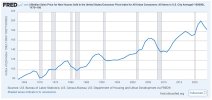
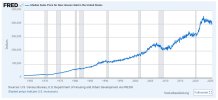
This got me wondering what the median cost of a new home was in 1975, and how that evolved over the next 50 years.

Normal 3% inflation has a doubling time of around 25 years, so two doubling periods; we'd expect a new house in 2025 to be roughly 4x what it was in 1975. One hopes that there have been improvements to productivity in the last 50 years, so it's plausible that it would come in lower.

If I made this graph correctly [1], however, it seems that median new home prices have grown faster than inflation:
fred.jpg
The same series, in nominal dollars:
fred2.jpg

I've never felt entitled to own a new house, so I'm not sure why someone ought to feel entitled to a new plane, in the same way that one is not entitled to own a home and raise a family in a posh neighborhood on minimum wage.

[1] https://fredblog.stlouisfed.org/2024/09/adjusting-dollar-figures-for-inflation-with-fred/
 
Last edited:
Well, its my understanding if the current recreational pilot-owner doesn’t step up and support those manufacturers after MOSAIC is fully implemented, then it won’t matter what materializes in the future. That said, its also my understanding that once Part 22 goes live, there will be a number of new LSA offerings in the following year or two.

So for all who have been on the bandwagon about the lack of new recreational aircraft and options don’t put their money where their mouth is, I believe these OEMs will shift their efforts in other directions as evidenced by the aftermath of GARA, AGATE, etc. for good. Its been my experience that aviation OEMs react to markets and not wait for them to materialize which I believe can be seen in their recent new aircraft developments.

We are in violent agreement; enough people need to buy enough new airframes to make it viable.
 
Well, its my understanding if the current recreational pilot-owner doesn’t step up and support those manufacturers after MOSAIC is fully implemented, then it won’t matter what materializes in the future. That said, its also my understanding that once Part 22 goes live, there will be a number of new LSA offerings in the following year or two.

So for all who have been on the bandwagon about the lack of new recreational aircraft and options don’t put their money where their mouth is, I believe these OEMs will shift their efforts in other directions as evidenced by the aftermath of GARA, AGATE, etc. for good. Its been my experience that aviation OEMs react to markets and not wait for them to materialize which I believe can be seen in their recent new aircraft developments.
I think it’s a two-way street. The manufacturers have to decide if there is a market for a particular item and they need to offer something that meets those potential buyers with enough enticement to make it make sense for them.

If one photographer per state in average wanted a new platform then some manufacturer should be able to offer a high wing strutless aircraft to the aerial photography market and we could replace our 50-year-old fleet with newer more efficient and maintenance-friendly aircraft and from what I can tell 50 airplanes is a lot in the current manufacturing market so if you find a niche and you can really meet that niche, manufacturers should be able to find a buyer if it’s affordable enough.
 
This got me wondering what the median cost of a new home was in 1975, and how that evolved over the next 50 years.

Normal 3% inflation has a doubling time of around 25 years, so two doubling periods; we'd expect a new house in 2025 to be roughly 4x what it was in 1975. One hopes that there have been improvements to productivity in the last 50 years, so it's plausible that it would come in lower.

If I made this graph correctly [1], however, it seems that median new home prices have grown faster than inflation:
View attachment 146796
The same series, in nominal dollars:
View attachment 146797

I've never felt entitled to own a new house, so I'm not sure why someone ought to feel entitled to a new plane, in the same way that one is not entitled to own a home and raise a family in a posh neighborhood on minimum wage.

[1] https://fredblog.stlouisfed.org/2024/09/adjusting-dollar-figures-for-inflation-with-fred/
Lok at monthly mortgage payment instead of purchase price. Mortgage rates are far lower today, and this is the primary driver of affordability.
 
Last edited:
I don't see many of these willing to put money on the table.
enough people need to buy enough new airframes to make it viable.
I think the question will be, at what annual airframe count and annual revenue point will the OEMs decide is "enough" to keep it going?

and from what I can tell 50 airplanes is a lot in the current manufacturing market
Except Cessna recently designed and produced a clean-sheet aircraft based on a 50 aircraft order for one customer with the 50th airframe rolling off the line this year I believe. Beech on the other hand designed a clean sheet aircraft with a clean sheet GE turbine in the hopes it can compete in a niche market with one other OEM who has produced just over 2000 airframes in a 30-year span.

Yet Cessna and Beech produce on average 284 piston singles yearly, has the market screaming at them for a new clean-sheet aircraft, but elects not to provide new designs for the recreational market. Why do you think that is?
 
Lok at monthly mortgage payment instead of purchase price. Mortgage rates are far lower today, and this is the primary driver of affordability.
I’d also look at the percentage of homes that are financed vs bought outright, but that could be both cause and effect.

Bottom line is there may not be an apples to apples comparison.
 
from what I can tell 50 airplanes is a lot in the current manufacturing market
50 airplanes a year is a lot. 50 airplanes total isn’t.

50 Starships paid for the tooling, not development and certification. 75 Hawker 4000s helped put Beech into bankruptcy.

It needs to be a sustainable line.
 
50 airplanes a year is a lot. 50 airplanes total isn’t.

50 Starships paid for the tooling, not development and certification. 75 Hawker 4000s helped put Beech into bankruptcy.

It needs to be a sustainable line.
I agree, but I think a Cardinal-like aircraft would have a place and expecting 50 initial orders would be enough to get it off the drawing board.
My company alone is running three Cardinals and they’re definitely getting more and more expensive to maintain because of their age.
 
George and cloudhound have very good relative data.

We bought a house with 2 previous owners in 1963 for the approximate price at the left edge of the second chart.

We sold it at the right edge for that approximate amount.

That money bought us a nice 1 bedroom and office unit in a quality retirement community.

In 1969, a 1960 Cessna 150 that had used up 3 engines but in excellent overall condition, sold for $10,000 with a fresh rebuilt engine, no useful radios.

That 150 cost 3 times what I paid for a new 1971 Ford 4 door sedan, radio, heater AC, V8, auto trans, power steering and power brakes.

Today, we should expect higher prices for aircraft, new or used, than we are inclined to find reasonable.

Unfortunately, the dichotomy between the high earners and low earners has increased, and the high end is prevalent on this board, but they are not willing to pay half the price of a nice house for a well worn 2 seater. That was the reality when I received my PPL, and a 10 pilot shared 150 met our needs for a while, then made it 20 with a 172 added. The 172 had many hours on it, from a flying school and glider towing.

That 172 and its replacements fit my needs, but the initial plan of replacing every 4 years with a plane 5 years newer until we were buying new failed. 1 year newer was the best we could do, and today the M model has been in the club for decades, and is getting another rebuilt engine. State of the art panel, though, and auto pilot.

Loose figures, back in 1975 the median household income was ~$15k, and the cost of a brand spankin' new C172 was ~$20k, so the wage earner was earing 75% what a new airplane cost.

Compared to 2024, the median household income was ~$85k, and the cost of a brand spankin' new C172 was ~$450k, so the wage earner would need to be making ~$337k to have the same impact on his/her pocketbook the same as it would have had back in 1975.
This got me wondering what the median cost of a new home was in 1975, and how that evolved over the next 50 years.

Normal 3% inflation has a doubling time of around 25 years, so two doubling periods; we'd expect a new house in 2025 to be roughly 4x what it was in 1975. One hopes that there have been improvements to productivity in the last 50 years, so it's plausible that it would come in lower.

If I made this graph correctly [1], however, it seems that median new home prices have grown faster than inflation:
fred.jpg

The same series, in nominal dollars:
fred2.jpg
 
Yet Cessna and Beech produce on average 284 piston singles yearly, has the market screaming at them for a new clean-sheet aircraft, but elects not to provide new designs for the recreational market. Why do you think that is?
A few years ago, when I was still working for a Cessna shop, I was told that Cessna made more profit off one Citation than off all the singles they built per year, put together.
 
That's assuming a sport pilot wants to upgrade to PP later. And it ignores all the existing PPs flying as SP due to medical issues, which could be nothing more than "I don't want and don't need to to deal with the FAA medical system."
That’s assuming a flight school in their area will train them under LS. The vast majority are not going offer LS just like they did not offer recreational.
 
That’s assuming a flight school in their area will train them under LS. The vast majority are not going offer LS just like they did not offer recreational.
That remains to be seen. Flight schools didn't offer recreational because it was a dumb idea nobody wanted it, there was no good reason not to go private. SP is different with its lack of a medical requirement. The reason few flight schools offered SP before now was the lack of LSA aircraft... but now that nearly everything is LSA, it's a different situation.
 
Back
Top