Mid-life Career Change to Airline Pilot. It's Doable.

To me, the biggest obstacle is that I'm still at ~ 550TT. I'm working on my CFI to accelerate it, but having a full time job in... you guessed... IT, it makes it a lot harder.
Yup, that would be my biggest obstacle as well, not to mention taking a pay cut. I'd have to go from sub 100 hrs to 1,500 and every rating on the way. It's definitely a "buy a 'cheap' airplane and fly the wings off of it" scenario, and hope that your biggest variable expenses end up being fuel/oil changes.
 
Thanks for the write up. I have status on a different airline so probably won't get to ride in the back with you. I'm curious how you did with single engine ILS approaches in your initial multi (piston) training vs the jet.
 
Thanks for the write up. I have status on a different airline so probably won't get to ride in the back with you. I'm curious how you did with single engine ILS approaches in your initial multi (piston) training vs the jet.
I have no idea how he did. But from personal experience. The ILS in the SIM (PIC) was much more involved, given that the hand flown one goes to a missed approach. Keep in mind the callouts and SOP's are very important, as is the flying.

In the piston "The missed isn't possible, just land it." Also, if all you've flown is raw data, and you don't have SOP's then you can get by with more...
 
Thanks for the write up. I have status on a different airline so probably won't get to ride in the back with you. I'm curious how you did with single engine ILS approaches in your initial multi (piston) training vs the jet.
I did fine in the Baron in real life.
The flight director and auto throttles were new and causing me to struggle.
 
I couldn't find an Embraer CPT picture online.

There is a lot that can spoil me on this equipment for sure.
I do hand fly the plane up to 18,000 and have committed to myself to continue to do so.
I am going to work up to getting the autopilot off higher on the approach but currently I am doing at about 1000 feet.
I never want to be the guy that goes to recurrent and has lost their stick and rudder skills.

Congrats and that's kind of a long road traveled a little bit uphill for you. Cool story! I'd say hand flying a clean airplane in auto throttles up to 18k (or 28K for that matter) is really not a big brag. I turn that stuff off and hit the easy button early on during departure. Helps in places like socal or the east coast where your attention might be better used looking outside for crossing traffic, VFR traffic, etc. But turning the automation off during the arrival, or hand flying a downwind VFR to final leg is pretty useful I'd think. Any moron can follow the pitch bar to 18k, just saying. Going through the 18 minute rigamarole of configuring to land while hand flying is much more useful for the stick and rudder skills id say
 
Congrats and that's kind of a long road traveled a little bit uphill for you. Cool story! I'd say hand flying a clean airplane in auto throttles up to 18k (or 28K for that matter) is really not a big brag. I turn that stuff off and hit the easy button early on during departure. Helps in places like socal or the east coast where your attention might be better used looking outside for crossing traffic, VFR traffic, etc. But turning the automation off during the arrival, or hand flying a downwind VFR to final leg is pretty useful I'd think. Any moron can follow the pitch bar to 18k, just saying. Going through the 18 minute rigamarole of configuring to land while hand flying is much more useful for the stick and rudder skills id say
I wasn't really bragging. I think just sort of mentioning it. Pilots i observed on my observation flights were clicking the AP on at 1000ish feet and off at 100ish. My hope is to hand fly more than that . I'd like to get to a point that I can hand fly the the arrival and approach with no automation so I'm not dependant on it but currently I think my passengers would prefer I use some of the automation until I'm more comfortable using less of it.

I think the real brag was mentioning that I busted the single engine ILS. It takes a super old moron to do that. Any old morning would have nailed it.
 
PV
After the 8 procedure trainer sessions comes the procedure validation. It is a checkride in the CPT sim. I came in stressed, tunnel vision, anxeity, all the stuff that goes into a checking event.
The examiner was super cool, cracking jokes and doing his best to diffuse any nerves I had. We did the flight and the whole time, he was really casual and just being a fun loving pilot monitoring while I did the pilot flying portion. After, I said I appreciate your style, it was very comfortable flying with you. He said "IF you hadn't been doing such a good job, you might have gotten a totally different version of me".
That was a boost of confidence and kinda lit a fire under me that this might actually happen.
I suffer from the worst imposter syndrome and live my life knowing every day, this is the day I get fired.
I don't know where it comes from but it was amplified during this training so this was a good experience for me.
Everyone in the class that made it this far passed their procedures validation.

SIMS
We had access to full motion simulators that were for lack of a better word, Bad Ass! Feels, sounds, behaves like the actual jet which I can now confirm as I have 30 hours in the Jet.
The sims were a little less stressful then the CPT because they were the same 8 lessons so nothing new other than now we were "Flying".
Everyone gets 8 two hour sim sessions as pilot flying and 8 two hour sim sessions as pilot monitoring. This portion of the training was fun for the most part. It is mostly focused on emergencies and how to handle them.
We almost never land the sim. Every time you see a runway, there is a dear on it or a truck on it or something. In my sleep I hear "Go around, Flaps 2!" that is the phrase most spoken in the sim.
Towards the end of the sims it started getting more difficult. I was doing just ok but really struggling with the single Engine ILS w/ no autopilot. That is just a terribly difficult maneuver for me.
Due to this and a couple setbacks, when they asked how are you doing and I said I am 80% there, they offered some additional sim sessions and I accepted them.
There were a handful of others in the class that accepted them as well and this sort of became the point where the class is no longer a class but individuals finishing their training.
The group chat goes dark and we all fight as individuals for the finish line.

CHECKRIDE 1: MV
The Maneuvers validation is the hard checkride. This is where you have to do stall recovery, emergency descent, V1 cuts, engine fire, and anything else they want to throw at you including for me the dreaded single engine ILS, hand flown. I nailed all of the maneuvers and totally botched the Single Engine ILS which they know is tough so they leave it for last. They have contingency built into the training for botched maneuvers and I used all of the contingencies offered up to the point where I had the examiner behind me stating "This is it I need you to do this or it's game over" My legs were shaking. I did a v1 cut and setup for the ILS. I clicked the autopilot and auto throttles off and I was on top of the flight director, absolutely glued to it. Speed set, configured, "flaps 1", "Flaps 2", "Gear down, Flaps 3", "Flaps 5 Landing Checklist". Set power to 69%. Runway in sight, "Minimums" and I nailed that landing. I stopped the plane and the examiner goes. "It would have been less stressful if you had just done that the first time. Sat complete by the way, congrats".

CHECKRIDE 2: LOE
Last checking event in the sim is Line Operating Experience. This is 2, 2 hour flights from gate to gate. They just want to see you fly. They will throw very minor emergencies at you just to see how you run the checklists, etc. It is calm, slow paced and low stress. Mine was fairly uneventful. If you mess anything up you have 2 chances to repeat it. We debriefed my landing at the end. The examiner said it wasn't pretty and I would liked to have seen x,y,z but everything was done to standards. He printed out my ATP and Type rating and we went to the sim to snap a couple photos.

IOE & LINE CHECK
That brings us to the last 2 weeks in the actual jet. Last week, I went to Miami, Jacksonville, North Carolina, South Carolina, Oklahoma, Alabama, Amarillo, College Station, and DFW about 6 times. I've been everywhere man. I've been everywhere. The jet flies like the sim but it is easier to land and there are these nice people that bring you food and coffee. On the longer flights it moves very slow and is very calm. Up in the flight levels, it is beautiful and the radio gets really quiet especially late at night. There are stressful flights. We had a flight to DFW and back out where we had a 30 min ground stop and had to switch planes which meant after the flight, I have to do a post flight walk around, grab my bags, get to the next gate, do a pre flight walk around, then get the flight plan and performance loaded while all the passengers are already there. You can feel rushed when that happens but you have to fight it. All through training the moto was "Don't rush" the tendency to do so is real. On my 2nd flight, we had a bird strike at 10,000 feet. It was loud AF. On my 3rd landing, I had an APU fail. when we got the next plane, the APU was inop. Flying into Miani, we were dodging thunderstorms all along the coast. So the first time in the jet I got exposed to a lot. The last flight yesterday was my line check and it went well. A short hop from OKC to DFW so a lot to do in a short period of time but I got it done and the examiner signed me off. It was the perfect end to a check ride. I greased the landing. And having strangers shake your hand and say "Great Landing" On their way out might be the best end to a check ride ever.

I posted these in another thread but some cool moments.
My wife hitched a ride out to College station so she could get on one of my flights. That was awesome.
She made a video of her on the plane while I was making a PA. She is super happy about my being employed again and I think she digs pilots.
View attachment 144442

Let me know if you know what kind of bird that was. I wonder what he was doing at 10,000 feet.

View attachment 144443


All in all, I do believe this was the hardest thing I have done in my life especially given all that hangs in the balance. The training is damn hard but a full career swap at nearly 50 with two kids about to go to college and mom holding down the fort and praying this works out compounded it significantly. She took on a lot of additional clients to offset some of the financial strain but we're on the other side now.

I am happy to be working again. I am happy I made the change even though it was starting to feel like my only option since the IT world and I are no longer compatible.
I still feel like the new kid on the first day of school at the airport but that should fade. I like the airplane a lot and I really love the company. Their focus on safety isn't lip service they are very serious about it.
Even though I barely have a toe in the water, I suspect I will be a lifer here. I could see myself retiring into the training department should this last.
The culture and emphasis on safety, fatigue, prioritizing family, etc is nice.

I did make 1 single joke over the last 3 months. On the long flights, we take turns eating. Captain said its quiet if you want to eat first, this is a good time.
I handed her a can of tuna and a can opener and said can you open this while I get my utensils out of my bag?
The stare I got back was priceless. The can was not opened.
That is about the level of "fun" that can be had on the flight deck.

That's it. That's the story if anyone is curious about the airline training process, the E-175, or any non company specific things, I am happy to do deep dives into any of the stuff above.
It was all a mystery to me as I was going through it and I learned a ton.

Also, for all the people that post "I'm 26, 36, 46, 56... Is it too old to get started?", You are not too old to start, you are not too old to change things about your life that you don't like.
It is hard to change but we can do hard things if we need to.

Last Call,
-F.O. SixPapaCharlie

Fantastic, and very inspiring! I am jealous.
 
Well,....


"Kids, you can be anything you want. Or you can afford to raise a family. I decided I wanted to be an airline pilot, so one of you has to go. Sorry!"
:devil:
Over the past ten years, I've made several career changes that came with significant pay cuts. I make a fraction of what I did. Let's be clear, I didn't impoverish my family or anything, but of course sacrifices had to be made. I hope my kids understand that money doesn't have to drive what they want to do. Bryan's kids are him following his dream, and that's an amazing thing for him to teach them.
 
Last edited:
I did fine in the Baron in real life.
The flight director and auto throttles were new and causing me to struggle.
I did the ATOP once and tried to shoot the ILS with both engines running in the 737 and following the FD was much harder than I thought. I did fine in the Baron as well, but the 737 in the sim had a lot more inertia and that threw me off.
 
The flight director and auto throttles were new and causing me to struggle.
It will get easier when you get more comfortable with the modes from the FMA (or whatever Embraer calls it). The A/T are typically either fixed (idle, climb, takeoff) or they are tracking airspeed to maintain the bugged speed. They aren't responding to flightpath/altitude. Pitch is flight path, unless the A/T are in a fixed mode, in which case, they are airspeed. On my airplane the FMA will say VNAV PATH, VNAV SPEED, V/S, ALT HOLD, etc.

For the F/D, the mistake that is often made is to become too reliant on the F/D bars and not paying enough attention to the actual pitch attitude. Fly the pitch attitude to bring the bars back into their normal position. The F/D gives you a early warning when your current attitude is not achieving the desired performance. You will see it in the F/D first, before it shows up on the performance instruments.
 
Over the past ten years, I've made several career changes that can't with significant pay cuts. I make a fraction of what I did. Let's be clear, I didn't impoverish my family or anything, but of course sacrifices had to be made. I hope my kids understand that money doesn't have to drive what they want to do. Bryan's kids are him following his dream, and that's an amazing thing for him to teach them.
This has turned out to be the biggest life lesson in my house.
My kids at 16 and 18 are stressed over trying to decide what to do when they grow up.

My daughter wants to be a neurologist but she asked me what if I go through all of the school and training and put in all this effort and I decide its not what I want to do?
I had to explain that 4 years of college and 25 years in IT wasn't lost or wasted. It was what I wanted to do until I wanted to do something else.

To your other point, there was a cost to the change and I wasn't the only one paying that cost. We are coming off a really hard year but hard just means I spent 6 months working in a 3D printing factory (Shout out to www.67d.com).We cut a lot of things out and I sweated my ass off for half a year while building time. Most of the sacrifices we made were superficial and I made it clear if at any point the family was baring too much of this strain, the plane was the first thing on the chopping block to liquidate. I own it outright and in liquid form, everything would be easy again. Everyone seemed on board with the less easy route. I will give a lot of credit to my wife who really took on more than she had planned to when she started her business to offset some of the strain as well. We're on the other side now and she announced "I don't work Fridays anymore" so I guess it worked.
 
Last edited:
It will get easier when you get more comfortable with the modes from the FMA (or whatever Embraer calls it). The A/T are typically either fixed (idle, climb, takeoff) or they are tracking airspeed to maintain the bugged speed. They aren't responding to flightpath/altitude. Pitch is flight path, unless the A/T are in a fixed mode, in which case, they are airspeed. On my airplane the FMA will say VNAV PATH, VNAV SPEED, V/S, ALT HOLD, etc.

For the F/D, the mistake that is often made is to become too reliant on the F/D bars and not paying enough attention to the actual pitch attitude. Fly the pitch attitude to bring the bars back into their normal position. The F/D gives you a early warning when your current attitude is not achieving the desired performance. You will see it in the F/D first, before it shows up on the performance instruments.

Yep, the big takeaway is well specifically for the Single Engine Landing, AT off is way simpler. The AT dance with every configuration, and then the rudder has to dance in accordance with the thrust changes.
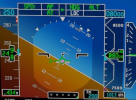
The formula for success for me was Power to ~75% and don't touch it again until fully configured. Let the configurations slow the plane down. At flaps 5, Thrust ~69% to get to Vapp. Doing that meant significantly less dancing on the rudder to accommodate the thrust changes. Our flight director is different than a lot I have seen. They call it the "pig" and we are a green circle they call the "frog". The more crass instructors would say "Kermit needs to F Miss Piggy". I am new to following a flight director and there is almost this sensing what it is about to do to stay on it. I feel like Luke learning to use the force from Yoda trying to anticipate where it needs to go next so I can be on top of it.

1756301154332.png
 
but of course sacrifices had to be made.

"Family, in order for daddy to pursue his dreams, some sacrifices have to be made. Tommy, you're first. Hop up on the altar while I go fetch the axe."
:devil:

There's a balance that must be maintained. I turned down some opportunities which would have required time away from the family, or relocating the family, which would have imposed some hardships on them and made it impossible to help out with aging family members. But I still did okay, and have no real regrets.

Circumstances are different for everyone, and there are many things to be considered in career change decisions. 6PC has made it all work, and I'm delighted for him. But I'm also happy for those who decide otherwise, who look at their families and decide the best thing is to stay put. There's no one right or wrong answer.
 
Yep, the big takeaway is well specifically for the Single Engine Landing, AT off is way simpler. The AT dance with every configuration, and then the rudder has to dance in accordance with the thrust changes.
The formula for success for me was Power to ~75% and don't touch it again until fully configured. Let the configurations slow the plane down. At flaps 5, Thrust ~69% to get to Vapp. Doing that meant significantly less dancing on the rudder to accommodate the thrust changes. Our flight director is different than a lot I have seen. They call it the "pig" and we are a green circle they call the "frog". The more crass instructors would say "Kermit needs to F Miss Piggy". I am new to following a flight director and there is almost this sensing what it is about to do to stay on it. I feel like Luke learning to use the force from Yoda trying to anticipate where it needs to go next so I can be on top of it.

View attachment 144512

This looks kinda like a Garmin G5
 
Congrats Bryan! You are an inspiration! That being said, I don't want to do what you are doing. 5 day trips? Living out of a suitcase? Airport food or junk from SkyChefs? Totally Meh. I totally commend you for such a strong desire to keep and improve the stick and rudder skills. DO NOT get complacent with the automation. Learn to fly the aircraft with ZERO gadgets. That includes radios. Does Envoy issue you a company Ipad with ForeFlight of something similar? Do you carry a backup radio in your flight bag?
 
Congrats Bryan! You are an inspiration! That being said, I don't want to do what you are doing. 5 day trips? Living out of a suitcase? Airport food or junk from SkyChefs? Totally Meh. I totally commend you for such a strong desire to keep and improve the stick and rudder skills. DO NOT get complacent with the automation. Learn to fly the aircraft with ZERO gadgets. That includes radios. Does Envoy issue you a company Ipad with ForeFlight of something similar? Do you carry a backup radio in your flight bag?
They have an iPad with their own EFB.
No backup radio. I carry one in the comanche but not the Embraer.
 
Yep, the big takeaway is well specifically for the Single Engine Landing, AT off is way simpler. The AT dance with every configuration, and then the rudder has to dance in accordance with the thrust changes.
Exactly. Minimize thrust changes. Eventually, you'll get used to going straight from the thrust level to the rudder trim when flying the sim single-engine. Don't chase airspeed when S/E. If you are within tolerance, leave it there. Trying to make a 4 or 5 knot change will just destabilize things.

Our flight director is different than a lot I have seen.
I've seen it many times from the jumpseat. The flight path vector is very handy to have. If you're trying to track a G/S or G/P, 3deg down is the key. Low-altitude level-off after takeoff? Push the FPV down to the horizon.

What I was trying to say was, don't just chase the F/D. If it's commanding a higher pitch, look at the pitch indication and raise it an appropriate number of degrees. The F/D tells you what to do but do it by reference to your actual pitch attitude and bank angle. That helps prevent over-controlling.

Ipad with ForeFlight of something similar
Most US 121 operators use Jepp FD Pro, with varying levels of add-ons such as the AMM, Skypath, etc.

I really think you should show up to work with a kneeboard
Then people would think he was a military pilot. Back in my DC8 days, I flew with a few who strapped on the kneeboard and bround out the gloves for departure and arrival.

Don't forget the E6B.
I carry my old CR-5. Don't use it often, but it's handy for endurance calculations when put in a hold planning for contingencies. (Why did the numbers printed on the CR-5 shrink so small over the decades?)
 
Just caught this thread - really cool and thanks for the tips!

A quick very specific question - did they teach anything about use of onboard RADAR? I feel like this is the one area of training where I'm really lacking. On weather trips I try to line up the onboard RADAR with what XM, ADSB, and my eyes see and it never really tells the same picture (so I end up deviating around stuff that's probably nothing). Wondering what they do at 121.

flight path vector
I'm such a FPV fanboy now I'm a bit worried I won't be able to go back to the flying V. But I also think once you get used to it it's mega easy. Though in my world when they fail the engine you don't have to worry about ILS approaches ;)
 
I feel like this is the one area of training where I'm really lacking. On weather trips I try to line up the onboard RADAR with what XM, ADSB, and my eyes see and it never really tells the same picture (so I end up deviating around stuff that's probably nothing). Wondering what they do at 121.
It's hard to train for weather radar. It isn't exactly a science.

You are trained in the specifics of how the radar systems works (my fleet has three distinctly different radars). You are trained in techniques for finding the parked tilt and how to interpret what it shows, shadowing, contouring, etc. You learn the practical application on the line.

The radar you get from XM, ADSB, etc. is a composite radar picture from multiple radar sites (and sometimes satellite). All of the returns from all altitudes are squished down into a flat image which very often, but not always, presents a very pessimistic view of the current situation. It's also old. At best, it will be ten minutes, or so, behind and is often farther out of date. The composite picture is best for deciding which way to deviate around the cells ahead. It is not good for picking a route through a collection of storms. It's very good at showing the tops and movement.

Then there is the visual picture which is, when you can get it, the best resource. You'll see building clouds that aren't yet showing up on airborne or ground radar.

There's an old joke that when you can't find a hole through a line on airborne radar, just turn the gain down until you find one.
 
Just caught this thread - really cool and thanks for the tips!

A quick very specific question - did they teach anything about use of onboard RADAR? I feel like this is the one area of training where I'm really lacking. On weather trips I try to line up the onboard RADAR with what XM, ADSB, and my eyes see and it never really tells the same picture (so I end up deviating around stuff that's probably nothing). Wondering what they do at 121.


I'm such a FPV fanboy now I'm a bit worried I won't be able to go back to the flying V. But I also think once you get used to it it's mega easy. Though in my world when they fail the engine you don't have to worry about ILS approaches ;)
They covered it briefly in some of the in-doc portion of the training but that's such a blur you never know what's important. But all of my captains have switched on the weather radar at some point and walked me through what they were doing. It's fantastic
 
Yep, the big takeaway is well specifically for the Single Engine Landing, AT off is way simpler. The AT dance with every configuration, and then the rudder has to dance in accordance with the thrust changes.
The formula for success for me was Power to ~75% and don't touch it again until fully configured. Let the configurations slow the plane down. At flaps 5, Thrust ~69% to get to Vapp. Doing that meant significantly less dancing on the rudder to accommodate the thrust changes. Our flight director is different than a lot I have seen. They call it the "pig" and we are a green circle they call the "frog". The more crass instructors would say "Kermit needs to F Miss Piggy". I am new to following a flight director and there is almost this sensing what it is about to do to stay on it. I feel like Luke learning to use the force from Yoda trying to anticipate where it needs to go next so I can be on top of it.

View attachment 144512
Whenever I read something like that it makes me think the 145 is easier to fly. Everything except ILS is vertical speed mode and you move your own throttles. Though CDFA/CANPA approaches gave us all aneurysms in training especially when every instructor taught it differently (not as big a deal on the line).
 
It's fantastic
Eh, no. The E170-series radar is a lot better than what they had on the E-145s, but it just okay. The radar on the MAX is the best I've flown. It scans on its own, building a 3D model of the weather in memory then displays the slices of weather you want to see. Returns that are more than 4000' above/below your flight patch are hatched to show that you aren't going through them. It also predicts lightning and hail.

It's no fun when you go back to the oldest version.
 
Whenever I read something like that it makes me think the 145 is easier to fly. Everything except ILS is vertical speed mode and you move your own throttles.
The automation modes are simpler, but the pilot workload is higher.

True VNAV calculates a vertical path based on the parameters programmed in the FMS. It isn't a fixed glidepath angle like the advisory VNAV on the CRJ and (I think) the E-145. It takes longer to understand the vertical modes and what is doing what, when. When you do, it greatly simplifies your workload allowing you more time to concentrate on flight management tasks. i.e. No need to calculate descent paths on a descend via STAR.

I jumpseat quite a bit on the E-175 and it's a very nice airplane for the pilots (and passengers, too). One must work, however, to avoid relying too much on the automation and letting your flying skills atrophy.
 
I wasn't really bragging. I think just sort of mentioning it. Pilots i observed on my observation flights were clicking the AP on at 1000ish feet and off at 100ish. My hope is to hand fly more than that . I'd like to get to a point that I can hand fly the the arrival and approach with no automation so I'm not dependant on it but currently I think my passengers would prefer I use some of the automation until I'm more comfortable using less of it.

I think the real brag was mentioning that I busted the single engine ILS. It takes a super old moron to do that. Any old morning would have nailed it.

haha sorry, I suppose "brag" wasn't the best word to use. I just meant that you don't learn much by flying a clean jet in auto throttles up to altitude, IMO. You do learn how much VNAV hunts for a pitch attitude, and I have found that knowing some basic "pitch+altitude" at typical climb power settings helps avoid the pitch oscillations. I flew a whole day once with inoperative AT and I think that taught me more about the airplane than anything else. Anyway, sounds like you're on the right track and I do applaud not hitting the easy button at 1000 to only click out at 100 ft. That certainly will teach you more than the bare minimum.
 
Eh, no. The E170-series radar is a lot better than what they had on the E-145s, but it just okay.

The 145 radar is better than closing your eyes and using your imagination, but just barely.

The automation modes are simpler, but the pilot workload is higher.

No doubt. I've had mainline guys in the jumpseat stunned at how much work we do on STARs.
 
The 145 radar is better than closing your eyes and using your imagination, but just barely.
I'm spoiled with the radar on the airplanes I'm flying now. I spent 15 years flying old DC8 and DC9s, some with green monochrome radar. The 145 is well ahead of that. The very small size of the radar display on the 145 surprised me.

No doubt. I've had mainline guys in the jumpseat stunned at how much work we do on STARs.
I did that briefly on the CRJ in 2014 after being furloughed off the 767 at ATI. At that time, we only did a couple of those types of STARs and had the descent angles listed in the company 10-7 pages so we could set the advisory-vnav (lower case) to give us a workable path. Still had to fly it in V/S mode.

That is not how those procedures were designed to be flown. Significantly increases pilot workload in a phase of flight where they need need to to be reduced. With "real" VNAV, workload is significantly reduced. It's reduced to the point where you actually have to work to stay engaged in monitoring the progress of VNAV. At least the 175 has the vertical situation display which goes a long way to improve situational awareness with paths and altitude restrictions.
 
Great thread, thanks for sharing.

I'm in a similar boat. 42 years old, supervisor of a team of cyber analysts (more meetings, less tools work). I have my IFR checkride in a month and am in my commercial ground school. I also have a very supportive wife which helps a ton.

The hardest decision for me is when I'm going to step away from the IT gig that pays the bills and provides the health insurance.

Thanks again for sharing, helps me feel less alone.
We used the marketplace insurance plans because neither of us have coverage through an employer. They weren't any worse than what we got from my prior employer. I think all insurance plans suck but we still had co-pays, and big things were covered. My daughter had a couple seizures while we were on that plan and I think the bill was $40k and we paid $3000 out of pocket. I pulled some financial levers to build a safety net prior to getting the airline job offer. Thankfully didn't need to use the net. When the time comes, consider ACA / Marketplace plans
 
..... pulled some financial levers to build a safety net prior to getting the airline job offer. Thankfully didn't need to use the net.....
so you got extra drinking money woohoo! er, I mean av gas money. or, well, I don't have to explain where we all know that money is going to.......
 
consider ACA / Marketplace plans

For anyone repeating the byline “I can’t leave, change, or retire because of health insurance”, do yourself a favor and make an account, log on, and compare plans. It took me a while to absorb it all, but got me to eventually stop repeating the BS everyone else repeated. With the subsidies, it’s definitely affordable (especially if your income drops).
 
Back
Top