Maintenance/ownership costs of a Vans RV vs. a certified Skyhawk/Cherokee/AA5

In aviation, the FAA loves creating monopolies that limit the supply side of supply & demand economics. , being it limiting DPEs or increasing new approved parts- especially safety related components- by making certification require hiring teams of expensive DERs and related process which is not feasible for most GA small upstarts.
I don't believe this. I believe the FAA has standards. Those standards are there to guarantee that the in-annual C-172 on the rental line has the appropriate parts, from fuel senders and spark plugs to the crankshaft or pistons. That's the de-facto bargain we make when we climb into a certified airplane - the parts and the guy installing the parts are safe/legal/appropriate to keep that airplane in the same condition it was (plus or minus accumulated wear and fatigue) when it rolled out of the factory.

There are no such guarantees on the experimental side and I can tell you from experience that there are people building and maintaining experimental aircraft who are challenged to grab the correct end of the wrench. I'm sure that's true on the certified side too, but the annual inspection should take care of the major issues.
 
In aviation, the FAA loves creating monopolies that limit the supply side of supply & demand economics. ,
Not really. The aviation industry is considered a closed system: anything entering that system has some person or entity taking responsibility for what enters. So, where you see a monopoly, I see accountability. To use the Gates alternator belt example again, when Piper certified the aircraft they took responsibility for the Gates belts at that time. And even when they sell the same belts as a spare 50 years later, by putting their sticker on it, they take the responsibility again. Now when I buy the identical Gates belt at a local vender and install it on the aircraft, I take the responsibility that belt meets all the necessary requirements as dictated by this closed system.

However, when a pilot or owner decides to buy the same Gates belt I bought and install it himself, he has now broke the system since he doesn't meet the requirements of that closed system. Unfortunately, the system is very porous and relies heavily on trust and integrity of its participants, which doesn't always happen. And without this long-established closed system, aviation would have never achieved the levels it has today and especially at the recreational level. So it all depends on whether you want accountably or not.
 
Accountability (someone else to blame when it breaks) for $150/hr for an ancient 172 or $25/hr for a virtually new airplane with only myself to blame when it breaks? I'll take door #2.
 
Not really. The aviation industry is considered a closed system: anything entering that system has some person or entity taking responsibility for what enters. So, where you see a monopoly, I see accountability. To use the Gates alternator belt example again, when Piper certified the aircraft they took responsibility for the Gates belts at that time. And even when they sell the same belts as a spare 50 years later, by putting their sticker on it, they take the responsibility again. Now when I buy the identical Gates belt at a local vender and install it on the aircraft, I take the responsibility that belt meets all the necessary requirements as dictated by this closed system.

However, when a pilot or owner decides to buy the same Gates belt I bought and install it himself, he has now broke the system since he doesn't meet the requirements of that closed system. Unfortunately, the system is very porous and relies heavily on trust and integrity of its participants, which doesn't always happen. And without this long-established closed system, aviation would have never achieved the levels it has today and especially at the recreational level. So it all depends on whether you want accountably or not.
Fair remark, to a point. The legacy manufacturers have fully capitalized their initial investment decades ago. When over 5-6 decades such manufacturers have done nothing to update or modernize their product, sell the same belt, for example, at a margin still so absurdly higher than all other mass produced components in other OE segments, proves a monopoly that allows them to do this. Show me another industry where such a mass-produced item can sell for 5x retail. This is a monopoly. By fact a TC holder has a monopoly due to regulatory supply chain and should profit accordingly. This is a government enforced monopoly that is far too leveraged by an industry.

Many OE's in all segments use such mass produced parts, but not as such margins and often have it private labeled so you don't feel you are getting burned. I have worked with such programs and it only adds pennies to cost depending on quantity.

GA's recreational demise is due to titanic cost to participate. In the 1980's I knew many people with normal middle class jobs that owned planes or in clubs or routinely rented. I am not going to argue economics and inflation comparisons, but anyone in GA for a while knows this. Such manufacturer pricing strategies exacerbates GA demise without bringing any additional value to customer base or second hand users such as renters.

I get the aviation parts pedigree and its vital role, but there's a logical and reasonable limit. As far as accountability goes, I would have no issue using the same belt bought from a legitimate source properly installed on my plane. When I needed a fuel sender and OE was over $350 for a stewart warner sender from the 1940's, i installed the SW for $30....only difference was ink stamp with FAA # on it.... by the way, is same unit used in old farm equipment and WW2 jeeps (just a different Ohm range). Not advocating anyone do this, just making a point.... my cessna is in experimental category so using such non-cert parts OK....your standard AWC has different rules.

There's a thing called perception of value in the marketing world..... if you are going to sell me an part that is packaged specifically to my need, marked with Piper of Land Rover markings and specific part #, i will more likely see the value and pay extra. But if I can buy the exact same part from a local source for 1/5 the price, I feel cheated and see no value in the OE part. As Mercruiser found out, as I mentioned above, simply placing a small new part # sticker on the GM packaging and charging 2-3 the costs, ****ed many off with most getting the same GM part elsewhere. They started repacking the part in their own boxes and stickers. Plenty of margin for Piper or others to do the same.

Again, that's why experimental has grown so fast as its often the only method for many to afford to fly. I know many feel safer getting the part from Piper and that's more than OK.... just pointing out it is tough seeing value in such pricing models and not feeling jilted, aircraft or automotive or otherwise, and it hurts the very safety system you rightly advocate for.
 
Show me another industry where such a mass-produced item can sell for 5x retail.
Except it starts with show me another industry that maintains and honors the same 80+ year old international agreement that oversees those same parts and allows them to be used across all 190+ members with no additional in-country certification. So with that agreement that same mass-produced belt can be sold in any member country with no issue. Imagine if Piper had to cover 190+ separate certification costs for that belt and what its price would be? People tend to forget, theres a lot more involved in the aviation world than the auto world or most other industries.
 
In Maule blog an owner called to replace a cigarette lighter socket.
Maule gave the owner a NAPA part number that was the same one Maule uses.
True? IDK
 
True? IDK
Sure. But how it gets installed depends on more context. Was the part number given by Maule the same as in the parts manual? If not, did Maule put that NAPA number in writing to the person? Goes back to the closed system mentioned above.
 
The issue is that Gates or NAPA doesn't have a quality control system acceptable to the FAA (even though the auto industry's QC systems are far more advanced than the FAA's). So in the FAA's eyes, theoretically Gates could change the design for that part number to something unsuitable for aircraft, and again theoretically the Piper employee slapping the PMA sticker over the Gates part number would see the difference and raise a flag, preventing an aeronautical catastrophe.

In Maule blog an owner called to replace a cigarette lighter socket.
Maule gave the owner a NAPA part number that was the same one Maule uses.

And the hangar fairies magically caused the socket to work again with nothing recorded in the logbook and the new still functional "original" socket still installed in the plane.
 
and again theoretically the Piper employee slapping the PMA sticker over the Gates part number would see the difference and raise a flag,
Actually, its a bit more than theoretical as to get the Piper sticker on it, someone is required to physically conform the belt to the type design.
 
One of the primary benefits of experimental is being able to do your own maintenance and not having to pay a mechanic. I was browsing VAF, and someone posted that while hiring an A&P would negate the cost savings on maintenance, it still really shouldn’t cost MORE than maintaining a certified spam can. How true would you say this is? If I can live without backseats, would maintenance cost about the same on an RV 6-9 for roughly the same amount?
I think ongoing stuff is comparable.
Parts likely a little cheaper.
I think a consideration ought be finding qualified help willing to work on experimental.

The greatest cost savings in my future comes from lsrma and no longer paying labor and waiting on other. Now it is all my fault.
 
Actually, its a bit more than theoretical as to get the Piper sticker on it, someone is required to physically conform the belt to the type design.
I would love to see that process working in person. I get your point, but I am pretty sure at this point it's an annual meeting between Gates and Piper where Gates swears on a stack of bibles, they haven't changed the manufacturing process or raw materials and Piper prints a bunch of stickers and slaps them on some belts that aren't going to NAPA.
 
Actually, its a bit more than theoretical as to get the Piper sticker on it, someone is required to physically conform the belt to the type design.
I seriously doubt they measure every belt.
I would love to see that process working in person. I get your point, but I am pretty sure at this point it's an annual meeting between Gates and Piper where Gates swears on a stack of bibles, they haven't changed the manufacturing process or raw materials and Piper prints a bunch of stickers and slaps them on some belts that aren't going to NAPA.
Or they randomly check one belt per lot, or per year, or whatever. Or Piper simply specifies a belt made to industry standards under Gates' ISO xxxxx quality system.
 
I would love to see that process working in person.
I seriously doubt they measure every belt.
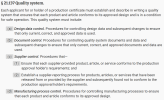
Except this is regulatory. As I stated this is a closed system, so each part that enters the system is recorded and tracked in some fashion. Its all about traceability. And how an OEM accomplishes this is found in their approved quality system procedures. So its really not as simple as “kick the tires, check the oil,” and let the part through.

For example, below is part of the regulatory requirements for a Production Certificate which Piper maintains to produce and support their aircraft. And to ensure the quality system is working there are requirements for internal audits as well which are under FAA oversight. This required process is also why OEM parts tend to cost more as this record/track cost is often passed on to the consumer.

1778455989509.png
 
Reads like the old ISO-9000 stuff when I was in the manufacturing world. I'm really not arguing, more just pointing out that you can comply with this without a lot of effort. Certainly not 10x the retail price worth of process. Write a spec, manufacturer certifies they are making to the spec, have dinner once a year after the meeting where you make said certification. From a cost standpoint on the Piper side, the inventory management costs likely exceed the margin from inventorying the parts and having the catalog, customer service costs associated with them. I would love to see anything on the Gates COGS system that shows an incremental cost associated with supplying Piper belts. If the Gates folks have half a brain, they are marking up the belts they sell to Piper by a crapload.

I don't really have a point, other than this process shouldn't drive the cost to be 10x the automotive part in this specific instance.
 
Reads like the old ISO-9000 stuff when I was in the manufacturing world. I'm really not arguing, more just pointing out that you can comply with this without a lot of effort.
Except it depends on what context you are referring to: a local solution to high aviation part costs or to the compliance with international aviation agreements. Any change in the latter context would shut down the domestic aviation industry on several levels. However, on the local side there already exist options to lower the belt cost as noted in previous posts. Unfortunately, switching to an ISO standard or Piper having dinner with a vendor to ensure compliance simply is not an option in the overall picture.
 
Hello,

Owned a Piper Cherokee during the 1990's, now own a Vans RV-6.

Purchased the 1998 RV-6 Dec. 2016.

Since it was purchased complete and flying, you can not do the Condition Inspections, you need an AP/IA. If you build it you can do your own inspections.

Biggest cost difference?
Insurance. An amateur built airplane is not something you can buy parts for off the shelf and replace, too many areas that the builder can change. You ding a wing, the insurance company will write it off, not repair.

During the yearly inspections, very little was found and needed correction, cost of the inspection has been $1,000 -$1500. $1621 this year at $135 per hour for the mechanic.

This year SB? Need to purchase or acquire an emergency egress hammer. Already have one.

What needed replaced? Someone had used silicone on the front main crankshaft seal, silicone does not work well with hydrocarbons. The split seal failed and was leaking big time, sliding in and out of the pocket. Since we had the prop off, time for a new alternator belt.

Oil filter and new oil, done.

Instead of AD you will learn about SB. These are not usually mandatory like an AD is. There was one SB about the rudder pedals that became mandatory.

The 1974 Cherokee 140 each time for the Annual needed several AD to be fixed.

The big savings will be on cross country flights. Cruising at 135+mph GS, 110ias @ 2100rpm; altitude 12,500ft traveling the Coast from Orcas Island, Washington to Petersburg, Alaska 5.57GPH with a LYC 0320 160hp. 702miles in 5-hours.The Cherokee on a 650 mile flight from Ketchikan to Orcas Island used up 45 gallons of fuel. The RV6 used 28gallons and went 50-miles further.

If you are thinking about an RV, you won't be sorry. There is a reason why there is a thing called the RV Grin.
Odin RV Grin 2.jpg

Mike
 
Last edited:
now own a Vans RV-6. you can not do the Condition Inspections, you need an AP/IA. If you build it you can do your own inspections.

Mike
This is outdated information Mike. Look up LSRI-A
Attend a 2 day course and you can perform the condition inspection on an EAB that you own regardless if you were the builder or not.
 
This is outdated information Mike. Look up LSRI-A
Attend a 2 day course and you can perform the condition inspection on an EAB that you own regardless if you were the builder or not.
And get older OPLIMs updated to include the new option.
 
This is outdated information Mike. Look up LSRI-A
Attend a 2 day course and you can perform the condition inspection on an EAB that you own regardless if you were the builder or not.
Absolutely correct. But I'll be asking a lot of questions before I fly in an airplane signed off by someone who's qualifications are a 2 day course.
 
For example, in your 172 nose strut “certified” o-ring comment above, what makes the $65.00 certified o-ring any different than an o-ring I buy from a non-descript supply house under the same part number for $5.00?
Well put simply the part number and the printing on the bag it comes in.

Its certified because it has the proper documentation to prove it meets the original specification.

Can an AnP just take an AutoZone packing and use it? Sure, but then you are breaking the law and the AnP is liable. So in its most basic form certified parts are half 'the right part' and half 'trust the MX'.
 
It depends on the owner’s skills and whether they can attain a repairman’s cert for the experimental, which allows them to perform the annual condition inspection. I built my exp Cub and I do all the maintenance. My annual maintenance costs are for oil and spark plugs, and Denso automotive plugs don’t cost much. Meanwhile, my Cessna is in for annual now and I fully expect the bill to be around $3K, as usual, with no repairs required.
 
Captive market != Monopoly.

If it was a monopoly there would only be one aircraft manufacturer. If you don't like how Piper sells their belts, you can go buy another plane, whether it be Cessna or Cirrus etc.

Now if you DO buy a Piper, it is a relatively captive market in how the airplane is maintained, but not a monopoly.
I will add that it's not impossible that Gates checks every belt that goes to Piper, but not every belt that goes to Ace Hardware.
Also, how often are new belts needed? Every few years for most of us. An inventory item that moves very slowly will have a larger cost due to the time/money thing, and thus a higher price.
 
Depending on how much you fly, change belt at every annual when prop comes off, preventative vs reactive maintenance.
 
Depending on how much you fly, change belt at every annual when prop comes off, preventative vs reactive maintenance.
JOOC, what aircraft/engine requires the prop to be removed arannual?
 
JOOC, what aircraft/engine requires the prop to be removed arannual?
If you swap the belt for preventative maintenance the prop has to come off.

Robinson helicopters have a spare alternator belt zip tied to the engine for a ‘just in case’ spare.

Typically the belt zip tied in place gets swapped out without ever being used at 2000 hours (TBO) because the belt has been cooked from being that close to the hot engine.
 
JOOC, what aircraft/engine requires the prop to be removed arannual?
a local owner of an older c152 constantly is tinkering on it and replaces parts or removes it for cleaning and visual inspection. there are studies on how over doing such maintenance can actually cause failures, mostly as it increases potential errors or wear on components. As time progressed and parts got more durable and such aggressive mx schedules did not need disassembly for inspections. maintenance schedules and instructions for continued airworthiness, as it's called in the certification world, are thus complicated to write....balancing the need for inspection vs disturbing working components.

I notice a good a&p inspects the engine compartment with a flash light , tugging on wires and squeezing hoses, collecting oil samples for lab, feeling nuts and bolts for tightness, using thread lock paint, etc, ... essentially non disturbing inspections can take the place of previous more intrusive inspections on a reoccurring cycle.

I get the above comment doesn't suggest replacing a belt on a regular basis but will use as example engineers use when coming up with mx schedules...
so although changing something as simple as a belt when visual inspection will likely catch most issues...over maintenance would statistically increase probability of not tightening the tension bolt or forget tighten of a cowl screw , rish stripping nut, or even forgetting a wrench in the cowling, so it's a clumative effect multiplied each time.
 
without this [FAA-created] long-established* closed system, aviation would have never achieved the levels it has today and especially at the recreational level.

There I agree with you.

The Otto cycle was discovered in 1876. Ford Motor Company was able to build 14 million Model T's by 1927 -- one car (of just that one model) for every 10 US citizens, in less than 50 years. The current adult population of the US is approximately 267 million; over 240 million of them hold driver's licenses -- dangerously close to 90%.

It's been over 120 years since Kitty Hawk. Aganist 267 million adults, 691k hold some form of pilot certificate (student, private, commercial, ATP) -- 0.25%.

The dearth of aviation today, particularly at the private level (~180,000 pilots), is entirely the fault of the FAA and its regulatory system.

*Long tradition of existence? Where have I heard that before?
 
Beyond the $2 to $3 million price tag, my guess is that the Skyhawk is much more expensive to operate.
1784841250507.png
 
There I agree with you.

The Otto cycle was discovered in 1876. Ford Motor Company was able to build 14 million Model T's by 1927 -- one car (of just that one model) for every 10 US citizens, in less than 50 years. The current adult population of the US is approximately 267 million; over 240 million of them hold driver's licenses -- dangerously close to 90%.

It's been over 120 years since Kitty Hawk. Aganist 267 million adults, 691k hold some form of pilot certificate (student, private, commercial, ATP) -- 0.25%.

The dearth of aviation today, particularly at the private level (~180,000 pilots), is entirely the fault of the FAA and its regulatory system.

*Long tradition of existence? Where have I heard that before?
great analogy .... I never tire of animal house or Airplane the movie quotes.
 
There I agree with you.

The Otto cycle was discovered in 1876. Ford Motor Company was able to build 14 million Model T's by 1927 -- one car (of just that one model) for every 10 US citizens, in less than 50 years. The current adult population of the US is approximately 267 million; over 240 million of them hold driver's licenses -- dangerously close to 90%.

It's been over 120 years since Kitty Hawk. Aganist 267 million adults, 691k hold some form of pilot certificate (student, private, commercial, ATP) -- 0.25%.

The dearth of aviation today, particularly at the private level (~180,000 pilots), is entirely the fault of the FAA and its regulatory system.

*Long tradition of existence? Where have I heard that before?
Sorry, but I disagree. The reason 90% of Americans have a drivers license is because driving a car is inherently useful to them, as it enables daily transportation needs. Flying a plane is a fun hobby, but the vast majority of people have neither need nor desire to fly. I fly more than most private pilots, and only make 1-2 long XC flights a month. If I didn't have a plane, I could do them by car or commercial flight.

If you got rid of the FAA, all regulation, and brought the cost of a new plane to $100,000, you'd still see very few people fly without getting paid for it.
You'd see a lot more, as dropping the price of a reasonable plane will drop the prices of used planes.
 
some person or entity taking responsibility for what enters. So, where you see a monopoly, I see accountability.
I somewhat agree but the system has been basically dead for 40 years. Other than millionaires buying million+ dollar Cirrus's (good AC I guess) the system is forcing Type Certificates to be enforced on planes that have not had active manufacturer support (aka accountability) for decades.

Also accountability is misspelled, the proper spelling is LIABILITY.

The FAA should allow a one time transfer from Certified to either LSA or Experimental where once you sign the new airworthiness certificate it can never go back and is no long type certified.

Most multi-place cross country LSA are still well out of the 'average' persons reach so S/LSA is going to be a big nothing as long as manufacturers are continuing to put lyc/cont engines in the nose.
 
If you got rid of the FAA, all regulation, and brought the cost of a new plane to $100,000, you'd still see very few people fly without getting paid for it.
That wouldn't move the needle much. A PPL is still $20k-ish and you need to have at least class III to use Basic Med (IIRC). So you could go Sport Pilot and live with the restrictions but they are artificial and basically made up for reasons know only to the FAA.

I can drive my family across the country with a drivers license and minimal training... but not fly them? What makes that 3rd and 4th person onboard subject to my medical history??

New 4 place LSA planes need to be sub $75k (closer to $50k) to expect any sort of kick start of GA.... because you're gonna need $10-20k of training to even start.
 
FAA doesn't want piston GA ;and Cessna, piper and others want legacy fleet scrapped. We had PP get their certificates for $3,500 in our exp c172 all in (plane, 60 hours,. fuel. cfi and dpe)....other ratings same savings....all without a drop of leaded gas and 20%+ lower noise..... FAA leadership made it clear and specifically exempted legacy aircraft to convert to LSA cat.

I hope there's some LSA option that cost about $80k and flies for about $60-80/hr, but doubt it anytime soon. .and the small numbers that will likely be produced each year won't likely be enough.

The small numbers that likely be produced each year won’t likely be enough for what?

There’s got to be a market. A company will not keep the numbers artificially low if people are placing orders.

Many people (including yourself) cannot accept general Aviation is on the decline and has been for decades. It’s not the big evil FAA or the manufacturers either.

As far as manufacturers wanting to scrap legacy fleets, why would they want to continue supporting 50+ year old airframes? Do you really think that’s a winner economically? It’s not. Each and every one of those airframes represents liability.
 
Won’t be enough to replace current 100k ish SE aircraft in US alone that are quickly becoming non economical to keep flying or parts not available over just next decade. Not to mention higher price points of new aircraft which need to be sub $100/hr to grab traction outside devoted career focused pilots. Even in Cessna c172 production heyday less than 2k were built in a year….. likely LSA replacement capacity not likely to keep up with legacy retirements. I argue conversion old cert planes to exp or LSA with new power plant, if allowed , best options in terms of cost and deployment.

I have no illusion ga decline/demise has been long time coming and very reason I tried to find solution. The most significant reason for this has always been cost and perception of value when seeing what it cost to fly a beat-up vintage relic. I never used term evil. What I contend is the FAA and influence from legacy industry perpetrated and protected segment from disruptors that all other industries did not enjoy such periods of time. One only needs to look at needing leaded gas when it was all buyer illegal for all other segments a quarter of a century ago; or manufacturers making the same stuff for 50 years which little to no meaningful upgrades….what other industry has this happened? All others were required to improve energy efficiency, emissions by regulation , burn cleaner and cheaper fuels, mandated to improve designs over time, ECT, reducing cost along the way. all but ga

This resulted in substantial pressures that reduced interest over time in a spiral dive which compounded shrinking of ga and continuing increase in cost to everything from hanger, shops, gas, insurance, parts….. amplifying collateral expense items critical to safety and innovation due to diseconomies of scale with final result of PAM so small no one with the resources to develop anything meaningful based on liabilities, cert costs and ROI due size of market.

To be clear, certification levels as ACO and MIDOs were great and encouraging. It wasn’t until policy making higher ups felt compelled to intervene the development of our project shut down.

Yet I digress …. Per OP, there is a significant expense delta cert vs exp…. Any new solutions as LSA, must be able to at least rent out at aggressive op cost savings and be numerous enough to bring more in and hold current ga size. But, important such developments are done right and not just as another home made experimental endeavor as history demonstrates typically fail and word travels fast…. such as automotive conversion reputation.

No one, myself included, believes ga will return to its 1960- 1970s era. Elements as expanded highway system, airline deregulation resultant lower cost and more airports, and plentiful GIBILL or Regan tax incentives are long gone. Regardless, cost and access to fly remains the greatest barrier and target to focus and stop the bleeding.

Manufacturers have good reason to want old plans scrapped for reason you mentions….unfortunately, this will do more to accelerate ha demise as there are currently no means to replace such in numbers in short terms.

My opinion only…. Go exp with mogas non , legacy engine.
 
To be clear, certification levels as ACO and MIDOs were great and encouraging. It wasn’t until policy making higher ups felt compelled to intervene the development of our project shut down.
Please post the specific FAA policy that shutdown your project.
 
Back
Top