Is the pilot shortage over

brien23

Pattern Altitude
Joined
May 31, 2005
Messages
1,624
Location
Oak Harbor
Display Name
Brien
Home Airfield
76S
The FAA is minting ATPs at a ratio of 4:1 against age 65 retirements. You've got a lot more people who were sold dreams and are $150k+ in debt from going to flight training, they've bet the farm on their delusion. The club I work at their are three of us well over 65 as CFI, also I work as the A&P/IA for the club and eight CFI building their 1500hr then their gone. CFI jobs are a little harder to find now and we are a wash in new CFI lookig for a job. Not that long ago all the new CFI were very high in demand close to the 1500hr mark now their not so hopefull, times have changed and it not a given the airline jobs will be as plentyfull as before. To address the aircraft A&P (Airframe and Powerplant) mechanic shortage, GA jobs pay is little more than flipping burgers Airline A&P good pay but limited to big maintenance facility locations. Other than those selling the dream or in their delusion of avilation what is the real outlook from those on the line.
 
Over the next 15 years the airlines will see 42,000 retirements (age 65). Add in for pilots that medical out and/or retire early, you’re still looking at 3,000+ a year.

I see it as more of a normalizing than anything else.
 
To address the aircraft A&P (Airframe and Powerplant) mechanic shortage, GA jobs pay is little more than flipping burgers Airline A&P good pay but limited to big maintenance facility locations. Other than those selling the dream or in their delusion of avilation what is the real outlook from those on the line.
The commercial side of GA is holding their own and planning for the future by starting in-house A&P apprentice programs. Part 121 appears to shifting in that direction as well but both sectors of the industry tend to be region specific vs wide spread. But I think there will be a big reduction in experience levels as the last Boomers retire in the next 2-5 years.

The Part 91 private, recreational side of GA will continue to condense as independent mx providers retire, but again the rate is more controlled by location. And with MOSAIC’s changes on the mx side, I think the big move will be internal as existing LSA and E/AB owners readjust to their new abilities. However, in general, based on how many pilots do actually perform mx on their aircraft, I don’t see huge increases in many owners performing all the work on their aircraft.

Regardless, I think the one big unknown on the A&P side is how many of the current 18-25 year olds will look to aviation as a career. From what I’ve been told, there has been an increasing shift to the trade skills with increasing school enrollments, apprenticeship enrollments, and just simply a higher interest in those fields. Another unknown is how the changes to the Part 147 instruction process, etc which includes distance learning abilities for an A&P will actually affect the numbers of people moving toward aviation.
 
Also, it is estimated that every additional airliner in the system supports 100 new pilots.
 
Regardless, I think the one big unknown on the A&P side is how many of the current 18-25 year olds will look to aviation as a career. From what I’ve been told, there has been an increasing shift to the trade skills with increasing school enrollments, apprenticeship enrollments, and just simply a higher interest in those fields. Another unknown is how the changes to the Part 147 instruction process, etc which includes distance learning abilities for an A&P will actually affect the numbers of people moving toward aviation.
My son just started his second year of A&P school. He was pretty lucky to get in the program - he got the last seat. We've been looking at programs for a while and they always seem to fill up.

Thing with these programs is that they are limited to 25 students per class and the first semester is pretty much "gotta pass" or you're out. It's intensive and 7 out of 25 of my son's class washed out. So, this path is not for everyone. But my son liking the work and is jazzed about his opportunities after he graduates. He got his general and airframe written out the way already between semesters and has scheduled his airframe O's & P's.
 
I think there was a shortage in the regionals for sure, a couple years ago. No reason to believe that this existed anywhere else back then, or especially now. Doesn't mean well qualified pilots aren't still in demand, but it probably means that CFI Timmy isn't gonna go from the piper to the airbus in one fell swoop again anytime soon.
 
Kit Darby remembers the Pilot Shortage(tm). His website is certainly experiencing an operational shortage.
 
Over the next 15 years the airlines will see 42,000 retirements (age 65). Add in for pilots that medical out and/or retire early, you’re still looking at 3,000+ a year.

I see it as more of a normalizing than anything else.
But the hiring rate is and will be greater. Todays numbers (as I posted in a different doom and gloom thread) is only a 2% churn.

Pre-covid hiring is a 5000 pilots a year. This is the normal rate. The 2022-2023 feeding frenzy (12,000 pilots in one year) is gone and every airline is saying this... 'we are back to normal' ie ~5000 pilots a year. If you average 5000*15 thats 60,000 hires against a projected 42,000 retirements.


Not seeing a 'pilot shortage'. If anything airlines have stopped hiring in 2025 and new CJOs are for 2026. There is a glut of new FOs that need to be raised into captains.
 
Kit Darby made a cottage industry from the “pilot shortage” grift many years ago.

Yep. As far back as the 90s he’s been doing that. His old jet-jobs website still works though. Looks like it was last touched in the 90s, too. What a time capsule. Looks like somebody bought the old airapps domain though.
 
I believe there is also a very significant backlog of airplane orders/delivery delays for a few airlines.
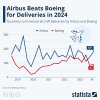
Of all the new orders for Boeing and Airbus, An estimated 650 to 700 airliners are retired from service each year, how many add to the airlines and how many are just replacements of old aircraft.
Boeing delivered in 2024.
  • Total: 348
  • 737 family: 265
  • 787 Dreamliner: 51
  • 767: 18
  • 1756855247747.jpeg
 
Last edited:
Old pilots aren't the only things to retire. Old airplanes do too.
The 20ish year old CRJ, 747s and even 717s would like to talk to you about their retirement plans. If the spreadsheet says they make money someone will fly them. Ship 302 (the one with the tail ripped off in an accident at ATL) is being put together as we speak (I walk by it every day). Couple million dollars to rivet a new ass end on a decades old airframe... because its still cheaper than buying a new/used one.

Also DC-3 now have turbo props (BT-67 now) .. on 60+ year old airframes. They just delivered two 'new' ones in 2025
 
Of all the new orders for Boeing and Airbus, An estimated 650 to 700 airliners are retired from service each year, how many add to the airlines and how many are just replacements of old aircraft.
Boeing delivered in 2024.
Those stats posted are murky the source:


With a compounded annual growth rate of more than 4%, aircraft retirements have gradually increased over the past decades. More than 15,000 commercial aircraft have been retired worldwide in the past 36 years. In the early 2010s, between 700 and 900 aircraft are retired on an annual basis;

From 1980 to 2015, more than 15,000 commercial aircraft have been retired world wide.

So take 700 planes since 2015 (10 years) means 7000-9000 aircraft retired in 10 years vs 15000 in the past 36? 50% retirement in 10 years? That report has some 'splaining to do.

(From the wiki... )
In the 10 years from 2015 to 2024, Airbus received orders for 8,950 aircraft and delivered 7,043, while Boeing received net orders for 5,012 aircraft and delivered 5,312

So that means Boeing and Airbus, since 2015-2024, DELIVERED over 12000 airliners. That means more airliners were ADDED then RETIRED.
 
Wow, I did not know they were still making the 767.

I believe those were 767F (freighters) only. Line is now closed, other than for KC-46 production, which I guess you could say is basically a 767.
 
No one wants a new airport in their backyard, with airports at their max capacity just how do those who figure large number of new aircraft and flight to work. Flights cannot be started or completed on schedule because of the queue of aircraft awaiting their turn for takeoff, landing, or use of taxiways and gates at terminal buildings. How do you expand a system everyone wants with no real fix.
 
No one wants a new airport in their backyard, with airports at their max capacity just how do those who figure large number of new aircraft and flight to work. Flights cannot be started or completed on schedule because of the queue of aircraft awaiting their turn for takeoff, landing, or use of taxiways and gates at terminal buildings. How do you expand a system everyone wants with no real fix.
Airports are typically miles outside the city, the problem is the city sprawls out to the airport. PEK, NRT are miles from the city, yet the city is growing towards them.

Within a 50 mile ring (1 hours drive) from my house there are no less than 25 airports. Most are private grass strips but there are some large municipal/international airports. The larger ones are significant revenue streams. There are new airports within the last 20 years, but it takes decades to build. The planing for Silver Comet Field started in 1975 and just opened in 2009.
 
No one wants a new airport in their backyard, with airports at their max capacity just how do those who figure large number of new aircraft and flight to work. Flights cannot be started or completed on schedule because of the queue of aircraft awaiting their turn for takeoff, landing, or use of taxiways and gates at terminal buildings. How do you expand a system everyone wants with no real fix.
In the LA Basin, expanding passenger capacity at Ontario as been significant, and Breeze added service from San Bernardino. Similarly, Westchester County (HPN) has experienced greatly increased passenger counts. I'm sure there are other examples of "outlying" airports that have plenty of room to expand without causing huge ATC issues. Of course, there are tons of ATC staffing issues, but that is a different conversation.
 
Other than those selling the dream or in their delusion of avilation what is the real outlook from those on the line.

Present day is still a far better outlook than I and many of us in this industry had when we started. I was delusional then, or so I was told. At age 17, I remember my manager at the marina for which I worked (I cleaned houseboats) heard I wanted to be a pilot. He shook his head. "You realize how dumb that is? No one is hiring pilots." Maybe it was dumb, but it's all I cared to do. 33 years later, it's been one heck of a ride and I wouldn't have traded it for anything. It's been a wonderful experience. Even the down years were opportunities to improve and get better, sharpen the blade, better my skillset.

I would make one small suggestion. Attitude goes a long way. I have many friends and colleagues in this business - some have had a more successful journey than others. The ones who were successful attacked every challenge cheerfully, with zero hesitation. They put one foot in front of the other every day. They always moved forward, even when it was inches at a time. They weren't naysayers. They weren't critical of others, or critical of the industry for that matter. They didn't make excuses for why their career had stalled out, they made difficult decisions (such as moving to where the right job was rather than staying comfy in their hometown), they did menial jobs to help pay the bills when they were furloughed early on in their careers at the regionals. Those are the winners, and they'll find their way to the top. It may be a delusion to you, but for them, it was a challenge they accepted and overcame.
 
1000000279.jpg
What's all this about short pilots . . .?
 
A friend just emailed me the following:

Today was my first day on property at United and I got my bid. I'll be a 737 FO based in Newark. The new hire class is pretty big (74 students) and we had a drop of 33 A-320s and 41 737s. United is looking to hire more than 2k pilots next year and will be taking delivery of new 787s, 321 NEOs, and 73 Max jets. It's definitely a cool time to be in industry.

A positive attitude, and persistence is paying off.

Congrats to your friend, and welcome to the world's best airline. It's a great place to be. I've been here just over 3 years, and there are 5800 pilots junior to me already.

We're on track to hire 700 more pilots than we originally forecasted for this year. There is going to be a big vacancy bid next month with a lot of narrowbody captain slots, and widebody first officer slots.
 
We're on track to hire 700 more pilots than we originally forecasted for this year. There is going to be a big vacancy bid next month with a lot of narrowbody captain slots, and widebody first officer slots.

Can't be, we were expertly told already:
If anything airlines have stopped hiring in 2025 and new CJOs are for 2026.

;)
 
Maybe I should have went to United! My company ceased hiring a few months after I arrived and is only taking 158 this year!
 
The big wrinkle of course will be if the retirement age is raised from 65 to 67. A slow in the retirement rate could substantially effect the hiring rate…at leave for the short term.
 
The big wrinkle of course will be if the retirement age is raised from 65 to 67. A slow in the retirement rate could substantially effect the hiring rate…at leave for the short term.

When it went from 60 to 65 it made a big difference due to the industry being slow (in hiring) and the period of 5 years. A two year bump and with today's hiring it would have minimal impact.

That gets bantered around but in reality I don't believe it's going to happen, not anytime soon.
 
He gets partial credit, the Air Line isn't hiring anyone right now.

Yea, but if you want the real scoop on pilot hiring you have to head down to the hangar floor and ask a shop mechanic. He knows the pilot lounge janitor who has a friend that services the printers in Flight Ops........... ;)
 
Yea, but if you want the real scoop on pilot hiring you have to head down to the hangar floor and ask a shop mechanic. He knows the pilot lounge janitor who has a friend that services the printers in Flight Ops........... ;)

For us, the best news source is the van driver in London.
 
Anyone who's been around the industry long knows pilot hiring is cyclical. Late 90s airlines were hiring anyone with 500 hours and a pulse to fly right seat in CRJ/ERJs, 9/11 happened everyone got furloughed. Economy and aviation recovered mid-2000s, then the 2008 recession hit and everything slowed again. 20teens things picked up, then COVID, then post COVID, and on and on. As one of my airline flying friends said, if you are planning to make a career as an airline pilot from 22 to 65, you will face a furlough or lay off at least 2 or 3 times.

Because so much travel is elective and subject to disposable income, aviation is the first to suffer during economic downturns, and the last to recover.

We are seeing a correction right now for the radical post COVID hiring, which was largely stimulated by the airlines over correction for the COVID downturn. We are closer to a sustainable norm for the time being. No one expected the travel market to bounce back as quickly as it did. During the height of the slowdown, most analysts predicted a 5-10 year return to normal from COVID, in actuality it was about 12-18 months.
 
But what constitutes “normal”? The last 25 years, or the 50 years prior?
Good question. The last 25 saw geopolitical uncertainty, an unusually brutal recession and COVID fun. The previous 50 was most impacted by deregulation destroying the business models of old stalwarts like Pan Am and TWA.

My crystal ball says the future will be different. How so? ‍Who knows
 
Back
Top