ID Bits from Oil Screen

But you don't have to look too far to find owners who are unaware the suction screen exists, think they don't have one because they have a filter, or have been told once a year is enough.
Except for a number of engines, not pulling the suction screen is counter to the performance requirements required in Part 43.13(a), which also covers preventive mx tasks. So if a pilot is "winging it" vs following the appropriate guidance that is simply one of those self-induced errors that can't be defended should the need arise.


2) Complied with AD 2026-04-11.
FWIW: Recurring ADs require stating the date and time of the next action in the record per 91.417, which also requires a record of the method of compliance. So with this AD may want to add: complied with AD 2026-04-11 per para. (g)(1), no bronze metal found. Next due at 1234.56 TT. (or at whatever interval you use to track your oil changes.) And while including the AD within your oil change write up is okay, may what to consider making a separate write up for just the AD, unless you also retain a dedicated AD record with the appropriate information per 91.417.
 
No vacuum pump.

Will probably send a piece to a lab to see what it is,
 
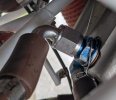
When I tighten the flare fitting, the stiff hose tends to spring back and loosen the pressure on the crush gasket slightly, and I get a little seepage over time.
Make sure the fitting is torqued properly first. It shouldn't move at all if at required torque, which should be listed in one of the Lycoming manuals. Then once the fitting is installed and safetied, when torque the B nut put a backup wrench on the fitting to counter the B-nut torque. If it still seeps then look at the faying surfaces of the case/fitting, fitting for crack, etc.
 
Make sure the fitting is torqued properly first. It shouldn't move at all if at required torque, which should be listed in one of the Lycoming manuals. Then once the fitting is installed and safetied, when torque the B nut put a backup wrench on the fitting to counter the B-nut torque. If it still seeps then look at the faying surfaces of the case/fitting, fitting for crack, etc.

The fitting to case torque is finger tight plus 135 degrees. At that point the crush gasket is not fully flattened and it does not take much force to inadvertently tighten it further after it has been wired.
 
At that point the crush gasket is not fully flattened and it does not take much force to inadvertently tighten it further after it has been wired.
Do you use new gaskets?
Have you checked to see if the case threads or fitting threads are worn?
Are the fitting/case faying surfaces true?
Sounds more like you have another issue as the hose spring back should not loosen the fitting.
 
@Pinecone - what oil has been used? Black bottle Shell, blue bottle Phillips, etc.? What flavor (X Country, etc.)?

At this point, hate to say it, but I'd drain the oil again, stick a borescope into the pan and see if you have any other "souvenirs" laying there.
 
How about this one?

(this is kind of like paleontologists constructing an entire T. Rex skeleton from a few fragments of a thigh bone.)
 
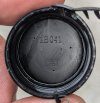
Another candidate. Note instructions molded into top of cap.

"CLOSE TIGHTLY ... WHILE PUSHING DOWN TURN"

SGP98077_1_main__90616.webpSGP98077_1_inset3__38287.webp
 
@Pinecone - what oil has been used? Black bottle Shell, blue bottle Phillips, etc.? What flavor (X Country, etc.)?
Still need to know what oil / what not was put in the crankcase for last few oil changes. Always use same oil?
 
Yes, agreed. I'm just observing that even the cheapest plastic crap has various codes molded in.
I think the Phillips XC 20x50 cap will fit into the filler tube. I'll be visiting the plane tomorrow and will check.
 
I think the Phillips XC 20x50 cap will fit into the filler tube. I'll be visiting the plane tomorrow and will check.
A Phillips or Shell oil cap would fit into my filler tube.
 
Last edited:
A Phillips or Shell oil cap would fit into my fuller tube.
Interesting...
For me, my trick to draining an oil bottle is to lightly thread the neck into the filler tube while I do other things.
Since that barely fits, I extrapolated that the cap wouldn't go in the filler tube. Never tried it, though.
 
I have a continental 0 470 R. When adding oil, I drop the oil bottle’s neck into the filler tube and just let it drain. The OP has a Lycoming though.

OP - when was the engine last overhauled / opened up?
 
Last edited:
I think the Phillips XC 20x50 cap will fit into the filler tube. I'll be visiting the plane tomorrow and will check.
The dip stick thread on a Lycoming (at least the ones that I fly) is the same as a AeroShell bottle. If the cowl is off or is capable of opening more than just an oil door, I just tilt the bottle really quickly onto the filler neck and then thread it on.
 
@Pinecone - what oil has been used? Black bottle Shell, blue bottle Phillips, etc.? What flavor (X Country, etc.)?

At this point, hate to say it, but I'd drain the oil again, stick a borescope into the pan and see if you have any other "souvenirs" laying there.
Last several changes have been Philips XC.

After sitting the pieces were brittle and breakable. A&P thinks paint chips.

Unfortunately, he was carrying the piece of paper towel and a gust of wind blew them away.
 
I finally exercised the option (by STC) to remove the screen to mitigate this risk.
The screen keeps the big chunks out of the filter. It is an additive safety feature, not a negative.
 
Could it be old gasket material? Those have letters and numbers on them and get hard and brittle after awhile. Had any work done like valve covers, mags etc?
 
The fitting to case torque is finger tight plus 135 degrees. At that point the crush gasket is not fully flattened and it does not take much force to inadvertently tighten it further after it has been wired.
I would disregard the 135 degree and tighten to crush the washer. Your overthinking it. Then back it up with wrench then safety wire it.
 
I would disregard the 135 degree and tighten to crush the washer. Your overthinking it. Then back it up with wrench then safety wire it.
The crush washer is not flexible. Once crushed, it stays crushed. To crush it then back off invites leakage.
 
No, I was in the next hangar. He went in and came out with the rag in his hand, then I heard OOOPS, as a gust of wind hit us.
 
I don't think that engine uses valve stem seals, or I'd nominate one of those. I've had 'em become "crispy" and self-destruct in motorcycle engines (old-school air-cooled.)
 
Back
Top