

You are using an out of date browser. It may not display this or other websites correctly.
You should upgrade or use an alternative browser.
You should upgrade or use an alternative browser.
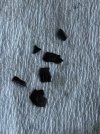
ID Bits from Oil Screen
- Thread starter Pinecone
- Start date

Dixiebluesky
Pre-takeoff checklist
- Joined
- Feb 25, 2020
- Messages
- 166
- Display Name
- Dixiebluesky
Carbon deposits

I thought so for a second, but the letters seem to be embossed and in the correct orientation, which means they're not bits of carbon deposited around something with a stamped part number.Carbon deposits
It's probably bits from the aircraft's Chemtrail Processing Unit. You need to notify the government to have a replacement unit sent ASAP.There seem to be letters on some pieces. C P and U
Have you had any seals changed in the last year?Any ideas?
Pinecone
Final Approach
NoMagnetic?
Pinecone
Final Approach
NopeHave you had any seals changed in the last year?
Not many hours in the past two years.

Dixiebluesky
Pre-takeoff checklist
- Joined
- Feb 25, 2020
- Messages
- 166
- Display Name
- Dixiebluesky
You are right, I did not zoom in. So is it hardened rubber or plastic?

Ed Haywood
Final Approach
How hard are they? Can you easily crush or crumble one?
How old are your oil hoses?
How old are your oil hoses?
bonefishpete
Cleared for Takeoff
- Joined
- Nov 10, 2024
- Messages
- 1,360
- Display Name
- Bonefishpete
Carbon deposits
Do you have a spin on or cartridge oil filter?Nope
Not many hours in the past two years.
Is this the 1st oil change in the past 2 years?
Was any work requiring a seal change performed in the year prior to those two years?
It doesn't look recent from the pics.

- Joined
- Sep 11, 2019
- Messages
- 2,885
- Display Name
- Domenick
Sump screen?Spin on. these were in the oil screen.
No, about 12 months on oil change.
No
If so it has to be from something with a direct clear path to the sump. Rocker cover seal? Pan gasket?

Llewtrah381
Pattern Altitude
- Joined
- Apr 9, 2010
- Messages
- 1,762
- Display Name
- Llewtrah
Maybe send them to AvLab or Blackstone?
Just dont't put pee in the jar (@SixPapaCharlie )Maybe send them to AvLab or Blackstone?
Did you flush the oil sump or any other difference with this last oil change?Spin on. these were in the oil screen.
No, about 12 months on oil change.
No
Short of that, it sounds like you had some debris from previous mx that finally made to the screen.
Whether you want to borescope the sump or drop it to see what else might be in there, may want to increase your oil change schedule to make sure its been cleared.

Jim Carpenter
Line Up and Wait
Was thinking maybe pieces from a broken vacuum pump vane, but I don't know how that would get into the oil sump with a dry pump.
Ed Haywood
Final Approach
There seem to be letters on some pieces. C P and U
C-U-P
Plastic measuring cup, dropped into filler tube or left in sump during assembly?
Cap from a quart of oil?
Material seems thin enough for that, but I don't recall any typical engine compartment fluid containers with letters stamped on their caps.Cap from a quart of oil?
You mean the blue fill tube ?Cases of Phillips XC 20w50 come with a plastic filler tube. If someone has one, check to see if there is writing on it. A piece could have broken off, though unlikely.
Ed Haywood
Final Approach
8 gazillion cheapo funnels and filler tubes out there. Sure looks like black plastic to me.
I would definitely make it a habit to check the suction screen at every oil change for a while.
I would definitely make it a habit to check the suction screen at every oil change for a while.
I believe that screen should be checked at every oil change.I would definitely make it a habit to check the suction screen at every oil change for a while.
Ed Haywood
Final Approach
I believe that screen should be checked at every oil change.
Yes absolutely, but my observation is that it often is not done.

- Joined
- Dec 5, 2010
- Messages
- 6,581
- Display Name
- GeorgeC
I finally exercised the option (by STC) to remove the screen to mitigate this risk.Yes absolutely, but my observation is that it often is not done.
Ed Haywood
Final Approach
I finally exercised the option (by STC) to remove the screen to mitigate this risk.
Does that not un-mitigate other risks?
- Joined
- Dec 5, 2010
- Messages
- 6,581
- Display Name
- GeorgeC
Probably. There are no solutions in life, only tradeoffs.Does that not un-mitigate other risks?
Ed Haywood
Final Approach
Probably. There are no solutions in life, only tradeoffs.
Fair point!

Spring Ford
Line Up and Wait
- Joined
- Jul 11, 2018
- Messages
- 794
- Display Name
- SpringFord
Google says:
"The black pieces shown in the image are fragments of a shattered oil bottle cap that fell into the oil fill neck during servicing.
The textured finish, distinct curvature, and the visible letters "C", "U", and "P" (typically spelling out part of "PUSH DOWN & TURN" or "CLOSE TIGHTLY") match the internal safety threading or outer rim of plastic caps from standard aviation oil bottles (such as Phillips 66 or AeroShell)."
I adjusted the exposure on the image (as a whole) to try to intensify the letters. It's not a "P" but likely a lower case "b".
"The black pieces shown in the image are fragments of a shattered oil bottle cap that fell into the oil fill neck during servicing.
The textured finish, distinct curvature, and the visible letters "C", "U", and "P" (typically spelling out part of "PUSH DOWN & TURN" or "CLOSE TIGHTLY") match the internal safety threading or outer rim of plastic caps from standard aviation oil bottles (such as Phillips 66 or AeroShell)."
I adjusted the exposure on the image (as a whole) to try to intensify the letters. It's not a "P" but likely a lower case "b".
Google says:
(typically spelling out part of "PUSH DOWN & TURN" or "CLOSE TIGHTLY"
match the internal safety threading or outer rim of plastic caps from standard aviation oil bottles (such as Phillips 66 or AeroShell).
I think the data center is hallucinating (shocker!!).
While I'll admit that I don't pay that much attention to my oil bottle caps, they're too small for that kind of text, which is most likely a wire crossed in HAL's brain connecting to a pill bottle cap.
Last edited:
Steamflyer
Line Up and Wait
- Joined
- Mar 23, 2022
- Messages
- 954
- Display Name
- Steamflyer
My oil bottles have no writing on the caps. I think it's expected you know how to unscrew one by the time you've been trained to add oil. Nice image enhancement though!

455 Bravo Uniform
Final Approach
Roller bearing dust seal/cover? Maybe on something that didn’t require it and facing inboard, or on the sump side of the crankcase.
Do vacuum pump rubber isolators have any lettering on them? I had an A&P who was fixing a vac pump gasket leak on mine. Someone turned the prop while he was gone and he needed to fish it out of the accessory case with a borescope and those flexible jaw thingies.
Do vacuum pump rubber isolators have any lettering on them? I had an A&P who was fixing a vac pump gasket leak on mine. Someone turned the prop while he was gone and he needed to fish it out of the accessory case with a borescope and those flexible jaw thingies.

I have always inspected the sump screen every oil change as well. For some Lycoming engines, this is now mandated by AD (AD 2026-04-11). Luckily, performance and documentation of the inspection requirement of this AD is permitted by the owner, so for me, all that it requires is modifying the text on my oil change sticker:Yes absolutely, but my observation is that it often is not done.
Date: N12345 S/N: XXXXX
TTAF: XXXX.X TTSR: XXX.X
1) Drained and replenished engine oil: 6.5 qts Aeroshell
15W-50. Changed engine oil filter: Champion CH48110-1.
Removed filter media inspected, suction screen inspected
IAW Lycoming MSB 480F, dated 5-25-2017.
No particulates found.
2) Complied with AD 2026-04-11.
3) Engine run, post-maintenance leak check OK.
_______________________________
Ed Haywood
Final Approach
I have always inspected the sump screen every oil change as well.
100% agree. But you don't have to look too far to find owners who are unaware the suction screen exists, think they don't have one because they have a filter, or have been told once a year is enough.
It is a bit of a PITA on the AEIO, especially if the hose from the ball valve is stiff. Since I changed to integral fire sleeve hoses, I am about 50/50 on crush gasket leaks.
The AEIO's have a lot of oil hoses. I have not seen a mandatory procedure for draining them, but I like to disconnect the low points every other oil change to get any residue out which might be accumulating. I also like to open up the ball valve, since there are reports of water accumulating there.
Lindberg
Final Approach
Well, let's see.... "PUSH DOWN & TURN" has no 'C'. And "CLOSE TIGHTLY" has no 'P' or 'U'. Not to mention the rest of the explanation is nonsensical. The great thing about AI is that while it freely makes stuff up, at least it feels no need to be coherent or consistent.Google says:
"The black pieces shown in the image are fragments of a shattered oil bottle cap that fell into the oil fill neck during servicing.
The textured finish, distinct curvature, and the visible letters "C", "U", and "P" (typically spelling out part of "PUSH DOWN & TURN" or "CLOSE TIGHTLY") match the internal safety threading or outer rim of plastic caps from standard aviation oil bottles (such as Phillips 66 or AeroShell)."
- Joined
- Sep 11, 2019
- Messages
- 2,885
- Display Name
- Domenick
I buy the 1" crush gaskets for my O-320 by the dozen.
Here's the note from my Warrior's personal info file.
• Oil Sump Crush Washer AN900-16
o 1" ID, folded copper/asbestos, MS35769-21
do not reuse nor anneal
Install crush gasket w/ unbroken surface against plug.
• Oil Sump Plug - 20 threads/per inch.
o Turn the plug until the sealing surfaces are in contact
o Basically, finger tight - then tighten another 180 degrees.

Do the shear couplings for vacuum pumps have letters stamped in them like this? I wonder if it's possible that this could have been somewhere in the engine for a long time and just finally worked it's way into the screen.
Ed Haywood
Final Approach
I buy the 1" crush gaskets for my O-320 by the dozen.
Here's the note from my Warrior's personal info file.
• Oil Sump Crush Washer AN900-16
o 1" ID, folded copper/asbestos, MS35769-21
do not reuse nor anneal
Install crush gasket w/ unbroken surface against plug.
• Oil Sump Plug - 20 threads/per inch.
o Turn the plug until the sealing surfaces are in contact
o Basically, finger tight - then tighten another 180 degrees.
AEIO engines have a coupling, not a plug. The other side of the fitting is an AN flare for an oil hose. It's tricky to tighten the hose flare nut without wiggling the coupling a bit or imparting a twist to the hose. Big hoses with molded sleeves are really stiff, and will back off the fitting a tiny bit if there is any slack in the safety wire. About half the time, I get it all tightened and wired, and then the $6/#)& thing seeps after 10 hours.