Hot take: the Dual Mag is actually pretty great

Sure would love to ditch the mags... Because not only do they have 500hr inspections, they have 500hr inspections in spite of having a dual, fully redundant system.
So you’re stating that since the magnetos are “a dual, fully redundant system” having a recommended 500 hour inspection is a sign that they are unreliable?

As to ditching the mags, you have several routes to take if this is a priority for you.
 
Dry vacuum pumps also have manufacturer-recommended inspections or replacements. They DO wear out, but many (most?) owners run them until they fail. Airborne wants them replaced at something like 600 hours. They don't have a vane wear inspection provision on the pump. Tempest and Rapco pumps have that provision, and you start inspecting the vane wear at 500 or 600 hours, and every 100 hours after that. Takes maybe five minutes. That lets you run that pump to its safe wear limit before replacing it, rather than spending money unnecessarily or risking a vacuum failure right at the worst possible time.

Same goes for alternators. In cars they run a lot slower and last a long time. In airplanes they run much faster and the brushes wear faster, and they should be internally inspected every 500 hours. Even Plane Power alternators need it. There is no magic in a Plane Power alternator.

Alternators are driven either by gears or belts, and the ratios are set by the engine and alternator redlines. A car whose engine redlines at 6500 will have its alternator loafing at highway speeds at 2100 engine RPM or whatever. The alternator will be at a third of its redline. In the airplane, the ratio is also set to make the alternator redline at the engine's redline; in cruise, that engine is at 90% or more of redline RPM, so the alternator is, too, and the brushes suffer more wear from friction. It's not rocket science. It needs more care, just like the vac pump and mags, or your flying gets riskier. And in the end you're not saving any money, not when the failure occurs far from home, or if the failure destroys that vac pump and the system sucks carbon debris all the way back into the instruments, or the mag trashes itself or its impulse spring breaks, or the alternator brushes fall out and the their springs gouge up the slip rings, making a new alternator necessary instead of a much cheaper inspection.
 
I think we just have a lack of real world data to support either side. What we need is failure encountered per 1000 hours of flight for both a dual mag system and a dual electronic system.

What’s interesting is the traditional mag system needs a 500 hour inspection but electronic does not. Does that suggest that the “powers that be” have data that electronic is more reliable? Or just that electronic can’t be inspected?
 
What’s interesting is the traditional mag system needs a 500 hour inspection but electronic does not.
Except the E-mag has a 500hr or annual shaft inspection. You'll find most of these type inspections revolve around components with rotating parts under load like the E-Mags PMA or have a rotating faying surface like the vanes on a vac pump. The Surefly drive interface is under no load so not much to wear, but it does have a 2400hr factory check.
 
  • Like
Reactions: WDD
So you’re stating that since the magnetos are “a dual, fully redundant system” having a recommended 500 hour inspection is a sign that they are unreliable?

As to ditching the mags, you have several routes to take if this is a priority for you.
For the average GA owner, that's a five to ten year interval. It's hardly onerous. Considering the ramifications of ignoring the recommendations, I'm surprised anyone complains.
 
So add a second alternator. Okay, good idea. What happens when the voltage regulator fails, spikes the voltage, and either kills everything on the bus or the bus gets disconnected by the crowbar circuit? Okay so now we're talking about two separate busses, batteries, alternators, regulators..... gets complicated, heavy, and expensive compared to a magneto.
My M20K has dual alternators. And dual voltage regulators. But both feed the same buss.

Dual electronic ignitions on airplanes require that at least one of them has a battery backup solely for the ignition.
 
Let's see. I see average speeds of around 35 - 40 MPH per fill up. So 40,000 miles is 1000 hours.

My newest car is a 2012 with about 120K miles, or about 3000 hours. I had a 1990 Jeep Cherokee that went to 300K before an engine rebuild or about 7,500 miles.

I have not had an alternator failure or electronic ignition or fuel injection failure. I did have some ignition failures will points based ignition.
 
"Same goes for alternators. In cars they run a lot slower and last a long time. In airplanes they run much faster and the brushes wear faster, and they should be internally inspected every 500 hours."

This is incorrect. Look at the pulley on an airplane alt and then the pulley on the crank. You're running about 3x faster than the engine does.

Car alternators are also run at a 3:1 ratio. Again look at the sizes of the sheave.. The large crank pulley is usually 3x the size of the alt pulley.

What internal inspection are you speaking of? Sealed bearings require no maintenance. As long as the regulator is working so is the alt. And you do know that the EXACT same alt is used on cars as in airplanes. IIRC its a Cessna part which is just a Ford alt. Absolutely nothing different other than the placard.

I hope you found this informative. That you for listening to my TED talk.
 
Last edited:
"Same goes for alternators. In cars they run a lot slower and last a long time. In airplanes they run much faster and the brushes wear faster, and they should be internally inspected every 500 hours."
Car engines can rev to 6000 or so, but usually cruise around at 2000 - 3000. Airplane RPM usually tune between 2000 - 3000 RPM. About the same.

But I’ve also had an alt failure once on the club plane, and an alt failure on wife’s car. So it does happen. In a plane it’s a bit more serious.

All that said, I’m starting to fall on the side of dual alternators with dual electronic ignition will perform better and be more reliable than dual mags.

But right now, I have no dog in this hunt. Other things ahead on the list for airplane money spending.

Enjoy learning from all the others who get spend money on this and report back.
 
Dual electronic ignitions on airplanes require that at least one of them has a battery backup solely for the ignition.
I have dual electronic ignitions that don't connect to the battery and do not need external power at all.
1748365921396.png
 
E Mag? Experimental?
Rotax 912 (4 stroke). Capacitive Discharge ignition.
Power comes from independent sets of coils mounted under the flywheel - same as a magneto except not in the same box as the control modules. Each coil fires two cylinders (waste spark near the top of the exhaust stoke in one of the cylinder pairs) so there is no spinney thing (technical term :-) ) to direct the spark to the right plug. No points - trigger coils mounted under the flywheel instead.

Yes, mine is in an E-AB. But it comes in certificated flavors as well.
 
  • Like
Reactions: WDD
So you’re stating that since the magnetos are “a dual, fully redundant system” having a recommended 500 hour inspection is a sign that they are unreliable?
I'm sure it's based on wear as well, but they're obviously a system whose importance is such that waiting for failure is undesirable in spite of the redundancy.

As to ditching the mags, you have several routes to take if this is a priority for you.
Well, in the list of priorities and their cost-effectiveness (including the time component thereof) this hasn't risen quite to the top yet. If I had the choice I'd probably go with the E-Mag, but they're apparently still not certified for 6-cylinder Continentals other than in experimentals.

What’s interesting is the traditional mag system needs a 500 hour inspection but electronic does not. Does that suggest that the “powers that be” have data that electronic is more reliable? Or just that electronic can’t be inspected?
Or that electronic doesn't "wear out". It's gonna fail when it's gonna fail and an x-hour inspection isn't going to give any useful information as to when the magic smoke is going to come out of it.
 
I wonder how well that actually works. There's no way to have the regulators set exactly the same, do one alternator will do most of the work.
Correct. You have a primary and a fail-back alternator. That’s a common approach.
 
"Same goes for alternators. In cars they run a lot slower and last a long time. In airplanes they run much faster and the brushes wear faster, and they should be internally inspected every 500 hours."

This is incorrect. Look at the pulley on an airplane alt and then the pulley on the crank. You're running about 3x faster than the engine does.

Car alternators are also run at a 3:1 ratio. Again look at the sizes of the sheave.. The large crank pulley is usually 3x the size of the alt pulley.

What internal inspection are you speaking of? Sealed bearings require no maintenance. As long as the regulator is working so is the alt. And you do know that the EXACT same alt is used on cars as in airplanes. IIRC its a Cessna part which is just a Ford alt. Absolutely nothing different other than the placard.

I hope you found this informative. That you for listening to my TED talk.
The same old baloney, repeatedly.

If a car's alternator is running at a 3:1 ratio, then at 6500 engine RPM, that alternator is at 18,300 RPM. That had better be a pretty small alternator, not the typical Ford or Prestolite we find in most airplanes. Those redline at 10,000.

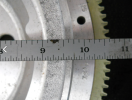
The pulley on the Lycoming flywheel is 9.75" diameter.

One (1) NEW Lycoming Flywheel Assy 72245 (very similar to 77579 see note)​

One (1) NEW Lycoming Flywheel Assy 72245 - 12/14 pitch 149 Teeth.
The pulley diameter is: 9-3/4" + 1/2" pulley width.

1748368165558.png​


On the Ford alternator, we get this:

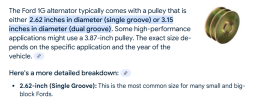
1748368802204.png

The ones I worked on, on many, many airplanes using Lycs, had the 2.62" pulley. If we divide the 9.75" flywheel pulley by the 2.62 Ford alternator pulley, we get a ratio of 3.72:1. That drives the alternator at 10,047 RPM when the engine is at its 2700 RPM redline. Simple enough to understand, right?

Now, in my Hyundai Sonata, the crankshaft pulley is 5.625" diameter and the alternator pulley is 2.25", giving us a ratio of 2.5:1. At the typical highway cruise of 2100 RPM, the alternator is running at 5250 RPM, or about half as fast as the alternator on the Lycoming. And that car is not always doing highway speeds; it spends considerable time loafing around town at 1000 to 1500 RPM, so that alternator's brushes last a long time, not like the aircraft alternator's brushes, on engines that spend most of their time at 90% of redline.

The Sonata's alternator is a Nippondenso 90-amp alternator, smaller rotor, that can handle brief periods of 18000 RPM.

I found that in most light aircraft the brushes were pretty much shot at 1000 hours. In the G1000-equipped airplanes, where a lot more electricity is used, the brushes were gone by 800 or 900 hours. The brushes are carrying more field current.

You can argue this all you want, but what experience do you have in checking and changing aircraft alternator brushes? None at all, I'd wager.

 
For what it's worth, I seem to have to replace automotive alternators in the 120K-150K mile range regardless of make/model. However, it's always been the internal voltage regulator that gives up the ghost, even though the alternator is putting out proper power and is running smoothly.
 
For what it's worth, I seem to have to replace automotive alternators in the 120K-150K mile range regardless of make/model. However, it's always been the internal voltage regulator that gives up the ghost, even though the alternator is putting out proper power and is running smoothly.
I had to replace the alternators in both my Sonata and Ford Ranger at about 230,000 kilometers, which is about 140,000 miles. They would have lasted longer except that we're on gravel roads occasionally, and the dust gets into the alternators and causes deep grooving of the slip rings. No use replacing brushes in something like that. The Ford had failed; the Nippondenso I took off and opened up and found it close to failure.

The new aftermarket alternator I put in the Sonata had a sealed shield around the slip rings and brushes, unlike the old one. They must have had problems with scoring and wear from dust. The Ford alternator in the Ranger is basically a third or fourth generation affair, very similar to the 1G alternators found on Cessnas. Biggest difference is that the 1G units use an external regulator.
 
For what it's worth, I seem to have to replace automotive alternators in the 120K-150K mile range regardless of make/model. However, it's always been the internal voltage regulator that gives up the ghost, even though the alternator is putting out proper power and is running smoothly.
I've pushed my last 4 cars to 175K, 250K, 275K, and now 200K+ miles and never replaced an alternator or a voltage regulator. 3 Hondas, one VW.
 
Two GMs, 2 Nissans, 3 Fords for me, all had (or have) over 160K on them lol. I do have a fully functioning single wire alternator on my Ford 351w-powered boat that is original from 1976, however it's only clocked about 800hrs of run time.
 
I've pushed my last 4 cars to 175K, 250K, 275K, and now 200K+ miles and never replaced an alternator or a voltage regulator. 3 Hondas, one VW.
Be thankful. I replaced the alternator on a Honda CR-V at approx 220K miles. Had to take off half the front of the car to access it.
 
I wonder how well that actually works. There's no way to have the regulators set exactly the same, do one alternator will do most of the work.
So what? I turn each one off as part of the runup to check function.

And they seem to be close enough that sometimes one carries the load and another time the other one will.
 
I wonder how well that actually works. There's no way to have the regulators set exactly the same, do one alternator will do most of the work.
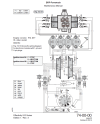
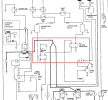
They handle that problem in twin-engined airplanes. From the Piper Seneca POH:

1748403591360.png

In the red square are the two regulators; each one feeds one alternator. Note that they are connected via their "P" terminals. These are called PAR terminals in the service manuals, probably short for "parity." The regulators are electronic, and that P circuit synchronizes the field outputs to the same voltage, within a narrow tolerance. If the alternators are the same, and the engines are running at the same RPM, both alternators get the same field voltage and will put out equal voltage. It keeps the loading equal.

The service manual has a detailed explanation of the function of that balancing circuit inside the regulators. For the curious:
https://www.mmca.com/fpc/N47815 Manuals/Piper Service Manual 761-590.pdf

Pages 2G10 and 2G11.
 
Thank you.
I'm used to generators/alternators feeding independent buses, with a bus tie relay kicking in if one of them fails.
Or important equipment being fed from multiple buses through isolation diodes.
 
I'm sure it's based on wear as well, but they're obviously a system whose importance is such that waiting for failure is undesirable in spite of the redundancy.
You'll find its all about the wear as I mentioned earlier. Even your E-Mags have a 500hr/Annual shaft inspection for bearing wear. As to reliability above the wear issues there are a number of examples of mags, vac pumps, etc. that did not follow the 500hr recommendation and lasted 1500+ hours of use until they simply fell apart. But from a cost effectiveness point I've found the effectiveness side is more subjective on whether the item or aircraft was properly maintained or not.
 
Mechanical wear does not bother me, because it is predictable. It happens at known points by design, can generally be inspected or measured, and service intervals can be specified to preclude most failures. Mags are a great example of this. What are the odds of dual mag failure prior to 500 hours in a new or correctly overhauled pair of mags? Miniscule, I'd wager.

Electrical system issues are a different animal. They are called gremlins for a reason. How many of us have spent days hunting for the cause of some unknown issue? And impending faults cannot be measured to predict when they will reach critical failure. A loose terminal, cracked solder point, fatiguing wire, or abraded insulation can get to 99% failure with zero warning, then it goes bad in an instant. Even worse, faults caused by vibration can shift back and forth from failing to functioning with no clear cause. And such faults can occur literally ANYWHERE in a system that is spread throughout the entire aircraft.

I've got lots of cool electronic stuff in my plane. My aircraft was originally designed with mechanical engine gauges so it could continue to be flown if the electrical system failed. The AFM says in case of electrical failure, land IF the pilot determines electrical power is necessary for continued safe flight. I replaced the mechanical gauges with electrical because they were a bit too Rube Goldberg. Capillary tubes, anyone? But the benefits and additional functionality of an engine monitor were just too clear to ignore. If the monitor goes down, NBD, land as soon as practicable.

But for stuff that causes the engine to immediately stop and the airplane to fall from the sky, I'll bet on mechanical systems, thanks.
 
Last edited:
I replaced the mechanical gauges with electrical because they were a bit too Rube Goldberg. Capillary tubes, anyone?
Those old gauges have Bourdon tubes in them, not capillary tubes. Different animal. But those old gauges were famous for working for a long time; there are many in beat-up old Champs and Taylorcrafts still working fine. The weakest of them are the mechanical oil temperature gauges; they use a fluid-filled copper bulb and a thin steel tube (sometimes called a capillary; maybe that's what you were referring to) that goes to a pressure gauge calibrated in degrees. The oil in that closed system expands and puts pressure on the Bourdon tube in the gauge, which starts straightening its curvature and pulling on a linkage that drives the gauge needle. That thin "capillary" tube is subject to cracking if it's handled roughly, and when the oil inside leaks out the gauge is dead. Expensive to repair. Very difficult to find OEM gauges for 1940s or '50s airplanes. With the small Continentals, that bulb has to come out of the oil screen at oil change time so the screen can be removed for cleaning. The thin tube gets bent, the retaining nut gets torn up and distorted because the mechanic or owner doesn't have the proper tube nut wrench, and you can't replace the nut without breaking the tube and ruining the gauge. I have encountered those nuts all rounded off and ripped by guys using vise-grips. What a mess.

So yes, that's when the electronic gauges make sense. Maybe they won't last 70 years, they almost certainly won't, but we won't be around to deal with that anyway. The senders on the EI and JPI certified systems are often troublesome right from new; heat and vibration can fail those senders. The electrical connections between the senders and gauge are famous for making trouble. The installer has to be careful to get the stuff right.
 
Last edited:
Mechanical wear does not bother me, because it is predictable. It happens at known points by design, can generally be inspected or measured, and service intervals can be specified to preclude most failures. Mags are a great example of this. What are the odds of dual mag failure prior to 500 hours in a new or correctly overhauled pair of mags? Miniscule, I'd wager.

Electrical system issues are a different animal. They are called gremlins for a reason. How many of us have spent days hunting for the cause of some unknown issue? And impending faults cannot be measured to predict when they will reach critical failure. A loose terminal, cracked solder point, fatiguing wire, or abraded insulation can get to 99% failure with zero warning, then it goes bad in an instant. Even worse, faults caused by vibration can shift back and forth from failing to functioning with no clear cause. And such faults can occur literally ANYWHERE in a system that is spread throughout the entire aircraft.

I've got lots of cool electronic stuff in my plane. My aircraft was originally designed with mechanical engine gauges so it could continue to be flown if the electrical system failed. The AFM says in case of electrical failure, land IF the pilot determines electrical power is necessary for continued safe flight. I replaced the mechanical gauges with electrical because they were a bit too Rube Goldberg. Capillary tubes, anyone? But the benefits and additional functionality of an engine monitor were just too clear to ignore. If the monitor goes down, NBD, land as soon as practicable.

But for stuff that causes the engine to immediately stop and the airplane to fall from the sky, I'll bet on mechanical systems, thanks.
Point taken... But mechanical stuff also can break instantly (see: my own mag and vacuum pump failures), and it tends to do so more often than systems that have no moving parts.

Plus, those mechanical gauges do have the tubes that are bringing hot oil through the firewall, where it can be dumped on your legs if it breaks. No thank you.
 
Plus, those mechanical gauges do have the tubes that are bringing hot oil through the firewall, where it can be dumped on your legs if it breaks. No thank you.

Hot oil never bothered me. The diameter of those tubes is so tiny that it would just be a dribble. But the wet fuel gauge scared the crap out of me.
 
Hot oil never bothered me. The diameter of those tubes is so tiny that it would just be a dribble. But the wet fuel gauge scared the crap out of me.
I've flown planes with the sight gauge tubes at the wing roots and for some reason that didn't bother me much... I think the tubes going to them are flexible.

As for hot oil, it won't be much, but your skin doesn't really care how little it is, those burns are gonna HURT at those temps, and be hard to avoid becoming 3rd degree I would think, given how difficult it'd be to treat them right away in the air. Resting is for steaks.
 
Back
Top