Hot take: the Dual Mag is actually pretty great

Jim K

360 For Spacing
Management Council Member
PoA Supporter
Joined
Mar 31, 2019
Messages
8,141
Location
Limbo
Display Name
Richard Digits
Home Airfield
KCMI
I've been doing something of a deep dive into aircraft ignition systems, a subject which I know very little about, but am being "forced" to learn for this RV project.

The engine I bought started life as a TIO-360-C1A6D. As many of us know, that "D" stands for dual mag, the two mags in one housing with one driveshaft that Bendix cooked up, and Lycoming widely adapted, in the 70's. My box-o-parts came with a completely stripped down D4LN-3000, which I tossed aside with intentions of selling later. I had always heard and believed the common wisdom that "they're dangerous" "they never should have been certified" "single driveshaft ZOMG" "they're full of plastic gears". To that end, before I even bought the engine I made up my mind that I would not use the dual mag.

Research turned up that a somewhat common solution is to run a Bendix S4RN-1200 in the single hole as it has the same mounting pattern and there's an adapter available to run it off the dual mag drive gear. Other set of plugs runs off a crank trigger system. I liked this solution because the engine will still run so long as it gets fuel; no computers to fail, no redundant electrical systems to set up. The Bendix 1200 is regarded as the "hottest" and best mag available. I actually found one on ebay and bought it.

It showed up and (my inexperience showing) I was shocked at how big & heavy it is. Took it out to the shop...it's nearly as big as the whole dual mag. The 1200 weighs 6.5 lb....the dual mag 7.5. It dawned on me that the dual mag was developed to reduce weight and complexity, which it does. It does away with the second case, magnet, drive shaft, and drive gear. The plastic gears I always heard about....yeah, the rotor gears are plastic. The one on the 1200 is, too. The 1200's is more robust for sure, but still the same number of plastic parts per magneto as the dual mag. As to the common shaft...if you break that thing you're already having a really bad day. Ditto the drive gear in the engine....if that gets away, away two mags probably wouldn't have saved you.

I'm not making any decisions today, but I'm certainly considering going with the dual mag. The overhaul is expensive....but it's not much more than 2X the cost to overhaul a regular mag. It eliminates the weight, complexity, and wiring of a second crank trigger system.

The negatives....it's oddly shaped. I'm not sure if it will fit in the RV engine mount. The 1200 is so huge I'm not sure about it either, so I'm going to wait until I can have the mount in hand to make the decision. I hear that parts are going to be an issue at some point; not sure how much of an issue this really is.

The only REAL concern I can see with the thing is that if the clamps that hold it it time break or back out, you lose time on both mags and you're going to be a glider.

What else am I missing?
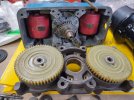
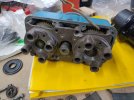
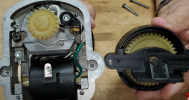
IMG_20250512_122813932.jpgIMG_20250512_122801629.jpg
 
Plastic rotor gears are normal; they have to insulate the distributor's spark finger from any grounding, so non-metallic gears are mandatory.

That dual mag has ONE impulse spring and it drives both mags. Impulse springs are made of high-carbon steel that is prone to corrosion pitting, leading to fatigue failure and spring breakage. If it breaks, the timing of BOTH mags go to TDC, and the engine's power output pretty much disappears entirely and you're in trouble.

That's what you're missing.
 
Last edited:
I've done deep dives on the dual mag in the past for obvious reasons. What I generally find is everyone looks at the design and judges it to be a terrible idea based on common sense....and yeah I see that. OTOH there doesn't seem to be any evidence that dual mag engines are having total failures at rates significantly higher than any other engine, at least none that I've seen. I've come to the conclusion it's just an item one wants to be extra diligent about inspecting and maintaining and not something someone should be overly concerned with.
 
OTOH there doesn't seem to be any evidence that dual mag engines are having total failures at rates significantly higher than any other engine, at least none that I've seen.
The FAA should have the data on that. Mag failures are not uncommon, and once in a great while it's a broken impulse spring that does it, so the risk is definitely there.

Yup, maintenance. There are good reasons why Bendix (Continental) have 400-hour internal inspection intervals on their mags. Slick (Champion) interval is 500 hours. Yet most never get anything until they quit. It's insane.
 
D mag has been good to me so far. I do have the 500 hr inspection done. Lots of parts are replaced then including the impulse spring.
I have flown 2 different D mags to 1500+ hours now.
 
That dual mag has ONE impulse spring and it drives both mags. Impulse springs are made of high-carbon steel that is prone to corrosion pitting, leading to fatigue failure and spring breakage. If it breaks, the timing of BOTH mags go to TDC, and the engine's power output pretty much disappears entirely and you're in trouble.

That's what you're missing.
And that's why I asked :thumbsup:
Thanks!
 
Also Continental owns the rights to the D-Mag and decided to stop manufacturing the mag or parts for the mag as it is only used by their chief competitor Lycoming legacy engines.

The new old stock inventory has pretty much dried up. Tough to get one rebuilt or overhauled. Yes there are parts floating around, but not hard to get.
 
The FAA should have the data on that. Mag failures are not uncommon, and once in a great while it's a broken impulse spring that does it, so the risk is definitely there.

Yup, maintenance. There are good reasons why Bendix (Continental) have 400-hour internal inspection intervals on their mags. Slick (Champion) interval is 500 hours. Yet most never get anything until they quit. It's insane.
When I bought my Van’s RV with 800 hours on it, I noted that the log showed a 500 hour inspection done on the Slick mag. (The other ignition was electronic.) The entry said “500 hour inspection ok” and was signed by the owner. It’s an Experimental, so it’s legal, but no reference in there as to parts replaced, if the manufacturer’s instructions were followed, et cetera. The engine ran well, so I went ahead and bought it.

After about 50 more hours, I got rough mag checks on runup twice, and couldn’t resolve it the second time. Since it was due for a condition inspection, we (A&P and I) pulled the mag and I took it to a nearby repair station for inspection.

The owner calls me a couple days later and says a yellow-tagged mag is on the way. When he inspected mine, every wear part was beyond limits. He said my suspicion was right - there is no way a proper inspection was done at 500 hours, because with as much wear as he found, there had to have been parts needing replacement at 500 hours.
 
Last edited:
This is what was replaced during my last 500 hr inspection. I did ask if parts were a problem for it and they said no. I got new capacitors and hardware. I was also given 2 SB to help reinstall properly with the latest clamps. This was June of 2024.
7dda7f65-8316-4b60-8a54-f29fbde08ec7.jpg
 
Last edited:
This is what was replaced during my last 500 hr inspection. I did ask if parts were a problem for it and they said no. I got new capacitors and hardware. I was also given 2 SB to help reinstall properly with the latest clamps.
7dda7f65-8316-4b60-8a54-f29fbde08ec7.jpg
I've also only heard about parts being an issue from forums. The places I've sent mine (off the lance) for 500hrs have never complained. I used "aircraft accessories of ok" for my last one and they turned it around in one day. I think it's the big parts like cases that are NLA, but used ones are pretty easy to find.

One of the terminating actions for the AD on the Lance's D3000 is replacing the impulsive coupling with a "shower of sparks" system. Not sure if that's even possible. Worth looking into on the expeimental side; things I've always wondered about but not taken time to explore.
 
Well, the only times the fan ever quit spinning for me involved one of those damn things bolted to the engine. I personally would do whatever I could to not use one. Every other magneto I've flown behind has given signs that its unhappy. The dual mag? It just seems happy until its not at which point its game over.
 
Well, the only times the fan ever quit spinning for me involved one of those damn things bolted to the engine. I personally would do whatever I could to not use one. Every other magneto I've flown behind has given signs that its unhappy. The dual mag? It just seems happy until its not at which point its game over.
what was the point of failure?
 
what was the point of failure?
I wasn’t the owner of the aircraft or involved in the repairs, so I don’t know all the specifics. In one case, I got lucky — the failure didn’t happen until after I had landed and was already rolling off the runway. I had to get it towed to the ramp. The other time, it failed before we even left the chocks.

Honestly, the whole idea behind the dual magnetos was flawed from the start. It feels like a classic example of top-down decision-making: an airframe manufacturer pressured the engine maker, who in turn leaned on the magneto supplier. There’s no way a magneto engineer sat down and said, “You know what would be great? Taking two redundant ignition systems and combining them into a single point of failure.”

Given that we’re talking about an experimental setup here, I see no good reason to stick with one of these. There are far better, more modern alternatives that don’t come with the same design compromises or failure risk.
 
Last edited:
Why not do dual electronic ignition and be done with it?
I don't like the idea of being electrically dependant, nor do I want the cost, complexity, and weight of redundant electrical systems to support it. I might get forced into that, but I'd like to retain one mag.
 
I don't like the idea of being electrically dependant, nor do I want the cost, complexity, and weight of redundant electrical systems to support it. I might get forced into that, but I'd like to retain one mag.

Fair enough, trade-offs for both, I guess. My understanding with e-mags are a loss of alternator supplied power results in reversion to ship’s power, so it’s not an instant loss of electrical power to the ingnition system.

Maybe a single mag and an e-mag combo?
 
Always lots of threads about what to do if your engine quits. Four general ways that can happen:

1. Lack of fuel.
2. Lack of air.
3. Lack of spark.
4. Internal component failure.

Two dollars per flight hour to service a pair of good old fashioned mags seems like a good deal to cross #3 off the list.
 
Why not do dual electronic ignition and be done with it?
Now you’re multiplying reliability factors -EI reliability x electrical system reliability. That spooks me. And is why I have one EI and one mag on both of my aircraft.

You’re also creating a single point of failure - the electrical system.
 
Now you’re multiplying reliability factors -EI reliability x electrical system reliability. That spooks me. And is why I have one EI and one mag on both of my aircraft.

You’re also creating a single point of failure - the electrical system.

To go dual electronic don't you need dual batteries. Or how big of a battery do you need to run one system for 30 mins.
 
Now you’re multiplying reliability factors -EI reliability x electrical system reliability. That spooks me. And is why I have one EI and one mag on both of my aircraft.

You’re also creating a single point of failure - the electrical system.

To your point, I have had 3 electrical system failures in the last 10 years. All were non-events because I did not need it to fly.
 
I don't like the idea of being electrically dependant, nor do I want the cost, complexity, and weight of redundant electrical systems to support it. I might get forced into that, but I'd like to retain one mag.
The Surefly 4 cylinder mag weighs 4 lbs. if you do a dual installment with the Surefly backup your net weight will be about the same. We went with one Surefly and one mag to avoid the need for a redundant system. You get 90% of the electronic ignition benefits and retain the ability to fly with no electrics. You gain some performance and drop a bit of weight.
 
The subject of this thread is dual mag. You cannot have a mag and e-ignition setup on these engines, or else I would go with such an installation. Comments regarding the benefit or preference for a 50-50 setup are thread drift. With dual mags, the choice is stay with all mags or go all electric.
 
The subject of this thread is dual mag. You cannot have a mag and e-ignition setup on these engines, or else I would go with such an installation. Comments regarding the benefit or preference for a 50-50 setup are thread drift. With dual mags, the choice is stay with all mags or go all electric.
Several RV builders have used a Bendix S4RN-1200 along with an 73000 drive coupling to run a magneto on dual-mag engines. That's my intention, assuming I can make it fit the engine mount. Leaning towards the Lightspeed crank-trigger system for the second ignition.

I was seriously considering running the dual mag until it was pointed out that the impulse coupling spring is, in fact, a very real single point of failure. Other possibility would be gutting one side of the dual mag, which would be lighter, but kind of hacky.
 
Two dollars per flight hour to service a pair of good old fashioned mags seems like a good deal to cross #3 off the list.
It's not costing $2 per flight hour. It's costing $2 MORE per flight hour.
 
Leaning towards the Lightspeed crank-trigger system for the second ignition.
Consider SDS. The system is pretty simple to install and is user configurable.
 
That makes you electrically dependent. You don't even have a mechanical fuel pump...
It would be insane not to have an electrically redundant aircraft, especially if you're even considering putting a glass panel in your homebuilt. Mechanical fuel pumps have their own set of issues, which I am not fond of, but if you want mechanical redundancies, then yes, SDS is the best choice for homebuilts.
 
3. Lack of spark.

Two dollars per flight hour to service a pair of good old fashioned mags seems like a good deal to cross #3 off the list.
You're not crossing it off the list, merely reducing the chances it'll happen. Probably. Maintenance-induced failures are a thing, too.

Since my only mag failures ever have been drive gear failures, no way in hell I'm running a dual mag.

Supposedly that's more common up here where we have winter - If you fly a lot in winter, the repeated wide temperature swings make those plastic gears really brittle, and they start shedding teeth and then eventually breaking outright. If you haven't lost too many teeth it may keep running OK just from momentum, but once you shut down it may not come back.
 
I don't like the idea of being electrically dependant, nor do I want the cost, complexity, and weight of redundant electrical systems to support it. I might get forced into that, but I'd like to retain one mag.
wut?

An electronic system weights almost nothing and are virtually indestructible. New Li-On batteries just work and weigh 3-4 lbs.

You don't want to depend on 'electricity' buy let me guess... you have an EFIS, GPS, Radios, engine monitor, usb charger etc etc etc. You will happily depend on a plastic gear, a tiny spring and capacitor? The one thing the FAA has really screwed up on is still allowing a/c with no electric system to fly. Yes, lets talk about safety but still allow airplanes to fly without ADS-B/transponders/Radios/position lights.

Sorry you're just regurgitating old wives tales.
If the gps, radios, efis all quit. I'm not falling out of the sky.

The electro air single dual mag is a complex install and has had issues.
 
Last edited:
It would be insane not to have an electrically redundant aircraft, especially if you're even considering putting a glass panel in your homebuilt. Mechanical fuel pumps have their own set of issues, which I am not fond of, but if you want mechanical redundancies, then yes, SDS is the best choice for homebuilts.
Jim is looking for redundancy in his ignition system, so the scope of my suggestion is one SDS ignition in addition to the solution he chooses around turning his dual mag into a single mag application. My personal preferences are biased towards redundancy, reliability, and relative simplicity. Complicated electrical systems on electrically dependent aircraft give me the willies. I've seen accidents where aircraft with tons of electrical redundancy still suffered full electrical failure. A couple of Diamond incidents come to mind, as well as the Jeju 737.
 
Supposedly that's more common up here where we have winter - If you fly a lot in winter, the repeated wide temperature swings make those plastic gears really brittle, and they start shedding teeth and then eventually breaking outright. If you haven't lost too many teeth it may keep running OK just from momentum, but once you shut down it may not come back.
The mag is probably going to lose timing if you shed teeth.
 
Since my only mag failures ever have been drive gear failures, no way in hell I'm running a dual mag.

Supposedly that's more common up here where we have winter - If you fly a lot in winter, the repeated wide temperature swings make those plastic gears really brittle, and they start shedding teeth and then eventually breaking outright. If you haven't lost too many teeth it may keep running OK just from momentum, but once you shut down it may not come back.
Have you ever had a mag apart? Those plastic gears are in the distributor inside the mag. They do not drive the magneto. The only load on them is rotating the spark finger to send the spark current from the carbon brush (that rides on the high-voltage output tang on the coil) to the electrodes that send that spark through the plug harness to the plug. The torque on those gears could be measured in tiny fractions of an ounce per inch. If the gears fail it's due to age or improper installation in the first place. I had one Slick mag in which the small rotor gear had not been pressed on all the way and its flange was rubbing on the ends of the distributor gear's teeth, making plastic dust that got into the points and fouled them. It was a Slick factory error.

Heat and age make the gears weaker. It's one reason why Slick and Bendix have hourly/calendar internal inspection intervals. Even so, those gears last a long time. I have opened up 40-year-old mags that are as old as the 1700-hour engine, and those gears are fine. The rest of the mag? Not so much.

Here's a shot of the inside of a Slick.
1747503961421.png

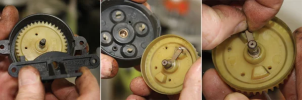
That small plastic (nylon) gear on the left engages with the large plastic gear inside the distributor cap on the right. Its only job is to rotate that gear, and the only friction is between the round carbon brush in the middle of that gear where it rides on the shiny metal tab on the coil on the left. And two tiny oilite bearings. The spark finger does not touch the electrodes. No friction. If you stick a finger into the distributor and give its gear a spin, it will rotate freely for several revs. Here's another look:

1747504260793.png
In the third picture, the tech is moving the spark finger. It's loose. This was the subject of a service bulletin. Another factory error.

Plastic gears MUST be used. You don't want the spark shorting to ground through metal gears, right? Old mags used gears made of Micarta, a phenolic resin with linen fabric reinforcement. My old Case mags that are nearly 80 years old have Micarta gears in them.

So let's not have any more baloney about "plastic drive gears."

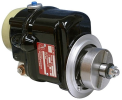
The magneto is driven by that steel coupling on the right:
1747504510260.png

In many cases that will be an actual gear. Steel. No plastic. A cast steel (not cast iron), machined and hardened gear. It doesn't wear or break easily at all. The steel impulse spring inside that couple will break if it gets corroded, and after that it doesn't keep the mag advanced to specified spark advance, and the power disappears. If you ground-run your engine and then put the airplane away, or make real short flights, crankcase condensation gets at that spring and rusts it. In the dual mag, the whole affair depends on that one spring.
An electronic system weights almost nothing and are virtually indestructible. New Li-On batteries just work and weigh 3-4 lbs.

You don't want to depend on 'electricity' buy let me guess... you have an EFIS, GPS, Radios, engine monitor, usb charger etc etc etc. You will happily depend on a plastic gear, a tiny spring and capacitor? The one thing the FAA has really screwed up on is still allowing a/c with no electric system to fly. Yes, lets talk about safety but still allow airplanes to fly without ADS-B/transponders/Radios/position lights.

Sorry you're just regurgitating old wives tales.
NOTHING IS VIRTUALLY INDESTRUCTIBLE. That, all by itself, is an old wives' tale. Electrical and electronic stuff is far more prone to failure than mechanical stuff. I have extensive experience with all three areas, and electrical stuff has been the most troublesome. In any engine performance problems, the electrics or electronics are the major culprit 90% of the time. And that's why we have two magnetos and one carburetor. It's why we need redundant power systems for electronic stuff. Anyone who just transplants the EFI/EI from a car into a homebuilt, and makes no provision for backup, is asking for an accident.

And as another poster noted, all that electrical stuff you mentioned doesn't bring the airplane down if it quits. And you still don't seem to understand magnetos, either. More baloney about plastic gears. The "tiny spring and capacitor" will give advance warning if there is impending failure. Even so, I have NEVER encountered a broken points spring in any magneto I have serviced, and a capacitance check during internal inspection is standard and will catch a failing capacitor. Never found one of those either. What check is there for an EFI or EI controller to determine if a transistor or capacitor or resistor is degrading and about to fail in it?

ADSB to fly safely? What did the previous aviators over the last 100+ years do without it? Seems to me they used their eyeballs, just I I did when I learned to fly over 50 years ago. And in those days there were far more private airplanes in the air. What percentage of America's territory is so congested that it makes a real difference?
 
Last edited:
ADSB to fly safely? What did the previous aviators over the last 100+ years do without it? Seems to me they used their eyeballs, just I I did when I learned to fly over 50 years ago. And in those days there were far more private airplanes in the air. What percentage of America's territory is so congested that it makes a real difference?
Going full caffeinated John Wick "Get off my lawn" right there....

My initial thought is that electronic ignition is more reliable than a mechanical system. I remember changing the points, setting the gap, changing distributor caps, setting timing, etc. on our cars growing up. Today's cars with a electronic ignition and a coil on each spark plug are virtually maintenance free.

I'm assuming the dual magnetos originated because of magneto reliability issues all those years ago. Curious that we haven't improved the reliability that we still require a dual system ???

I do appreciate the above post explaining more what the aircraft magneto looks like and how it works. Giving me something to think about and reconsider dual mags vs electronic ignition. Appreciate it.
 
if Cuban taxi cabbers had access to reliable wireless telecom, I reckon this is what it'd prob read like..

I'd insert a special olympics snark here, but I'd get cnx in 2025. :biggrin:
 
My initial thought is that electronic ignition is more reliable than a mechanical system.
If you look into the data, the magnetos are the most reliable component on the engine. And when they fail, 99% of the time it was due to improper mx or upkeep. While there are advantages to electronic ignition, as noted above if all electrical systems are lost, a magneto will still keep you in the flying.
 
If you look into the data, the magnetos are the most reliable component on the engine. And when they fail, 99% of the time it was due to improper mx or upkeep. While there are advantages to electronic ignition, as noted above if all electrical systems are lost, a magneto will still keep you in the flying.
The question isn't reliability of magneto vs other parts of engine, but magneto vs electronic ignition.

What is the chance that I'd suddenly loose my alternator and the battery would be dead at the same time? And if I did loose the alternator, the engine would still run on the battery for 1/2 hour (?) until I could land.

I would weigh the sudden alternator and battery failure and/or an electronic ignition failure chance against both magnetos becoming dead at the same time. Both options seem extremely small.
 
Back
Top