Ground leaning

Ed Haywood

Final Approach
Joined
Jul 12, 2020
Messages
7,624
Location
Tampa FL
Display Name
Ed
Home Airfield
FD77
I question the need. :stirpot:

My Lycoming operators manual is clear on the matter. If idle mixture is correctly set, there should be no need for additional leaning.

What's the harm? Well, there is a non-zero chance of forgetting to set mixture back to full rich for takeoff.

Note to people from Colorado: leaning for takeoff at high elevation is a separate issue.
I guess I’m not fully understanding the question or intention.

No harm will be done leaning aggressively on the ground. The mixture should be leaned to the point that any power setting above what’s needed for taxi will cause the engine to stumble.

If you forget to enrichen before takeoff, the engine will cough if it’s leaned too far, in which case you simply go full rich.
Oh I didn’t know that, I just put it about half way. I think I read in the POH that you should increase the MP for extended ground ops. Any thoughts on that?
 
Oh I didn’t know that, I just put it about half way. I think I read in the POH that you should increase the MP for extended ground ops. Any thoughts on that?
Helps to keep the cyl pressures and temps high enough for adequate lead scavenging.
 
I question the need. :stirpot:

My Lycoming operators manual is clear on the matter. If idle mixture is correctly set, there should be no need for additional leaning.

What's the harm? Well, there is a non-zero chance of forgetting to set mixture back to full rich for takeoff.

Note to people from Colorado: leaning for takeoff at high elevation is a separate issue.
If you lean aggressively on the ground and advance throttle without going rich. It will stumble badly
 
Note to people from Colorado: leaning for takeoff at high elevation is a separate issue.
It's also a ground issue there. Full rich, the engine might quit and the plugs fouled before you get to the runway. And that part translates to lower altitudes.

I don't worry about forgetting to go to the appropriate richness for takeoff.
 
I've gotten to where I do it by habit, pretty aggressively. And yes, I've stumbled on take off once or twice. Really no different than coming down from altitude and forgetting it I guess.
I know my plugs look better every time I check them.

As a side note: Recently, the throttle shaft on my carburetor was loose, and after replacement, the EGT is several degrees cooler on climb out, so I'm sure I was running leaner, likely due to air getting in around those worn bushings. Just wanted to share that for other owners to check. My mechanic found it on annual.
 
I aggressively lean on the ground. To the point where if I need to go up an incline, I need to richen a touch. Been doing it for 600 hours (flight time, not ground time) with no ill effects. Avoiding plug fouling is my rational for doing it. If it's leaned that much, it will stumble right away if you forget to richen it for take off.
 
Correctly set per the instructions in the engine operators manual.
Is there something there suggesting that the engine should no be leaned for ground operations if the idle was properly set?

You mentioned Colorado. Why would that be any different? PMP in Florida is 20 MSL. PDK in Georgia is 1,000 MSL. HYS in Kansas is 2,000 MSL. SNY in Nebraska is about 4,000 MSL. Is there a cutoff when it is and is not a good idea to lean for ground operations? If so, based on what?

Never mind the substantial difference one can see at run-up power, but I know I can taxi out on a hot day at my home base at only 243' MSL and leaning the engine will make a difference in the power output.

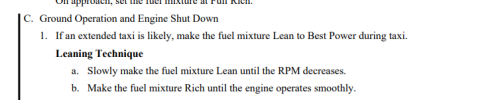
From Lycoming about the IO360: And that's aggressive leaning rather than the guestimate most do.

1745090200101.png
 
Last edited:
Correctly set per the instructions in the engine operators manual.
I didn't ask "per what", but "for what"?
What is the goal of those instructions? Set the idle mixture to a stoichiometric ratio of 14.7:1 when the mixture control is fully in? That will probably still foul plugs at idle, since the lead scavenger isn't working. Set it to 18:1? An engine can still run (once warm) with a lean 18:1 mixture. Probably won't run that well when cold.
 
Is there something there suggesting that the engine should no be leaned for ground operations if the idle was properly set?
My O-320 Operator's Manual dated Oct 2006 says in the normal operating procedures under 'Ground Running and Warm-up' :
b. Leave mixture in Full Rich.
c. Operate only with the propeller in minimum blade angle setting.
d. Warm-up at approximately 1000-1200 RPM. Avoid prolonged idling and do not exceed 2200 RPM on the ground.

There is nothing in the manual about ground leaning and the manual assumes a properly trimmed engine, i.e. idle metering is properly set.

That being said, on the engine this one replaced, I had plug fouling problems that went away when I started aggressively leaning on the ground.

Nauga,
lead astray
 
My Lycoming operators manual is clear on the matter. If idle mixture is correctly set, there should be no need for additional leaning.
Does the manual also say to use 80/87 fuel?

I always leaned the O-290 in my Hatz, the plugs stayed clean. The C-85 in my Parrakeet has no mixture control, the lower plugs are always fouling.
High wings are better than low wings.
And biplanes are better than either!
 
What's the harm? Well, there is a non-zero chance of forgetting to set mixture back to full rich for takeoff.
I didn't see anyone touch on this (sorry if I missed it, but it is not what's the harm, but what's the benefit? There's a huge benefit for not fouling your plugs! With any engine, even if "properly" set up, you run the risk of one (or more) cylinders being on the very rich side and occasionally fouling the plugs. If after startup you AGGRESSIVLY lean, you will not get fouled plugs. As for forgetting to go full rich, if you really lean, the engine will never get close to Takeoff Power and won't even get to enough power to hurt anything.

I'm sure you can find lots of videos on this, and if you want, I'm sure you could find someone that believes in the process to show you. Basic process is:
- Start the engine and start to lean. Pending the temperature (winter, etc.), you may only get a couple of turns before the engine starts to stuble.
- Let the engine warm up as you set up radios, etc.
- Prior to Taxi, set a normal idle (not the slowest you can do, but what you normally "idle" at.
- Lean the engine until it stumbles and *slightly* enrichen so the engine runs smoothly.
- Then Taxi normally.

The first time, taxi as needed out onto the ramp (or the Runup Area) where there is no one behind you and start to do a Runup. You may, or may not, get to your normal Runup power. If you do, push it a little further, and you should not get anywhere near Takeoff power. If you do, you didn't lean enough. Go back down to idle and lean some more and try it again. Once you get the process down, it is easy to repeat. (In my plane I can get to Runup Power, but that's about it. I really can't get much more power than that.)

 
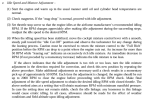
As I suspected, some of you are not aware there is such a thing as an idle mixture adjustment setting and what it does.

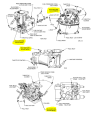
View attachment 140068

View attachment 140067
All great information, but...

Expecting a 50 rpm increase as you lean means you're richer than peak power mixture (about 13:1), and adding at least 13% more fuel than needed for a stoichiometric mixture.
With the engine able to run leaned down to 18:1, that's 40% more fuel being fed to an engine cold enough that the lead scavengers aren't able to do their job, instead allowing the lead to deposit in the engine, potentially fouling spark plugs.
That calculated 40% extra fuel figure seems to correlate well with my idle fuel flow in rich and leaned conditions.

And that's why we lean on the ground.
 
Like a lot of things in aviation this starts with primary training. My students learn aggressive ground leaning from lesson 1. If the CFI doesn’t do it and understand it, the student won’t either. I see this in flight reviews. Unfortunately ground leaning is not even mentioned in Preflight Procedures Tasks C and D in the private pilot airplane ACS.
 
I made a mistake the other day on takeoff. I usually aggressively lean on the ground. However I got distracted and left the mixture leaned on the roll. It did not cough but produced a noticeably poor rpm and power. As I lofted in the air, I discovered my mistake and quickly went full rich.

This could have been a serious engine destroying episode however I discovered it quickly and I reasoned that the engine, even at sea level, was significantly leaned that it could not produce enough power/rpm to melt anything, even if it was flying. Certainly it is not something to be repeated.
 
Last edited:
I made a mistake the other day on takeoff. I usually aggressively lean on the ground. However I got distracted and left the mixture leaned on the roll. It did not cough but produced a noticeably poor rpm and power. As I lofted in the air, I discovered my mistake and quickly went full rich.

This could have been a serious engine destroying episode however I discovered it quickly and I reasoned that the engine, even at sea level, was significantly leaned that it could not produce enough power/rpm to melt anything, even if it was flying. Certainly it is not something to be repeated.
Aaaaand this is why I say ground leaning is a bad idea. Unnecessary and potentially dangerous. What if you had been performing a short field takeoff?
 
Like a lot of things in aviation this starts with primary training. My students learn aggressive ground leaning from lesson 1. If the CFI doesn’t do it and understand it, the student won’t either. I see this in flight reviews. Unfortunately ground leaning is not even mentioned in Preflight Procedures Tasks C and D in the private pilot airplane ACS.
Perhaps the FAA read their engine operators manual?
 
All great information, but...

Expecting a 50 rpm increase as you lean means you're richer than peak power mixture (about 13:1), and adding at least 13% more fuel than needed for a stoichiometric mixture.
With the engine able to run leaned down to 18:1, that's 40% more fuel being fed to an engine cold enough that the lead scavengers aren't able to do their job, instead allowing the lead to deposit in the engine, potentially fouling spark plugs.
That calculated 40% extra fuel figure seems to correlate well with my idle fuel flow in rich and leaned conditions.

And that's why we lean on the ground.
I trust Lycoming more than I trust you.
 
Back
Top